

Ten at Night, and the Line Is Still Growing
In Urumqi, the air finally cools down around ten in the evening. The steam over the food stalls does not.
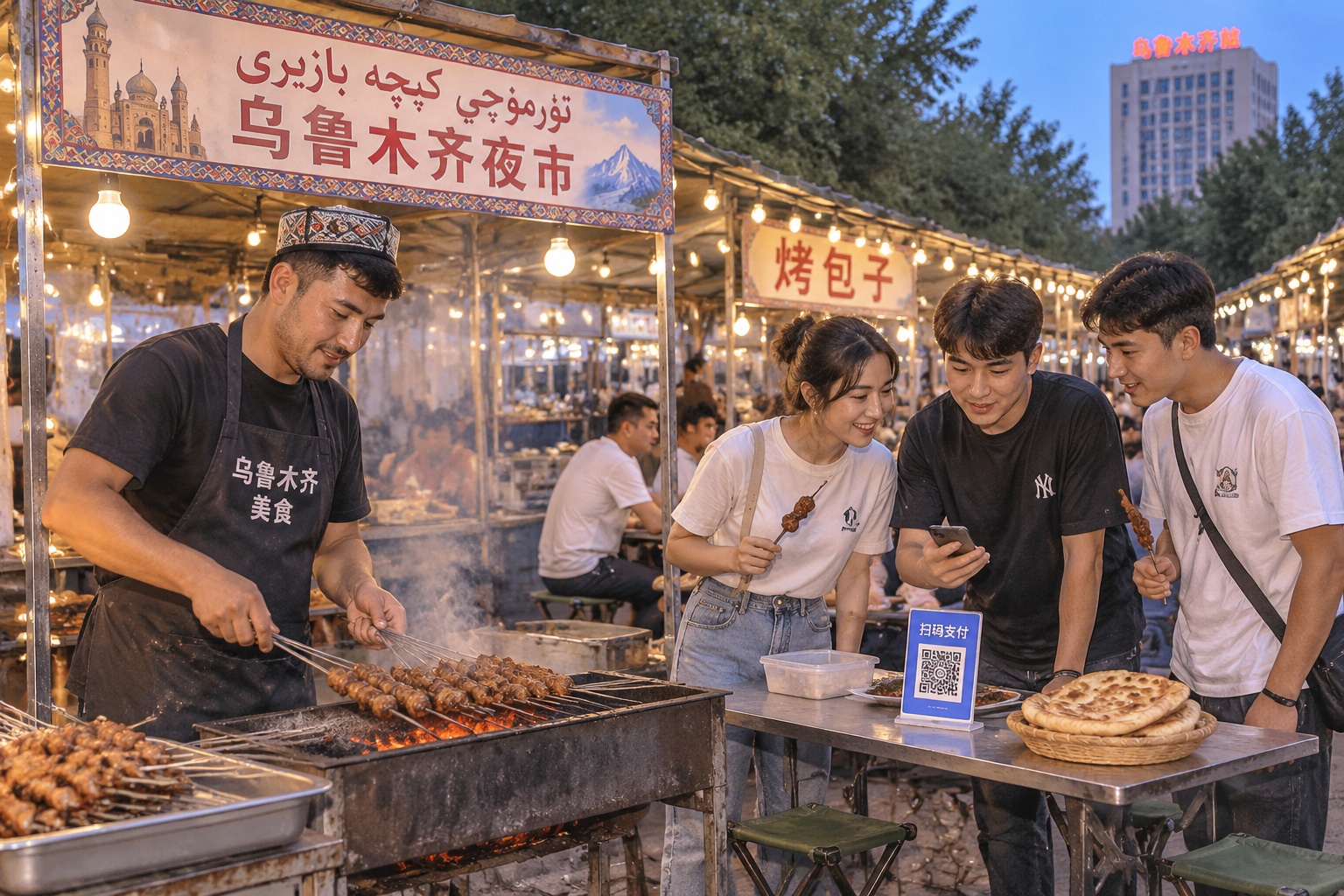
A young woman in a dark jacket stands third in line at a skewer stall, phone in hand. A dozen people are ahead of her. In the metal trough, the charcoal is still glowing red; rows of lamb skewers sizzle, fat dripping into the fire and sending small flares up. Two students stand to one side, eating baked buns and laughing at a phone screen, oil shining on their lips.
“After work there’s not much to do, so I come here and walk around,” says Gulnar, 28, who works in administration at a local company. She orders three skewers of grilled lamb, one baked bun, and a cup of pomegranate juice. She scans a QR code and pays 34 yuan — just under five dollars. “Sometimes I come with colleagues and sit for an hour or two.”
It was a Tuesday. No holiday, no tour group, nobody livestreaming. Just an ordinary summer night.
What a Night Market Is Actually For
To an outsider, Xinjiang’s night markets can look like a tourist performance. The smoke, the rows of grills, the vendors calling out — it has a theatrical quality.
But the people in those lines are overwhelmingly local, and often from just a few streets away.
A night market is, first of all, public space. People come here for dinner — and dinner is often assembled piece by piece: skewers from this stall, noodles from the next, a bowl of cold noodles from another, a cup of pomegranate juice. After eating, they keep walking and eat a few more skewers. Children hold their parents’ hands. Elderly couples carry plastic bags. A young couple splits a bowl of yogurt zongzi — sticky rice dumplings topped with yogurt and syrup, a local summer classic, sweet and a little sour.
A proper meal here usually runs 30 to 60 yuan per person. Smaller cities are cheaper; Urumqi costs a bit more, but still far below a sit-down restaurant of the same quality.
Why Young People Show Up, One After Another
Ask the young customers and the answer is rarely “tourism.”
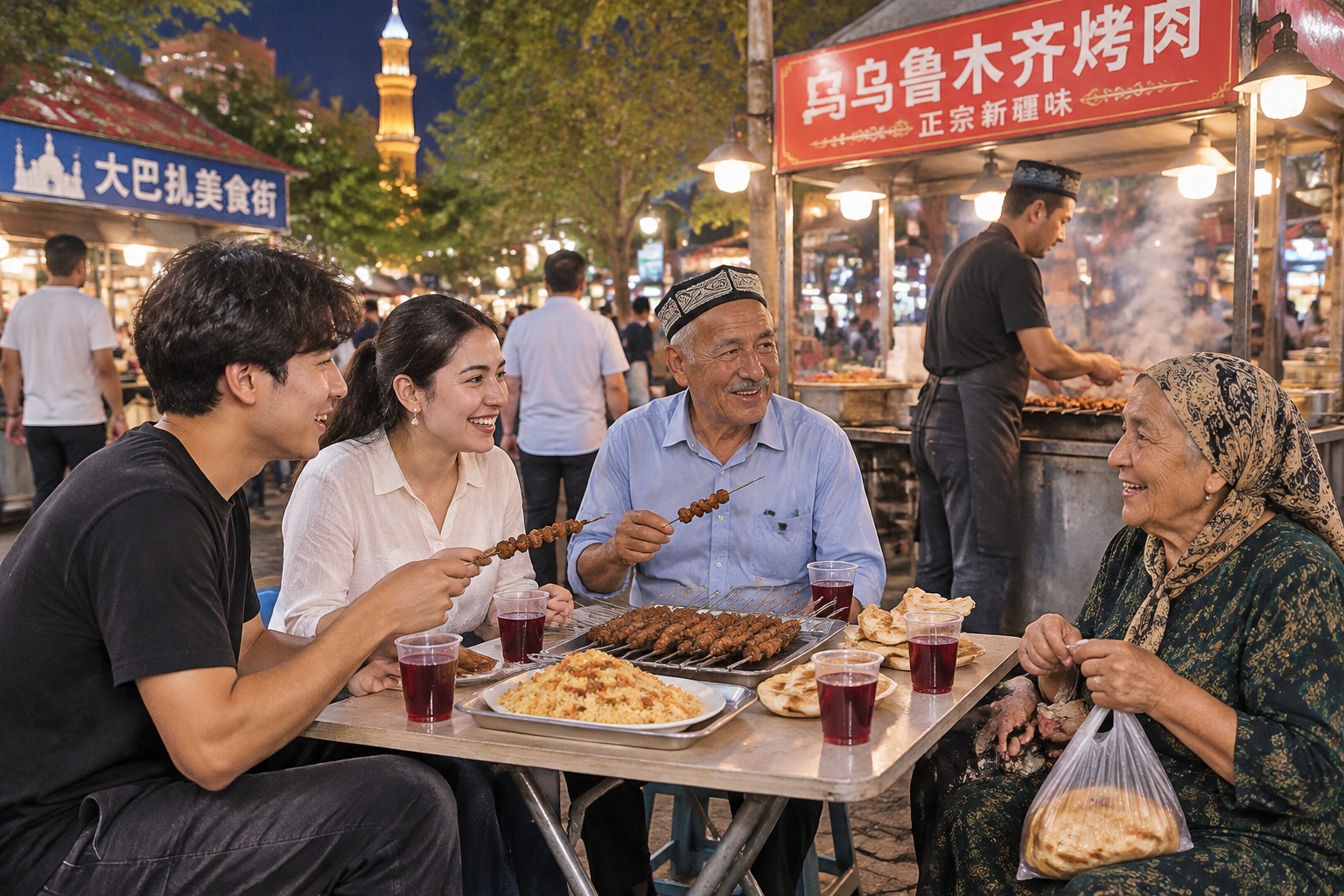
“Cheap, lots of choices, open late,” says Abdurehim, 23, a student in Urumqi. He and two friends are sharing a large plate of lamb skewers, a plate of pilaf, and a few bottles of soda. “At a restaurant, four of us sit down and order and it’s two or three hundred yuan. Here, sixty or seventy makes us full, and we can keep walking around.”
There are other reasons too.
Time. Shopping malls close at ten. Night markets stay busy at eleven, and some stalls still have their lights on well after midnight. For people who finish work late, this is the only window when dinner doesn’t have to be rushed.
No performance required. At a restaurant, you get seated, order, eat, and leave. At a night market you stand, walk, move between stalls, and talk. You don’t need to buy a coffee to keep a conversation going.
The phone. This sounds superficial, but it’s real. The night market photographs well: close-ups of skewers, the pour of yogurt over zongzi, rows of stalls glowing warm. Young people post it, and it comes back to them as a feed. For vendors, that’s traffic — and pressure.

The Purchases Changed: Small, Frequent, Eaten on the Move
Behind all this is a bigger shift. According to China’s National Bureau of Statistics, people in China spent roughly 5.57 trillion yuan on food service in 2024. Growth is continuing, but the shape of it has changed — away from celebratory sit-down meals and toward small, frequent, experience-driven spending: a milk tea, a snack, a dinner assembled across several stalls while walking.
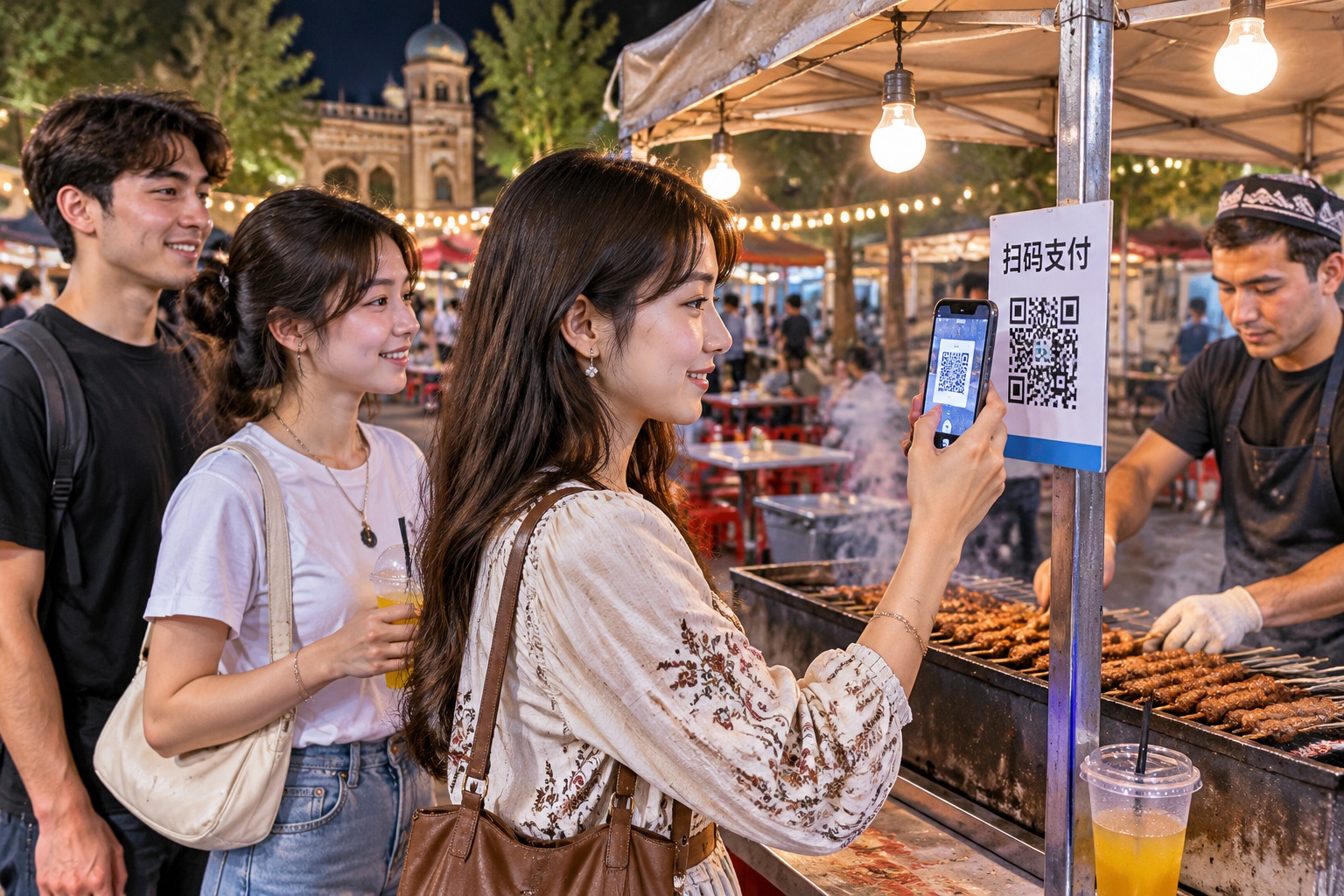
Mobile payment is infrastructure now, not novelty. More than 900 million people in China use it. A QR code taped to a stall’s pole or folding table is the cash register. No change to count, no cash to reconcile. A vendor can take payments while flipping skewers.
What’s newer is the platform layer. Short-video and local-services apps push crowds toward specific stalls, sometimes specific dishes. A quiet stall can suddenly have a line because someone’s video captured the sound of lamb fat hitting charcoal. The price gap is small — skewers run 3 to 8 yuan — but the difference between a good week and a bad one decides whether a vendor can cover the month.
This is also why city governments now take the nighttime economy seriously. It creates volume, not big bills: thousands of small transactions, spread across a street, sustained by people who live nearby.
Old Stalls, New Owners: Two Ways of Doing Street Food
The food itself is changing, but not in one direction.
Abdurehim, 62, has sold naan in the same spot for twenty years. He kneads dough before dawn, slaps it into the tandoor, pulls the bread out with an iron hook, and stacks it on a cloth-lined wooden rack. Plain, sesame, and chili-flecked. He doesn’t do set meals, doesn’t film videos, doesn’t livestream. His customers are mostly neighbors who buy bread and chat for a minute. “This is fine,” he says. “No rush.”
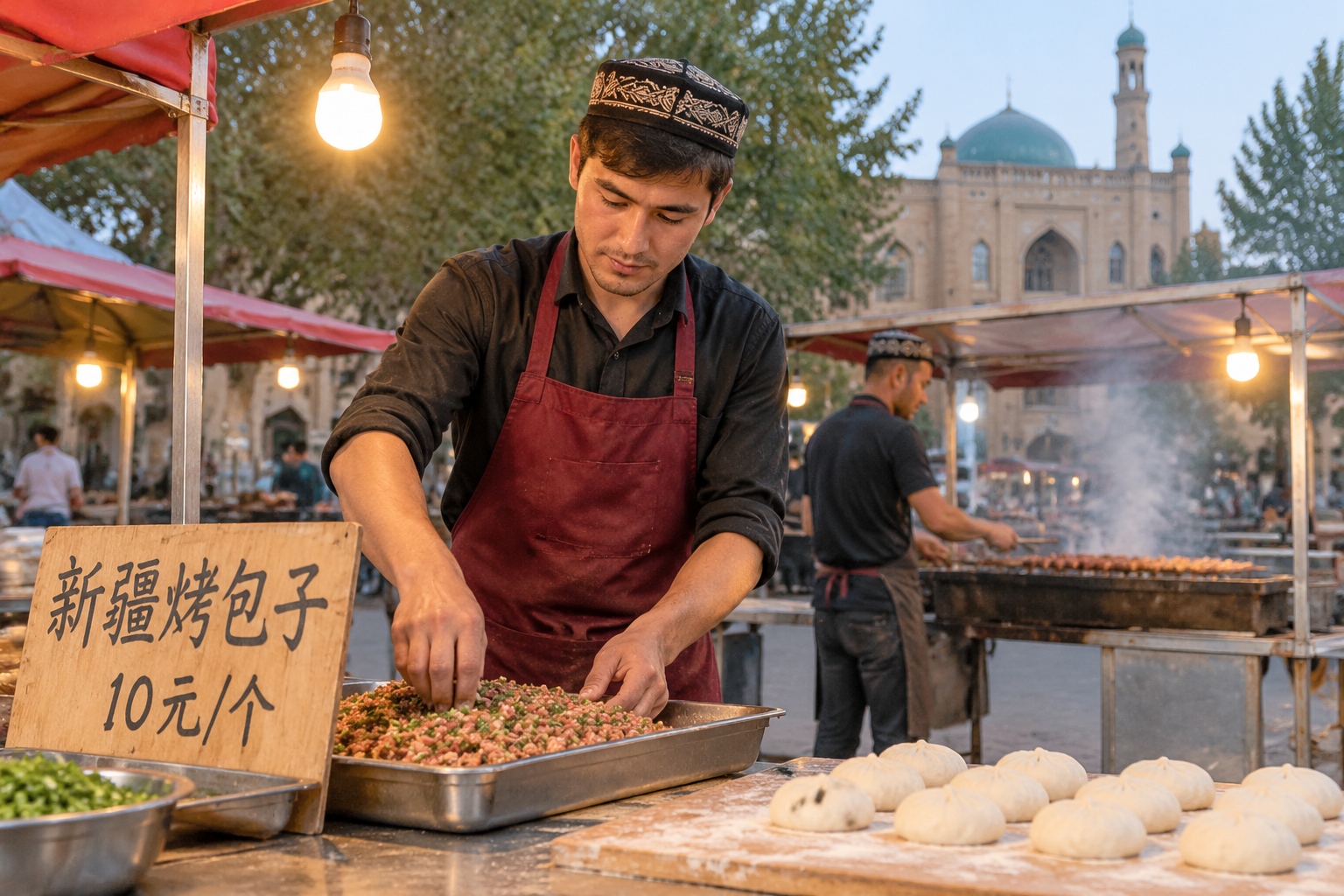
A few steps away, Ma Jun, 25, sells baked buns (samsa) with a younger customer in mind: beef filling, a spicy version, a vegetable version, with a sign that reads “wrapped fresh every day.” He posts new fillings on short video. “When a video goes out, people come the next day looking for it,” he says. He has hired two helpers and brought in family to keep up.
That combination — traditional and adjusted — repeats up and down the street. The classics still dominate: grilled lamb, naan, pilaf, hand-pulled noodles, offal sausages, braised lamb trotters. But yogurt zongzi now comes with more elaborate toppings. Naan is vacuum-packed into gift boxes for travelers. Pomegranate juice is poured into clear cups so it can be photographed on the move. Old methods and new demand coexist, sometimes inside the same stall.
The Vendor’s Arithmetic
Selling at a night market is different from running a small restaurant.
The costs are right there: lamb (good lamb is not cheap), charcoal, stall fees, disposable plates and cutlery, and labor if one person can’t handle the rush. Skewers go for 3 to 8 yuan; a stall selling several hundred skewers a night is normal, and over a thousand on a holiday. But rain kills traffic. Winter shrinks the open-air market — some vendors move indoors, others close for the season. Peak season runs May to October, and the rest is a long wait.
“On a good night I can sell over a thousand skewers,” says one vendor, who doesn’t want his name used, and sketches the math on his hand. “Stall fee, lamb, charcoal, helpers — all come out of that. It’s not a lot left. But it’s freer than working for someone else.”
Younger vendors increasingly treat the stall as a business rather than a stopgap: costing ingredients, tracking cash flow, reading reviews on platforms, wondering whether to open a second stall.
How a City Manages a Street Like This
The boom is not unsupervised. Behind it is a set of municipal arrangements: stall zones, waste collection, noise control, traffic, fire safety.
In a typical city, night market sites are planned, stalls are registered, and food vendors need permits. Garbage gets collected daily — skewers, takeout boxes, bones, fruit peel. City management officers walk the street, not only for order but to handle noise complaints and blocked sidewalks so nearby residents can sleep. In some cities, certain roads close to cars during evening hours.
The process isn’t friction-free. Residents complain about smoke and noise. Vendors want to stay open later. Street offices and urban management have to find the line in between. “We’re not trying to shut down the night market,” one community worker told a local paper. “We want it to keep going without making life miserable for the people living next to it.”
When it works, a night market can last for years rather than spike and fade. That matters for the people whose income depends on it.
Putting It in the Global Street-Food Picture
If you’ve spent time at night markets in Bangkok, Istanbul, Mexico City, or Taipei, much of this will feel familiar. Cheap food, night hours, dense foot traffic, small vendors who have anchored a neighborhood’s economy for decades. The smoke, the calling out, the plastic stools — that’s the common language of street food.
What’s different in China is payment, management, and the way platforms move crowds.
In Bangkok or Istanbul, cash is still king at many stalls. In China, the QR code is the default, even for the oldest vendor on the street. City management is organized and rule-based: registration, hygiene inspections, waste pickup, and clear hours. And the platform layer — short video and local services apps — can change a single stall’s fate overnight, in a way that word of mouth in most cities still takes years to do.
The result is a night market that’s cleaner and more structured, but also more dependent on online attention, and with sharper seasonal swings.
After Midnight
By half past twelve, the line has thinned.
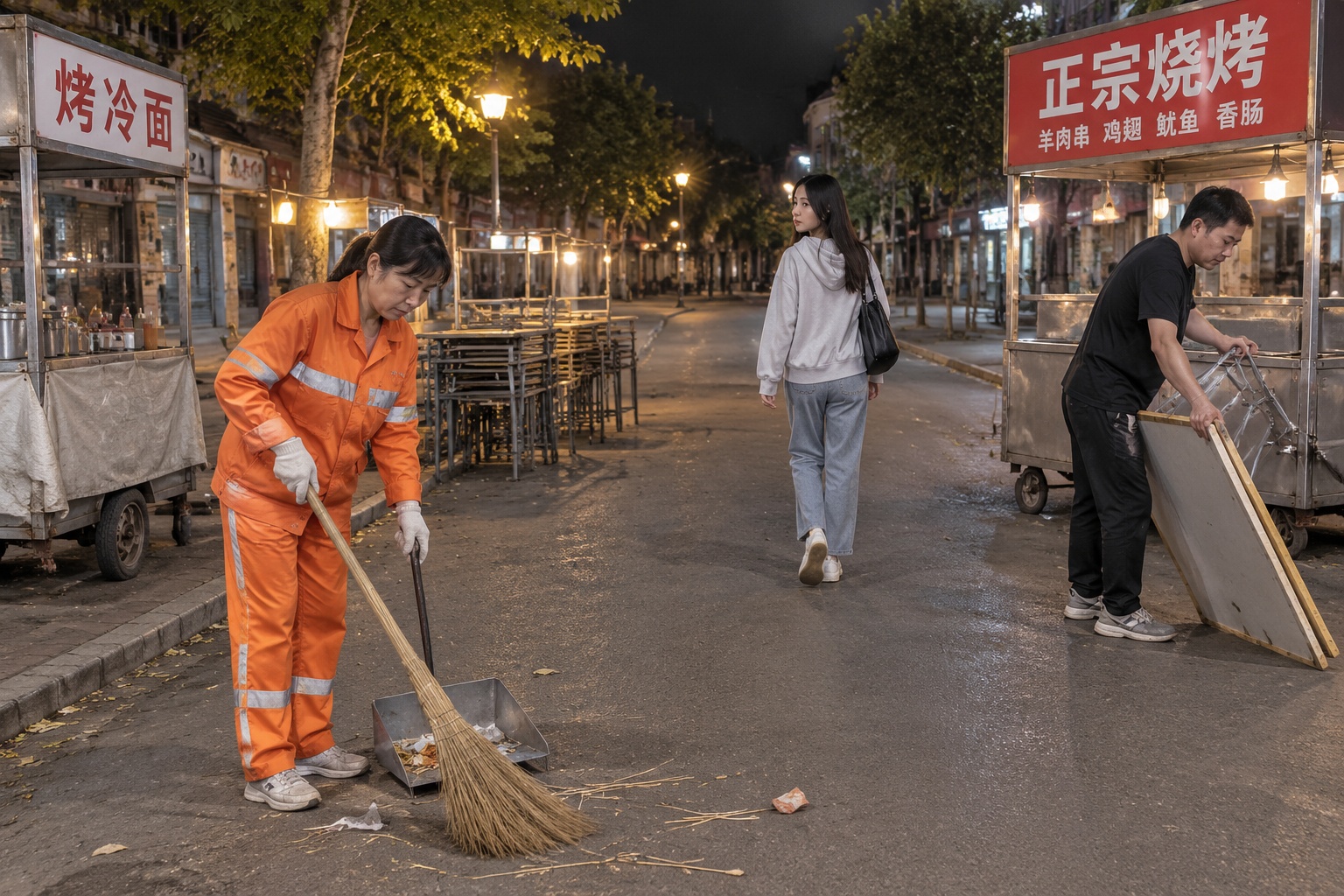
Gulnar drops her skewers in a bin and walks with a colleague along the edge of the street. Lights on one side of the market go out, one by one. Vendors scrape the griddles, fold up tables, load carts. The garbage truck hasn’t arrived yet, but the sanitation workers are already busy.
“Coming back tomorrow?” someone asks.
“Depends,” she says. “I’ve been coming a lot lately.”
The street goes quiet soon after, with a few vendors still packing up and the occasional taxi passing through. No slogans, no closing statement. Just a night market in Xinjiang, on an ordinary summer night, slowly closing down.