

“Mild is still a little spicy, you know”
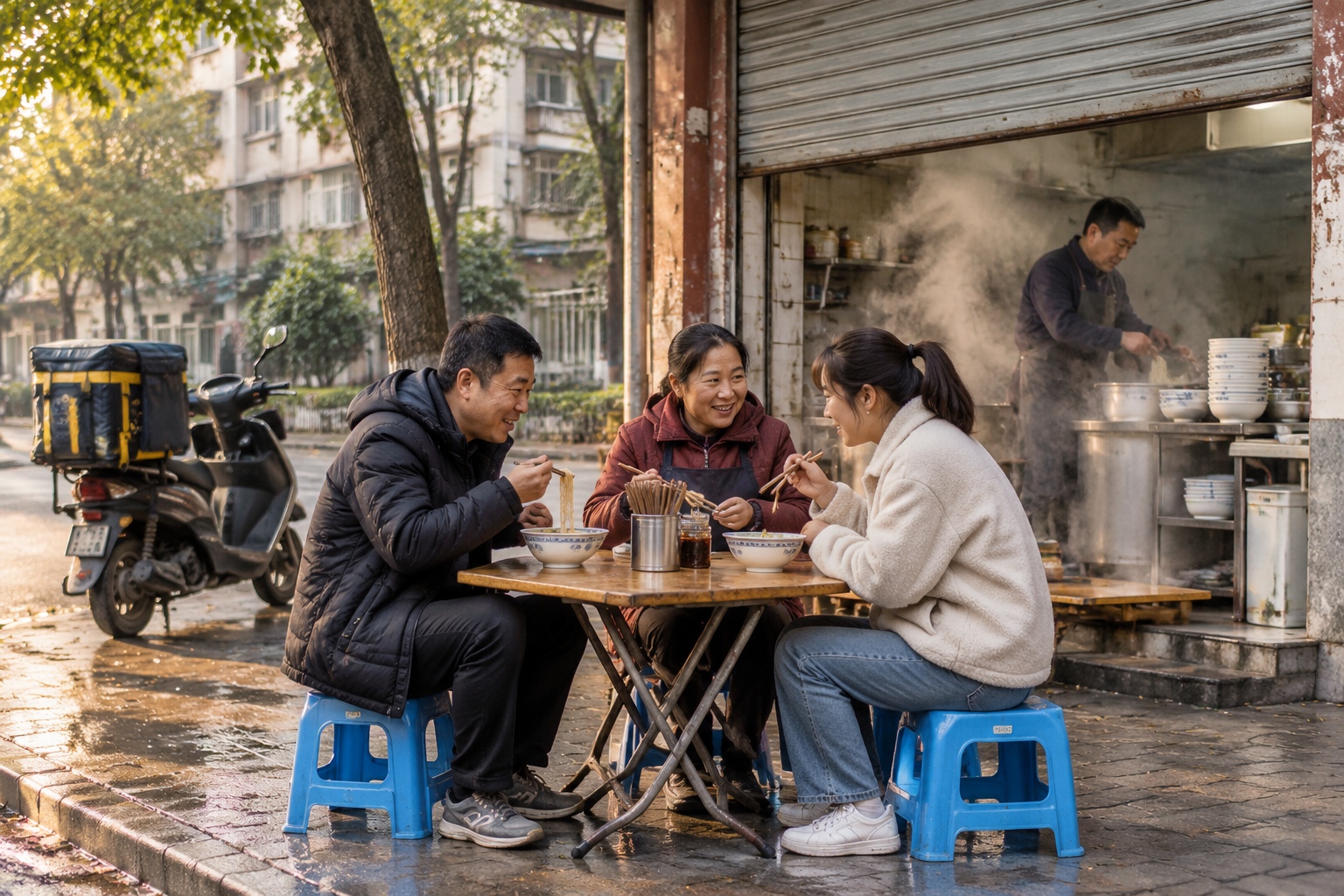
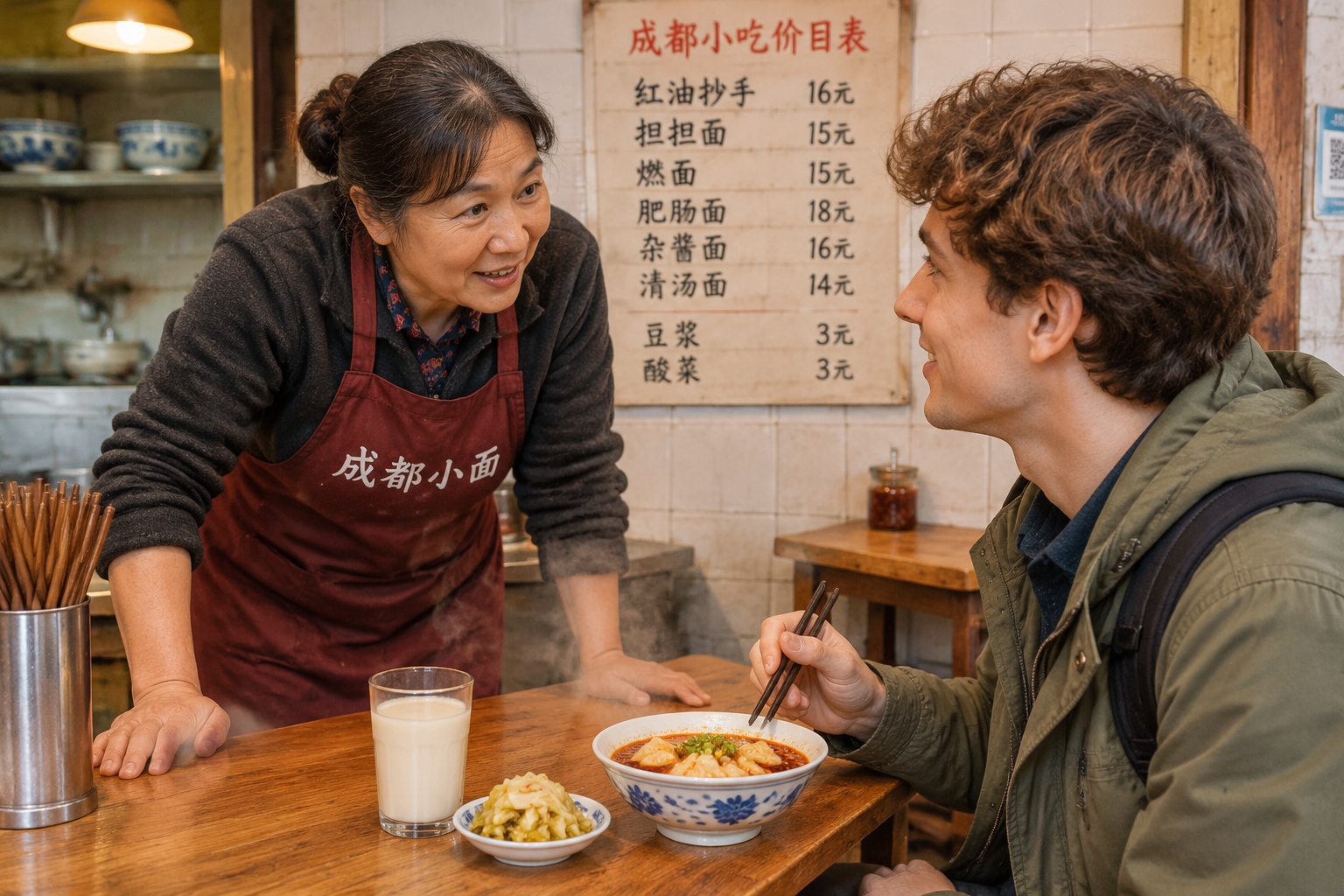
It is 8:10 on a Tuesday morning in a residential block on the east side of Chengdu. The noodle shop has eleven seats, a wall menu in three columns, and a woman in her fifties who has been standing at the same stove since before six. A visitor from Melbourne sits down, points at the red-oil wontons, and uses the only phrase he practiced: “微辣 — mild, please.”
She leans over the counter, smiles, and says slowly: “微辣也有点辣哦.” Mild here is still a bit spicy.
He nods anyway. Ten minutes later he is wiping his forehead and laughing, and she has put a small dish of pickled cabbage and a glass of warm soy milk on his table without being asked.
That exchange explains Sichuan food better than most of what tourists see online before they arrive — not because she was right about the heat (she was), but because of what it shows. The food is adjustable. There is a dial. Nobody is testing you.
How “Sichuan food equals fire” gets built
Ask a first-time visitor what Sichuan food is and you will usually get three words: hot, numbing, hotpot. That is not wrong. It is just about ten percent of the picture.
Two things get flattened together. 麻 (má) is the tingling sensation from Sichuan pepper — a citrus-floral buzz on the lips, not a burn. 辣 (là) is chili heat. They are separate ingredients with separate effects, and a good Sichuan cook uses them independently: 椒麻 chicken is mostly má with very little là, while a 家常 dish can be warmly spicy with no numbness at all.
The bigger issue is what visitors are shown. The places that market hardest in English — hotpot chains with photo menus, “spicy challenge” videos, the branded chili oil in airport shops — sit at the most intense end of the spectrum. Meanwhile the classic Sichuan flavor taxonomy counts more than twenty composite profiles, and only a handful of them are 麻辣. There is 鱼香 (fish-fragrant, actually built from pickled chili, garlic, sugar and vinegar), 荔枝味 (lychee — sweet and sour), 怪味 (a deliberately disorienting mix of sesame, pepper, sugar and vinegar), 咸鲜 (plain savory), and 甜香 (sweet). A Sichuan banquet often carries more non-spicy dishes than spicy ones.
Breakfast is where the myth starts to crack
Between seven and nine in the morning, the noodle shop belongs to regulars. A retired man orders 二两清汤杂酱面 — a two-liang bowl (roughly 100 grams of noodles) in clear broth with minced pork, no chili at all. A delivery rider gets the red-oil wontons and eats standing up. Two schoolkids split a plate of 油条 and dip it into soy milk. The pickled cabbage is self-service, in a plastic tub by the door.
Portions run on 两 (liǎng): one liang is a snack, two liang is a normal breakfast, three liang means you are very hungry or about to do physical work. Prices are painted on the wall — 9, 11, 13 yuan.
This is the part that surprises visitors most. A Sichuan person’s ordinary morning is as likely to be clear broth and soy milk as chili oil. People choose by time of day, by mood, by what their stomach has been doing that week. Spice is a seasoning, not an identity.
The market, and what 麻辣鲜香 actually means
Walk into any 菜市场 in Chengdu around nine and the argument about spice gets more concrete. One stall sells Sichuan pepper by weight, the good kind from 汉源 in Ya’an — small seeds, and a smell closer to lemon peel than to chili. Another has 郫县豆瓣 in open buckets: fermented broad bean paste, dark red, heavily salted, aged a year or more.
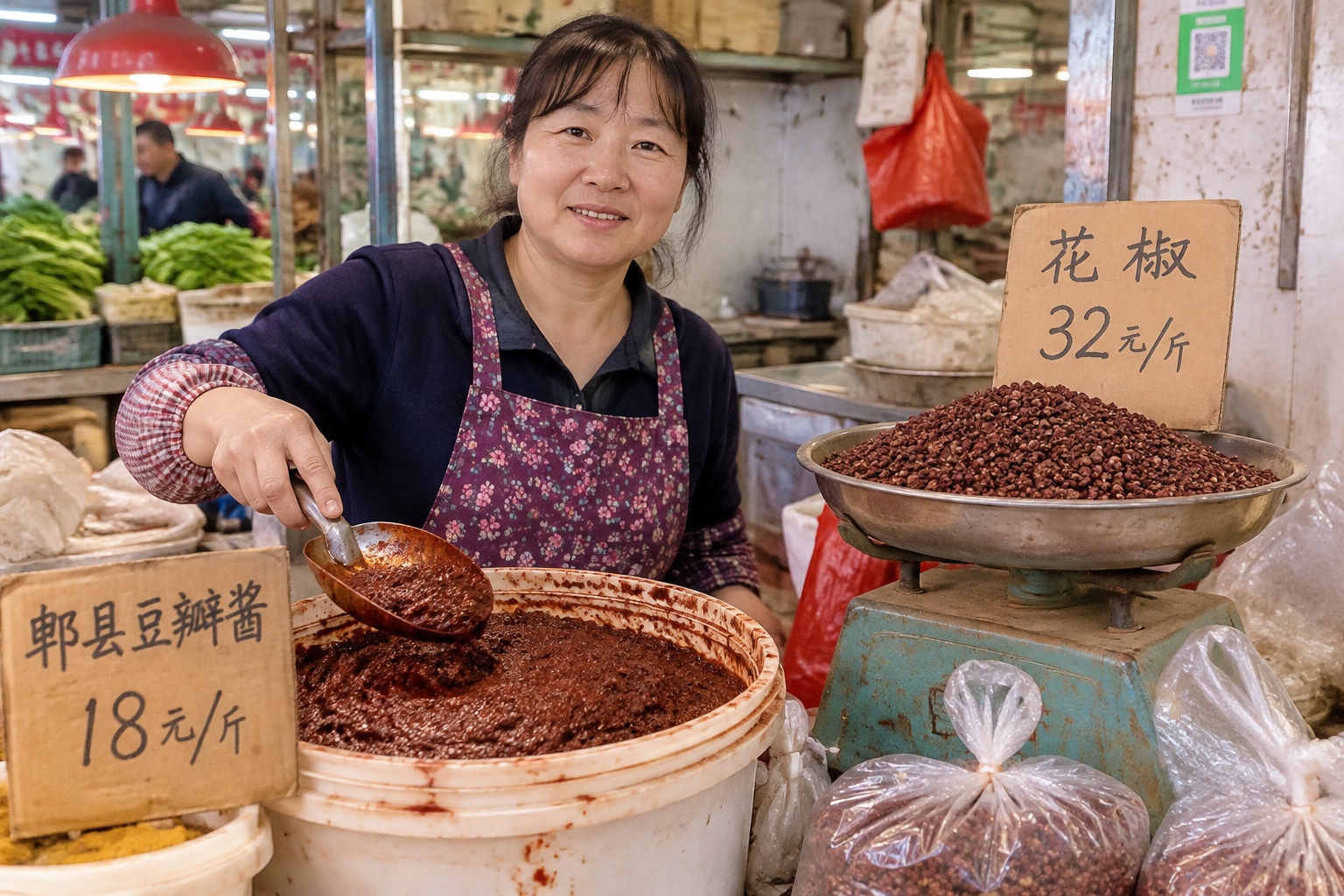
That paste is the backbone of the cuisine, and it is not primarily hot. It is savory, fermented, deeply umami; a spoonful goes into the wok before anything else. 麻辣鲜香 is a balance rather than a heat level — the 鲜 (freshness) comes from vegetables picked that morning, the 香 (fragrance) from rendered fat, garlic, and chili oil poured at the right temperature.
The vegetables are seasonal and cheap: 藤藤菜 (water spinach) in summer, 儿菜 and 豌豆尖 in winter, sold in bundles for two or three yuan.
What a family actually cooks on a Wednesday
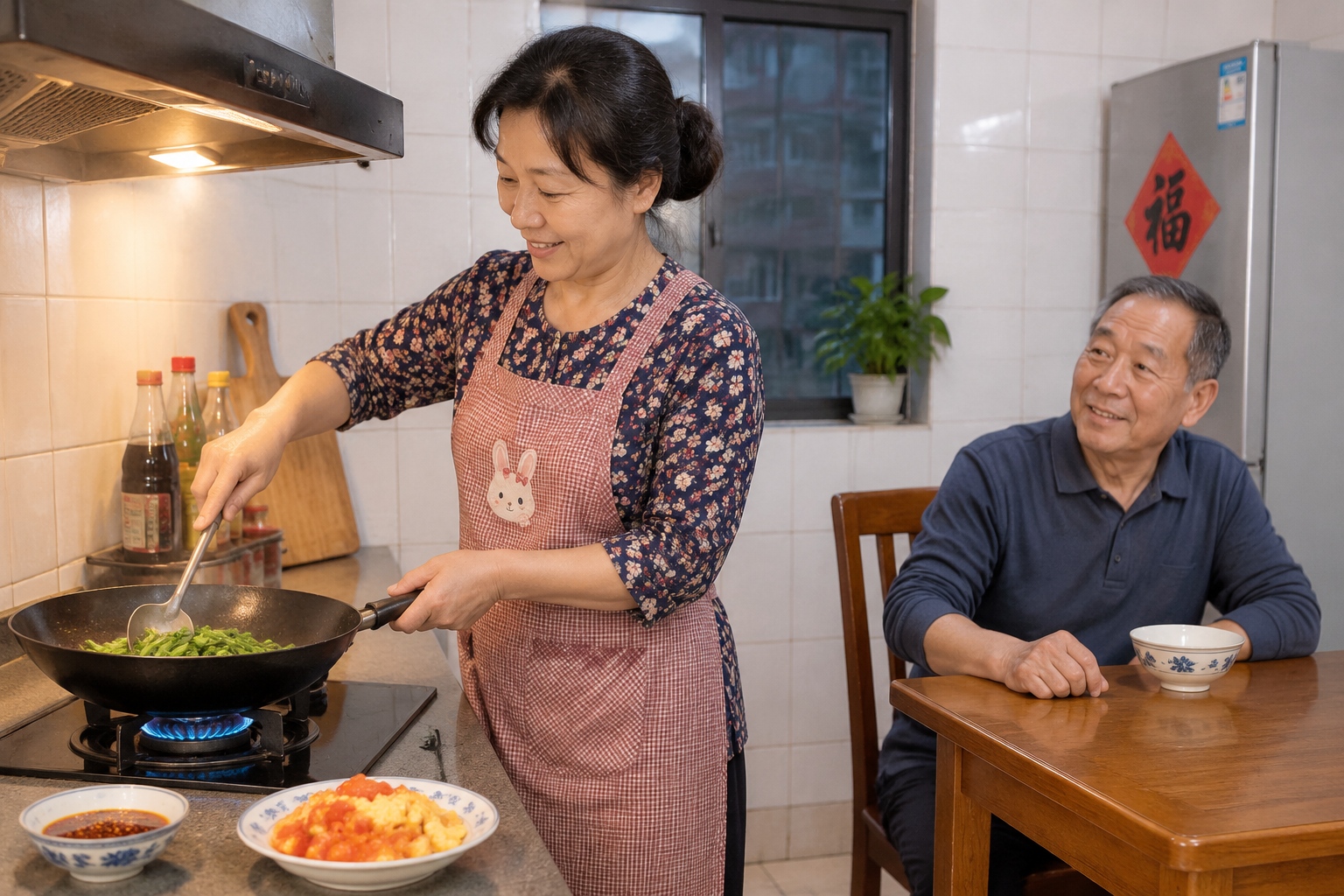
A typical home dinner in Chengdu is 两菜一汤 — two dishes and a soup. Often that means one meat, one vegetable, one broth. On a weekday it might be 番茄炒蛋 (tomato and egg, not spicy), a plate of greens stir-fried with a little chili, and a plain winter melon soup. The chili appears on the side, in a small dipping dish, for whoever wants it.
In home kitchens, spice is dosed like salt: by feel, and by who is eating. Grandparents often get a separate, milder version of the same dish. Children start with almost none and build up slowly, the way children elsewhere build up to coffee.
A 15-yuan lunch, and the QR code problem
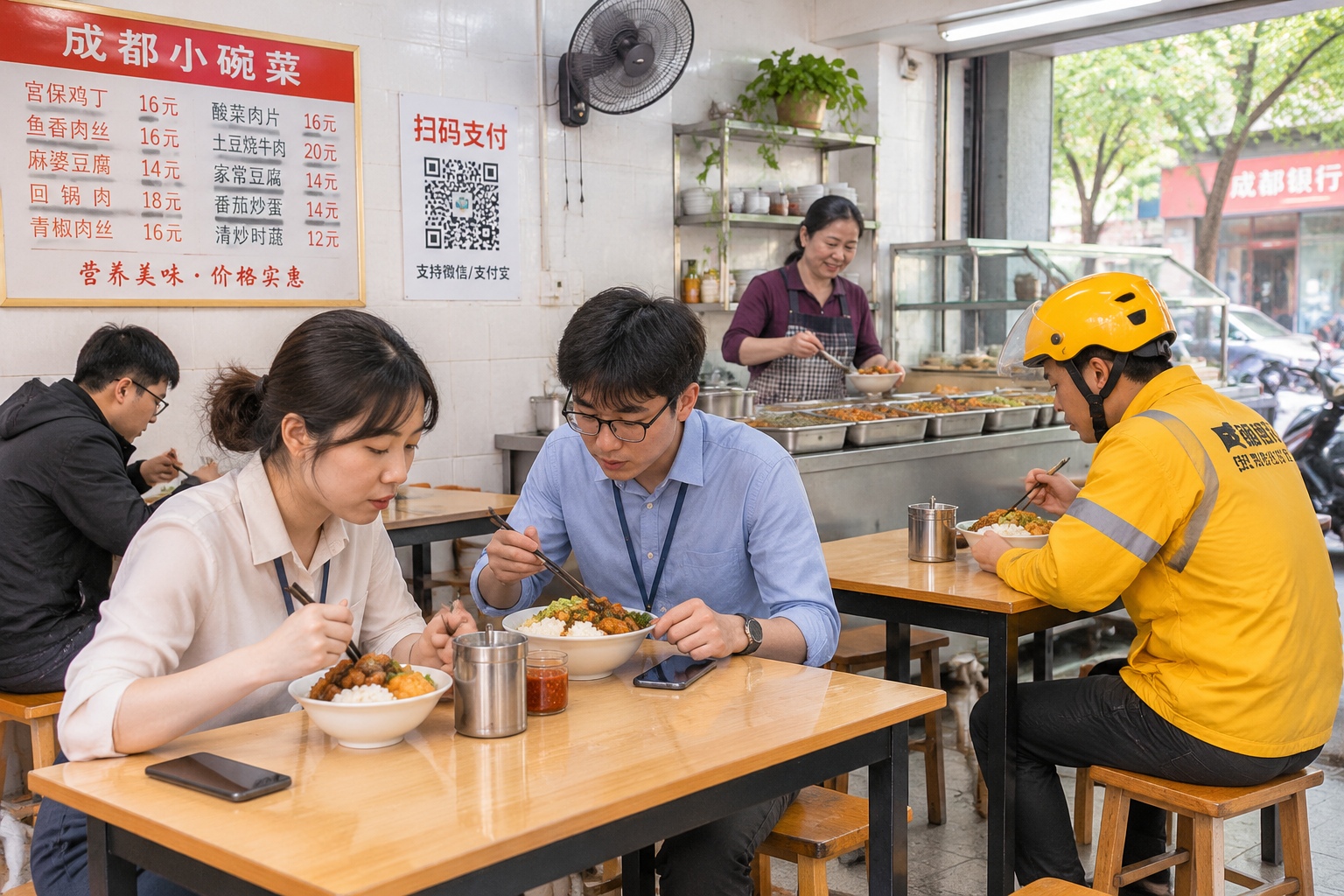
At noon, the small restaurants fill up with office workers, construction crews and delivery riders. Locals affectionately call the cheapest ones 苍蝇馆子 — “fly restaurants.” A 盖浇饭, rice with a topping spooned over it, costs 14 to 18 yuan. The portion is large, the soup is free, and the menu is printed on the wall, usually with no English at all.
Here a foreign visitor runs into a genuine friction point: payment. Almost everyone pays by scanning a QR code with WeChat or Alipay. Cash is technically accepted, but small shops often have no change. Since 2023 both apps support foreign cards, yet some vendors still use a personal code that may not process an international card. The owner will usually wave you toward the code on the wall and try it anyway; if it fails, she may refuse your cash and tell you to come back next time. It is not a scam and not a tourist tax — just a small shop being casual about a 15-yuan transaction.
Hotpot is a dinner party with a stove in the middle
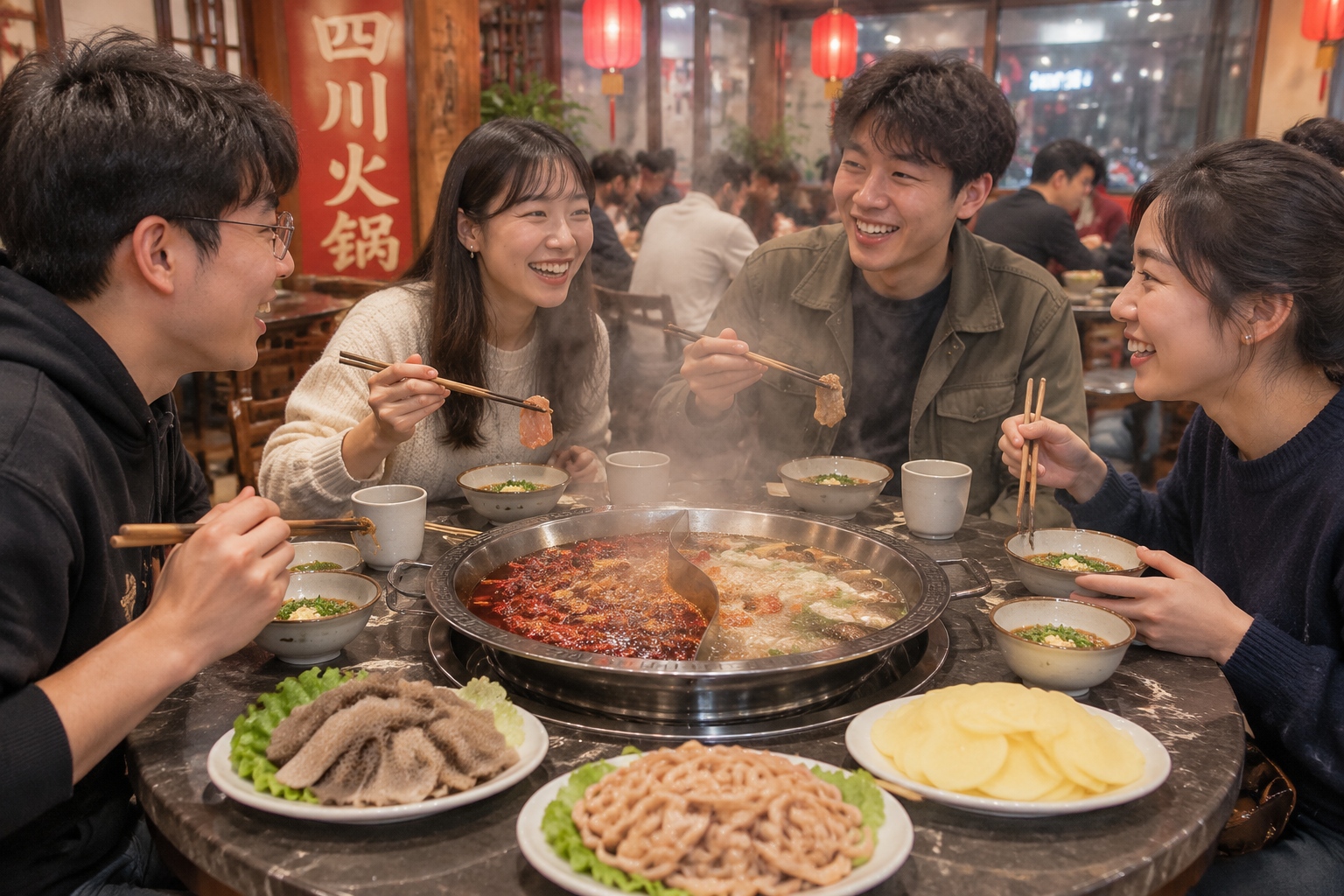
Now the part everybody already knows, with a correction. Sichuan hotpot is a social format, closer to a long Sunday lunch than to a dare. A group books a table at seven and stays until nine-thirty. The pot is often split — 鸳鸯锅, half mild, is completely normal and carries no shame. Each person builds their own 油碟: sesame oil, raw garlic, cilantro, maybe oyster sauce or vinegar. The oil cools the food and carries the aroma; it is not there to make anything hotter.
What locals order is as much about texture as heat: 毛肚 (tripe) for the crunch, 鸭肠 (duck intestine) for the seven-second dip, 黄喉 (aorta) for the snap, 脑花 (brain) for those who grew up with it, plus potato slices, lotus root, and afterwards a bowl of 冰粉 or 银耳汤. There is beer, there is gossip, there are children doing homework in a corner. Nobody is timing anybody.
One province, several palates
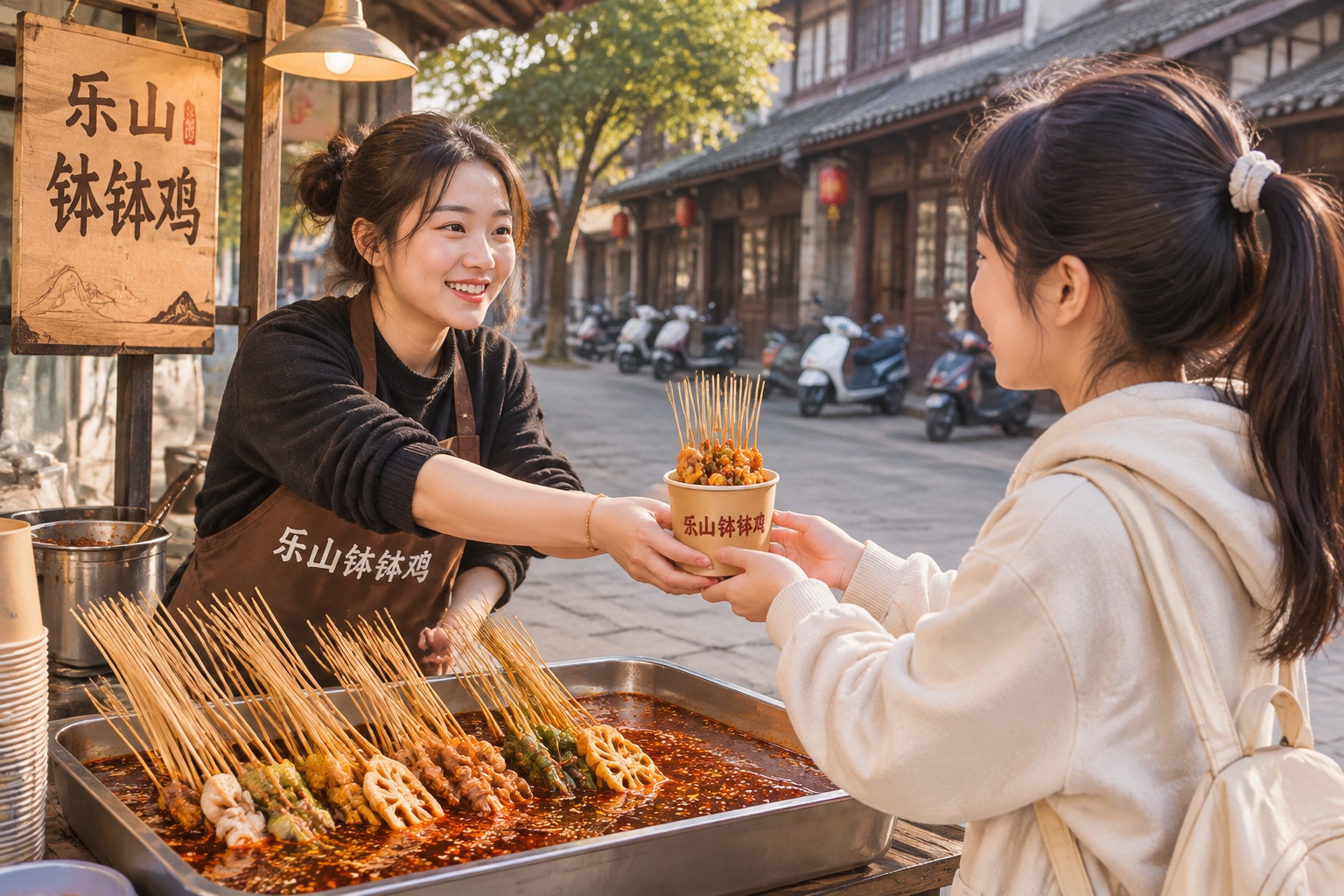
“Sichuan food” is a category error of the same kind as “Italian food.” Chengdu cooking leans toward 复合味 — layered, slightly sweet, moderately hot. Leshan, an hour south, is known for 甜皮鸭 (sweet-crusted roast duck) and 钵钵鸡, cold skewers in a chili oil that reads fragrant rather than brutal. Zigong, further south, developed 盐帮菜, the cooking of salt merchants, which is sharper, saltier and more direct: 冷吃兔, 跳水鱼, dishes that hit fast and finish clean.
Young locals and young visitors are drifting in the same direction, and it is not only about tradition. In Chengdu, new coffee shops sit next to forty-year-old noodle stalls, and a generation raised on hotpot also queues for light meals and Japanese bakeries. The interesting question is not whether Sichuan food stays “authentic.” It is that the same person will eat a nine-yuan bowl of noodles at eight in the morning and a three-hundred-yuan tasting menu at eight at night, and think nothing of it.
What fits in the suitcase
On the last morning, visitors tend to buy the same things: a vacuum-packed bag of Hanyuan Sichuan pepper, a jar of Pixian broad bean paste, maybe a pack of hotpot base for friends back home. Useful, certainly. But the smaller souvenir is the adjustment in expectation — the discovery that “Sichuan food” is a family of habits, prices and social rituals rather than a spice rating.
The woman at the noodle shop was making a small, practical point: mild is still a little spicy, so choose accordingly. It turns out to be a good rule for the whole trip. What visitors carry home is not the burn. It is the memory of a city where breakfast can be clear broth, lunch costs 15 yuan, dinner lasts two and a half hours, and the chili is always optional — even if the answer is usually yes.