
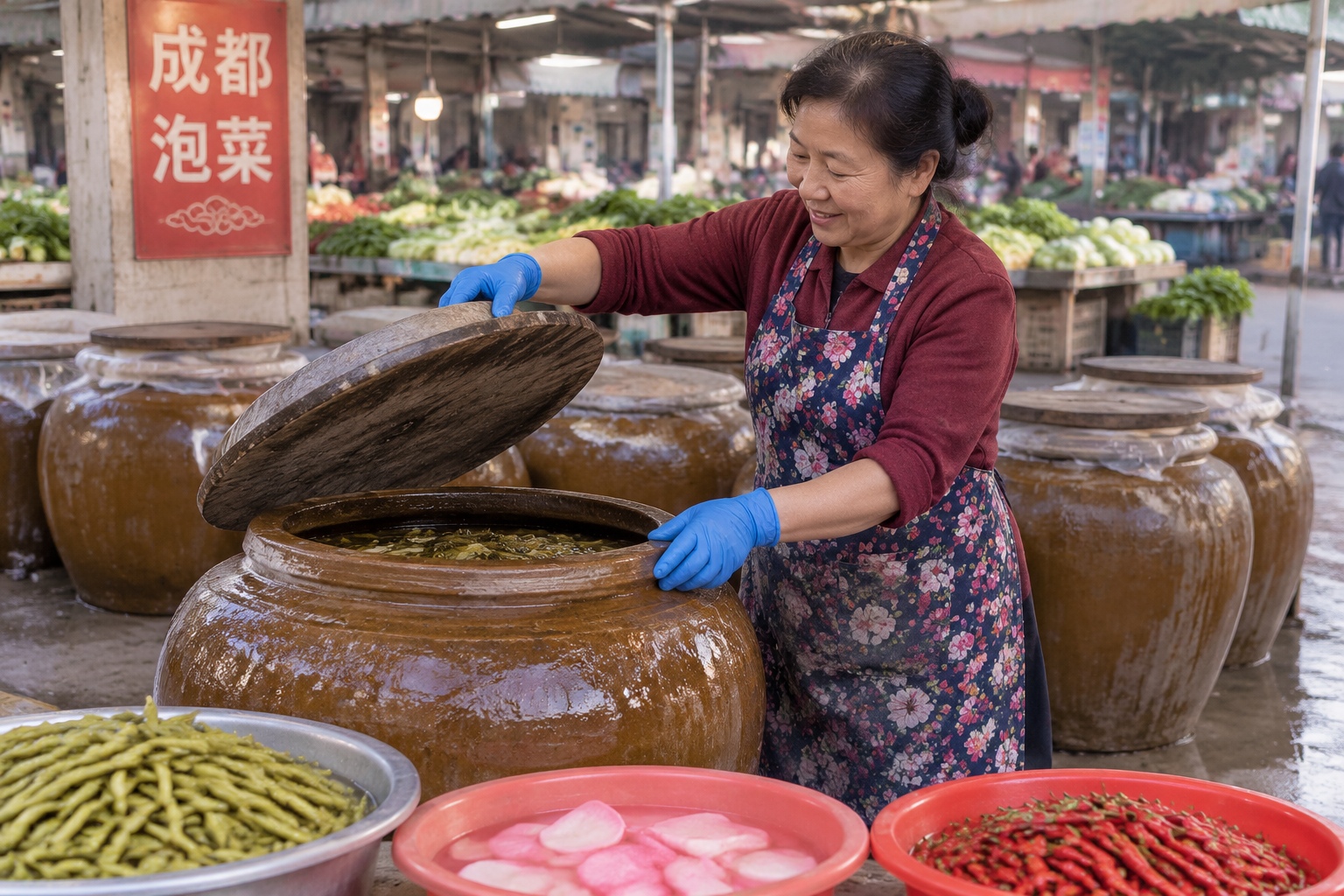

A Lid Comes Off at 6:40 A.M.
The lid comes off with a wet suck of air. The smell arrives before your eyes adjust to the stall: sour first, then salt, then something faintly sweet, and behind it a chili sharpness that makes the back of your jaw tighten.
It is 6:40 in the morning at a wet market in Chengdu’s Qingyang district. Around the stall, the market is already running. A woman two aisles over is trimming greens with a knife the size of her hand. A man is cutting keys on a grinding wheel. Someone is selling soy milk and fried dough sticks out of a steel pot, and three retirees are eating standing up, bowls balanced on a plastic crate.
This is what a Chinese wet market (菜市场, càishìchǎng) actually is: not a picturesque farmers’ market, but a working piece of neighborhood infrastructure. Vegetables, pork, live fish, tofu, a tailor, a key cutter, a noodle stall, a pickle stall. Most open before six and close by early afternoon, when the vendors go home to nap and prepare for tomorrow.
The pickle stall is a metre and a half wide. Behind it stand eleven glazed clay jars, shoulder to shoulder, each with a lid and a water-filled rim. In front of it are twenty plastic basins, and in those basins is the reason people queue here at an hour when they could still be asleep.
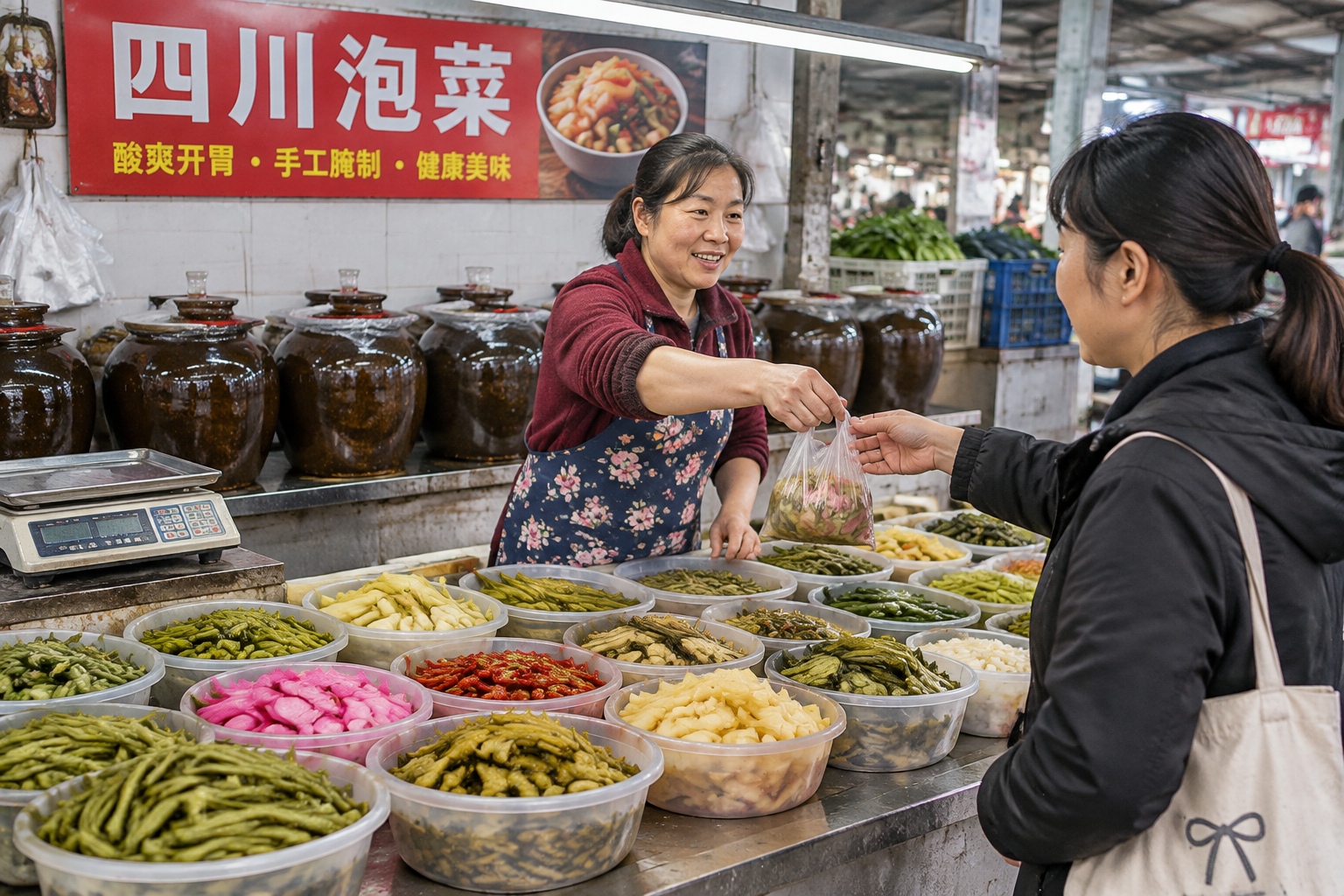
The Woman Behind the Jars
Auntie Luo is 58 and has sold pickles in this market for nineteen years, which makes her neither the oldest vendor nor the newest. She wears a floral apron, blue plastic gloves, and the flat, unimpressed expression of someone who has been asked “is it good?” ten thousand times and has stopped bothering to answer with words.
Ask her how she chooses vegetables and she becomes specific fast. Long beans (豇豆) have to be picked young, before the seeds inside swell, or they go soft in the brine. Young ginger (仔姜) should still have pink tips. The best chilies for pickling are erjingtiao (二荆条), the long, slightly wrinkled ones — aromatic rather than merely hot. Red radishes get a two-day soak and come out pink and crackling.
“If the vegetable is tired, the pickle is tired,” she says. “You can’t fix it with salt.”
Her bench holds a bag of coarse sea salt, a bottle of 52 percent sorghum liquor, a jar of rock sugar, and a small dish of Sichuan peppercorns. That is the whole toolkit. Everything else is time.
What Is Actually Happening in the Jar
Foreign visitors often mistake Sichuan pickles for Korean kimchi. They are cousins, not twins. Kimchi is usually seasoned with chili powder, fish sauce and garlic and eaten as a main side dish. Sichuan paocai (泡菜) is submerged in salt brine, and it functions more like a condiment: a sour, crunchy counterweight to a plate of twice-cooked pork or a bowl of plain rice porridge.
The mechanics are simple enough to explain at a stall. Vegetables carry lactic acid bacteria on their skins. Put them in a mild salt solution without oxygen, and those bacteria eat sugars and produce lactic acid, which sours the vegetables and, conveniently, stops the wrong microbes from taking over. Salt concentration matters: roughly 3 to 5 percent for pickles eaten within a few days, higher for jars meant to sit for months. Temperature matters more in Chengdu than almost anywhere, because a summer kitchen can push a jar through fermentation in 48 hours, while a January kitchen slows everything down.
The clay jar’s design is the clever part. The rim holds a moat of water, and the lid sits in that moat like a lid in a lock. Air gets out. Air does not get in. Vendors top up the rim water every morning — miss a few days in dry weather, and the seal breaks.
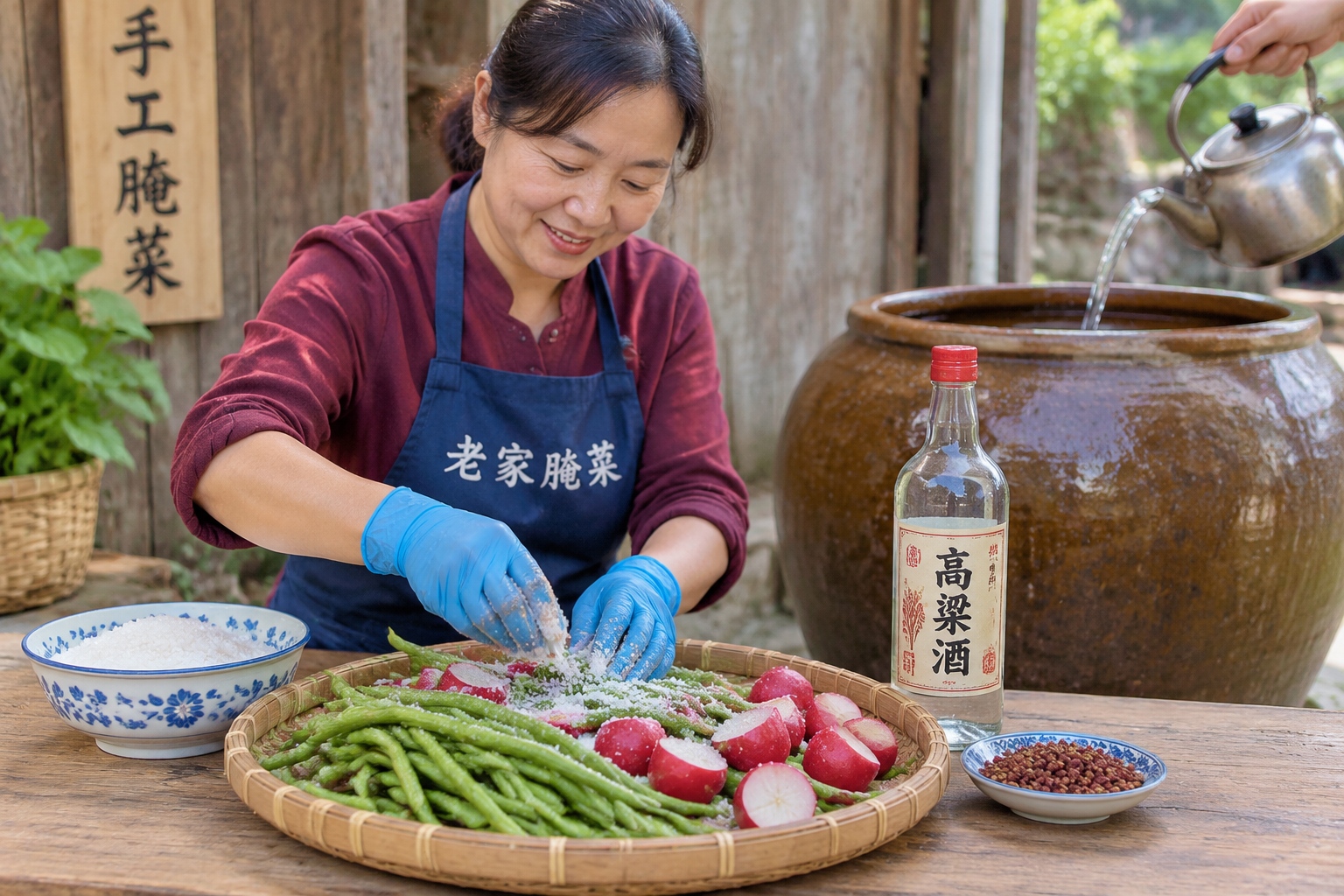
The most common household crisis is a white film on the surface, called 生花 in Chinese. It is kahm yeast: ugly, mostly harmless, and a sign that oxygen got in. Auntie Luo skims it off with a spoon, adds a splash of liquor, and drops in a piece of young ginger. “Old people’s method,” she says. “It works. I don’t need a laboratory.”
A Competition With No Trophy
Between the stalls there is a rivalry nobody announces. It is measured in the age of the brine.
Serious vendors keep a jar of 老盐水 — literally “old salt water” — and never empty it. Every few days they add vegetables, salt and a little sugar, and the culture keeps going. Auntie Luo’s is nine years old. A vendor one street away claims fourteen, and says it like a man showing a passport. The brine is fed, smelled, and tasted like a sourdough starter, and it is the closest thing a Sichuan kitchen has to a family heirloom.
Old brine is also a product. Vendors sell it by the bag — a few yuan for a scoop of cloudy liquid — so a customer can start a jar at home with a culture that is already proven. It is a small, unglamorous trade in living things.
The judging happens quietly. Regulars don’t compare brine ages; they compare flavor and trust. Auntie Wang, a retired schoolteacher, has bought from the same stall for twelve years. “I know her salt,” she says. “If I go elsewhere, it’s too salty or too sweet, and I have to think about it. Here I don’t think.”
Prices are modest: a plastic bag of mixed pickles costs around ten yuan, less than two dollars. The margins come from volume and from loyalty, which is why vendors remember who likes their radish cut thick and whose son has gone to university in Shanghai.
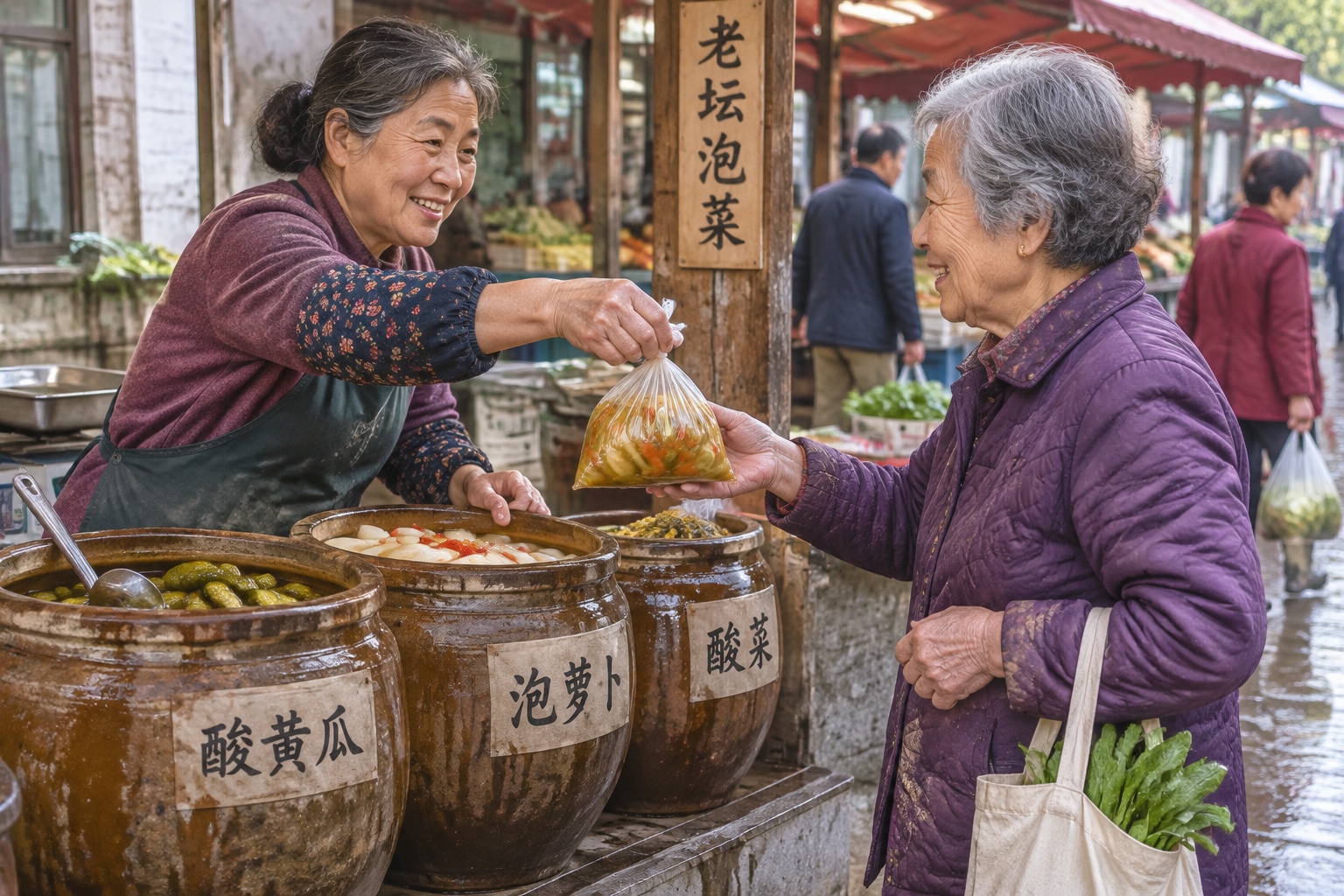
From Every Balcony to the Market Stall
For most of the twentieth century, buying pickles was slightly absurd. Almost every household had a jar on the balcony or in the kitchen corner, fed with whatever the season produced. My former landlord in Chengdu, now in her seventies, still describes her mother’s jar as if it were a member of the family.
That changed with the cities. Apartments got sealed windows and small kitchens. Working hours got longer. Young people moved into rented flats where drilling a shelf is a negotiation with the landlord. Supermarkets and delivery apps responded with vacuum-sealed pickles in neat 200-gram packets, which are consistent, convenient, and — by common local verdict — fine, but flat.
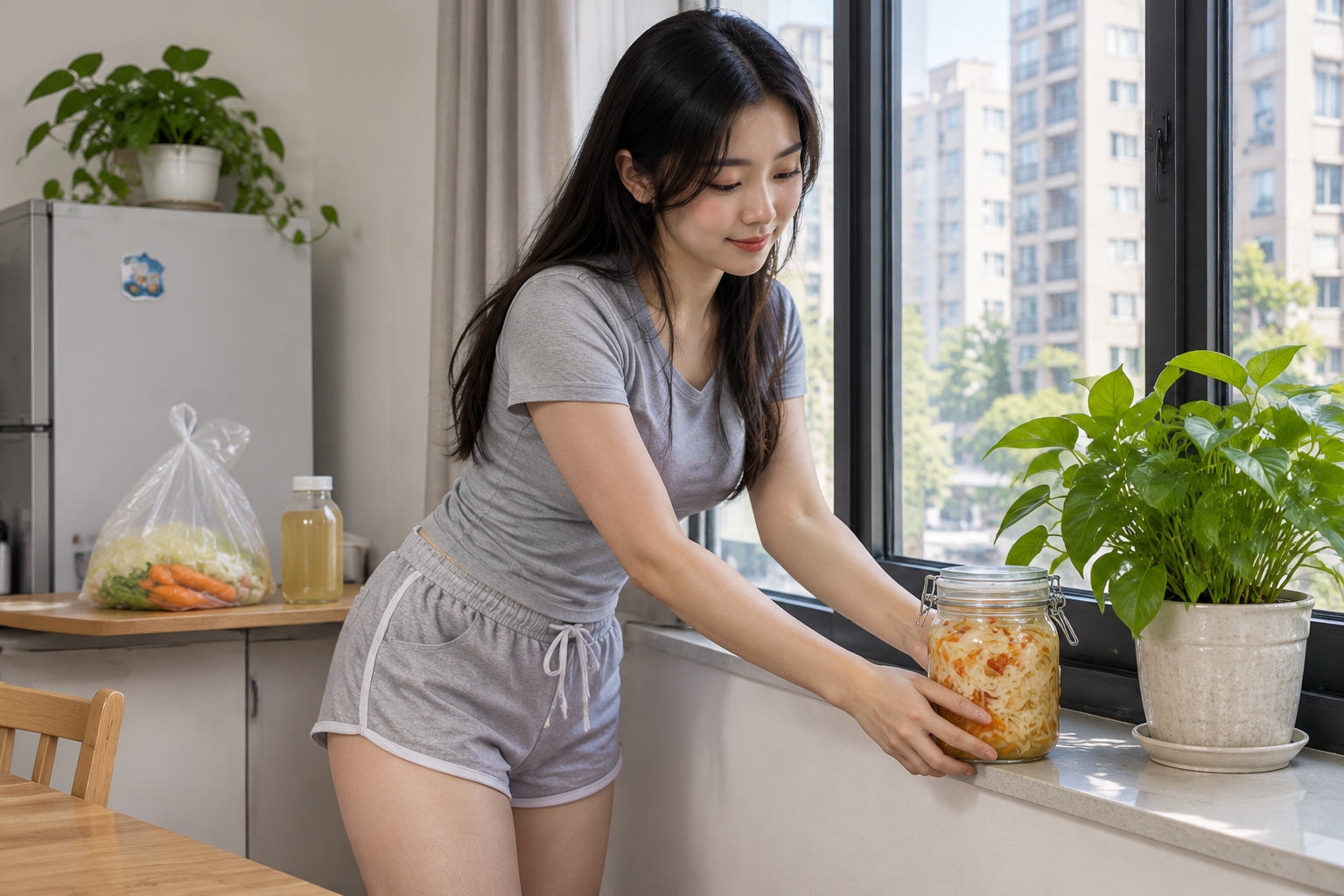
What is interesting is that the market stalls did not disappear. They adapted. On a weekday morning, roughly a third of the customers at Auntie Luo’s stall look under 35. Some buy a small bag for lunch. Others buy a bag of old brine and start their own jar, usually on a windowsill, usually posting about it. One 26-year-old graphic designer told me she keeps a jar because it makes her rented room “feel like somebody lives here.”
Season, Table, Neighborhood
A pickle stall is also a calendar. Spring brings 儿菜 and young garlic shoots. Summer is long beans, chili and cucumber. Autumn is the season for making large batches of chili paste. Winter is radish, mustard tuber and cabbage. Auntie Luo changes what she sells not because a supplier tells her to, but because the market tells her.
None of this is dramatic. There is no technology to marvel at, no policy to debate. But it is a decent answer to a question foreigners ask a lot: what does ordinary Chinese city life actually look like? It looks like a woman topping up the water in a clay jar at 7 a.m. so the seal holds, and a customer buying two yuan of radish to eat with congee, and a young renter carrying a bag of cloudy liquid home on the subway like it’s a plant.
Before I leave, Auntie Luo pushes a plastic bag across the counter. Long beans, radish, a few chilies, the brine staining the bag pink. “Try it in two days,” she says. “Not today. Today it’s still thinking.”