


The box of fruit at the door
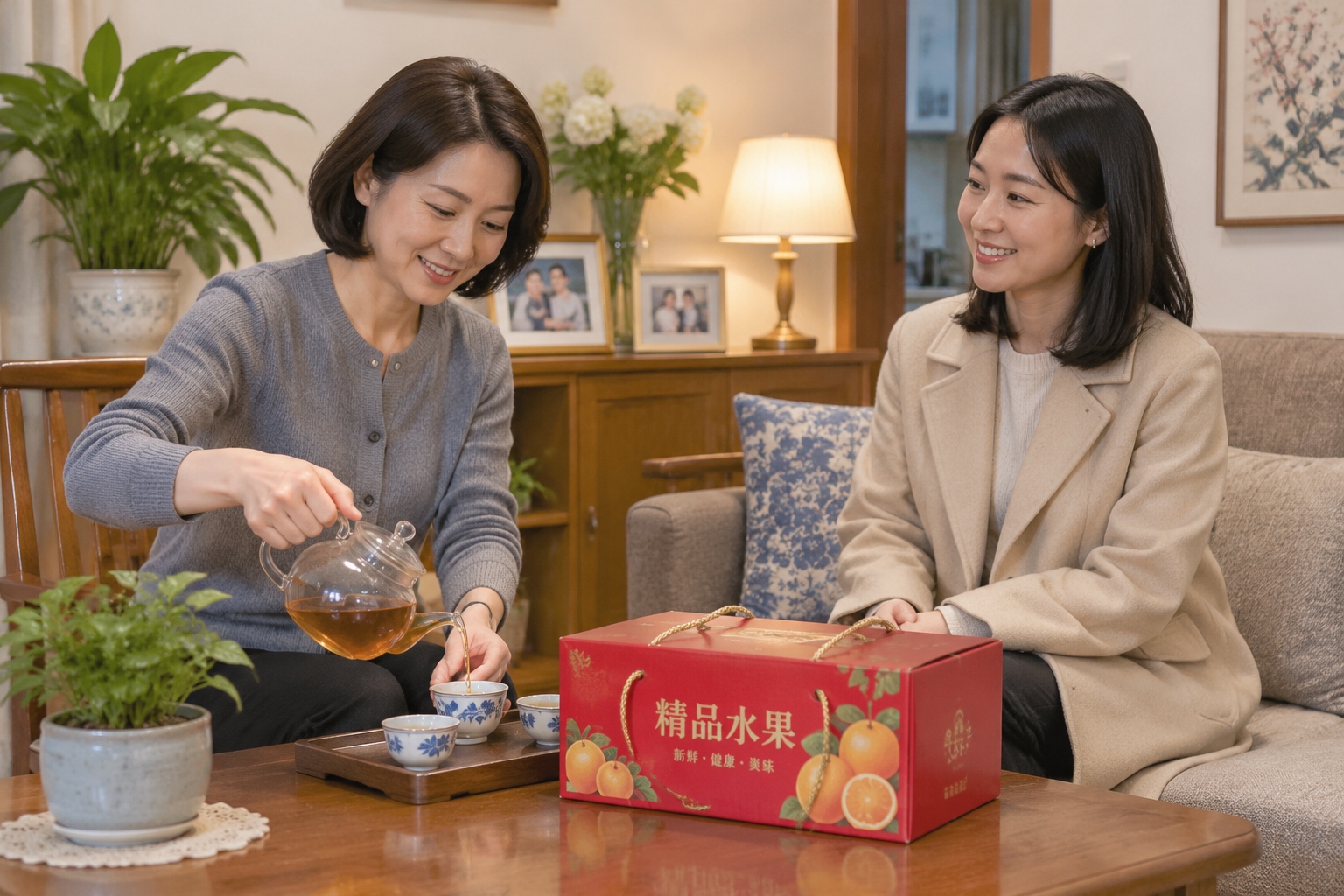
You have been invited to dinner at a Chinese friend’s flat. On the way you stop at one of the small fruit shops that appear on every other corner and buy what everyone buys: a cardboard gift box with a plastic handle, cherries or mangoes, sealed under clear film. It costs eighty yuan. You feel slightly awkward carrying it, then slightly pleased with yourself.
The door opens. Before you finish saying hello, your host looks at the box and says: “哎呀,你太客气了!来就行了嘛,还带什么东西。” — “Oh, you’re too polite. You coming is enough — why bring things?”
You stand in the hallway holding cherries, wondering whether you have insulted her, or whether she thinks you are bribing her. Neither. Within about forty seconds the box will be in her hands and then on the kitchen counter, and she will be asking whether you have eaten yet.
That gap — between the words and the hands — is what this article is about. One clarification before we go further: this is about ritual politeness in ordinary social situations. When someone genuinely refuses a gift, they mean it, and the correct response is to respect that decision rather than to keep pushing.

“Too polite”: a phrase that does a lot of work
The key word is 客气 (kèqi). The first character, 客, means guest. To be kèqi is to behave like a guest rather than like family — to stand on ceremony, to keep a certain distance. Chinese uses the word constantly: 别客气 (don’t be polite, meaning make yourself at home), 不客气 (you’re welcome), 你太客气了 (you’re too polite).
Being kèqi with someone close to you is faintly negative. It implies distance, treating a friend as a stranger. So when a host says “你太客气了” at the door, the phrase carries two things at once: it acknowledges that you went out of your way, and it suggests you did not need to.
English has an exact cousin: “You shouldn’t have.” Nobody in Manchester or Ohio hears that sentence as a literal instruction either. The difference lies in timing. An English speaker usually says “you shouldn’t have” while already reaching for the bottle of wine, or after the gift is in their hands. In Chinese, the refusal and the acceptance are separated in time, and that separation is the polite part. The pause gives the giver room to say “it’s nothing”, which is the sentence that actually makes the gift small enough to accept.
Four beats, in order
Most doorstep exchanges follow the same short choreography. Once you know the shape, it stops feeling like a test.
1. The offer
You hold the box with both hands or set it down on the shoe cabinet. You do not press it into the other person’s palms; that reads as insistence, and insistence is for later, if at all.
2. The first no
It arrives fast, often before you are through the door, and it is warm rather than cold. Sometimes a hand lifts slightly toward the box, sometimes not. What matters is that it is short and it does not come with a reason.
3. The reason
Here the giver supplies a small, deflating explanation. “I was passing by.” “It’s from my hometown.” “It’s for the kid.” “It’s really not worth anything.” What you do not do is state the price or explain how much effort it took. The point of the sentence is to lower the weight of the gift so the other person can pick it up without feeling indebted.
4. Acceptance
The host takes it, thanks you, and — the part foreign visitors notice most — often puts it aside without opening it. A box of tea goes on the shelf. The fruit stays in its plastic film until later in the evening.
This is not coldness. Opening a gift in front of the giver invites both of you to assess the thing, and in a hospitality context the visit is supposed to be the point, not the object. Practically, most of these gifts are meant to be shared anyway: the cherries get washed and put in a bowl in the middle of the table, and everyone eats them while talking.
It is also worth saying that not every gift is declined. If your host simply says 谢谢 and takes it, that is not rudeness or greed. Among close friends, among people of the same age, and in most younger urban circles, the ritual is often shortened to one sentence or dropped altogether.
Two conversations worth telling apart
The skill is not learning to decline. It is learning to hear the difference between a ritual no and a real one. Here are two exchanges, both of which happen in China every week.
The ritual decline
— “阿姨,一点心意,路上顺手买的。” (Auntie, a small thing, I picked it up on the way.)
— “哎呀,你这孩子,太客气了,来就来嘛。” (Oh, you, always so polite. You should just come.)
— “真不值什么钱,您留着吃。” (It really isn’t worth anything. Keep it and eat it.)
— “那行吧,下回可别带了。” (Alright then. But next time don’t bring anything.)
Notice what happens in the fourth line: 那行吧, “alright then”. The host has not changed her mind about gifts; she has completed a sequence. The thanks is real, the mild complaint is also real, and both are meant kindly.
The real refusal
This one is set in an office, where a supplier’s employee is trying to leave a box of tea with a manager.
— “王姐,这个你收着。” (Sister Wang, take this.)
— “真不能收。我们单位有规定,收了我要写说明的,你这是给我添麻烦。” (I really can’t. We have rules here; if I take it I have to write an explanation. You’d be making trouble for me.)
— “就是盒茶叶而已……” (It’s just a box of tea…)
— “我知道,心意我领了。你要是想帮我,下周把材料提前发我就行。” (I know, and I appreciate it. If you want to help me, send the paperwork over before next week.)
Four signals separate this from the first conversation. The refusal comes with a specific rule rather than a general “you shouldn’t have”. The hands do not move toward the box, not even a token gesture. A concrete alternative is offered in place of the gift. And the tone is flat and unembarrassed — there is no performance in it, no door left ajar.
Since the anti-corruption campaign that began in late 2012, employees of government bodies and state-owned enterprises, along with many doctors and teachers, operate under explicit gift rules. When someone in that position says 单位有规定, they are not being modest. They are telling you that accepting would cost them something.
One line that gives the other person a way out
If you are the giver and you cannot tell which conversation you are in, say this: “这个你要是不方便,我拿回去就行,别有压力。” — “If this is inconvenient, I’ll take it back, please don’t feel pressured.”
It works because it removes the price of saying no. In a ritual exchange, both people are quietly protecting each other from embarrassment; a sentence that says “you can refuse and nothing bad will happen” lets the other person either accept warmly or decline honestly, without either of you losing face. Then watch the hands. Hands that come toward the box mean yes. Hands that stay still, or a palm held flat and calm, mean no.
And if the answer is no, leave it there. Setting the gift on the table and walking away is not generosity; it converts a refusal into pressure and puts the other person in an awkward position they now have to manage.

Why the first no is not a no
The underlying logic is about obligation. In a society where relationships are long and dense — colleagues for twenty years, neighbours who know your parents, a classmate network that will still be calling in 2040 — a gift creates a debt, and both sides know it. Accepting instantly can look greedy. Declining once gives the giver a chance to say “it’s nothing”, and that sentence shrinks the debt to a size both people can live with.
It also protects the receiver. If the gift turns out to have a request attached, there was a verbal exit early on. The ritual is a small piece of social insurance, and it is cheap to run.
Compare this with Northern Europe or North America, where the polite formula is verbal only and very short: “you shouldn’t have”, a hug, the bottle goes in the fridge. Neither approach is more sincere than the other. Societies simply place the politeness in different parts of the exchange — one in the speed of acceptance, the other in the delay.
What is changing
Two things are eroding the doorstep scene. The first is delivery. A growing share of gifts now arrive by courier, and the whole choreography disappears: no doorway, no boxed cherries, just a notification on a phone. The second is the digital red envelope. With WeChat 红包 there is nothing to physically hand over and nothing to decline; the etiquette has migrated to how long you wait before tapping to open it, and to whether you send one back.
Young people in Shanghai and Shenzhen also tend to compress the ritual among friends. “谢谢啊” and it is done. Older relatives may still run the full four beats, and may be slightly disappointed if you do not push back once.
If you are the guest
Bring something small and shareable: fruit, tea, pastries, a bottle of something from your own country, a snack your hometown is known for. Avoid anything that could be read as a payment, especially in a workplace or a medical setting.
Offer it, expect one no, give a light reason, then let it go. Do not be wounded by “you shouldn’t have”. Do not announce what it cost. And if you hear a rule, a policy, or a personal boundary, stop immediately — a real refusal is information, not a challenge.
The cherries, later
An hour after the doorway scene, the box is open on the kitchen counter. The cherries are rinsed, piled in a white bowl, and set in the middle of the table between the tea cups and the plates of dumplings. Nobody makes a speech about the gift. People just eat them.
That is what the first “no” was for. It was not a rejection of the cherries. It was a way of saying thank you twice — once at the door, and once at the table.