
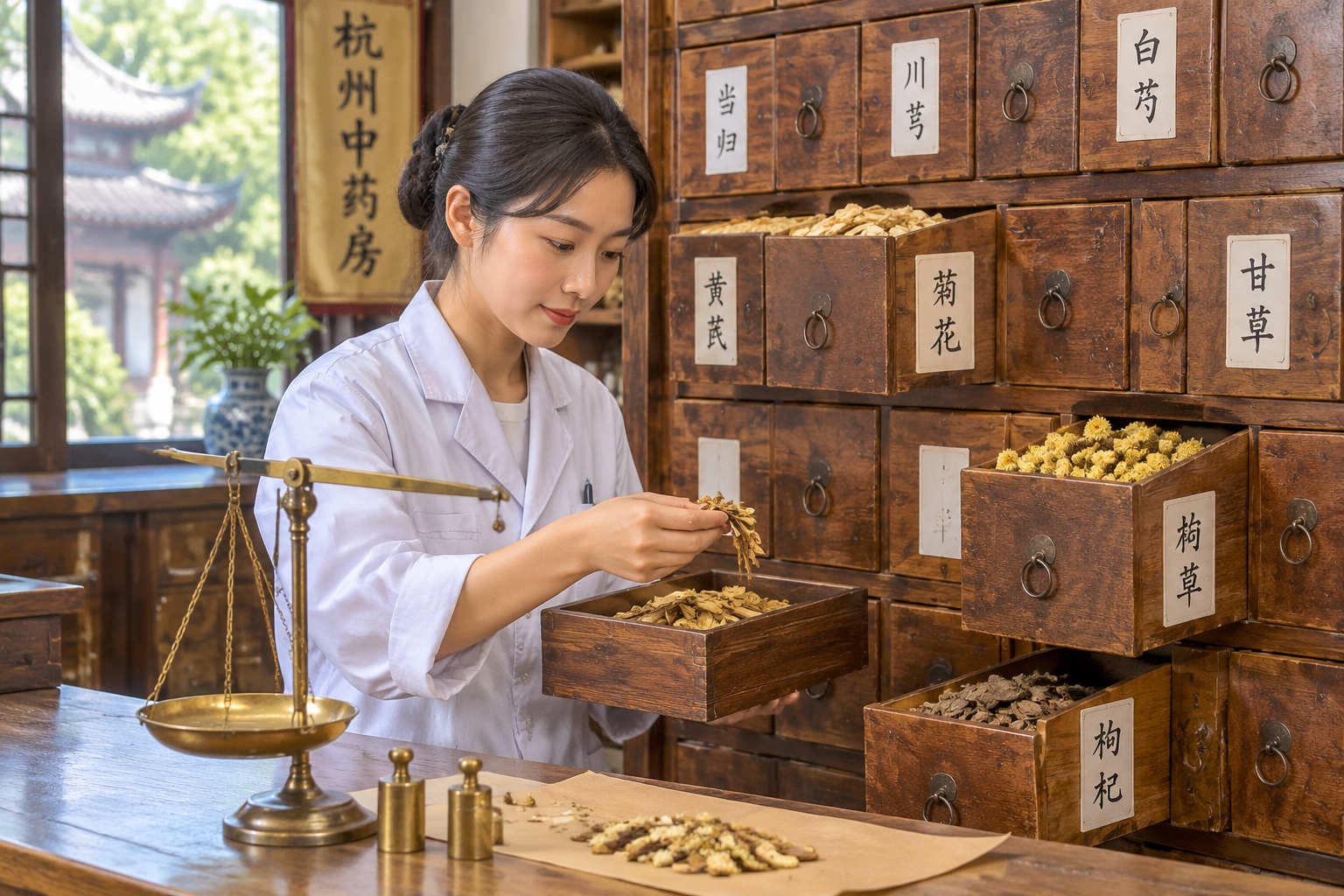

At a neighborhood pharmacy in Hangzhou, a woman in her early thirties pushes a paper slip across the counter. Her cough has lasted nine days. The pharmacist, a man in his fifties in a white coat, does not reach for the cough syrup.
He asks two questions. Is the cough dry, or is there phlegm? Do you feel cold, or hot and thirsty?
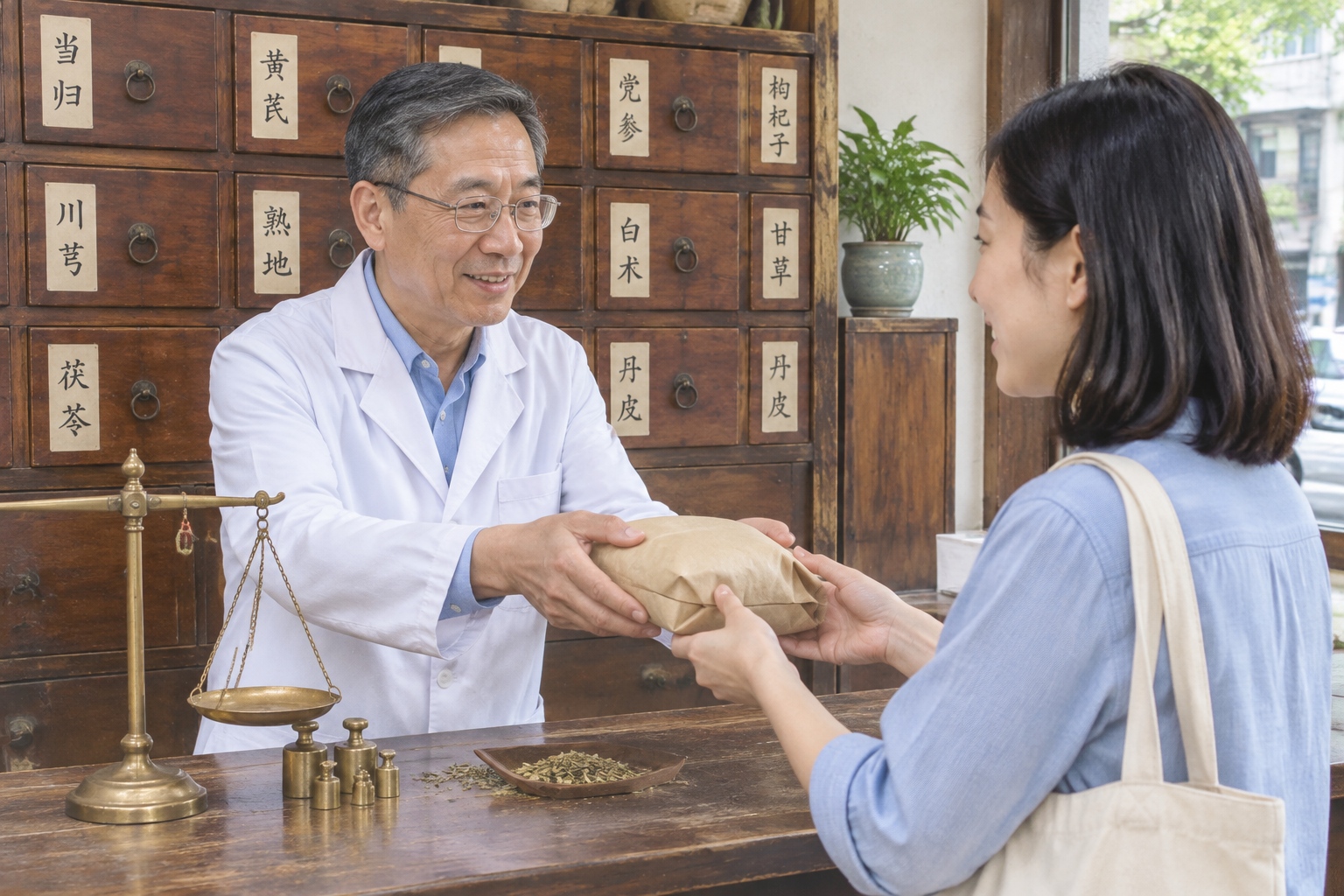
Dry, she says, and thirsty. He turns to a wall of small wooden drawers, pulls four open, and starts weighing dried leaves and flowers on a brass scale. Twenty minutes later she leaves with a brown paper packet, a printed slip of boiling instructions, and no brand name anywhere.
To her, this is an ordinary errand. To a visitor, the scene raises a fair question: what is actually in the packet, and why didn’t he just hand over a box labelled “cough”?
“Natural” describes where something came from, not what it is
In English, “herbal medicine” and the Chinese word 中药 (zhōngyào) are often treated as the same thing. They overlap, but they are not synonyms.
中药 is a defined catalogue. The Pharmacopoeia of the People’s Republic of China sets specifications, doses and processing methods for each entry, and the standard teaching list runs into the hundreds of items. Most of them are plants. Plenty are not.
Gypsum (石膏) is a mineral, used in formulas for high fever. Oyster shell (牡蛎) is exactly what it sounds like. Cicada moult (蝉蜕) is the shell an insect leaves on a tree. Donkey-hide gelatin (阿胶) is made from animal skin. So “plant” cannot be the definition.
Meanwhile, a great many plants sit on supermarket shelves with no medical label at all. The line is drawn by the catalogue, not by biology.
None of this is uniquely Chinese. European medicine used hot, cold, dry and moist to describe drugs for roughly two thousand years, from Hippocrates through Galen until the eighteenth century. What looks exotic from outside is often a familiar idea that stopped being revised in one place and kept being revised in another.
Four natures: is this herb cooling or warming?
Every entry in the catalogue carries a nature: 寒 cold, 凉 cool, 温 warm, 热 hot, or 平 neutral. It has nothing to do with the temperature of the tea.
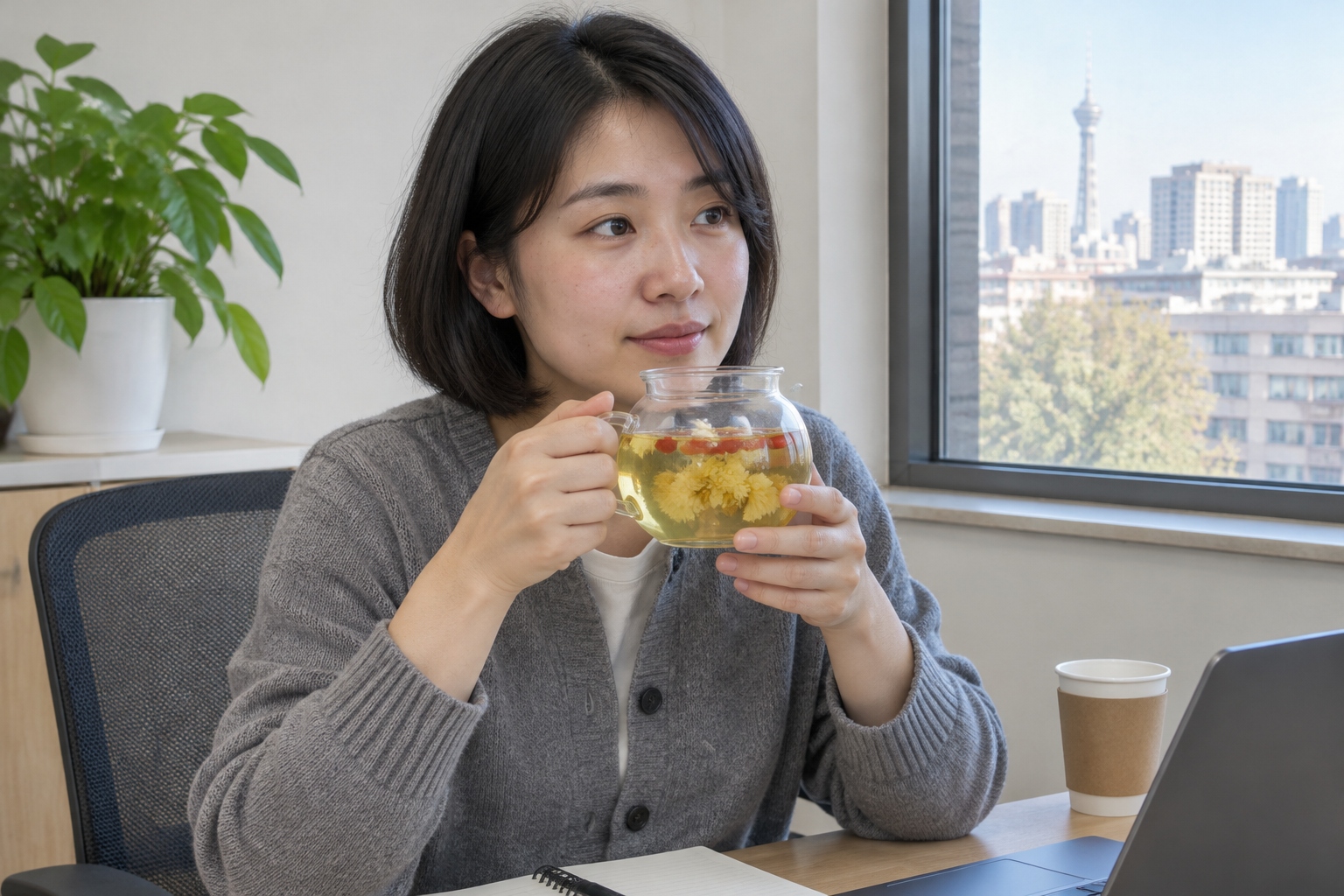
Honeysuckle (金银花) and chrysanthemum (菊花) are cold or cool. They turn up in sore-throat formulas, and people drink chrysanthemum tea in summer the way people elsewhere reach for iced drinks. Fresh ginger (生姜) and cinnamon bark (肉桂) are warm to hot. Ginger-and-brown-sugar water is what a Chinese family makes when someone comes in from the rain and can’t stop shivering.
| Nature | Common examples | What people use it for |
|---|---|---|
| Cold / cool (寒凉) | 金银花 honeysuckle, 菊花 chrysanthemum, 黄连 coptis | Sore throat, red eyes, the cluster of symptoms people call 上火 |
| Warm / hot (温热) | 生姜 fresh ginger, 干姜 dried ginger, 肉桂 cinnamon bark | Chills, cold hands, the first day of a cold caught in the rain |
| Neutral (平) | 甘草 liquorice root, 山药 Chinese yam | Gentle support; appears across a very wide range of formulas |
Anyone who has heard a Chinese friend say 上火 — roughly, “I’m on fire” — has met this vocabulary in daily use. It isn’t a lab result. It’s a shared shorthand for a cluster of symptoms: sore throat, mouth ulcers, dry eyes, constipation.
Five flavors: a rough label for what a herb does
酸 sour, 苦 bitter, 甘 sweet, 辛 pungent, 咸 salty, with 淡 bland and 涩 astringent as close neighbours. Again, this is not a tasting note.
Bitter herbs such as 黄连 are described as draining heat and drying dampness; they are the ones people grimace at. Sour ones like 乌梅 and 山楂 are astringent — they hold things in, which is why they appear in formulas for a cough that won’t stop or diarrhoea that won’t settle. Sweet ones like 甘草 and 大枣 tonify and harmonise, which is a polite way of saying they smooth the edges off everything else in the pot. Pungent ones like 薄荷 and 生姜 push outward and make you sweat slightly. Salty ones like 牡蛎 are said to soften hardness.
The mapping isn’t literal. 石膏 is classified as pungent and sweet, and tastes like chalk. Flavour here is a functional tag, used the way a mechanic uses a parts number.
Meridians and direction: which address, and which way
归经 — “entering the meridians” — is the address. 大黄 is assigned to the stomach and large intestine, and it purges downward. 麻黄 is assigned to the lung and bladder and opens the surface to stop wheezing. Two herbs can both be classed as cold and still be sent to completely different parts of the body.
升降浮沉 is the direction of travel. 麻黄 rises and floats: it makes you sweat, clears the nose. 大黄 sinks and descends. 桔梗 is described in the old texts as a boat, carrying other medicines upward to the throat and chest — which is why it appears in so many cough formulas.
If you are used to thinking in molecules and receptors, this is the strangest part of the system. Think of it as a delivery service that specifies both the address and the direction of travel, and you’re most of the way there.
Why a formula is not a pile of herbs
麻黄汤 is four items: 麻黄, 桂枝, 杏仁, 甘草. Each has a job. One opens the surface and calms wheezing; one helps warm and release; one directs the action downward toward the cough; one holds the group together.
Take out the 桂枝 and you no longer have 麻黄汤. You have something else, with a different name and a different use. This is the part that surprises people who assume a formula simply means “more herbs, stronger effect.” In practice, adding one herb can reduce a side effect, redirect another herb’s action, or cancel it outright.
The classical vocabulary is 君臣佐使 — sovereign, minister, assistant, courier. The sovereign does the main work. The minister supports it or handles a secondary symptom. The assistant moderates toxicity or contradiction. The courier guides the whole thing to a location. 六味地黄丸, one of the most common boxes on any Chinese pharmacy shelf, is built exactly this way: three herbs that tonify, three that drain, and the draining herbs exist partly to stop the tonifying ones from sitting too heavily.
There are also explicit incompatibility lists — 十八反 and 十九畏 — pairs that tradition says must not be combined. Some of these rules have since turned out to have a chemical basis. Others are inherited and not well explained. A careful practitioner treats the list as a warning, not as a law of physics.
Processing is where safety actually lives
炮制 — processing — is the step foreign readers almost never hear about, and it is often the difference between a medicine and a poison.
Raw 半夏 irritates the mouth and throat and is toxic. What a pharmacy sells is usually 制半夏, soaked and steamed with ginger and alum until it isn’t. 附子, from the aconite plant, contains aconitine, which can stop the heart. It must be processed, then boiled for a long time before use — which is exactly why the instruction slip says 先煎, “decoct first, before adding the rest.” The heat breaks the toxin down.
Processing also changes direction. Raw 麻黄 is a strong decongestant and sweat-inducer; honey-fried 麻黄 is gentler and aimed at cough. Raw and prepared 何首乌 are used for different things, and it is the prepared form that later ran into safety trouble — a reminder that “processed means safe” needs checking too.
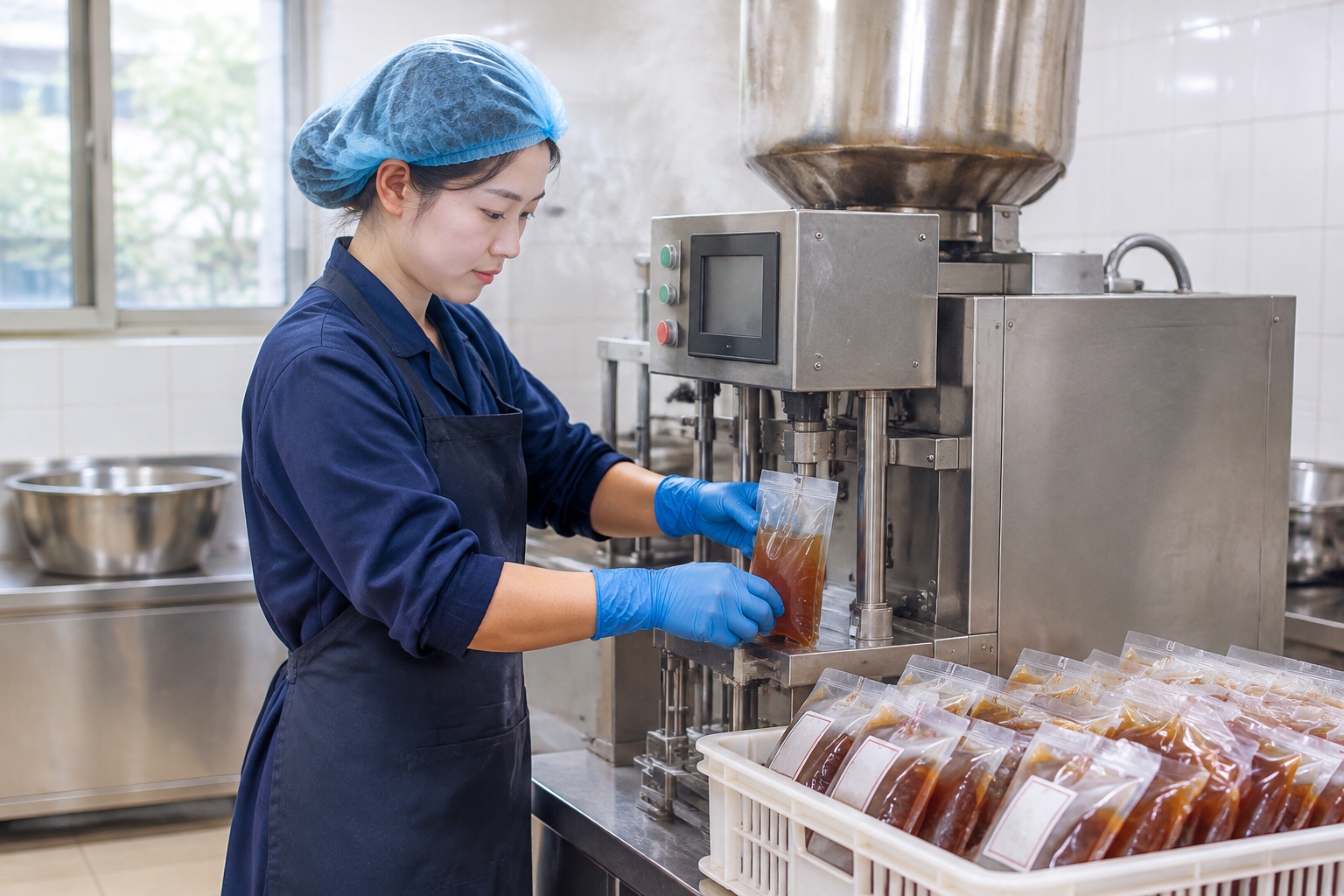
When you buy 中药 at a pharmacy in China, you are not buying dried plants. You are buying material with a specification: origin, processing method, dose, all written down in a pharmacopoeia. That distinction is the whole game.
“Natural” is not a safety claim
This is where the popular framing does real harm. 关木通, a vine containing aristolochic acid, was an ingredient in 龙胆泻肝丸, a very widely used over-the-counter pill. Long-term use was linked to kidney failure and, later, to upper urinary tract cancer. China banned 关木通 in 2003 and required the formula to be made with a different species. Regulators in the United States and Europe had already moved against aristolochic acid products around 2000–2001.
In 2014, Chinese regulators added liver-injury warnings to oral 何首乌 products after a cluster of reported cases. In 2006, several 鱼腥草 injections were suspended after severe reactions. None of this is an argument against Chinese medicine as a whole. All of it is an argument against the sentence “it’s natural, so it can’t hurt you.”
Interactions matter too. 丹参, 当归 and 银杏 all increase bleeding risk, which is a problem if you take warfarin. The Western mirror is St John’s wort, which speeds up the metabolism of oral contraceptives and some antidepressants. The mechanism is the same. Only the reputation differs.
Dose and constitution matter as well. 甘草 appears in hundreds of formulas and is generally benign, but long-term high doses of glycyrrhizin cause potassium loss and raised blood pressure — a well-documented effect. And a cold herb given for weeks to someone whose body runs cold tends to produce diarrhoea: predictable inside the system, unexplained outside it.
What to actually look at on the box
If you walk into a Chinese pharmacy, a few things on the packaging are worth your attention.
功能主治 — the indications. They are written in the system’s own language: 清热解毒, “clear heat and resolve toxin.” Increasingly the label also carries a plain-language condition alongside it.
批准文号 — the approval number. 国药准字Z… marks a registered Chinese medicine; the Z is the giveaway.
不良反应 and 禁忌 — side effects and contraindications. On older boxes these often read 尚不明确, “not yet clarified.” That does not mean “none.” It means the data was not there. Since 2017 the regulator has been pressing manufacturers to replace that phrase with real information, and many labels have changed.
The decoction slip. 先煎 (boil first — 附子, 牡蛎), 后下 (add in the last five minutes — 薄荷), 包煎 (wrap in cloth — 车前子, which otherwise turns the pot into sludge), 烊化 (melt separately — 阿胶). Follow it. It isn’t decoration.
And tell your doctor everything you are taking, especially if you are on blood thinners, immunosuppressants, or drugs with a narrow therapeutic window.
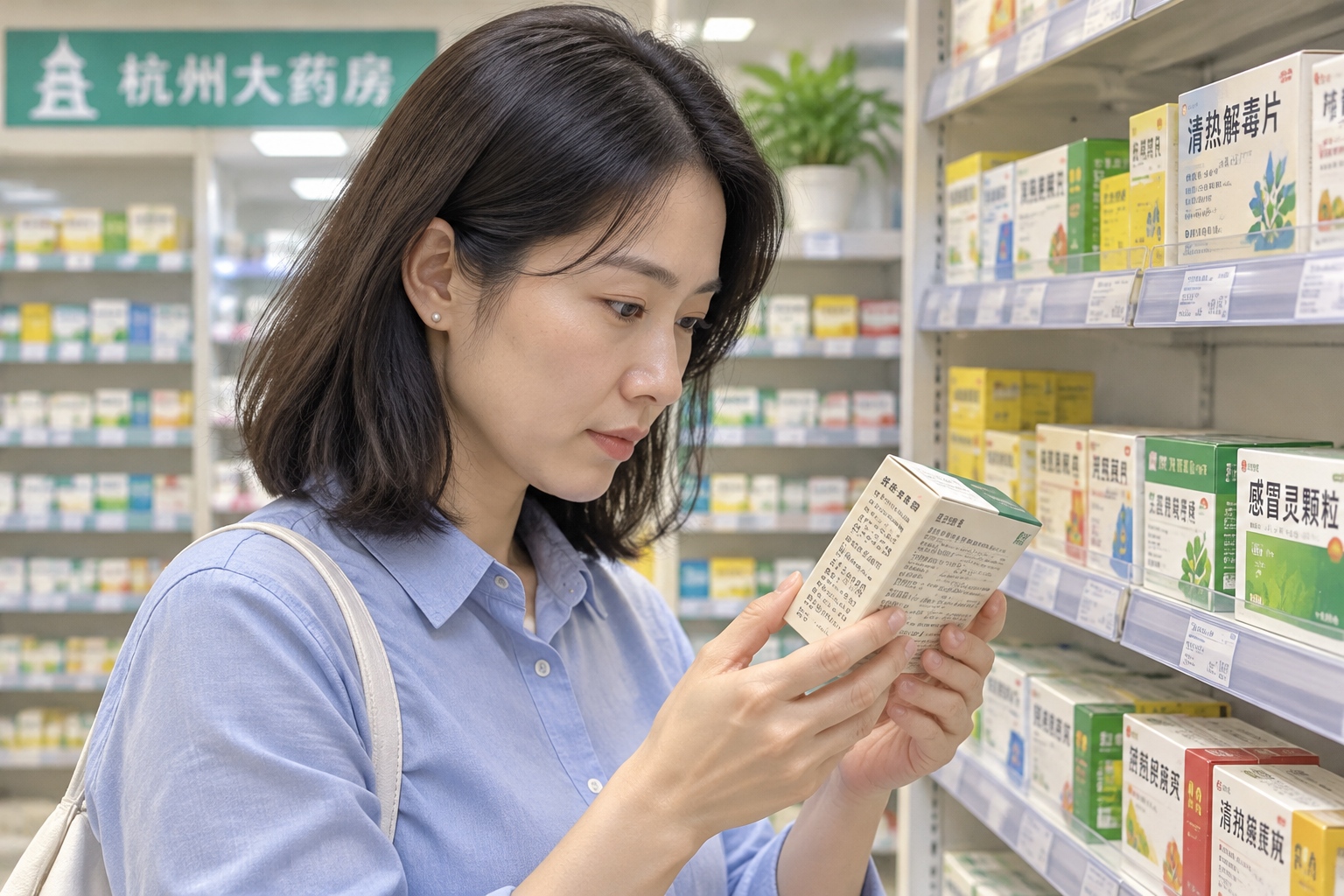
The packet on the counter
Back in Hangzhou, the pharmacist staples a slip to the paper packet: three items to boil first, one to add at the end, twice a day, warm, after food. The woman takes it and asks whether she can still have her morning coffee. He says yes — but not with the medicine.
That is a more useful answer than “it’s natural.” The framework behind those wooden drawers — four natures, five flavors, meridians, directions, formulas, processing — is a way of describing what a substance does to a body, built long before anyone could look at a molecule. It is more specific than the word “herb,” and in places more fragile. Both things are true, and neither one fits inside the phrase “natural remedy.”