
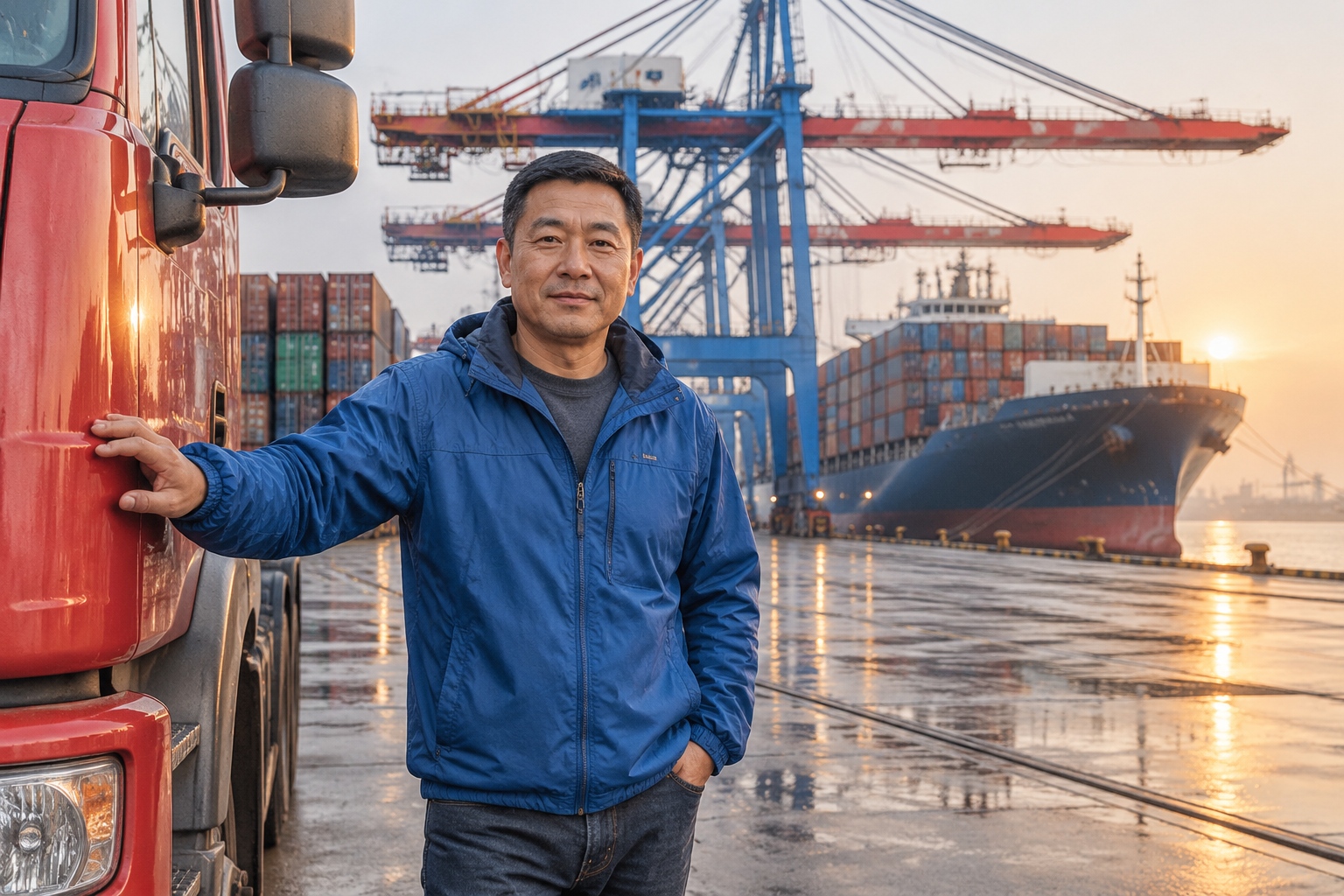

6:10 a.m. at the Yantian Container Terminal
The port arrives as sound before it becomes a picture. A low diesel hum from the yard, the beep of a reversing truck, and somewhere out in the dark the three-note horn of a ship easing into its berth. Then the light lifts off the water and the cranes appear — a row of them, each tall enough to pick up a house, leaning over a vessel that looks like a floating car park.
This is Yantian, on Shenzhen’s eastern coast, about an hour by road from the glass towers of Futian. By six the yard is already running. A driver in a blue windbreaker sits in his cab with the engine idling while a straddle carrier lowers a forty-foot box onto his trailer. A worker in an orange vest walks the quay with a clipboard, checking twist locks. Nobody hurries. Everything is on a clock measured in minutes.

What 16 Million Containers a Year Actually Means
Shenzhen is the world’s fourth-busiest container port, and the deep-water terminals at Yantian alone move roughly 16 million TEU a year. TEU is port shorthand for a twenty-foot equivalent unit — one standard steel box. If you have never stood next to one: a twenty-foot container is 6.06 metres long, 2.44 metres wide, and heavy enough that a loaded one visibly flattens the road under a truck.
Sixteen million of them, lined up nose to tail, would run about 97,000 kilometres — two and a half times around the equator. Another way to feel the number: on an average day, around thirty containers cross this quay every minute. One every two seconds, through the night, through Chinese New Year, through typhoon warnings.
The port runs more than 270 international shipping routes. Ask the people who work here what is inside the boxes and you get a shrug and a list: air conditioners, solar panels, e-bikes, circuit boards, patio furniture, and artificial Christmas trees that leave in September because they have to reach a shelf in Ohio by November.
For a city that markets itself as a software and hardware capital, this is the older business, and it is still enormous. Yantian is the physical point where a factory in Dongguan meets a warehouse in Rotterdam. Stand at the fence long enough and global supply chain stops being an abstraction. It becomes a man in a windbreaker, waiting for a box to lock into place.
A Border You Can Cross Under Sail
Forty minutes west along the same coast, the water is doing something else entirely.
Behind a gate in Nanshan, Shenzhen Bay Yacht Club holds a few hundred berths. On a Saturday morning the pontoons are busy: a man hosing down a white hull, a family loading a cooler, a woman in a sailing school bib tightening someone’s life jacket. Beyond the breakwater, the low green hills of Hong Kong’s New Territories sit close enough to look like scenery somebody forgot to move.
Under a pilot scheme called Guangdong–Hong Kong–Macao yacht free travel, yachts registered in Hong Kong or Macau can sail into designated Guangdong marinas and clear customs, border inspection and quarantine at the dock instead of at a commercial cargo port. Shenzhen Bay Yacht Club has handled 243 such vessel movements — not a flood, but enough that the procedure has become routine rather than exotic.
The mechanics matter more than the slogan. The captain or a local agent files the vessel’s registration, insurance and crew and passenger lists a few days ahead. On arrival, officers come to the berth. If the paperwork is in order, clearance usually takes somewhere between under an hour and half a day, depending on the marina and the day. The yacht can then stay for a set period before it has to leave or re-apply.
This is still a pilot, and it has edges. Only certain marinas are approved. Nobody on board gets an automatic visa — passengers still need to be eligible to enter the mainland, and the rules differ by nationality. Berthing fees and club requirements vary. But the practical effect is easy to picture: an owner in Sai Kung can leave Hong Kong on Saturday morning, cross Shenzhen Bay in about an hour, eat lunch in Shekou and be home for dinner. Twenty years ago that trip was a paperwork problem. Now it is a weekend.
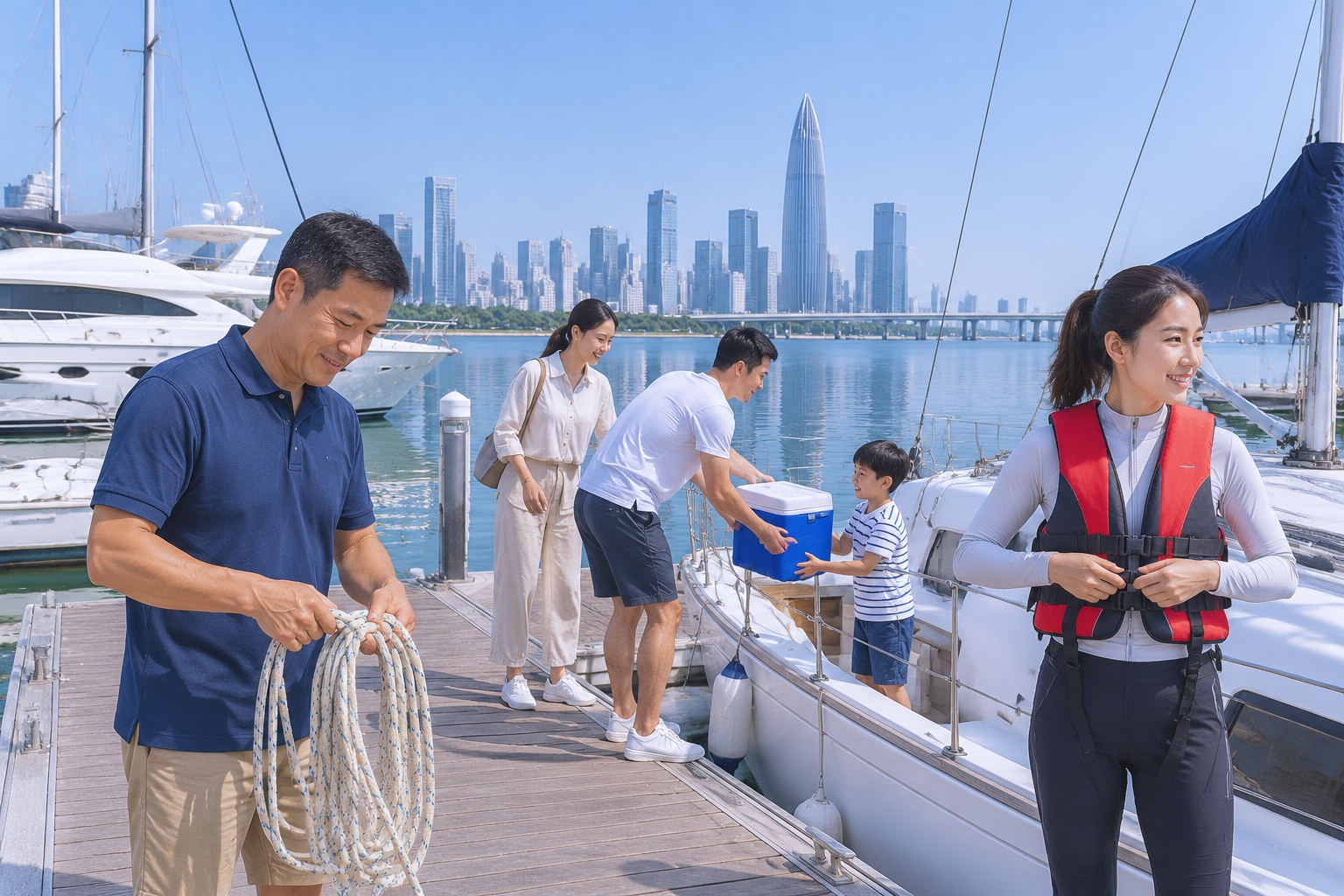
Sailing is not only a rich man’s game here. Several clubs and operators along the coast run half-day and full-day trips for people with no experience at all. You turn up in soft-soled shoes, someone hands you a life jacket, and you spend four hours learning that wind is not a metaphor. Expect to pay somewhere between 400 and 800 yuan a person.
How Ordinary People Get to the Water
Most people in Shenzhen do not own a boat. They still use the coast, and the ways to do it have multiplied in the past decade.
Shenzhen Bay Park
A 15-kilometre promenade along the western shore: free, open at all hours, reachable on Metro Line 9. On one side are mangroves and egrets; on the other, Hong Kong’s hills across a stretch of grey water. Sunset is the busy hour — runners, delivery e-bikes, kite flyers, and dozens of people sitting on the sea wall with milk tea, watching ships.
The Yantian coastal boardwalk
About 19.5 kilometres of walkway hugging the eastern shore, from the old border at Shatoujiao to the rocks below Xiaomeisha. Long stretches are timber deck built out over the water, with the working port still visible from the path. Walking it end to end takes a full day; most people do a section and take a bus back to the metro.
Dameisha and Xiaomeisha
Two public beaches on the eastern coast, both free, both with showers and lockers, both extremely crowded on summer weekends. Since Metro Line 8 was extended to Xiaomeisha at the end of 2023, you can step off a train and be on sand in ten minutes. In peak season you need to reserve a free slot online through a WeChat mini-program before you go — that booking is the only thing standing between you and a very full beach.
Dapeng Peninsula
Another hour east and the city falls away. Dapeng is where Shenzhen keeps its old fishing villages, a 600-year-old fortress, and its clearest water. Xichong and Dongchong are the beaches people photograph; Jiaochangwei is the guesthouse strip with surfboards leaning outside. Kayaks and paddleboards rent by the hour, and small ferries leave from Nan’ao for a handful of islands offshore.
Boats that need no licence
The Shekou–Zhuhai ferry takes about an hour and costs around 140 yuan — a cheap way to be on open water with spray on the windows. There is also a fast ferry from Shekou to Hong Kong International Airport, and short sightseeing boats along the bay. None of it requires experience or equipment, which is precisely the point.
Why the Tech Story Buried the Sea
Shenzhen’s international reputation is built almost entirely on screens: Huawei, Tencent, DJI, BYD, the electronics markets of Huaqiangbei, the sheer speed of the place. That story is true. It is also only half the map.
The city’s own name points the other way. Shenzhen refers to a drainage ditch — a zhen — that once ran through the fields here. Yantian, the district where those cranes stand, literally means salt fields. On the western shore, the town of Shajing has been known for its oysters for centuries and still is. When the reform era began in 1980, one of the first things built was a port at Shekou, because the whole project depended on ships. The electronics came later, and they were paid for, in part, by containers.
Geography hid the rest. For decades most of the waterfront was working land — oil terminals, shipyards, container yards, aquaculture ponds — so an ordinary resident had little reason to go there. The promenade, the boardwalk, the swimmable beaches and the marina are largely a recent conversion, and parts of the coast are still being converted.
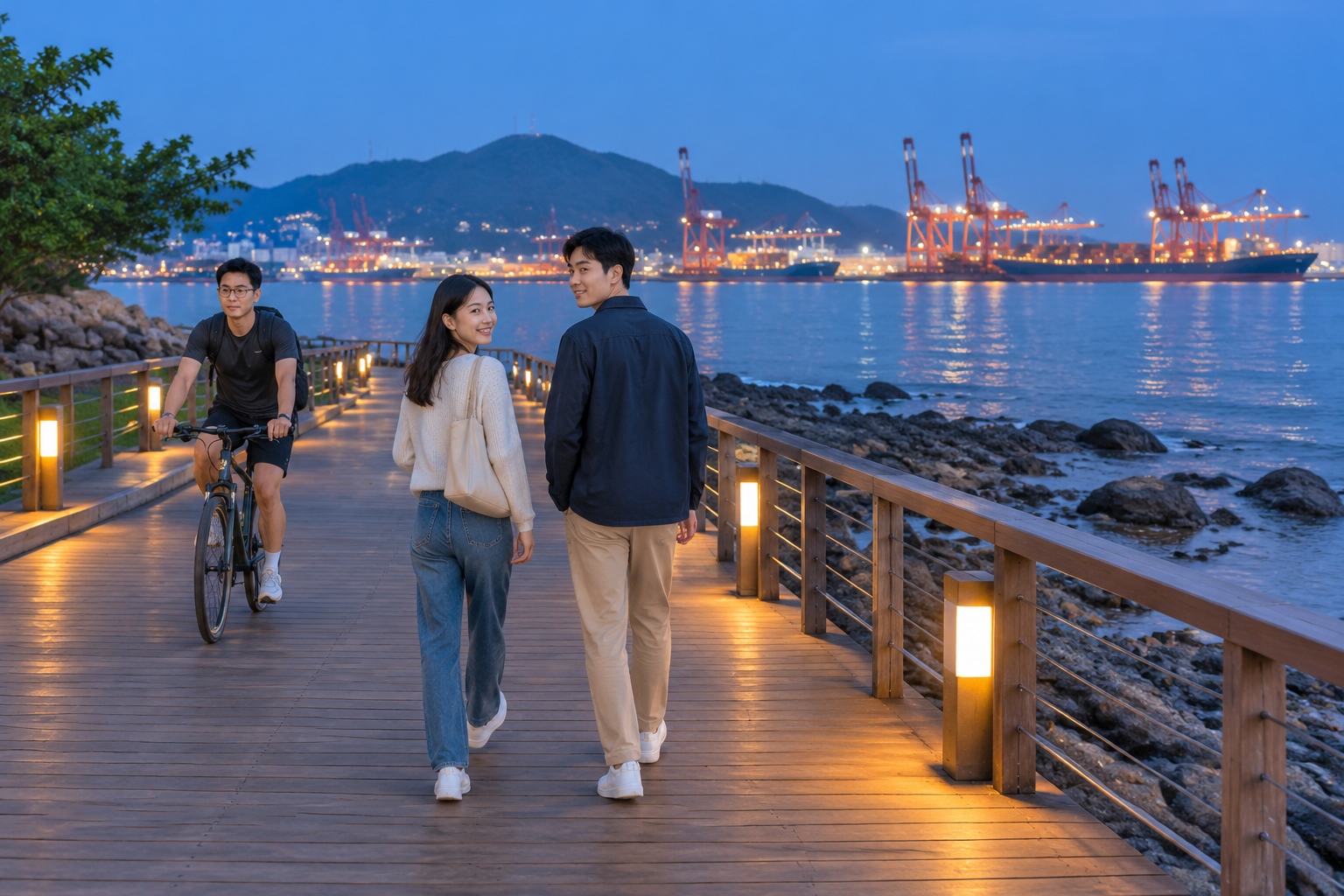
The Same Water
On a weekday evening in Shenzhen Bay Park you can watch both versions of the city at once. Behind you, the towers light up in sequence. In front of you, a container ship slides past the mouth of the bay, its deck stacked six high, heading out into open water. A small white sail leans somewhere off to the right. A man on the sea wall is fishing with a rod he made himself.
That is the Shenzhen that rarely makes the brochure: an Asia-Pacific logistics hub that is also a place where you can take your shoes off and walk into the sea. Both are true, on the same coast, at the same time, and neither one cancels out the other.
If You Go
Getting there. Shenzhen Bay Park is on Metro Line 9 (Shenzhen Bay Park station). For the Yantian boardwalk and the eastern beaches, take Metro Line 8 to Yantian Road, Dameisha or Xiaomeisha and continue by bus or taxi. Dapeng is easiest by car or a long taxi ride; allow an hour from the city centre.
When. October to April is the comfortable window — dry, 20–26°C, clear skies. July to September is hot, humid and occasionally interrupted by typhoons, and the beaches are at their most crowded.
Costs. Public beaches and Shenzhen Bay Park are free. A half-day sailing trip runs 400–800 yuan per person. The Shekou–Zhuhai ferry is about 140 yuan.
Book ahead. Dameisha, Xiaomeisha and Xichong require a free online reservation in peak season. Marina visits and yacht clearance need to be arranged through a club or agent several days in advance.
One honest note. Not every stretch of this coast is swimmable — some is still industrial, and shipping lanes are shipping lanes. Check locally before you get in the water.