
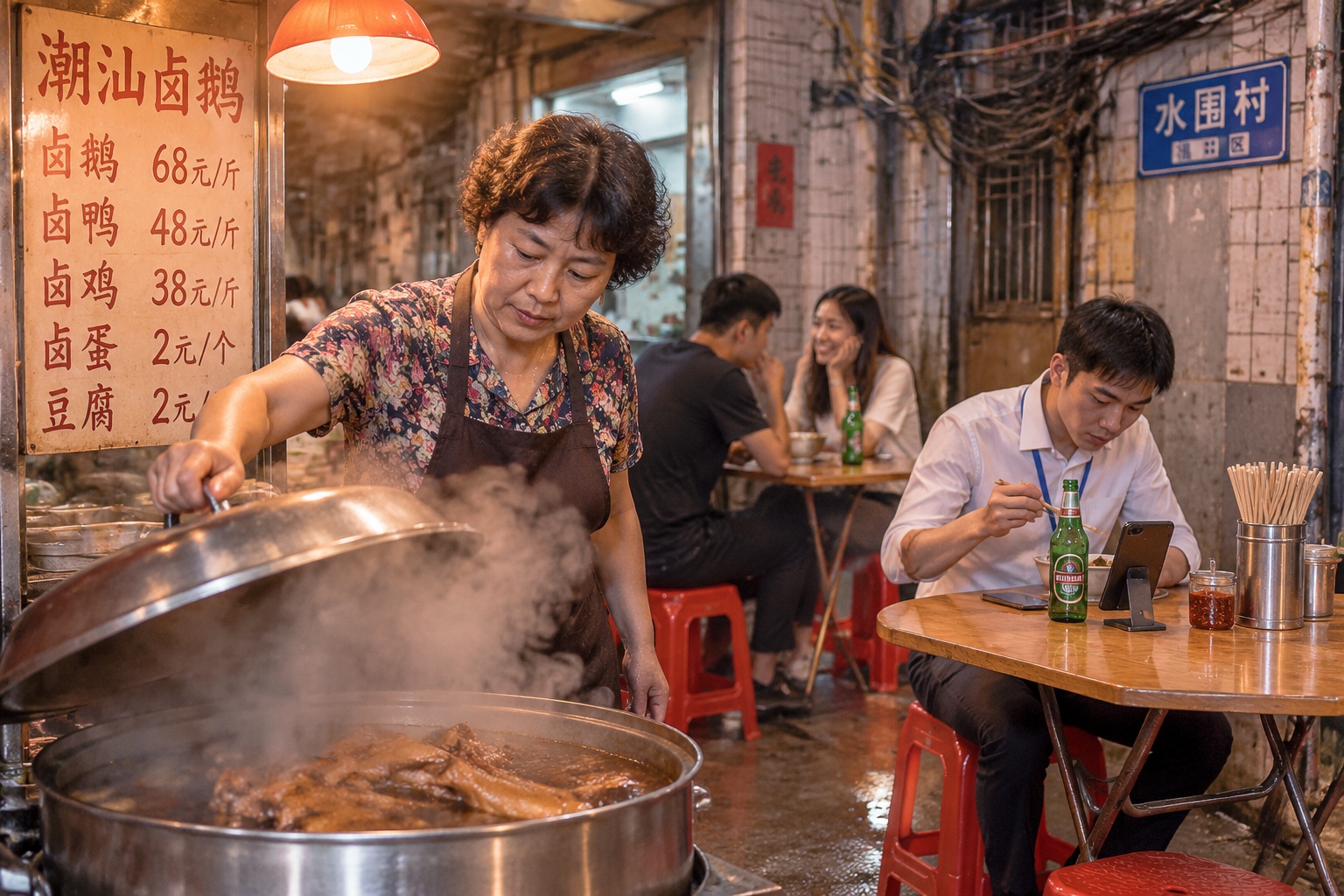

Nine-forty on a Tuesday in Shuiwei
The lid comes off the pot and the temperature of the whole corner changes. Braised goose — soy, star anise, rock sugar, a slick of fat floating on top. The woman running the stall is in her fifties; she came south from Chaozhou in the 1990s, which in Shenzhen terms makes her an old-timer.
The tables are plastic. So are the stools. A man in a company lanyard is eating alone, phone propped against a beer bottle. Two seats away, a couple is having a low, serious argument about whether to add the cold crab. Dinner for two, with beer, will come to under 100 yuan.
This is Shuiwei, a dense knot of alleys in Futian, ten minutes’ walk from some of the most expensive office space in China. It is what people here call a chengzhongcun — an “urban village,” farmland that the city swallowed as it grew and never demolished. Rent is cheap, the ground floors are all restaurants, and the food comes from everywhere.
Nothing about the scene announces a Michelin city. And yet.
What the guide actually measured
For readers who don’t track these things: Michelin’s stars are a three-tier system. One star means worth a stop, two means worth a detour, three means a restaurant worth building a trip around. There is also the Bib Gourmand, for good food at moderate prices, and a longer list of merely “selected” places that get a sticker in the window and no star at all.
When the guide published its first Shenzhen edition in 2026, the city came away with seven stars, spread across a handful of restaurants. Not one of them three-star.
Read that again, because the interesting thing isn’t the number. It’s the shape. In most cities, three stars cluster around one kind of restaurant: old, formal, expensive, usually French, usually backed by generations of wealth and a dining public that has been rehearsing for decades. Shenzhen is 45 years old.
A city that has no grandmothers
Before 1980, Shenzhen was Bao’an county: farmland, a rail line, a few fishing harbours, a border crossing into Hong Kong. Then it was designated a Special Economic Zone, and across four decades it absorbed roughly 17.8 million people, the overwhelming majority born somewhere else. Hunan, Sichuan, Guangxi, Hubei, the Northeast — and a very large number from Chaozhou and Shantou, up the coast to the northeast.
The city’s average age is around 32.5. Only a minority of residents hold a Shenzhen hukou, the household registration that grants full local rights. Which means most people here grew up eating their mother’s food in another province, then moved to a place where nobody’s mother lives.
That single fact explains more about Shenzhen restaurants than any economic statistic. There is no hereditary dining class. No century-old family kitchen. No local bourgeoisie with a grandmother’s recipe for soup. Guangzhou, an hour away by train, has teahouses that have been pouring the same tea since the Qing dynasty. Hong Kong has its own lineage. Shanghai has the 1920s. Shenzhen has a market of young salaried people who eat out four or five times a week, complain about it, and come back the next night.
Why the starred list doesn’t look Cantonese
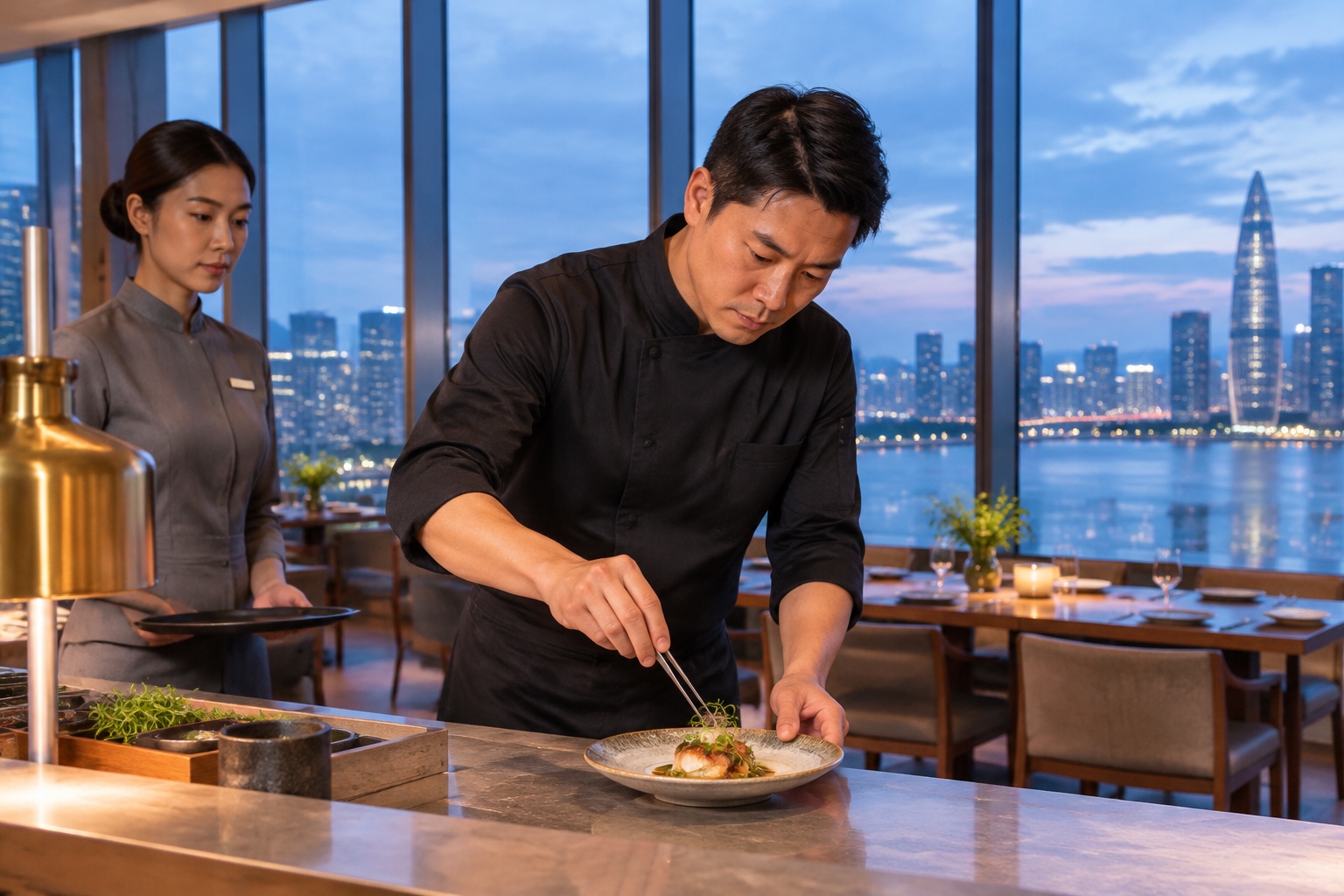
Overseas readers tend to file southern Chinese food under a single label. It doesn’t work that way. Cantonese — dim sum, roast meats, steamed fish — is the tradition of Guangzhou and the Pearl River Delta. Chaozhou and Shantou, further east along the coast, have a separate and in some ways more austere cuisine: meats braised in a master stock (lu), cold crab, fish rice, fermented radish, and an obsession with the freshness of beef that borders on theology.
Shenzhen’s population is heavily Chaoshan in origin, and the restaurants show it. When the stars came out, Chaoshan cooking was on the list. So was modern French technique built on Chinese ingredients. So were regional kitchens from inland provinces, and Japanese counters. Cantonese restaurants were there too — they just weren’t running the show.
That is what a migrant city looks like on paper. The food map isn’t a hierarchy handed down from the past. It’s a census.
Three tables, three different cities
Ensue: forty floors up, in Nanshan
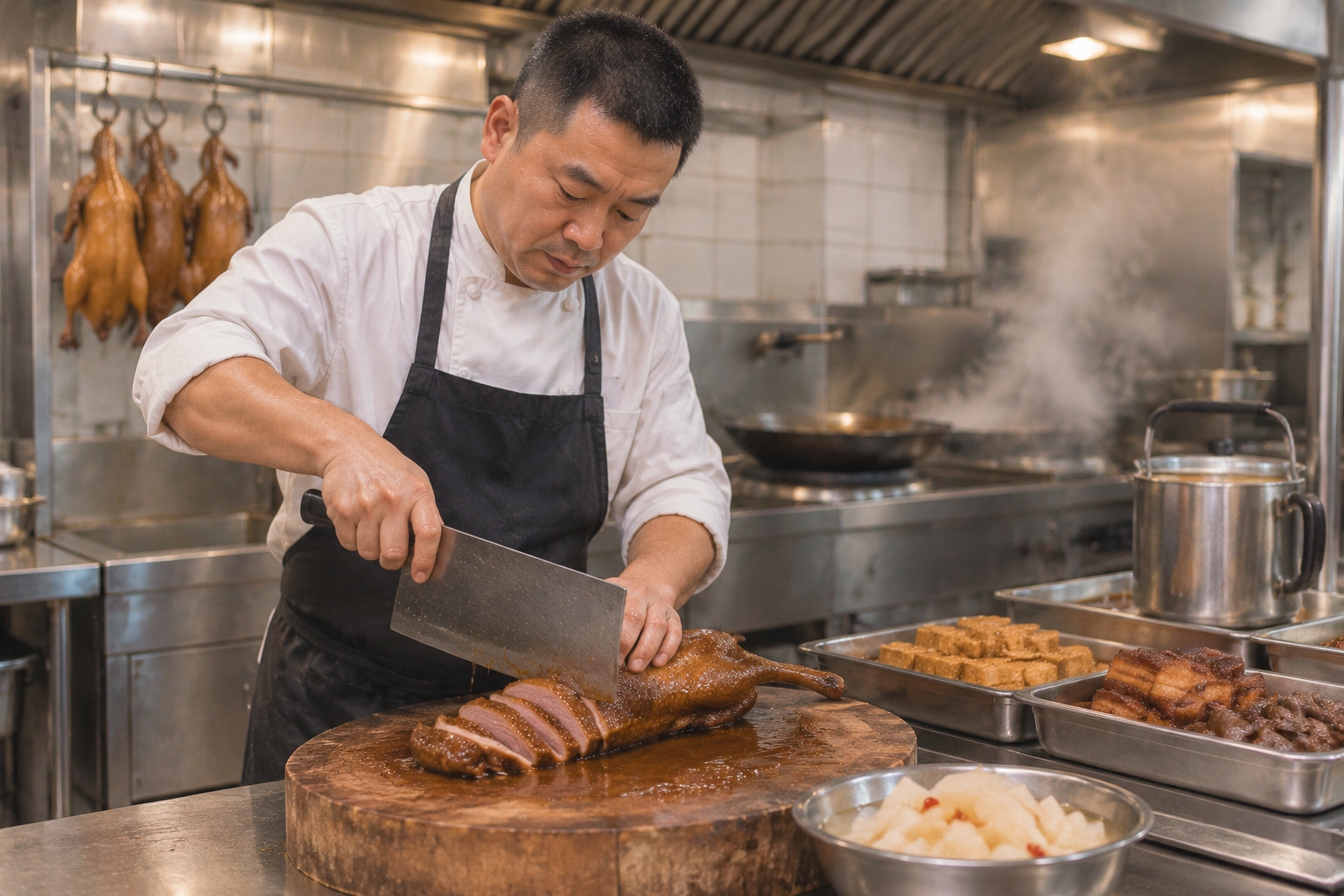
Ensue sits on the 40th floor of the Shenzhen Bay No. 1 tower, looking across the water toward Hong Kong. It opened in 2018 as a collaboration with the Napa chef Christopher Kostow, and it became the room where Shenzhen’s fine-dining ambitions started being taken seriously. Tasting menu, Chinese produce, Western technique, a lot of restraint on the plate and none at all in the view.
Restaurants with a skyline face an obvious temptation: let the window do the work. Ensue’s kitchen mostly refuses. What you notice, several courses in, is how little it leans on luxury ingredients and how much on a single perfect mushroom, or a sauce reduced from duck bones for two days. Dinner runs roughly 1,500–2,000 yuan a person before wine — normal in Shanghai or Tokyo, startling in a city that a lot of foreigners still picture as a factory floor.
Zhen Ting: Chaoshan cooking with the volume turned up
A very different statement, in Futian. Zhen Ting takes the street-corner Chaoshan repertoire and treats it as fine dining. The master stock gets its own service ritual. Cold crab arrives with almost nothing done to it, because the point is the crab. There is a tea station and a person whose job is to keep your cup at the right strength from the first course to the last.
What makes it interesting isn’t luxury. It’s the argument: that the food of a regional migrant population — the food that fed construction crews in the 1990s — deserves the same ceremony Europe reserves for its own old cuisines. In Shenzhen that argument lands differently than it would elsewhere, because the people eating there are very often the children of the people who cooked it at home.
Baheli Haiji: the beef hotpot everyone names first
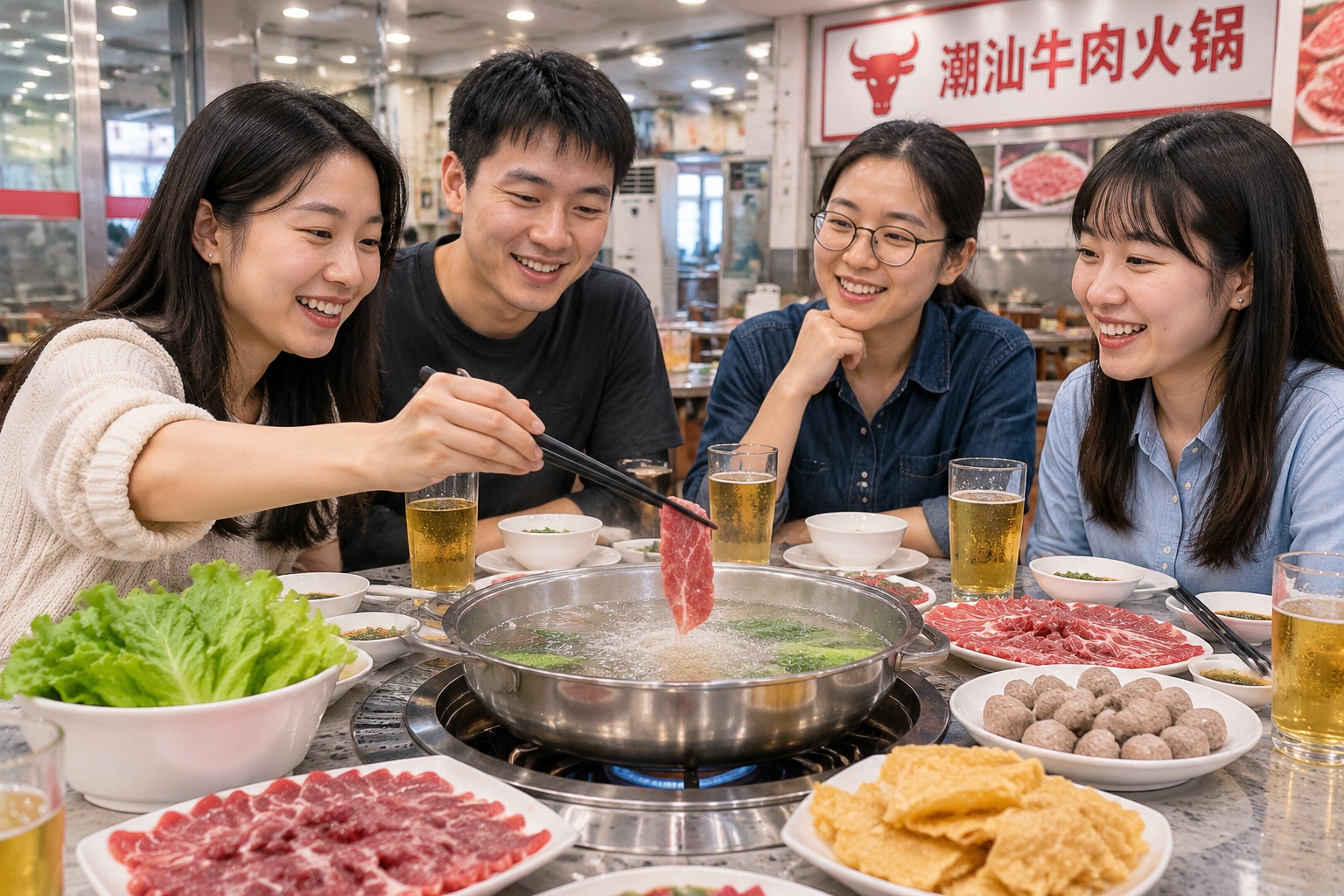
Ask any Shenzhener under 40 where to eat beef hotpot and you get the same answer. The chain is loud, bright, always full, and runs on one claim: the beef reaches the table within hours of the animal being killed, which is why the cuts are named for body parts and dunked for eight to twelve seconds rather than cooked.
You order diaolong, chibing, wuhuazhi — sirloin, shoulder, shank — plus beef balls, fried tofu skin, and a pot of clear broth with nothing in it but water, ginger and a few pieces of corn. Around 100–150 yuan a head, sometimes less. There’s usually a queue. There’s always noise. It’s the closest thing this city has to a communal dining room.
The visitor’s short list
If you’re arriving from abroad and want one evening that explains the city, here’s the practical version.
Booking. Most mid-range and up restaurants take reservations through Dianping or Meituan, or through the restaurant’s WeChat mini-program. Fine-dining rooms release tables about a week ahead at a set hour and sell out in minutes, so set an alarm. Hotpot and street food don’t take bookings: you take a number and wait 20 to 60 minutes at peak.
Paying. WeChat Pay and Alipay are near-universal. Foreign Visa and Mastercard can now be linked to both, which is the single biggest quality-of-life upgrade for visitors in recent years. Cash works in theory and is mildly inconvenient in practice.
Tipping. Don’t. A few upscale places add a 10% service charge; that’s the ceiling.
Price bands, per person. Urban-village stall: 30–60 yuan. Beef hotpot: 100–150. A serious bistro or regional restaurant: 200–400. Tasting menu: 800–2,000.
Timing. Lunch 11:30–14:00, dinner from 17:30. The Chaoshan dalan stalls in Shuiwei and the villages around it run past midnight, and past three on weekends.
Language. Photo menus and QR-code ordering cover most of it. Staff at starred restaurants speak English; staff at hotpot places will point, gesture, and occasionally just bring you what they think you should have, which is usually right.
What the seven stars are actually saying
Michelin guides are imperfect instruments. They over-reward formality and under-reward the 40-yuan bowl of pork trotter rice that plenty of people in this city would call the best thing they ate all week. Shenzhen’s starred list is not a ranking of Shenzhen food. It’s a photograph of one moment in the city’s self-invention.
But the photograph is worth looking at. A city with no inherited dining culture, populated almost entirely by people whose families came from somewhere else, produced a first-edition list as mixed as its population: Chaoshan, Cantonese, French technique, inland regional cooking, Japanese counters, a noodle shop or two. That isn’t cosmopolitanism as a marketing line. It’s what happens when 17 million people bring their own food to a place with no grandmothers and enough money to open a restaurant.
Go to Shuiwei at nine-forty on a Tuesday. Then go forty floors up on a Friday. Same city. The distance between them is the story.