

A Small Cup Nobody at the Table Could Name
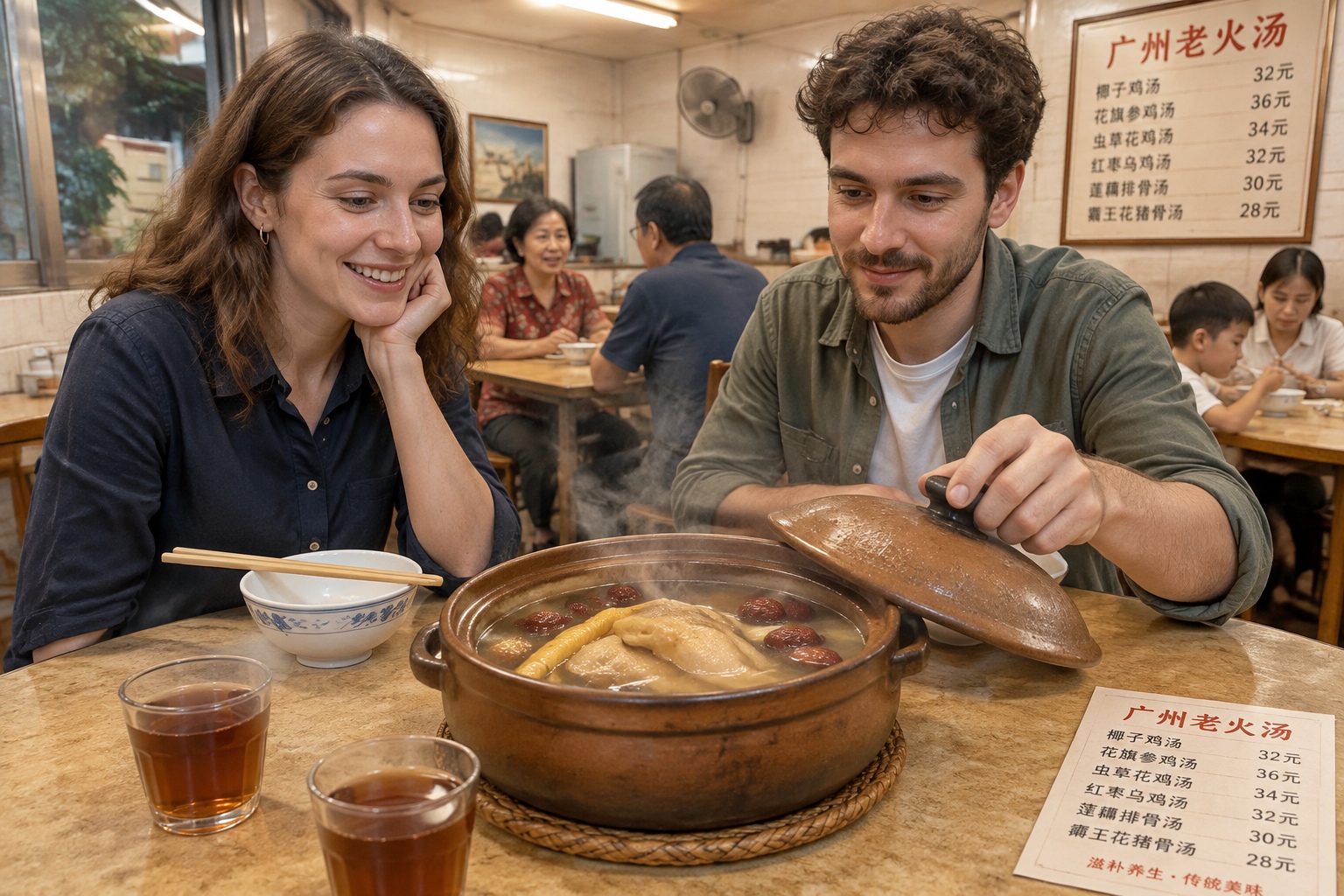
In a soup shop in Guangzhou’s Yuexiu district, the menu does not start with pork or chicken. It starts with verbs. Qu shi. Run fei. Jian pi. A table of four — two Australians, a designer from Shanghai, and a local friend who did the ordering — spent ten minutes on the first page, pointing at characters and asking what each one fixed.
Nothing, exactly. The waitress brought a clay pot of chicken soup with a root called wuzhimaotao, which smells faintly of coconut and dried fig. “For when your body feels heavy in wet weather,” the friend translated. It was 34°C outside and raining. Everybody nodded as if that settled it.
Then came the small cups: a dark amber tea, unsweetened, a little smoky, bitter at the back of the throat. Nobody could name it. The label said nian si wei — twenty-four flavours — the standard bitter herbal tea sold from steel urns on street corners across southern China for around 10 yuan. One of the Australians photographed the cup before drinking it, and then after.
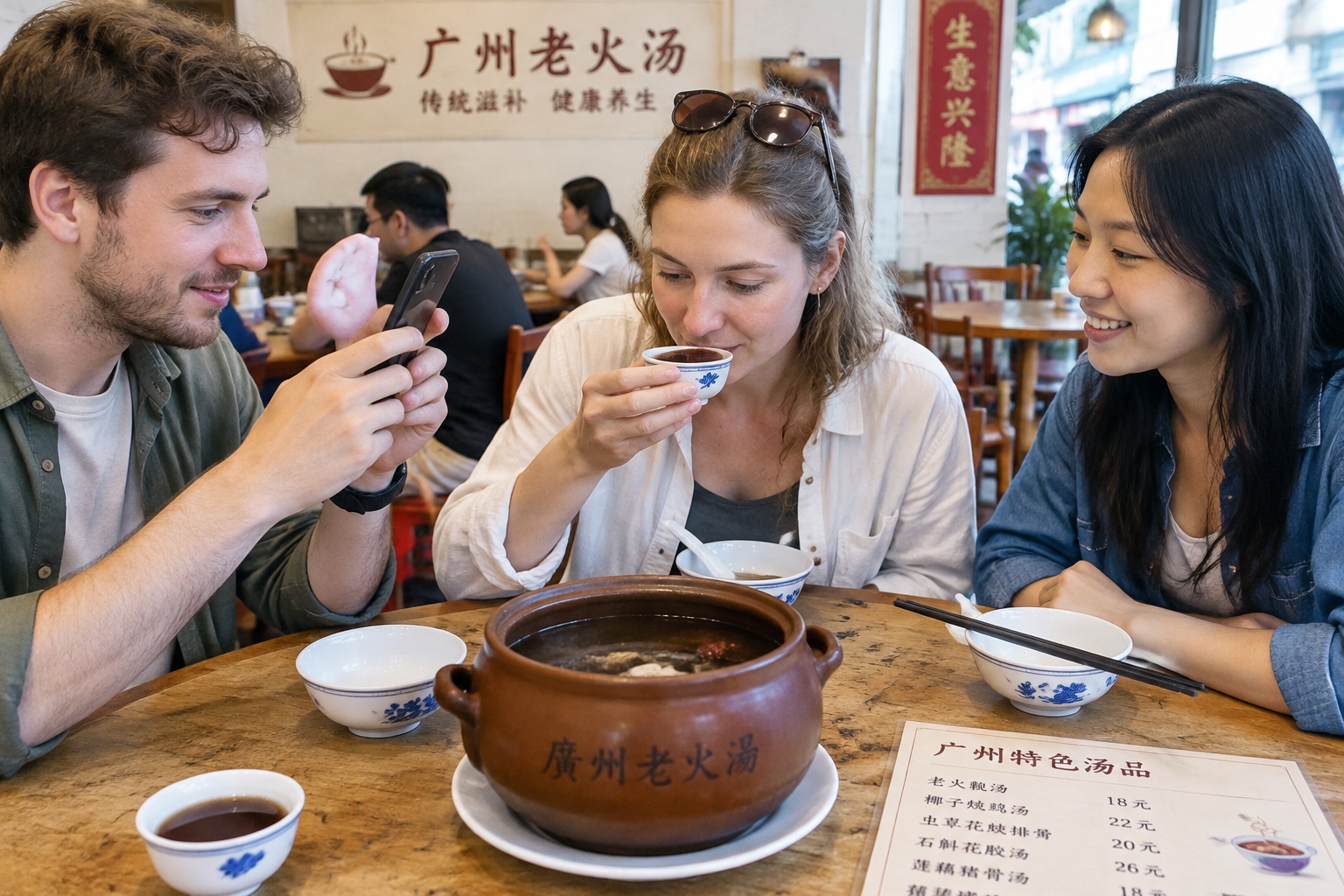
That sequence — confusion, a small cup, a photo, a second sip — now plays out in Chinese cities constantly. Herbal cooking, long something families made at home and few visitors put on a list, has become a stop on the itinerary.
The Menu Reads Like a Body
If you grew up outside this food culture, the vocabulary is the first wall. Cantonese home cooking treats “dampness” as a household word, the way English speakers talk about feeling run down. Soup is chosen by season and by how you feel, not by what is on special. My own first encounter with the idea happened in a Hong Kong supermarket, where a shelf of soup packs was labelled by symptom rather than by flavour.
Herbal cuisine — yaoshan — sits inside that habit. It is not a course of pills disguised as dinner. It is ordinary ingredients cooked the way people already cook: chicken broth with astragalus, red bean dessert with dried tangerine peel, sour plum drink in July, ginger and brown sugar boiled for whoever got caught in the rain. The “medicine” is largely the same shopping list, used with intent.
What “Medicine-Food Homology” Actually Means
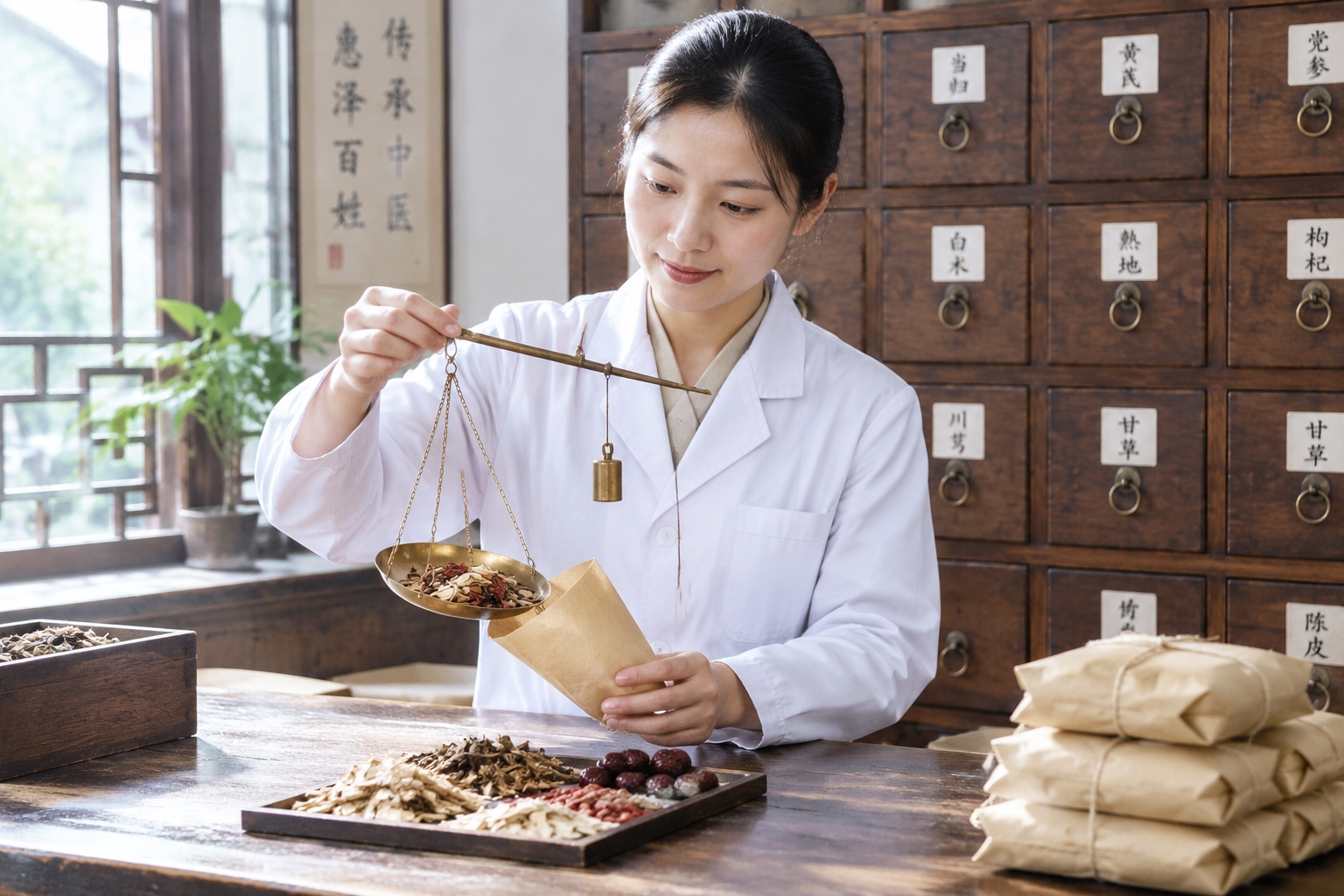
The Chinese phrase is 药食同源 — medicine and food share one source. In practice it is a regulatory idea as much as a philosophical one. The government keeps a catalogue of substances considered safe both as food and as traditional medicine; it runs to well over a hundred items, among them ginger, jujube, goji berry, hawthorn, tangerine peel, Chinese yam and poria mushroom. Anything outside that list cannot legally be sold to you as a dish, which is why restaurant menus stay inside a fairly narrow pantry.
The list has grown. A 2019 pilot allowed nine more substances — including codonopsis, astragalus and reishi mushroom — to be used in food in selected provinces, and the trend has since spread into ordinary shops.
What surprises visitors is not the philosophy but the ordinariness. Goji berries sit in a colleague’s thermos at nine in the morning. Dried tangerine peel goes into a dessert because it tastes good and, incidentally, is said to help digestion. Nobody at the table is undergoing treatment. They are eating, with a thin layer of inherited theory on top.
Why It Became a Stop on the Itinerary
Three things pushed herbal food out of home kitchens and into travel plans. The first is a shift in how people move through this country: fewer checklist landmarks, more “what does a normal day look like.” A neighbourhood soup shop costs less than a theme park ticket and tells you more.
The second is social media. On Xiaohongshu, posts about hospital-made sour plum drinks and herbal milk tea routinely collect tens of thousands of saves. The visual language is a paper cup on a marble counter, not a museum hall.
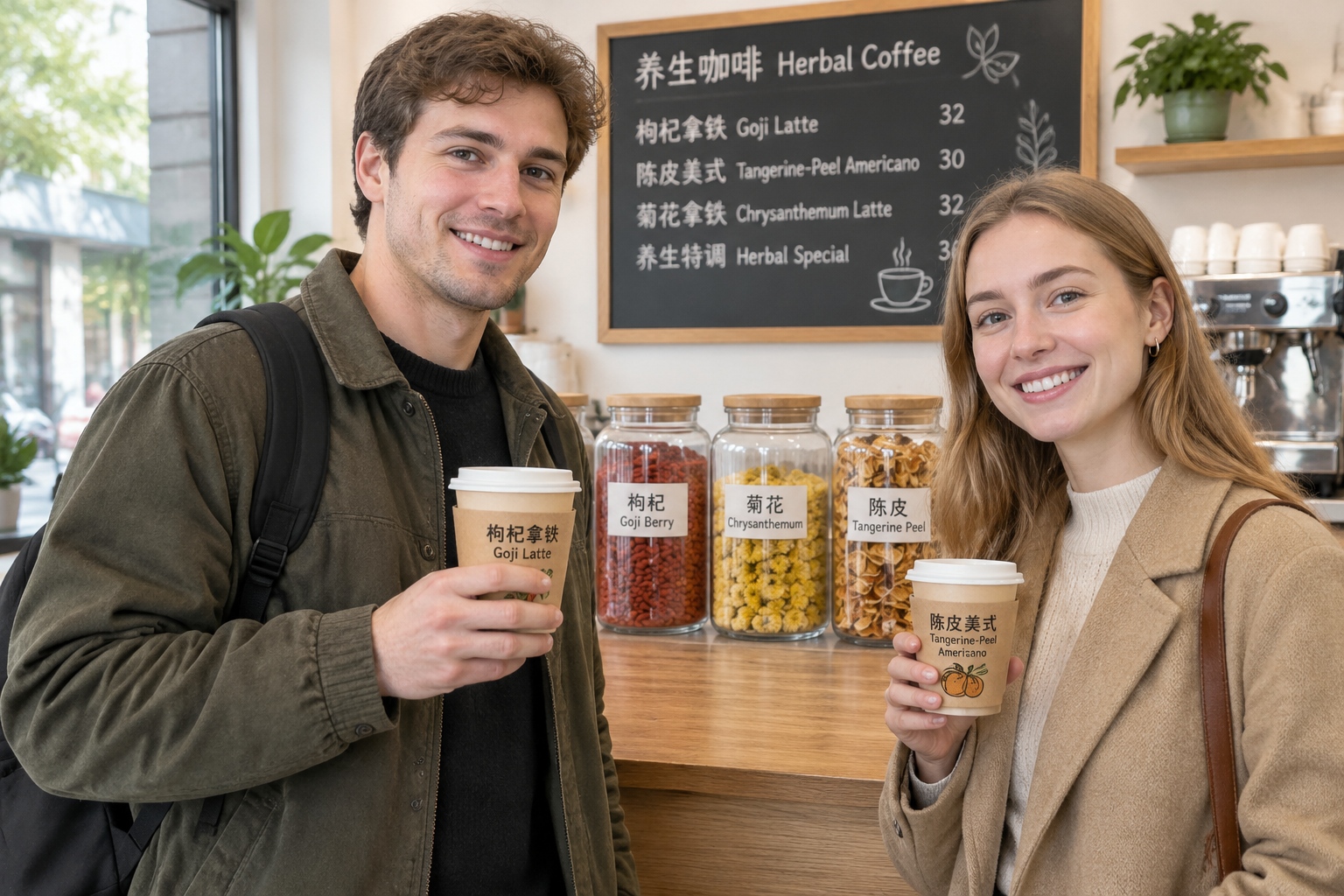
The third is the restaurants themselves. In 2019 the centuries-old pharmacy chain Tongrentang opened a café in Beijing selling goji lattes and tangerine-peel americanos, and the format has been copied across the country. Hospital shops selling vacuum-packed sour plum soup went viral in 2023 and sold out repeatedly the following year. Herbal ice cream, herbal milk tea and wellness bakeries followed. The entry price is a coffee, not a consultation.
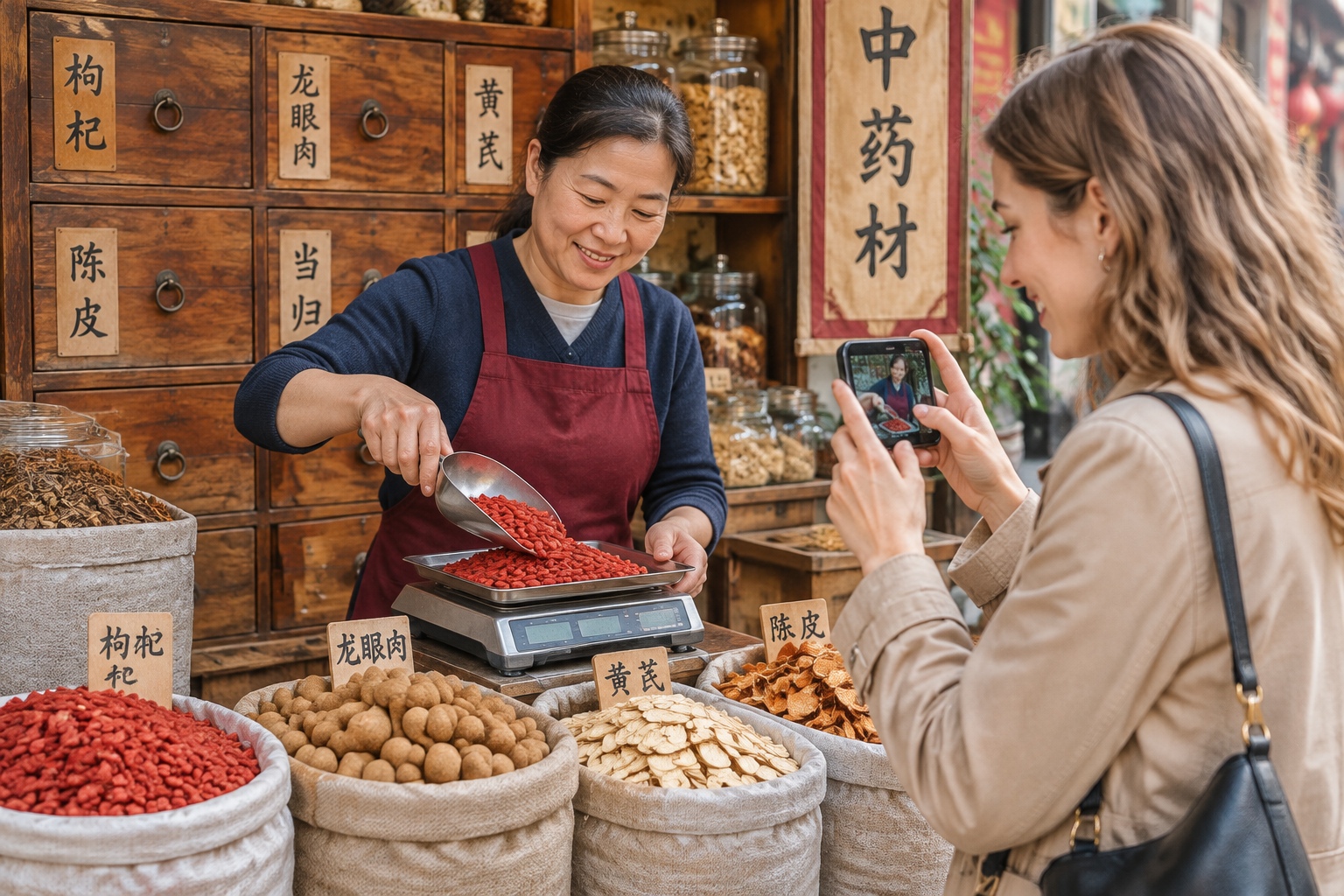
Walk through Qingping market in Guangzhou and you can see the supply side. Stalls sell dried scallops, aged tangerine peel, dried longan and roots I cannot name, and a growing share of the customers are visitors filming for their phones. A few streets away, a licensed TCM clinic will do a short consultation for the price of two bowls of soup — maybe 50 to 100 yuan — and tell you, often, that you do not need anything.
It is worth saying what local people think. For most families here, this is not a trend; it is Tuesday. Several older Guangzhou residents I have eaten with find it quietly funny that tourists now pay for what their grandmothers simmered for free. “This is just soup,” one said, ladling a second bowl.
What It Tastes Like, and What It Costs
Honesty first: much of it is bitter, woody or medicinal, and the appeal is acquired. Bitter herbal tea is handed over with a slip of preserved plum to chew afterwards. Guilinggao, the dark jelly made with turtle shell and herbs, needs condensed milk before most people enjoy it. Angelica root stays in the broth and smells like wet earth. Young Chinese customers say exactly what foreigners say: 有点苦, a bit bitter. Then they finish the cup, because they came for the bitterness as much as despite it.
Prices are unremarkable by city standards. A bowl of slow-cooked soup in a neighbourhood shop runs 30 to 80 yuan. A herbal set meal in a mid-range restaurant is 150 to 300 yuan per person. Street-corner herbal tea is 8 to 15 yuan. A goji latte is around 30, roughly Starbucks money. Compared with a spa afternoon or a bag of supplements from an American pharmacy, the barrier to trying is low.
A short ordering guide
If you have never tried any of this, go in this order: sour plum drink — tart, cold, easy; then chicken soup with wuzhimaotao root, mild and faintly coconutty; then red bean dessert with dried tangerine peel; then guilinggao jelly. Leave the twenty-four-flavour tea for last, or for a hot day when you genuinely want to be jolted awake.
For readers from Europe or North America, the nearest familiar frame is the wellness aisle: vitamin gummies, green powders, kombucha, herbal tea bags, a smoothie after the gym. The difference is social and sensory. Here the supplement is served hot, at a table, often shared, and it arrives with vocabulary borrowed from a medical tradition rather than from a marketing department. You do not swallow it alone in your kitchen at seven in the morning. You eat it with three other people and argue about whether it is too bitter.
Where the Food Stops and the Treatment Starts
This part needs a firm line. Herbal dishes are food. They are not a treatment for illness, and Chinese doctors are unusually direct about it: hospital dietitians describe herbal meals as supplementary, not a replacement for care. Some ingredients interact with medication. Dang gui and danshen can matter for people on blood thinners; licorice raises blood pressure in quantity; several herbs are unsuitable in pregnancy. The old caution is 是药三分毒 — every medicine is a little poisonous — which is also an argument against drinking “detox” brews daily for a month and expecting a reset.
Regulation is stricter than the souvenir market suggests. Restaurants need a standard food licence. Advertising law forbids claiming that food cures disease. Only catalogue items may be sold as dishes. Big chains and hospital-run shops tend to be more standardised than a stall aimed at tourists, and a licensed TCM clinic is a better place than a menu to ask whether a particular herb suits you.
What a Bowl Actually Explains
The recipe has not changed. The setting has. A practice that used to live inside families and pharmacy counters now appears as a café, a dessert shop, a hotel menu, a city walk. Young Chinese consumers sometimes call it punk wellness — staying up until two, then drinking goji tea — half joke, half a real attempt to build a habit. Public health ideas become ordinary the moment they become edible, and here they are edible for 20 yuan.
For a visitor, the appeal is the appeal of any good travel experience: low-risk, sensory, and slightly confusing in a way that makes you pay attention. You do not have to believe anything to enjoy a bowl of soup. You only have to wonder why the woman at the next table is choosing her broth by the weather.
Back in Yuexiu, one of the Australians asked for the recipe. The waitress laughed and said the root is hard to find outside Guangdong, then wrote the name down anyway. They bought a small bag of dried wuzhimaotao at a market the next morning. It sat in a suitcase for three weeks, smelling faintly of coconut, until somebody finally boiled it with a chicken.