

Three questions at the counter
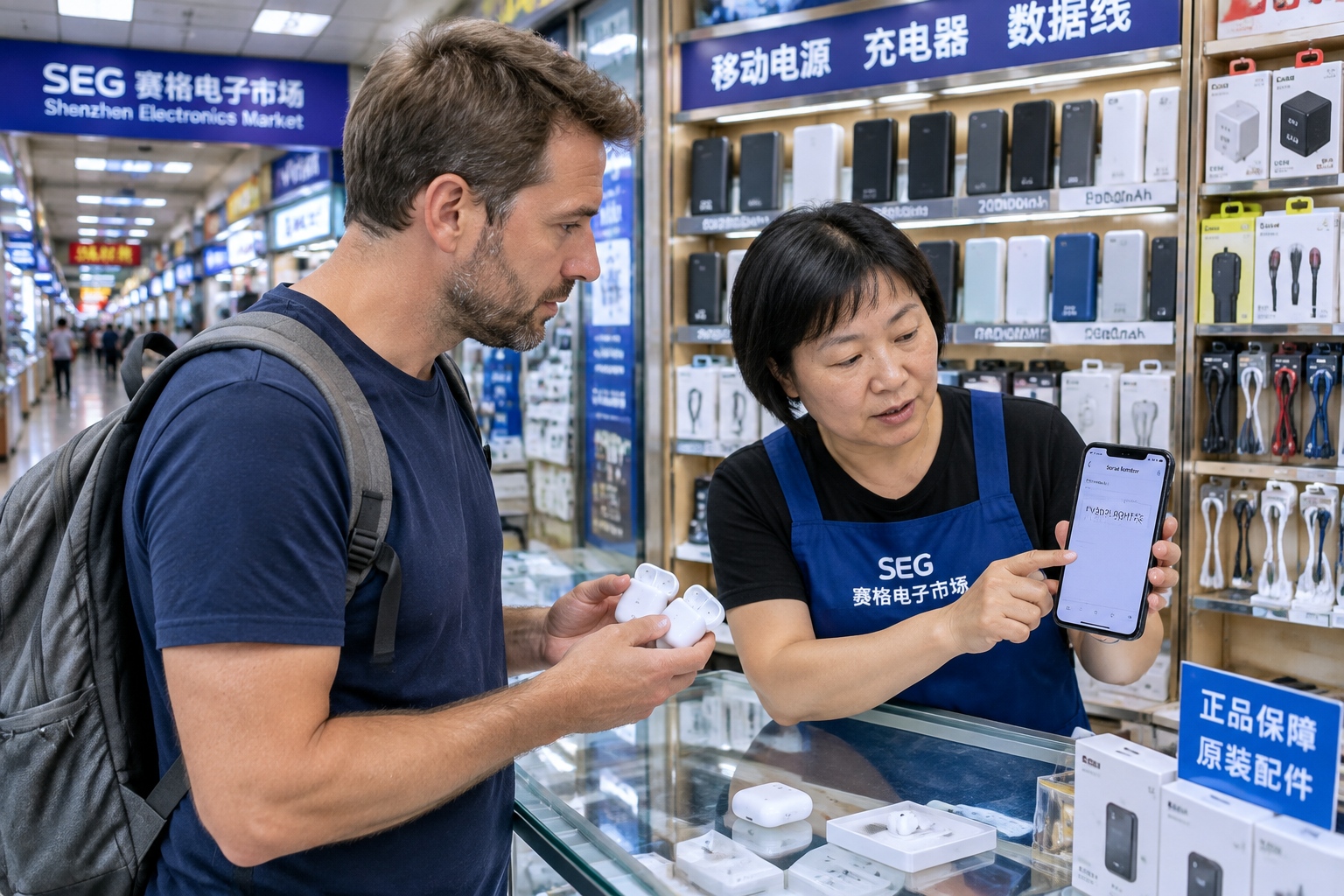
The escalator at SEG Electronics Market in Huaqiangbei drops you into a corridor of glass counters, each one lit like an aquarium. A man in a navy T-shirt is holding two pairs of wireless earbuds, one in each hand, asking the woman behind the counter the same question three different ways: “Is this one real?”
She doesn’t argue. She pulls out a phone, scans the box, and turns the screen around to show him the serial number on the manufacturer’s website.
That is roughly how shopping works in Shenzhen. Not a showroom, not a scam — a market with its own rules, where you can buy a drone motor, a robot vacuum and a replacement laptop fan in the same building, then spend ten minutes negotiating the price of a charging cable.
If you are in town for a few days, three questions matter more than any list of landmarks: What should I actually buy? How do I get the tax back? How do I pay?
Huaqiangbei: what is worth carrying home
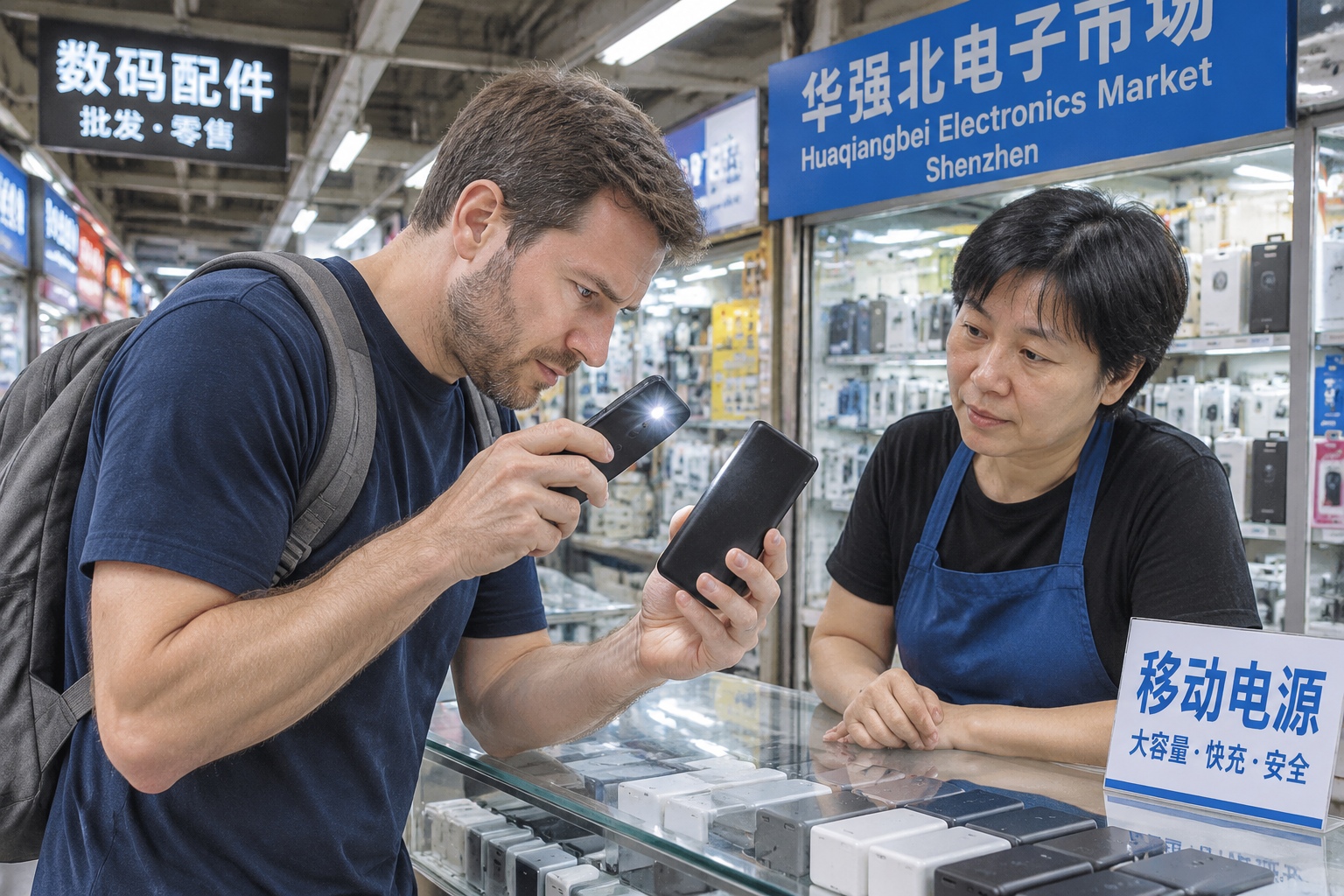
Huaqiangbei is a few square blocks in Futian district that supply a surprising share of the world’s small electronics. Several buildings — SEG, Huaqiang Electronics World, Yuanwang Digital Mall — are stacked with stalls. Floor by floor, the categories shift: components and tools at the bottom, finished consumer gadgets higher up, phone repair parts in the older towers.
It is not a tourist attraction with a gift shop at the exit. It is a working wholesale and retail market, and that is exactly why it is interesting.
Categories that hold up
Audio is the safest bet. Wired earbuds, wireless earbuds with noise cancelling, small Bluetooth speakers — a genuinely good pair of ANC earbuds often lands somewhere around 150 to 400 yuan. Chargers and cables are cheap and useful: a 65W GaN charger for roughly 100 yuan, braided USB-C cables for 15 to 30. Power banks run 80 to 200 yuan for 20,000mAh, though capacity claims deserve suspicion at the low end.
For hobbyists, the component floors are the real attraction: soldering stations, multimeters, ESP32 and Raspberry Pi-style dev boards, sensors, LED strips, tiny motors. Smart home gear — robot vacuums, air fryers, smart plugs — is well priced but bulky, so think about your suitcase before you fall in love.
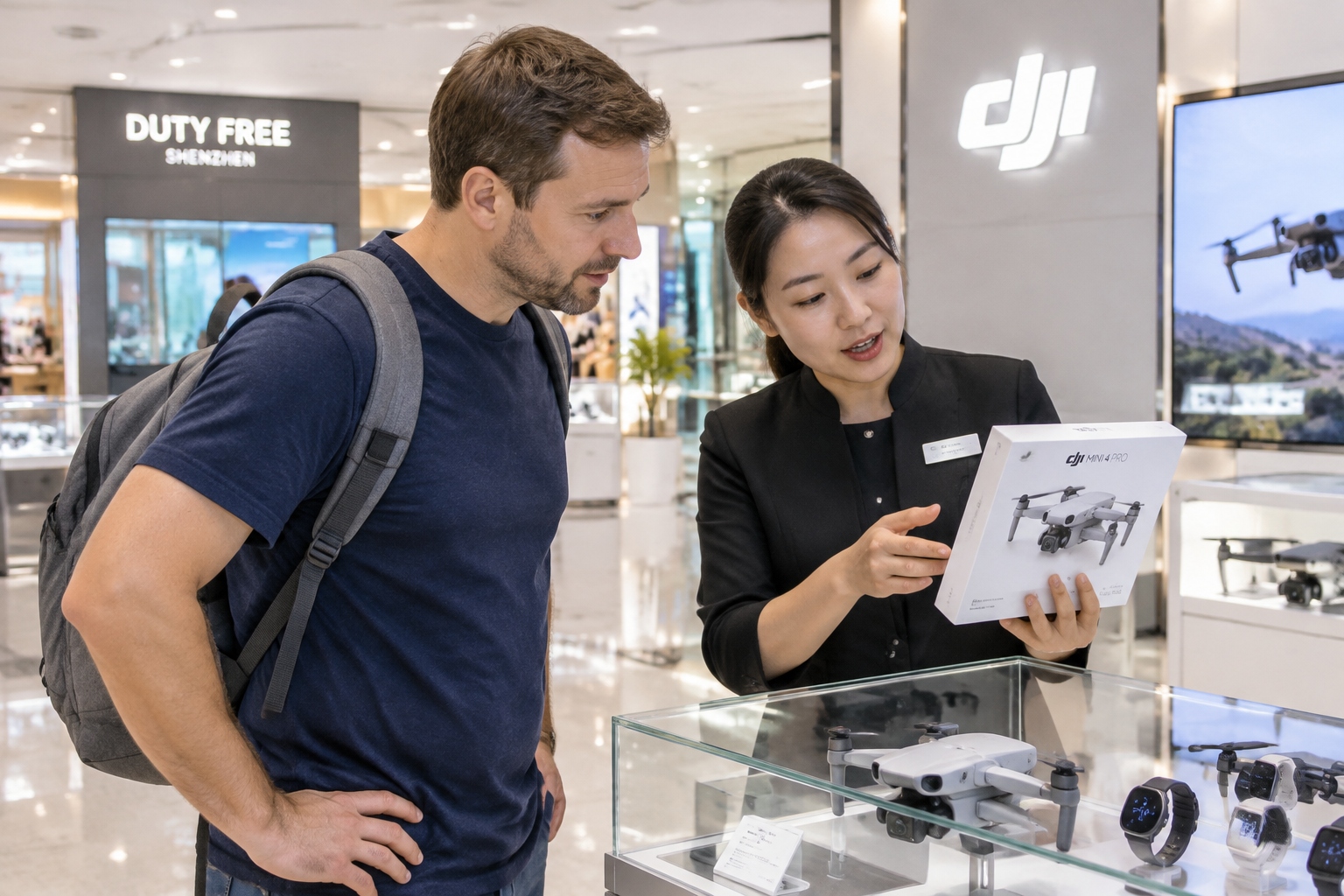
Two categories need care. Phones and laptops: refurbished units are often sold as new, and a “new” phone may be a China-market model without Google services. Drones and cameras: buy from official brand stores rather than stalls if the warranty matters to you.
How to check what you are buying
Bring a charged phone and a cable. Ask the vendor to power the device on in front of you. Plug it in. Pair the earbuds. Check the plug type — China uses 220V with Type A, C and I sockets, so a multi-plug charger travels better than a single-region one.
For power banks, pick it up. A real 20,000mAh pack weighs roughly 350 to 400 grams. If it feels hollow and light, it is a shell with a sticker on it. For anything above a couple of hundred yuan, ask for the model number and photograph the box and the receipt together. A receipt with the shop’s name and phone number is your only leverage later.
Haggling and warranty
Bargaining is normal at stalls and pointless at brand counters and fixed-price shops. A reasonable opening offer is 20 to 30 percent below the first quote; buying three of something gets you a better number than buying one. Walking away works more often than arguing does.
Warranty is the weak spot. Many stall goods carry only a shop warranty, meaning you would have to be back in Shenzhen to use it. Ask before paying — “保修多久?” — or type it into a translation app. On cheap items, assume no warranty at all and treat them as disposable. You will be happier, and you will usually be right about the quality.
The duty-free “tech corridor”: who it is for
If haggling is not your idea of a holiday, Shenzhen’s duty-free stores have been building out tech sections — clean, brightly lit corridors of drones, headphones, smartwatches and travel gadgets, staffed by people who will walk you through a spec sheet without sighing.
Prices are not always lower than the market. What you are buying is certainty: sealed boxes, an official warranty, no negotiation, and a tax-refund invoice printed correctly the first time.
It suits people buying gifts, people who need a warranty they can actually use back home, and people with forty minutes before a ferry. It does not suit anyone hunting for the one strange little gadget they saw on a video and cannot name.
Getting the tax back
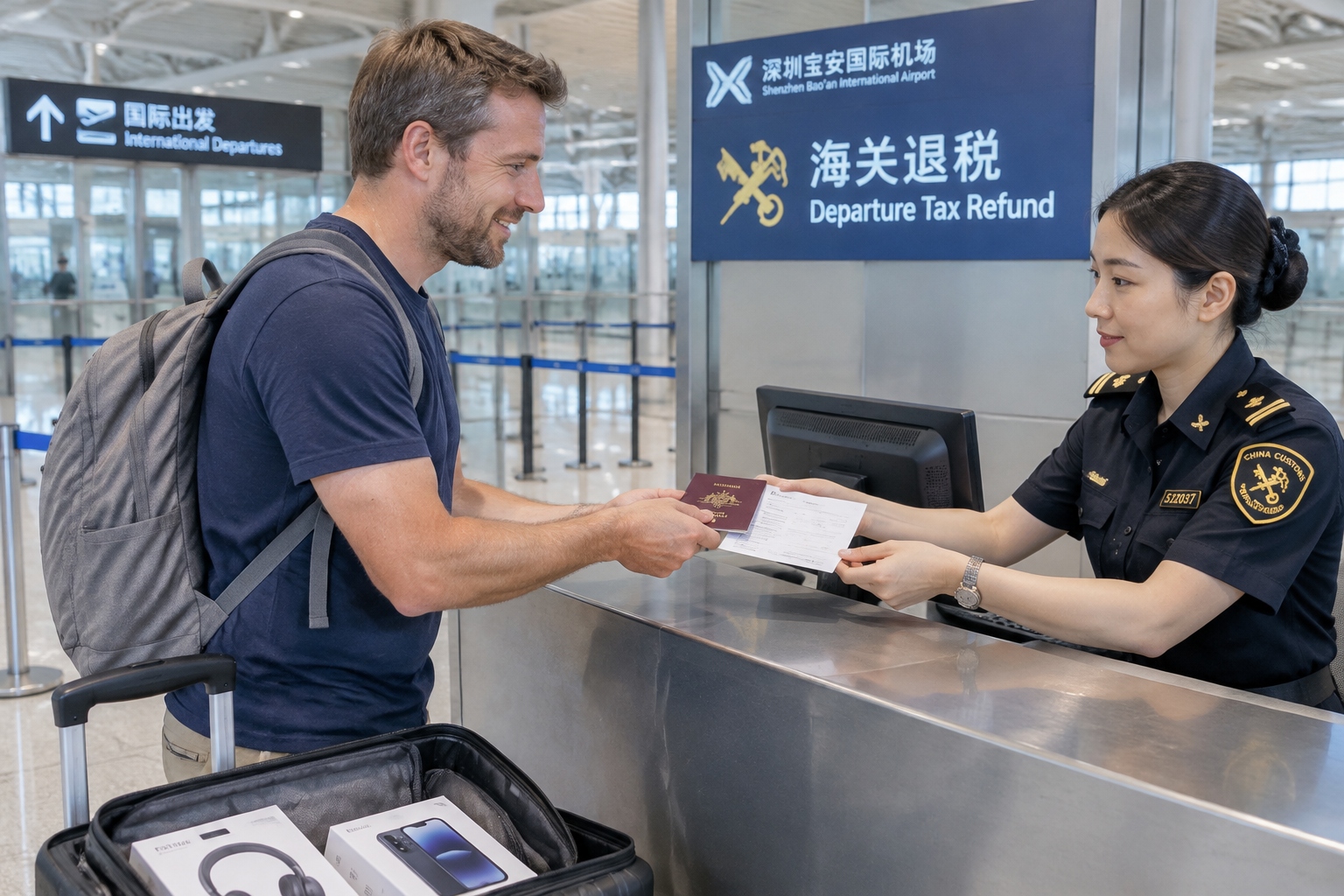
China runs a departure tax refund scheme for foreign visitors. Most goods carry 11 percent VAT in the sticker price, and the refund returns that VAT minus a 2 percent handling fee — so in practice you get roughly 9 percent back. On a 2,000 yuan haul, that is a decent dinner.
What you need
- Your passport, not a photo of it.
- A purchase at a designated tax-refund store, same store, same day, above the minimum spend — currently 500 yuan.
- The store’s tax refund application form plus the official invoice.
- The goods unused, in original packaging, and reachable — customs may ask to see them.
- Departure from China within 90 days of purchase, through a port with a refund counter.
Two ways to do it
Option one: refund at the port. At Shenzhen Bao’an International Airport, or at land crossings that have refund counters, go to customs first with your goods, passport, invoice and form. Get the stamp, then walk to the refund desk. Cash or card both work. Arrive early — the customs window and the refund desk are not always next to each other, and the queue moves at its own speed.
Option two: instant refund at the shop. A growing number of stores will pay you on the spot, usually against a credit card pre-authorisation. It is faster, but it is not free money. The deposit is released when customs confirms you actually left with the goods. Skip that step and the card gets charged back.
Shenzhen now has more than 3,000 tax-refund stores, and the main shopping districts — Luohu, the Futian CBD, Nanshan — are broadly covered. Look for the refund sign in the window, or ask at the counter before you pay, because a shop that does not issue the right invoice cannot fix it afterwards.
How to pay
A decade ago, using a foreign card in a Chinese shop was a small adventure. Now it is mostly a question of matching the tool to the counter.
Foreign cards
Visa, Mastercard, Amex and JCB work at hotels, department stores, duty-free shops, airport counters and most mid-to-large restaurants. They do not work at market stalls, noodle shops, many taxis or the little shop selling phone cases. Cash works everywhere and is still legal tender, so keep a few hundred yuan in your bag.
Alipay and WeChat Pay
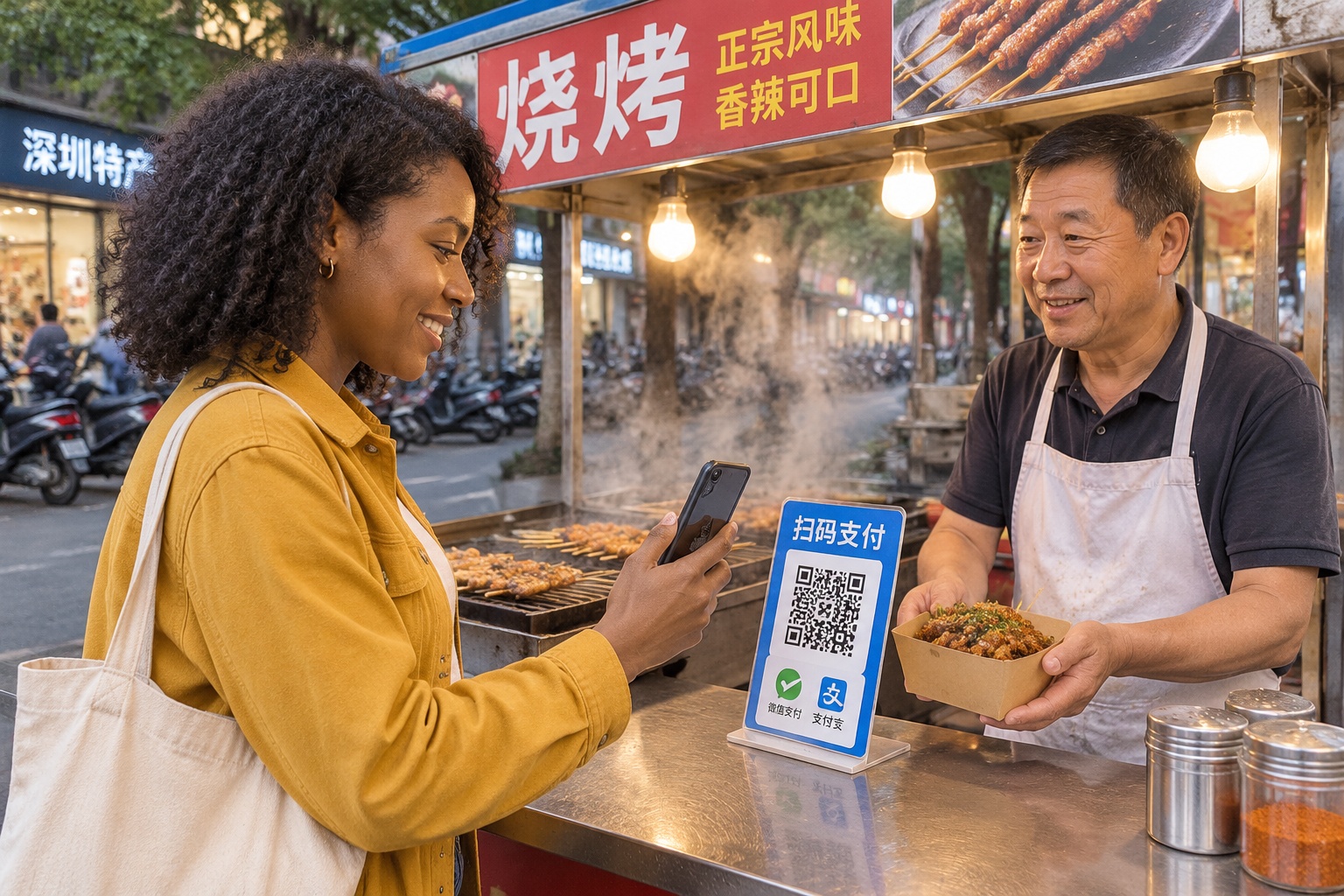
Both now accept international cards. Download the app, register with your home phone number, add a Visa or Mastercard, and scan. Alipay’s international version is the friendlier of the two for visitors — it has built-in translation and a transport mini-program for metro QR codes. Expect a fee of around 3 percent on transactions above 200 yuan, and your own bank may add a foreign transaction fee on top.
The common snag: some small merchants use personal QR codes that will not accept international-card-funded payments. If a payment fails twice, do not fight it. Pay cash and move on.
Digital RMB
Shenzhen is a pilot city for the digital yuan. Foreign visitors can open a wallet, and there are self-service machines at the airport that issue a physical hard wallet card. It is genuinely interesting to try, and useful if you would rather not link a bank card at all. Coverage is uneven, though. Treat it as a backup, not your main plan.
One last thing
People worry about the language and the payment system. In practice, both are manageable: a translation app, a screenshot of your hotel address in Chinese, one QR code that works. The real difficulty is choice — three floors of the same product at four different prices, and nobody to tell you which one is actually good.
So do what the man at the counter did. Ask, check, compare, and buy from whoever answers your questions without hurrying you along. That is the Shenzhen skill. The rest you can pick up on the metro.
A note on numbers: refund thresholds, store counts, refund rates and the list of ports with refund counters are all subject to change. Details here were checked in mid-2025. Confirm the current rules with the Shenzhen tax authority or your refund agent before you travel.