
9:20 on a Tuesday: the ten-minute exam
The second floor of a community health centre in Hangzhou smells faintly of dried herbs and hand sanitiser. Dr. Chen, 57, short grey-streaked hair tied back, a white coat over a dark green sweater, pulls the curtain halfway across the window so the daylight falls on her patient’s face instead of behind him.
“Show me your tongue. A little further — relax it.”
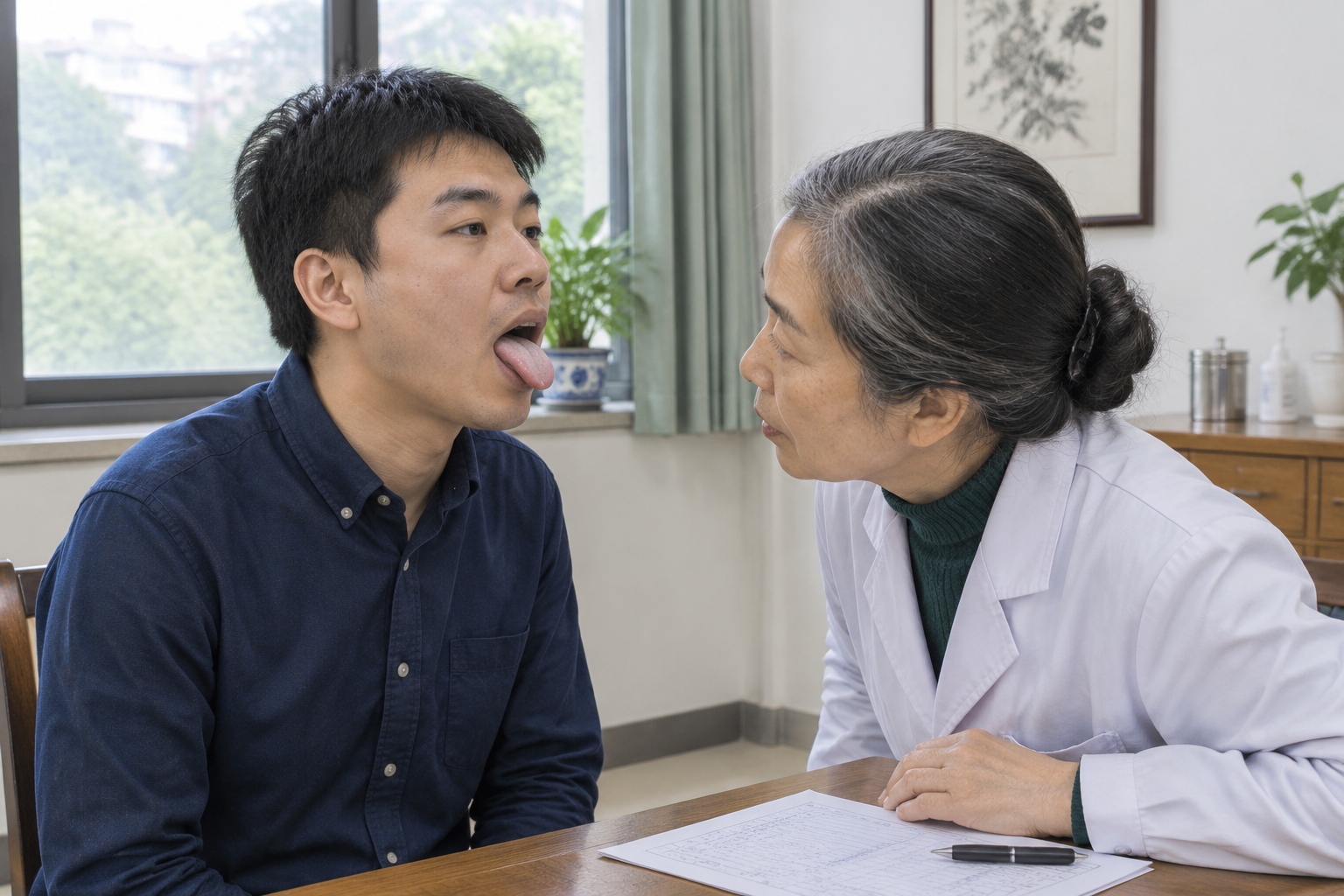
The man is 31, a software sales rep in a navy shirt, and he has come about insomnia that started in March. He holds out his tongue for perhaps fifteen seconds. Dr. Chen leans in, sits back, and writes two lines on the intake form: pale body, thin white coating, slight teeth marks along the edges.
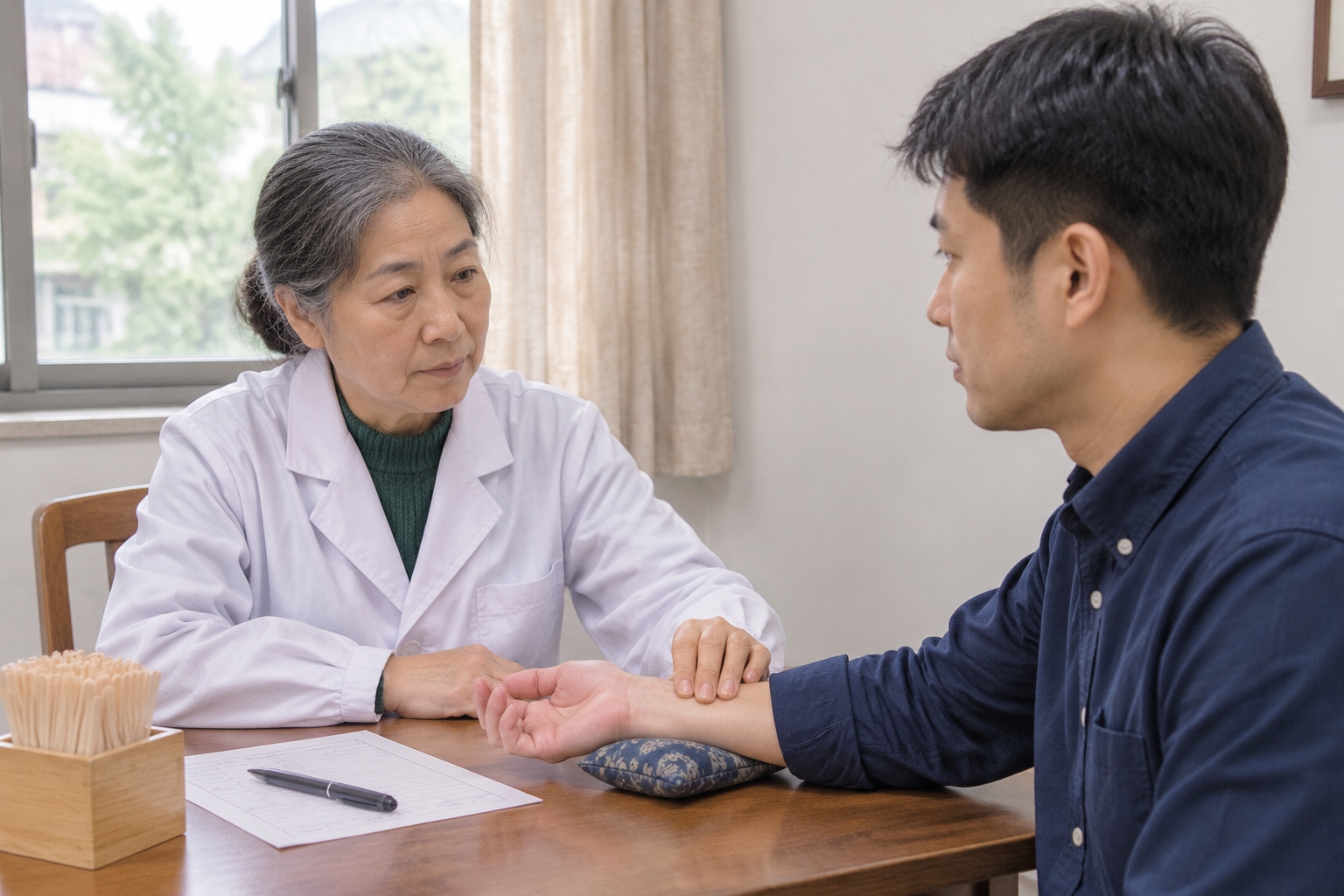
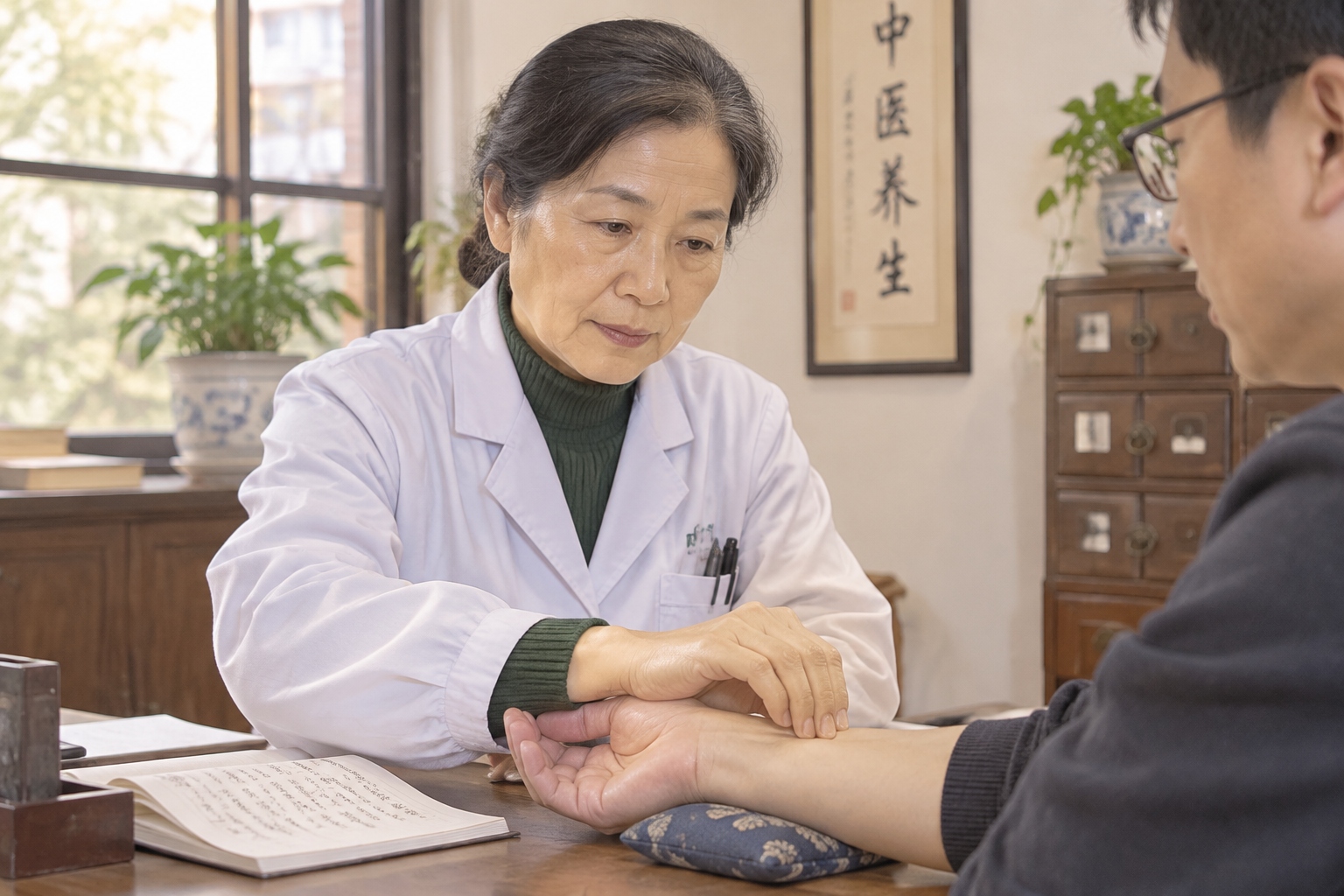
Then she reaches for his wrist. Two fingers find the radial artery, a third joins them to make the standard three-finger position, and she presses — light, then medium, then firm enough that the skin whitens under her fingertip. She stays quiet. She is counting beats against her own breathing, an old way of keeping time that long predates the watch on her wrist. Four to five beats per breath is unremarkable; his runs faster and feels, she will later write, “thin and wiry.”
“When you can’t sleep — is it hard to fall asleep, or do you wake up?”
“Falling asleep. I lie there with my phone. Then I’m awake again at two or three.”
“Hot at night? Sweating?”
“Sometimes.”
“Appetite? Bowel movements? Thirsty — and if so, do you want cold water or warm?”
The questions keep coming for six or seven minutes, in a flat, unhurried voice, and none of them is about sleep.
What the four examinations actually collect
Chinese medicine calls this sequence wang, wen, wen, qie — looking, listening-and-smelling, asking, feeling. English speakers usually meet it as “the four examinations.” It sounds mystical in translation. In the room it looks more like a structured intake interview with two physical checks built in.
Looking (望)
The tongue is the famous part, and it is genuinely informative as a snapshot: body colour, shape, how wet it looks, whether the coating is thin or greasy, whether the edges carry tooth marks. But the doctor also reads the face — dull or bright, flushed or sallow — plus posture, hair, skin, how the patient sits down. In pediatric clinics, practitioners still examine the small vein on the index finger of toddlers, a technique that survives because it requires no equipment.
Listening and smelling (闻)
Voice strength and pitch, breathing, the sound of a cough, sighing, and in principle breath and body odour. This is the thinnest of the four in modern practice: stethoscopes, blood tests and imaging have taken over most of what the ear used to do. What remains is mostly vocal quality — a voice that trails off at the end of a sentence is treated as data.
Asking (问)
Standardized since at least the Ming dynasty in a mnemonic known as the “Song of Ten Questions”: chills and fever, sweating, head and body, stool and urine, food and drink, chest and abdomen, ears and eyes, sleep, and menstruation where relevant. Contemporary clinics add the things that shape a modern body — shift work, screen hours, coffee, alcohol, how often the patient eats takeout — and, increasingly, whatever lab results the patient brings on their phone.
Feeling (切)
Pulse reading is the most written-about and least standardized part. Three positions on each wrist, each felt at three depths, producing qualities with names like floating, deep, slippery, wiry, choppy, rapid, slow. A practitioner is not counting heart rate; a heart rate monitor does that. They are registering the feel of the vessel wall under different pressures. It is a real skill and a subtle one, and — this matters — a subjective one.
From clues to a pattern
All of that material gets compressed into a phrase. Dr. Chen’s note for this patient reads something like heart yin deficiency with empty heat, plus liver qi stagnation. That is not a disease. It is a zheng hou — a pattern.
The distinction is worth spelling out, because it is where most misunderstandings start.
A symptom is what the patient reports: I can’t fall asleep.
A disease, in the biomedical sense, is a named entity with an expected course and mechanism: hypertension, migraine, major depressive disorder.
A pattern is a configuration of signs gathered at one moment, describing how this particular body is currently stuck — too hot or too cold, too dry or too damp, qi moving or not moving. Patterns are provisional by design. They are expected to shift, which is why a good TCM prescription is often rewritten every one or two weeks rather than renewed for a year.
One complaint, two patterns, two prescriptions
Take two people who both say “I can’t sleep.”
Patient A falls asleep badly, wakes with palpitations, sweats at night, has a dry mouth, a red tongue tip with almost no coating, and a thin, rapid pulse. The pattern reads as deficiency with heat. The herbs will be sweet, moistening, cooling — dated back to formulas like Tian Wang Bu Xin Dan. She will also be told to stop the 9 p.m. hot yoga and the chilli oil.
Patient B wakes at three, is irritable, sighs without noticing, carries his shoulders by his ears, has breast tenderness before his partner’s period is not relevant here but his own PMS-like tension is, and shows a wiry pulse with a normal-looking tongue. That reads as stagnation. The herbs move rather than supplement — Xiao Yao San and its relatives. His advice is different: walk forty minutes, and say no to one weekly meeting.
Same complaint. Different pills. Neither of them is “the insomnia herb,” because in this framework there is no such thing.
The hard part: it depends on the person holding your wrist
Individualized treatment is the selling point and the weak point at once. If the prescription is tailored to a pattern, and the pattern is read by a human being from a tongue and a pulse, then the accuracy of the whole system rests on that reading.
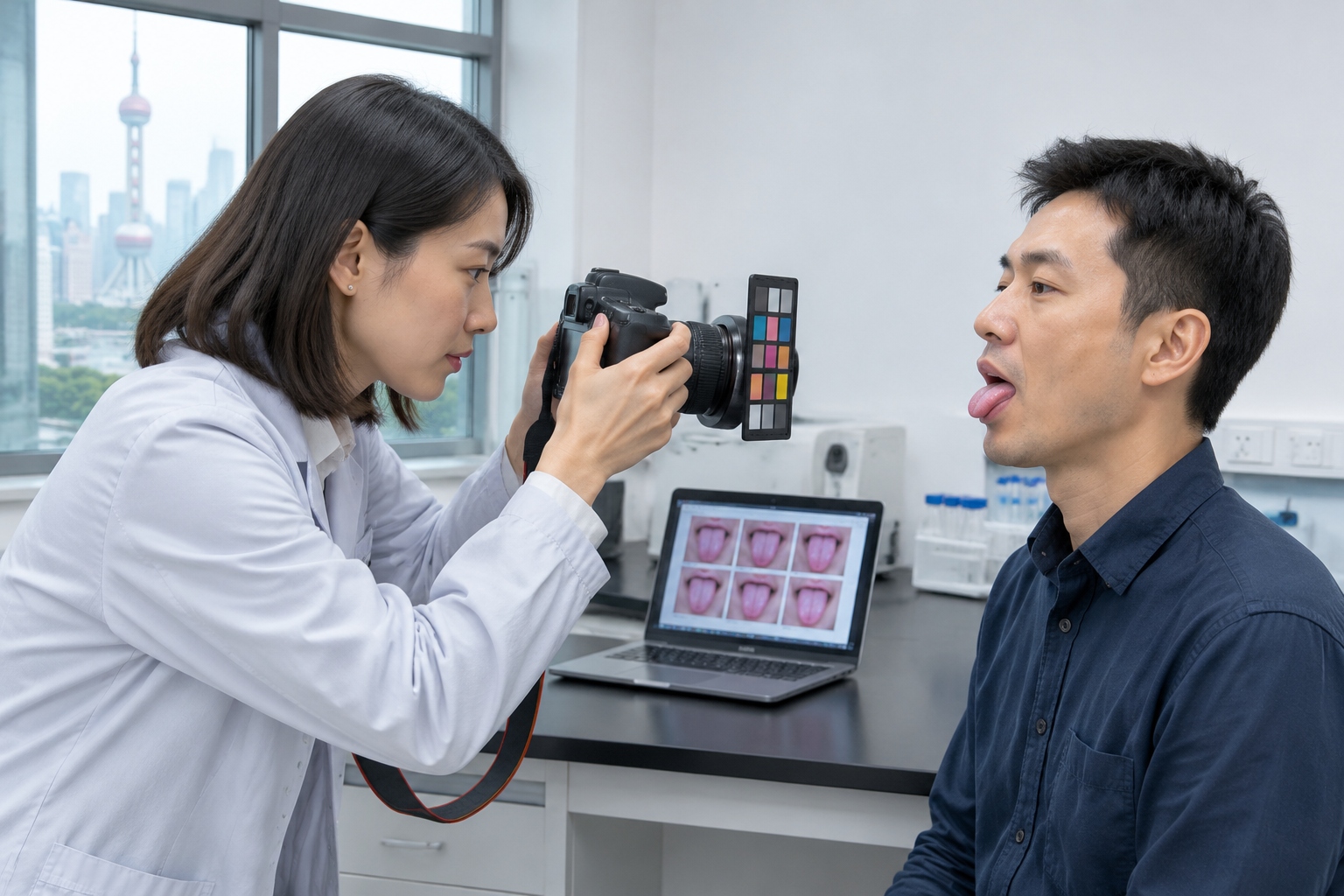
Studies that ask two experienced practitioners to feel the same patients’ pulses tend to find only moderate agreement on everything except rate and rhythm. Tongue diagnosis is more consistent but hardly perfect. China has spent more than a decade trying to instrument it: calibrated cameras with colour cards to photograph tongues under fixed lighting, pressure sensors to record pulse waveforms, machine-learning models trained on thousands of images. Some of this is genuinely useful for teaching and for research. None of it has replaced the fingers.
The evidence base is uneven, and it is more honest to say so. Acupuncture has a substantial trial literature for some pain conditions and for chemotherapy-related nausea, with results that range from positive to ambiguous depending on trial design. Individualized herbal medicine is much harder to test: placebos are difficult to disguise when the intervention tastes and smells like a decoction, and a treatment that changes every fortnight resists the fixed protocol a randomized trial wants. In 2019 the World Health Organization’s ICD-11 included a chapter for traditional medicine conditions — a real milestone for coding and statistics, and a genuinely contested one among researchers who worry it lends legitimacy ahead of evidence.
What the system does offer, patients here often say, is time. A first consultation runs twenty to thirty minutes, sometimes longer. The cost is modest by the standards of private medicine elsewhere: a community clinic consultation may run 20–50 yuan, a week of herbs 100–300 yuan, often partly out of pocket.
Before you book: check who is holding the wrist
Inside China, TCM is regulated in ways foreigners often don’t expect. Practitioners in hospitals and clinics need a medical practitioner’s certificate and work inside registered institutions; many large hospitals are explicitly zhong xi yi jie he — integrated Chinese-Western — and the same patient may get an IV drip in the morning and a herbal prescription in the afternoon. The two systems share corridors, records and, increasingly, arguments.
Outside China, rules vary enormously. Acupuncture licensing in the United States is handled state by state. In the UK, herbal medicine practitioners are not statutorily regulated, though some voluntary registers exist. Training ranges from a weekend certificate to a five-year degree.
So the practical advice is unglamorous but real. Ask where the practitioner trained and for how many hours. Ask which licence or register they belong to. Ask whether they will tell you to see a doctor when a symptom needs a scan. Be cautious with anyone who promises to cure cancer, tells you to stop prescribed medication, or discourages you from talking to your GP.
Ten minutes later
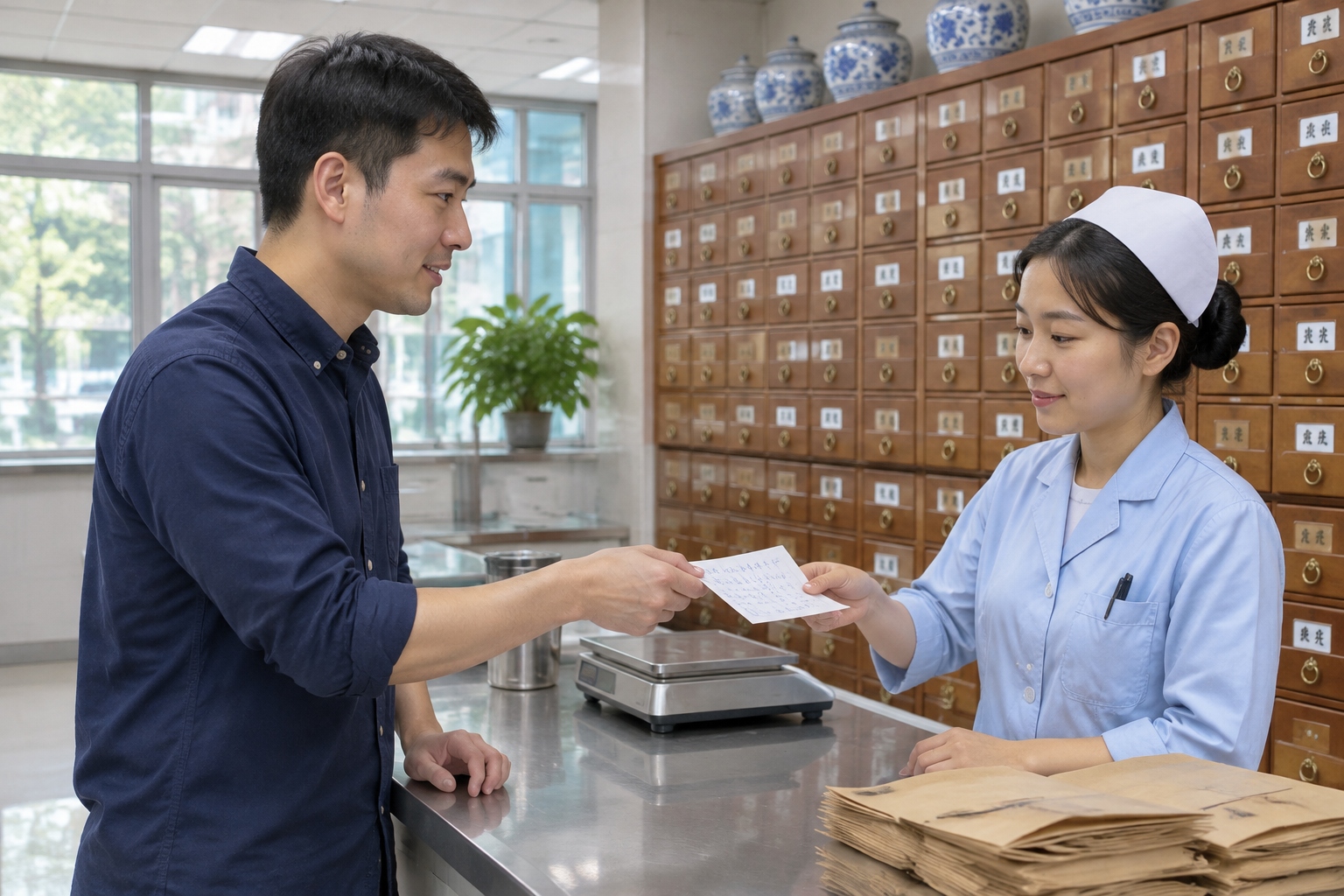
Dr. Chen writes out twelve herbs in a neat column, hands the slip to the man in the navy shirt, and tells him to come back in a week. She asks him to keep a rough sleep log on his phone — bed time, wake time, what he was doing before.
“Can I still drink coffee?”
“One cup. Before noon.”
He laughs, takes the paper, and goes downstairs to the dispensary where the drawers are labelled in characters he half recognizes. Whatever one concludes about qi and yin, a good deal of what happened in that room was pattern recognition, careful questioning, and advice about coffee. The line between the ancient and the ordinary is thinner than the packaging suggests.