

The Delivery That Doesn’t Come Down the Street
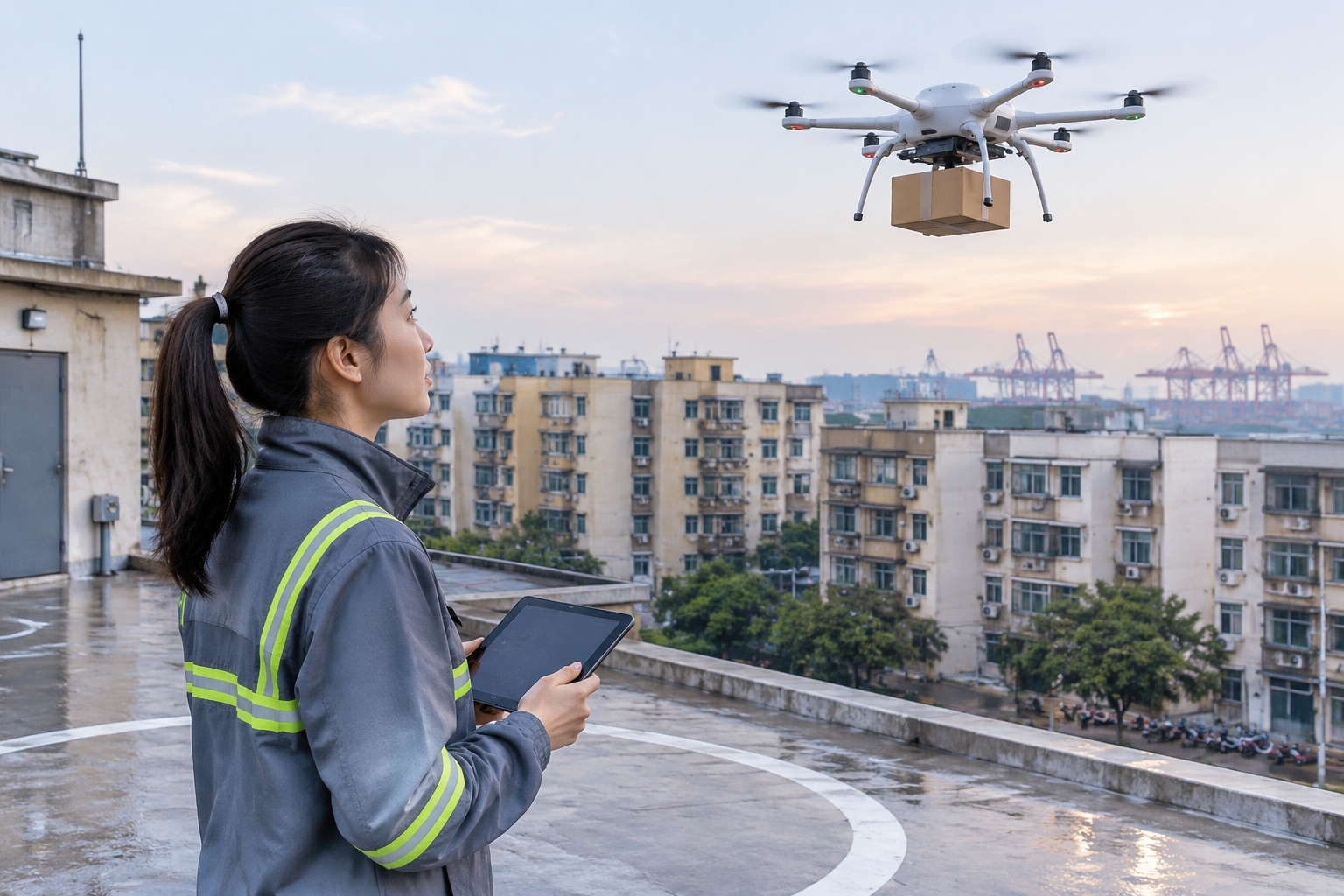
At 7:20 on a Tuesday morning, a white drone the size of a carry-on suitcase lowers a cardboard box onto a painted square in a residential compound in Bao’an, on Shenzhen’s western edge. The flight took 11 minutes from a rooftop pad two kilometres away. The woman collecting the box does not look up.
On the roof, Zhang Min watches it settle on her tablet. She is 29, wears a grey technical jacket with reflective stripes and keeps her hair in a ponytail. She runs fourteen routes over this district, up from two when she started three years ago.
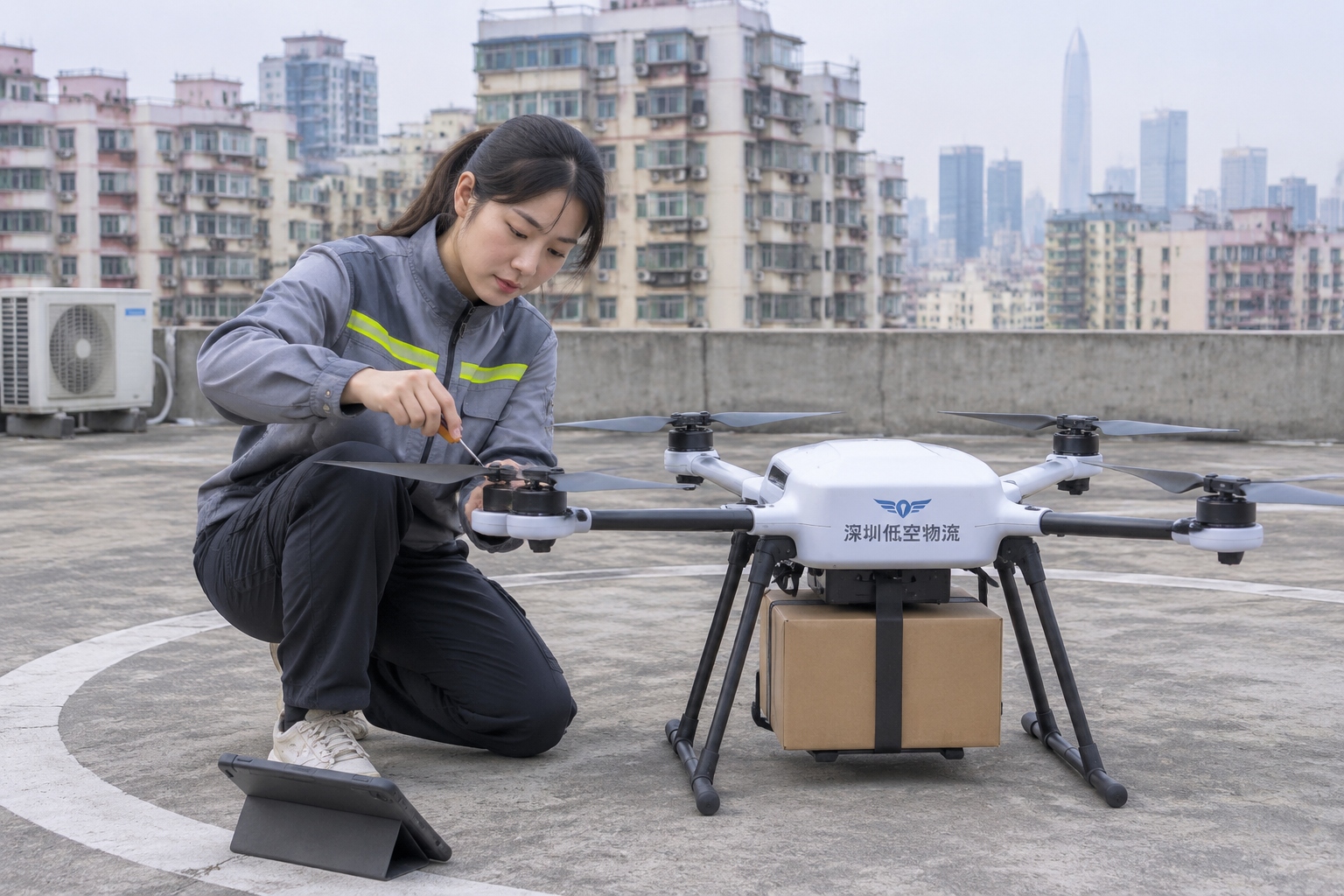
Drone delivery is easy to sell as a gimmick. Here it is a line item. Meituan has flown meals and small parcels to fixed pickup cabinets since 2021; SF Express runs routes between hospitals and testing labs; the city passed China’s first dedicated low-altitude economy regulation, in force since February 2024, so operators can plan routes instead of requesting one-off permits.
That regulation is a good reason to start an article about Chinese industry on a rooftop rather than in a boardroom. The interesting question is not whether Shenzhen looks futuristic. It is why a certain kind of manufacturing keeps landing in one 2,000-square-kilometre city — and why it is harder to leave than the headlines about tariffs suggest.
What “Number One” Actually Means
Two figures about Shenzhen’s electric cars get quoted as if they were interchangeable, and they are not. The first is a ranking: for two years running, Shenzhen has produced more new energy vehicles than any other Chinese city, ahead of Shanghai and Xi’an. The second is a share of the national total: in 2025, vehicles built inside the city accounted for about 22.3% of China’s new energy vehicle output — roughly one in five electric cars made in the world’s largest car market.
The difference matters. A ranking compares cities, and a city can top it in a year when the whole market slows. A share tells you how much of a country’s capacity sits in one place. Shenzhen is doing both at once, which is why the two numbers keep turning up in the same sentence.
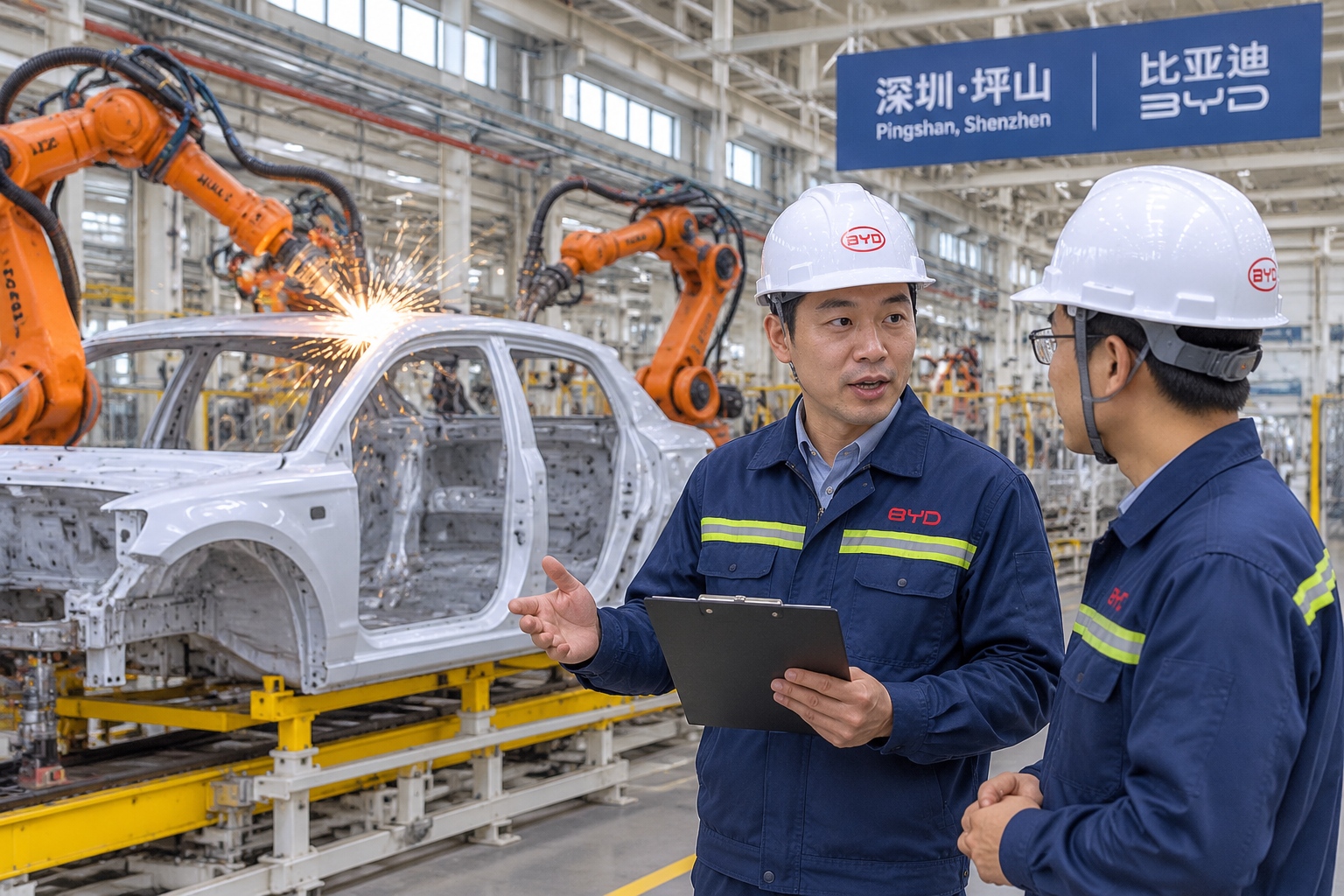
Most of that volume rolls out of BYD’s plants in Pingshan and the Shenzhen-Shanwei cooperation zone, plus the supplier estates that grew up around them. Less visible is the demand side. All of the city’s roughly 16,000 public buses are electric, as are almost all of its taxis, and charging points have become street furniture — in parking garages, outside wet markets, along the ring roads. Shenzhen is not only where vehicles are built. It is where they are used hard, in traffic and heat, by a city of about 17.8 million people, before anyone exports them.
The Two-Hour Rule
A car is roughly 10,000 parts. In Shenzhen and the two industrial cities it runs into — Dongguan to the north, Huizhou to the east — a manufacturer can reach suppliers of battery cells, motors, power electronics, die-cast aluminium housings, wiring harnesses and interior plastics within about two hours of driving. Not every part, and not the most advanced chips. But enough that a design change on Friday can be a physical sample on Monday.
The same density built Shenzhen’s older electronics trade. In Huaqiangbei, the component market district, a hardware team can source a circuit board, a connector and a custom cable in an afternoon, then find a small factory willing to run 200 units while everyone waits.
Engineers here call the result iteration speed, and it explains why “Shenzhen” on a supply-chain map is really a region. Land inside the city is scarce and expensive, so new plants push outward to Huizhou, Dongguan and Shanwei, while design, prototyping and sales stay near the centre.
The Third Dimension
“Low-altitude economy” sounds like a policy slogan until you see the invoice. It covers everything flying below roughly 1,000 metres: parcel drones, inspection drones that check power lines and building facades, camera drones, and the airspace software that keeps them apart. Shenzhen’s low-altitude industry has passed 130 billion yuan in output, and the city’s plan calls for more than 1,500 takeoff and landing points — vertiports, rooftop pads, converted helipads — so that flights become routine rather than ceremonial.
This happens in Shenzhen rather than in a city with more empty sky for the same reason cars happen here: the parts. Motors, propellers, batteries, gimbals, flight controllers and the firmware binding them together are made within an hour or two of each other. DJI, which holds roughly 70% of the global consumer drone market, is headquartered in Nanshan, with a long tail of smaller suppliers and rivals around it.
Dense cities are what make short flights pay. A drone crossing a traffic-clogged district at 100 metres is not a stunt; it is a way to skip a 40-minute van ride. That economics, more than the hardware, is what other countries are now trying to buy.
What Scale Feels Like at Three in the Afternoon
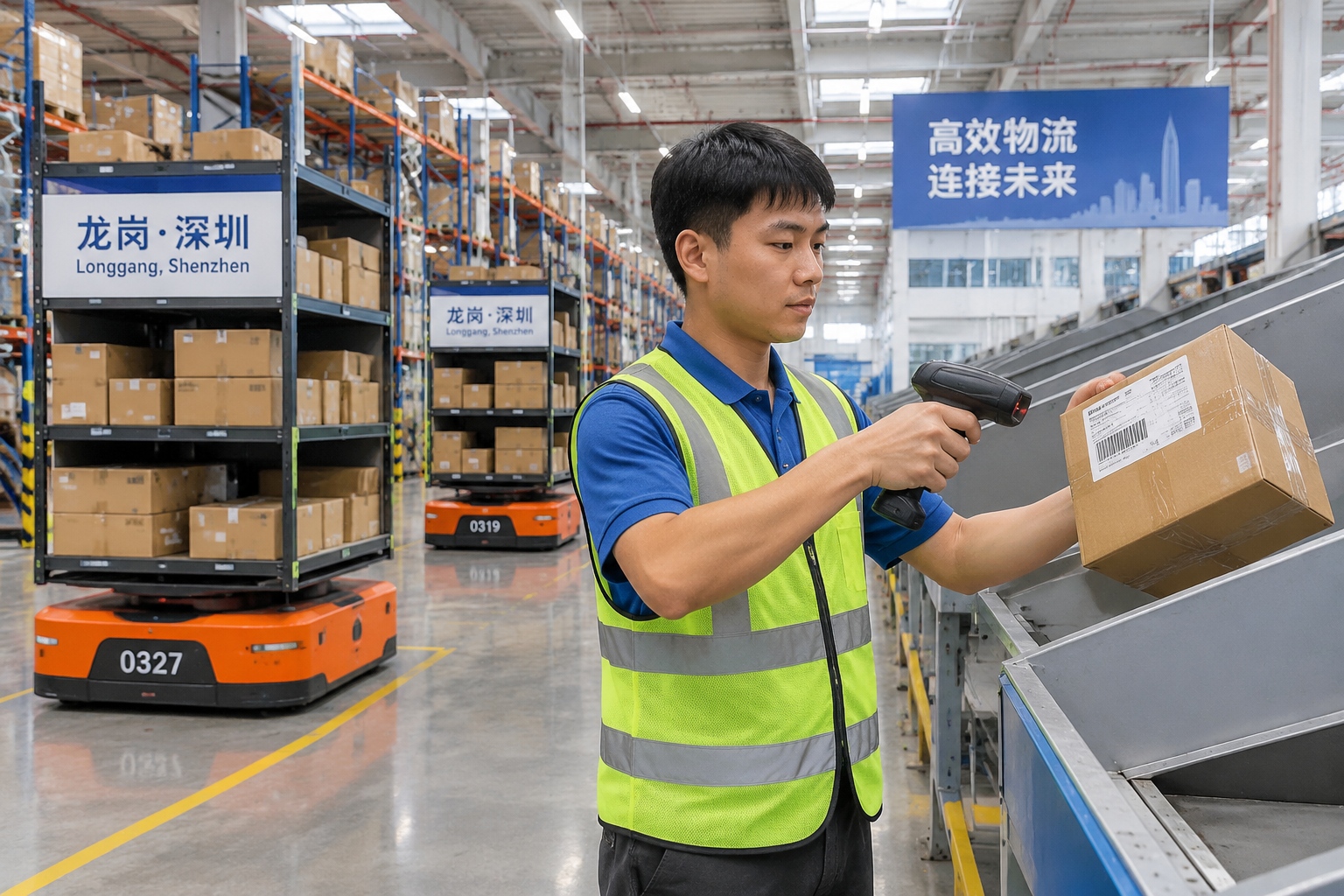
The numbers turn abstract fast, so it is worth standing on a warehouse floor. In a logistics hub in Longgang, orange robots the size of coffee tables carry shelving units across polished concrete to a picking station. A 26-year-old worker in a blue polo shirt and a yellow safety vest scans parcels with a handheld reader and lifts them into a chute. He does this about 900 times a shift.
He is not a symbol of anything. He has a rented flat, a commute by electric scooter, and a job that changed shape around him. The robots did not take his position; they changed what he is measured on, from items picked per hour to exceptions fixed per hour. Work that used to be walking is now mostly reading, scanning and troubleshooting.
Pay is what overseas readers ask about most. Entry-level assembly and warehouse work in Shenzhen typically brings in 5,000 to 7,000 yuan a month including overtime, against a legal minimum wage a little above 2,300 yuan; a technician who can maintain the robots earns noticeably more. A small flat in an outer district rents for 2,000 to 3,000 yuan. The arithmetic is tight, which is why the factory workforce is increasingly made up of migrants from other provinces, and increasingly mobile.
Why You Can’t Route Around It
Three things sit within an hour of each other. The first is engineers. Shenzhen spends about 5.8% of its GDP on research and development, a ratio above most countries, and companies such as Huawei, Tencent, BYD and DJI have trained a deep pool of hardware and software people. A hardware startup can hire a mechanical engineer, an embedded developer and a supply-chain manager inside a month.
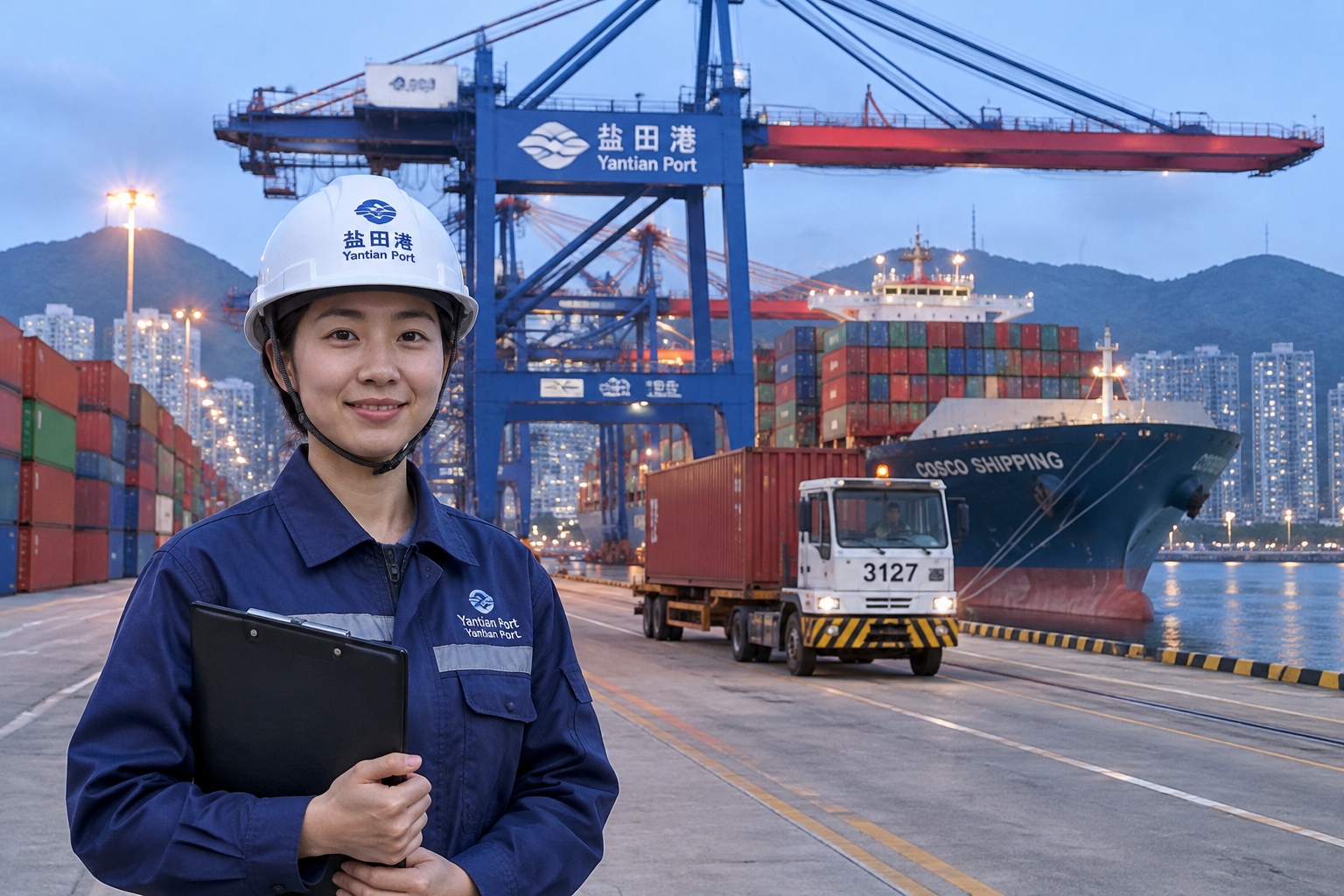
The second is a port. Shenzhen’s terminals handled more than 30 million standard containers in 2024, among the four busiest container ports in the world, with Yantian’s deep-water berths sailing directly to Europe and the US west coast. For an exporter, the factory gate and the ship are on the same side of town.
The third is orders. Because Shenzhen is also a market — dense, young, quick to adopt — a product can be tested at home before it is exported, and the feedback returns to the same engineers who designed it.
Put those together and you get a loop that is genuinely hard to replicate: design on Friday, prototype on Monday, ship on Wednesday, fix the design from real user data the week after.
None of this makes the city immune to politics. The United States has imposed a 100% tariff on Chinese electric vehicles; the European Union adds duties of up to 45.3% on top of its standard 10%. Chinese carmakers have answered by building plants in Thailand, Brazil, Hungary and Uzbekistan, and component suppliers follow. But moving final assembly is a decision; moving a supplier ecosystem takes a decade. Most design, tooling and component work stays put.
The constraints are real too. Land is nearly used up, so factories migrate outward. Housing costs push workers to the edges. Advanced chips remain a chokepoint. Automation raises output while shrinking the number of people needed to produce it — a trade Shenzhen manages better than most places, but does not escape.
The Shenzhen Part of Your Day
In November 2026, Shenzhen will host the leaders of the APEC economies. Delegates will arrive at a convention centre with fast wifi, and the temptation will be to treat the city as a stage set.
A more useful exercise is to walk through your own home. The robot vacuum, the power bank, the e-bike battery, the drone a neighbour flies at weekends, the wireless earbuds, the camera module in your phone, the steel mould behind a plastic casing — a meaningful share of it was engineered, tooled or assembled within 40 kilometres of that convention centre. For readers in Tokyo, Seoul, Hanoi, Sydney, Santiago or Los Angeles, “Shenzhen content” is already in the weekly shopping list. It simply stopped being visible.
Precision matters here. Some of these products are designed in Shenzhen and made in Shenzhen. Some are designed abroad and manufactured here. Some are designed here and assembled in Vietnam or Mexico from Shenzhen-supplied parts and Shenzhen-built tooling. That mixture is more interesting than the slogan, and it is why tariffs rearrange trade routes without necessarily moving the capability.
The Unremarkable Future
The usual way to write about Shenzhen is to reach for the skyline and the word miracle.
The better measure is the woman in Bao’an who does not look up. Infrastructure that works stops being a story; a parcel that arrives in eleven minutes becomes a fact of the morning, like running water.
What makes the city hard to copy is not one factory or one drone. It is the unglamorous middle: tens of thousands of suppliers within two hours, a workforce that can maintain robots as well as operate them, a port that sails everywhere, and a public habit of letting new things be tested in the open, imperfectly, before the rest of the world decides whether they are real.
That is also the honest limit. Shenzhen builds the future quickly, then makes it ordinary. The ordinary part is the hard part.