

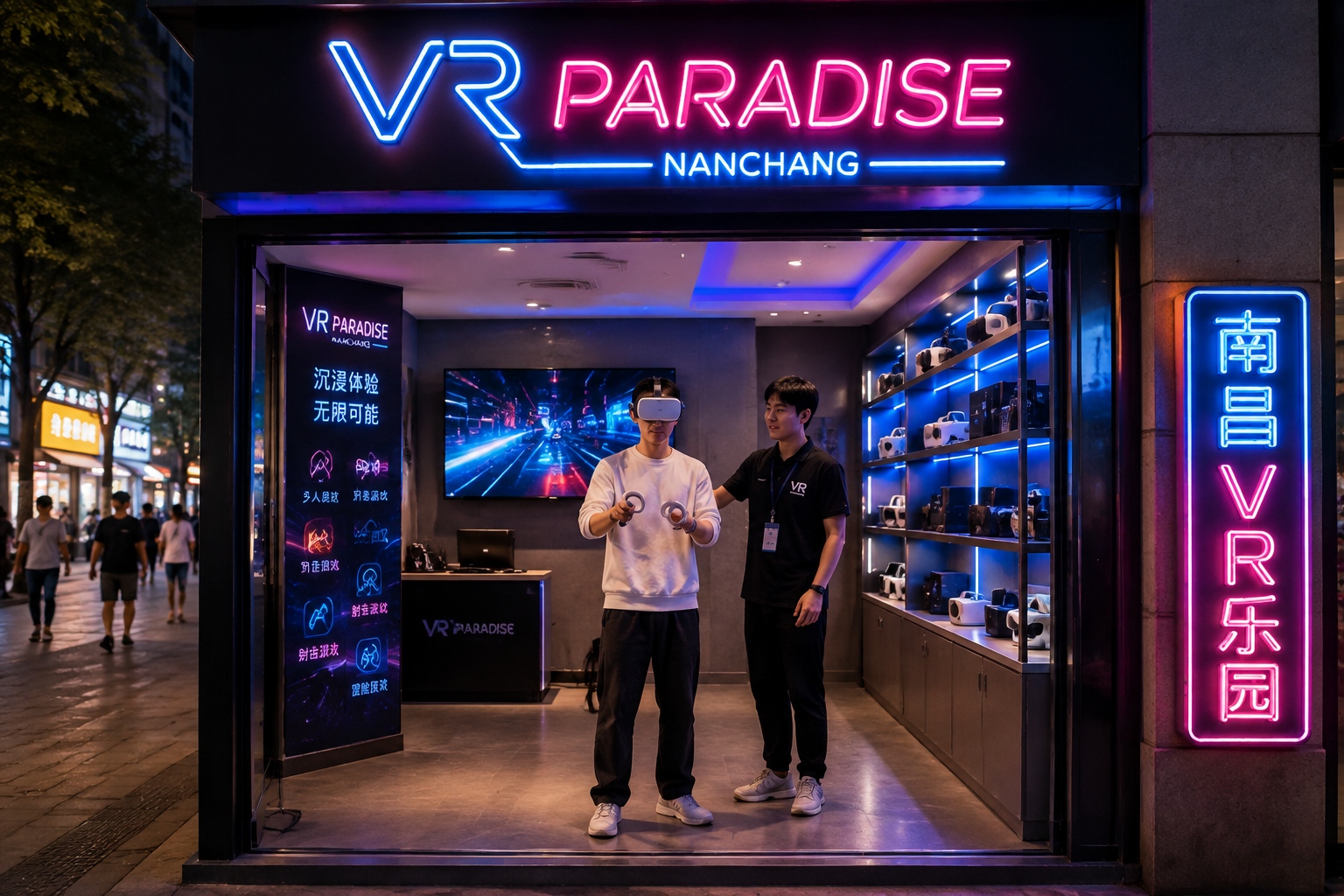
On a humid Saturday evening, a line of teenagers is waiting outside a small shop in downtown Nanchang. The storefront glows with neon lights, and a sign reads “VR Paradise.” One by one, they step inside, put on plastic headsets, and enter a different world—climbing mountains, fighting zombies, or flying over the Yangtze River. For the shop owner, a former garment-store manager named Li Wei, the headset is not just a toy. It’s his new career.
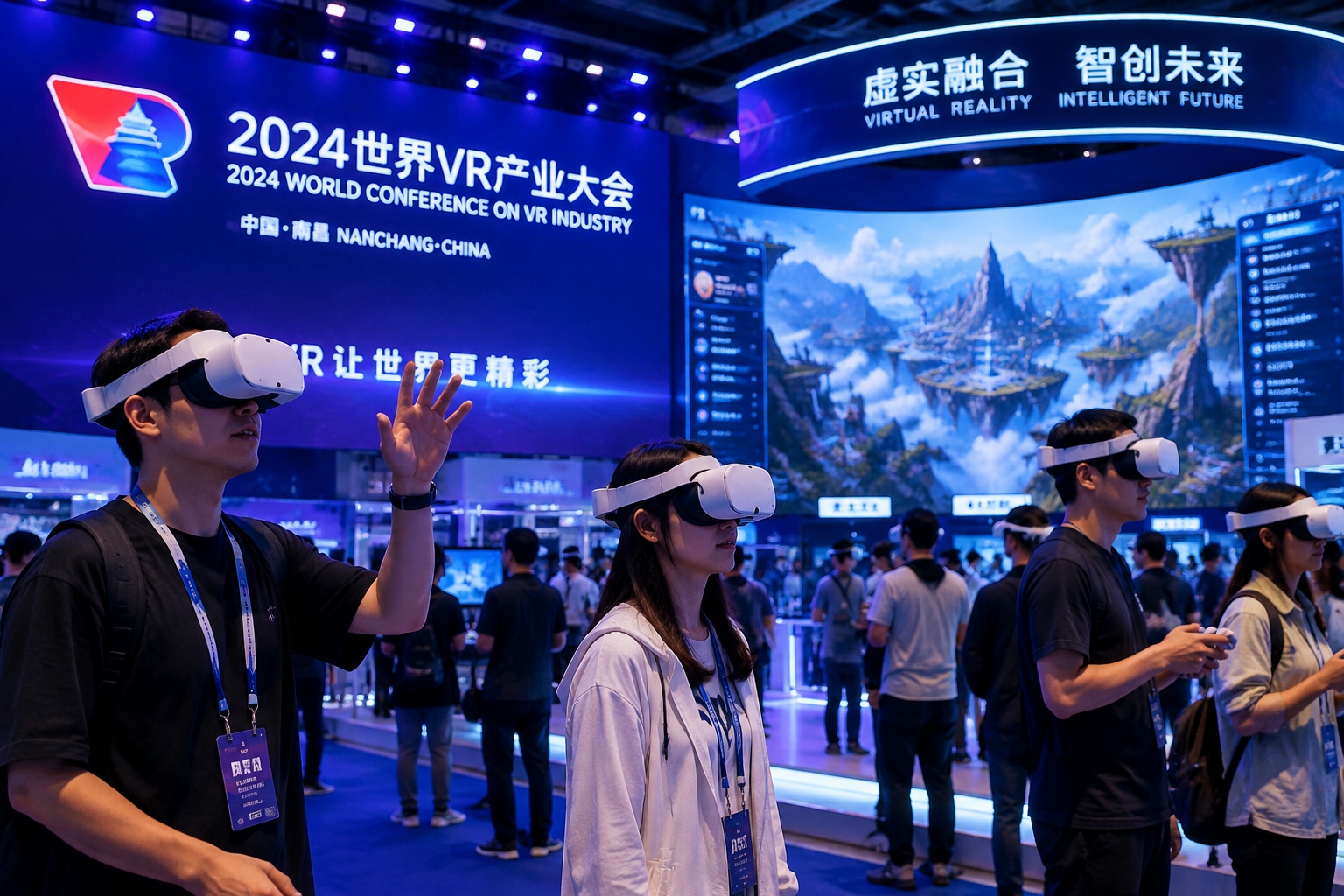
This is the new face of Nanchang, a city of over six million people in central China. Once known for its old industrial base—tractors, aircraft parts, and pharmaceuticals—Nanchang is now trying to rebrand itself as China’s virtual reality capital. Since 2018, the city has hosted the World VR Industry Conference, a large annual gathering that attracts tech giants like Huawei, Tencent, and HTC. The conference is officially permanently based here, and the city has been investing heavily in building a VR ecosystem.
Why Nanchang? The Politics of a New Industry
You might think a tech event like this would land in Beijing or Shenzhen. So why Nanchang?
The answer involves both policy and strategy. In China, cities often compete for flagship industries by offering land, tax breaks, and subsidies. Nanchang has something else as well: a willingness to commit fully. Local authorities have set aside a large area of the city to build the “China VR Valley” (中国虚拟现实产业基地), a 9-square-kilometer zone dedicated entirely to virtual reality. The zone includes incubators, labs, manufacturing facilities, and showrooms. Companies that move in get reduced rent, access to funding, and a streamlined bureaucracy.
For the government, VR is a promising sector. It’s clean, modern, and high-tech—a stark contrast to the heavy industries Nanchang has relied on for decades. It also fits into China’s broader focus on “new quality productive forces,” a term promoted by official policies to encourage innovation-driven growth. In practical terms, this means the central government backs the project, giving local officials confidence to pour resources into it.
The result is a cluster effect. More than 200 VR-related companies have registered in Nanchang, ranging from start-ups that make VR education software to manufacturers producing headsets and haptic gloves. The city has also attracted research institutes and universities to collaborate on VR content and hardware.
From Factory Floor to Virtual Floor
Numbers tell only part of the story. To understand what VR means for ordinary people, you need to talk to locals like Chen Jie. Chen, 28, used to work as a programmer in Shenzhen, the country’s tech hub. Three years ago, he moved back to Nanchang to join a VR start-up. “The salary is lower than Shenzhen,” he admits, “but I don’t pay rent, and I can see my parents every weekend. Also, I wanted to work on something that feels real. Here, everything we build is used in local schools or hospitals. That’s satisfying.”
Li Wei, the VR Paradise owner, is another convert. After the garment industry slowed down, he tried a few businesses before going into VR. He spent around 200,000 yuan (about $28,000) on equipment and rent. “Business is good on weekends; parents bring their kids. Many adults come to try the games too,” he says. During the World VR Industry Conference, his shop was flooded with visitors—not just locals, but international delegates who wanted to see how VR entertainment works in a small Chinese city.
Shop owners and programmers are the obvious beneficiaries. But VR is also creating new jobs for less skilled workers. The assembly lines that once made machine parts are now producing VR headsets for domestic and international brands. Workers who used to put together tractors have been retrained to assemble electronics, learning new skills in their 40s and 50s.
VR Gets Personal: School, Hospital, and the Street
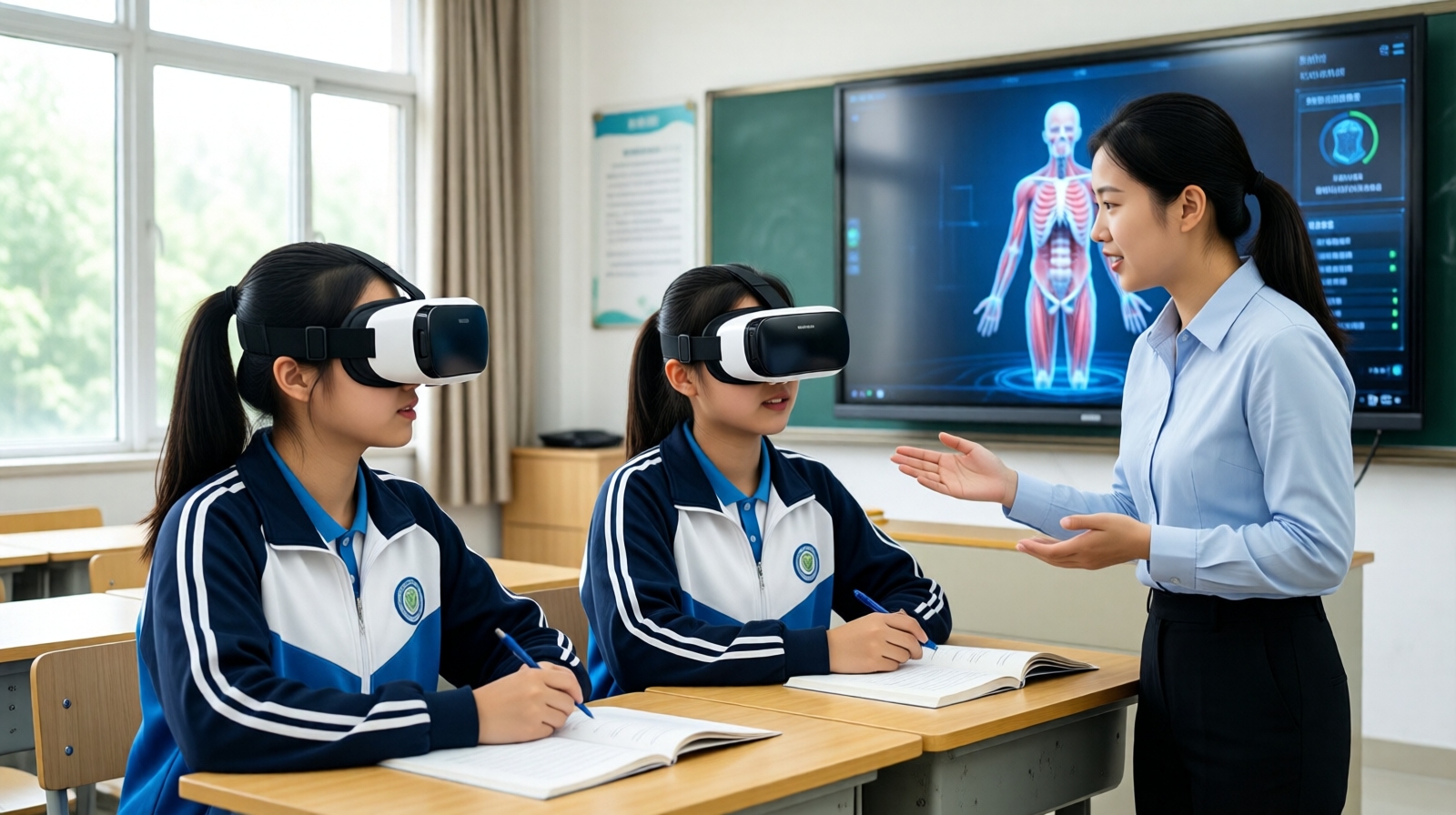
Walk into a middle school in the Honggutan district of Nanchang, and you might see a classroom where students are wearing VR headsets. They’re not gaming; they’re taking a virtual field trip to a coal mine to learn about safety, or exploring the inner workings of a human cell. Teachers say that students remember more from these immersive lessons than from textbooks.
Hospitals are also experimenting. The First Affiliated Hospital of Nanchang University has used VR to help train doctors for complex surgeries, and to treat patients with anxiety disorders through exposure therapy. In a country with a shortage of specialist doctors, VR training could help improve the skills of rural physicians at a low cost.
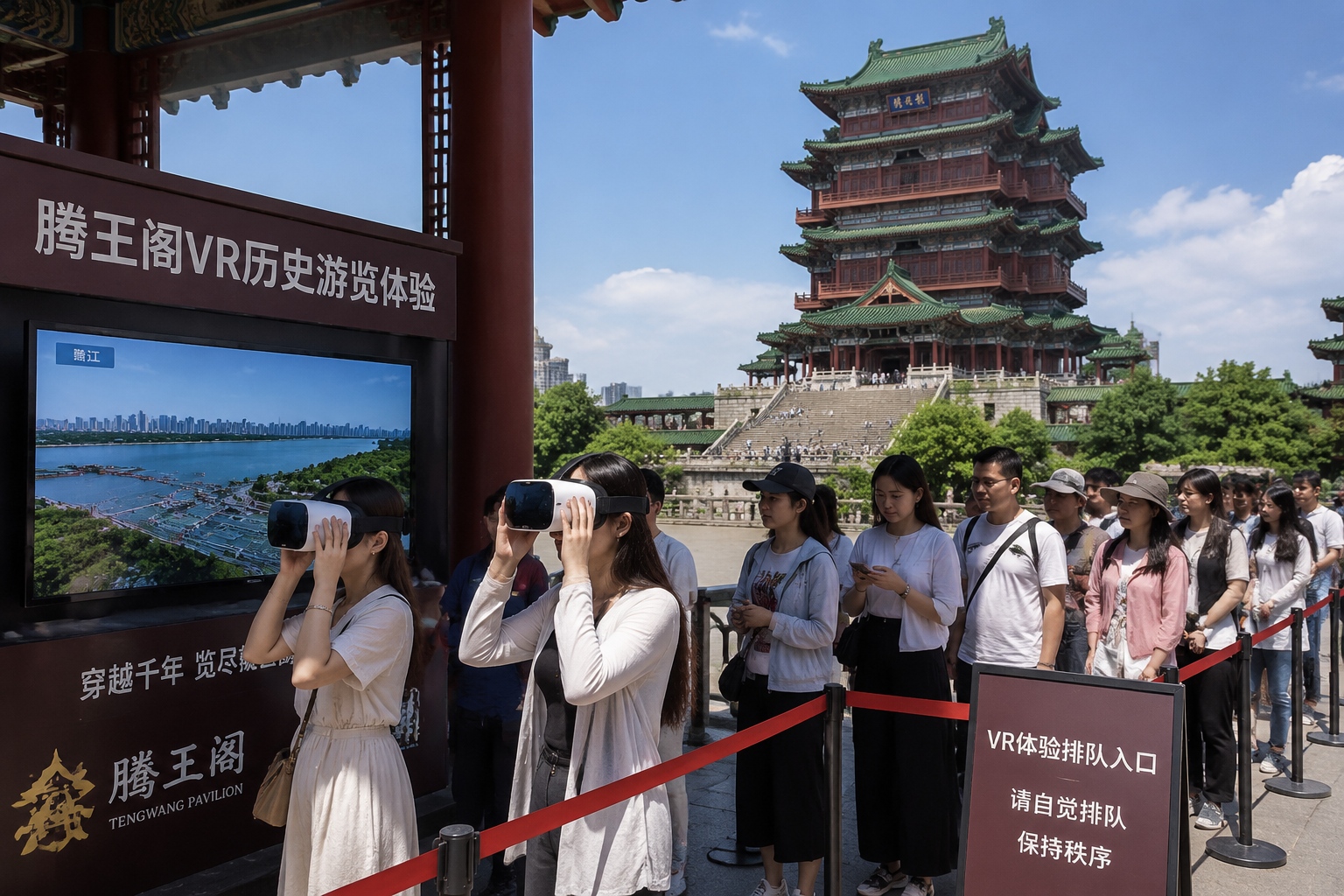
Tourism is another area where VR is making a splash. Nanchang is home to the iconic Tengwang Pavilion, a historic tower with a thousand-year history. Now, visitors can don a headset and experience the tower as it might have looked in the Tang Dynasty, complete with virtual dancers and ocean views. For old cities like Nanchang, this is a way to bring history alive for younger audiences who might otherwise scroll past. It also helps people who can’t physically climb the tower—like elderly visitors—experience it fully.
A City Brand Built on Pixels
For many residents, VR has become a point of pride. In Nanchang, “VR” is everywhere—on bus stops, in shopping malls, even in street light advertisements. The city has built a “VR Theme Park” where families can spend a day riding VR roller coasters and solving VR escape rooms. A light show in the summer projects VR imagery onto the city’s famous skyline.
The World VR Industry Conference itself is the biggest event of the year. In October, the city turns into a scene from a sci-fi convention, with engineers and venture capitalists from the US, Germany, Japan, and elsewhere mingling with local students and entrepreneurs. For young locals who can’t attend the official conference talks, public demo zones let them try the latest prototypes for free. The conference has a tangible impact: hotel bookings surge, restaurants stay open late, and taxi drivers learn new English words like “headset” and “virtual reality.”
But the branding is not just about fun. The city is betting that VR will attract a new generation of knowledge workers. Housing prices are still far below those in Beijing or Shanghai, but the influx of young tech workers is gradually changing the city’s demographics. Some local universities have added VR-related majors, helping to create a talent pipeline.
The Hard Part: The Gap Between Hype and Reality
For all the buzz, VR in Nanchang still faces real challenges. The first is technology. Modern headsets are lighter than their predecessors, but they still cause motion sickness for some users, and display resolution isn’t perfect. After the initial wow effect, many people put the device down and don’t pick it up again. Sustaining interest is difficult.
Then there’s the question of content. Hardware companies can set up factories easily, but producing compelling software is a different story. Many VR experiences are short, repetitive, or lack polish. The industry needs content for education, healthcare, and enterprise use, which takes time to develop and requires skilled creatives.
Competition is another issue. Many other Chinese cities—including Qingdao, Chengdu, and Wuhan—have jumped on the VR bandwagon. Nanchang has the advantage of being the conference’s permanent home, but it’s not alone in the race for talent and market share. Some observers worry that the city’s reliance on government subsidies could create a fragile ecosystem. If subsidies dry up, will the companies stay?
Finally, there’s the human factor. For the average resident, VR is still a novel experience rather than a necessity. At 200-400 yuan an hour in a commercial VR playzone, it’s too expensive for many families. The technology needs to become more affordable and more useful for daily life—something that may take ten years or more.
Conclusion: The Future Is Still Loading
Standing in the virtual Tengwang Pavilion, you can almost believe that Nanchang has already become the tech hub it wants to be. But if you take off the headset, you’re back in a city that still has plenty of construction sites and traffic jams. Industry parks are growing, but some are still waiting for tenants. The promises are big, but implementation takes time.
Yet something is happening here. For every problem, there’s a counter-example. A start-up making VR safety training for miners has found customers all over China. A woman who ran a traditional tea house opened a VR-themed branch, and now hosts students who learn about tea culture in a 3D environment. These are small, human steps—but they add up.
Nanchang isn’t planning to be a Silicon Valley. It’s trying to build a more grounded, niche-driven VR ecosystem. If VR is the future, this city wants to be one of the places where that future takes shape. Whether it succeeds depends on policy, capital, and—perhaps most importantly—the willingness of ordinary people like Li Wei and Chen Jie to embrace the new world, one headset at a time.
Start the discussion at forum.chinacomes.com