

A Friday Night in the Miao Village
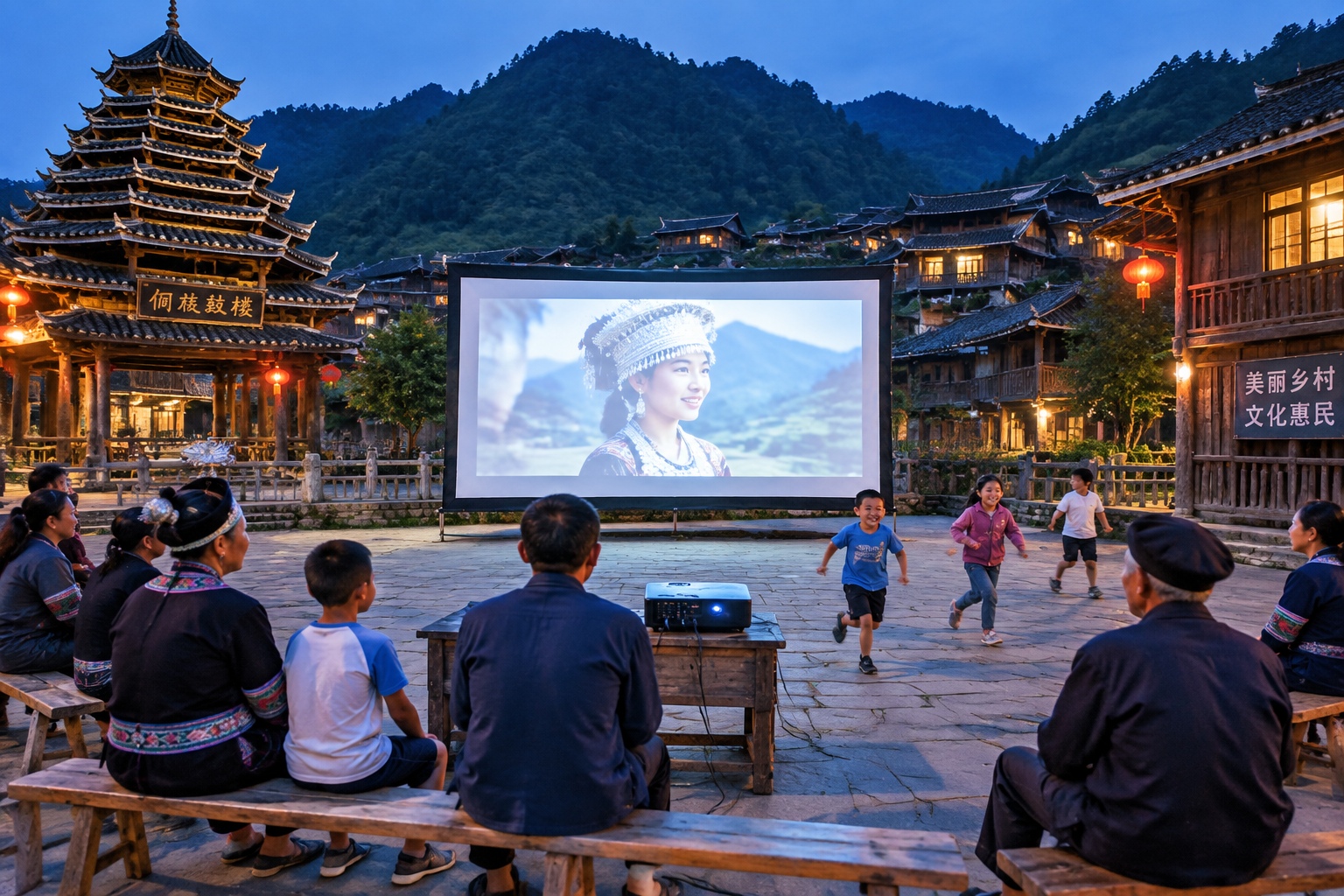
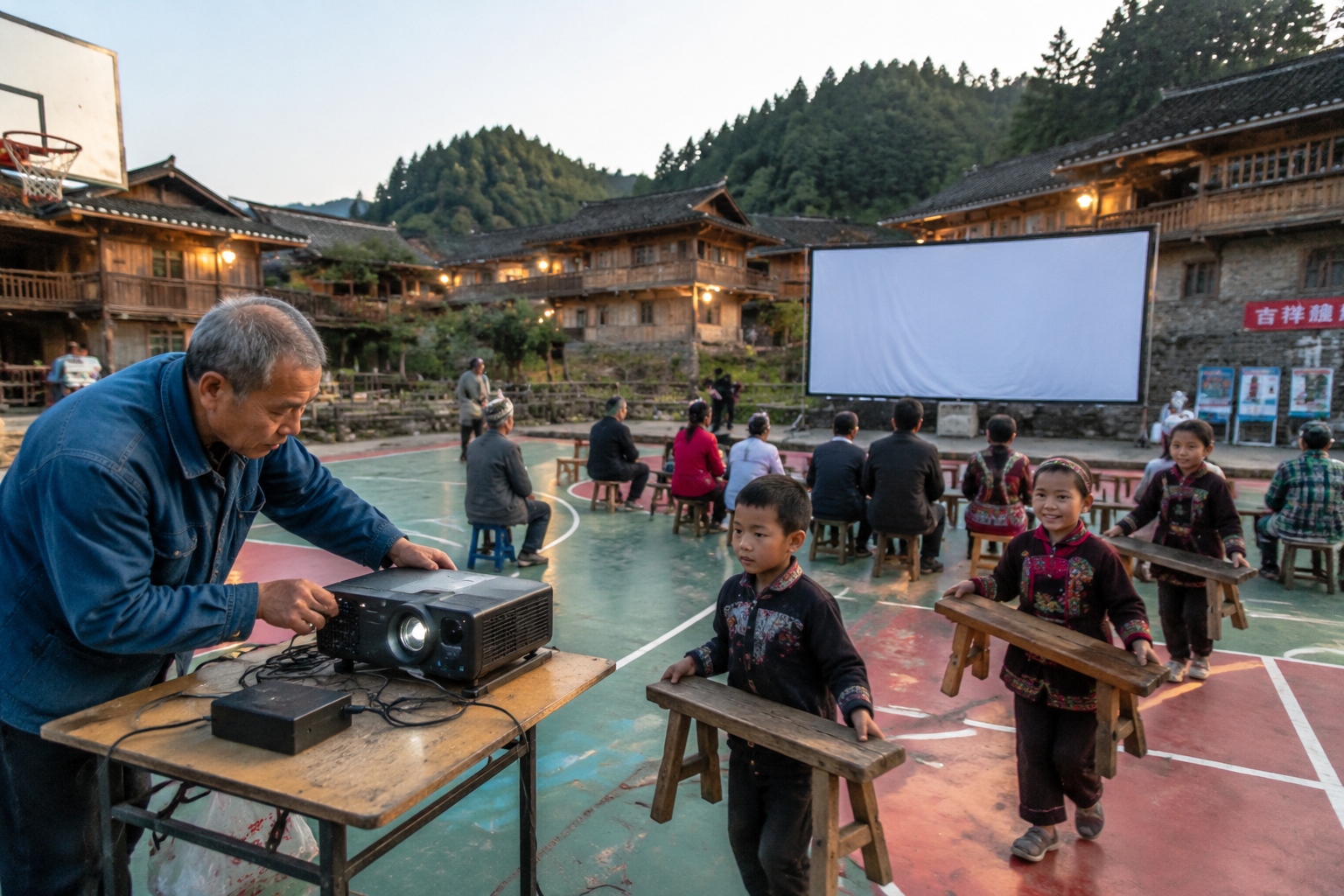
The sun slips behind green ridges, and the mountain air turns cool. In the center of a Miao village in Leishan County, Guizhou Province, children are dragging wooden benches across the concrete of a basketball court. A man in his sixties, Lao Yang, is setting up a digital projector and a white screen. The screen ripples in the wind, and the first stars appear above the black tiled roofs of the stilted houses.
By the time the projector light goes on, the court is full of neighbors. Elderly men sit near the drum tower, fanning themselves and talking about the weather. Women in Miao aprons share a bag of sunflower seeds. Toddlers run between the benches, and a few teenagers lean against the railing of the raised walkway, phones in their hands. The screen comes alive with a Chinese comedy, and laughter rolls across the square.
From ‘Cultural Delivery’ to a Weekend Ritual
Outdoor film screenings have long been a part of rural China’s cultural life. In the 1960s and 1970s, state-run mobile projection teams traveled across the countryside, often by bicycle or on foot, carrying heavy film reels. In remote Miao areas, a single screening could pull in hundreds of people from neighboring valleys. Lao Yang remembers those days. ‘I was maybe eight years old. The uncle setting up the film machine was a hero to us. We pressed against the screen to make shadows with our hands.’
Those early screenings were part of the ‘Culture Delivery’ initiative, which let the state bring films, books, and dance troupes to villages. In the 2000s, it was revived with the Rural Film Project, which guarantees every Chinese village at least one free film show each month. In many places, including this one, the show happens even more often. Every Friday, Lao Yang sets up his screen, rotates his small library of digital movies, and invites the whole community.
The movie choices have evolved too. Where once there were propaganda films and revolutionary epics, now there are blockbuster comedies, animated films, and even the occasional Hong Kong thriller. ‘I try to pick something upbeat,’ Lao Yang says. ‘If the film is too dark, people go home depressed. We want them to laugh and talk.’
More Than a Movie: Building Neighborly Bonds
The film itself is often the least important part of the evening. What matters is the space it creates for conversation. In a village where everyone knows each other, a movie night is a rare chance to sit still together. ‘We are busy all day, in the fields or in the guesthouse. On Friday, we know we will meet here,’ says Wang, a guesthouse owner in her forties.
Before the film starts, the square hums with exchange. Villagers compare notes on the price of rice, inquire about a relative in the hospital, tease a teenager about a new romance. During the film, snacks are shared without ceremony. ‘If you come empty-handed, you will still be eating someone else’s snacks by the end,’ Lao Yang says with a laugh.
At the end, people walk home together, lighting the path with phone flashlights. Some stop to chat on the steps of the drum tower. It is a ritual of reconnection. The bond of a shared experience lingers, and small needs are met. ‘If a family is going through hard times, you find them at the screening and they feel supported, just by being seen,’ Wang adds.
Why Young People Show Up
It might seem strange that young people, raised on streaming platforms, would trade their sofa for a hard bench. But at any given Friday, a good part of the audience is under 30. For them, the outdoor screening is a break from the isolating glow of a phone screen. ‘When I watch on my phone, I tap through everything,’ says Xiao Liu, a 23-year-old who returned from Chengdu to work in rural tourism. ‘Here, I have to commit. That is kind of meditative.’
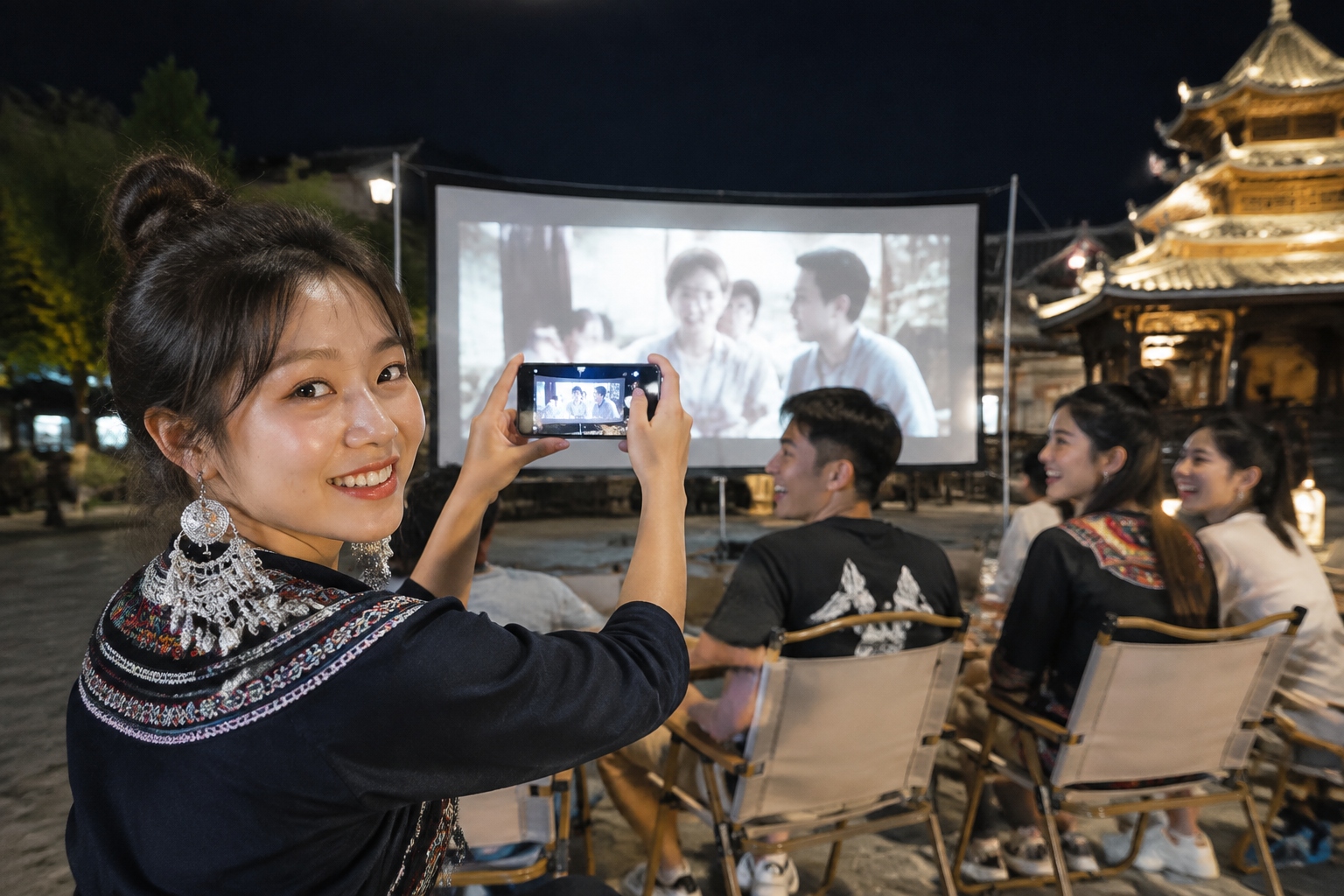
Young people also bring new energy to the event. They are the ones taking photos, posting short clips, or even running a live stream. Some arrive in small groups and turn the night into a social event. One young man, who runs a drone photography side business, occasionally captures an aerial shot of the crowd and the glowing screen. ‘The video always gets a lot of likes,’ he says. ‘People are surprised that such a small village has this kind of vibe.’
The open-air screening also works as a social bridge. A young woman in Miao silver earrings may sit next to an elderly auntie, and they end up discussing the movie or the annual festival. ‘It is a common language,’ Xiao Liu says. ‘When I bring friends from the city, they always ask if it is really free. Yes, it is. It is simply part of our community.’
How the Screening Has Changed
In the 1980s, Lao Yang would have needed a truck to carry a 16mm projector, film reels, and a diesel generator. Now, his digital projector fits into a backpack. The machine is charged overnight and runs a three-hour film on a battery. ‘No more threading reels or worrying about scratches,’ he says. ‘I just plug in a drive.’
But the new technology comes with new rituals. The evening’s first minutes are often documented by a row of smartphones. Some villagers livestream the opening credits. A drone may buzz overhead, capturing the scene from above. The audience has become part of the content, not just a passive crowd.
The screening is also more mobile. Instead of staying in one fixed spot, Lao Yang moves the event around the village to include hamlets that are far from the center. One week, it’s the basketball court; the next, it’s the square in front of the community center; sometimes it’s a small plateau that overlooks a bamboo grove. Each location gives the same film a slightly different backdrop.
Breathing Life into Public Spaces
In many Chinese villages, public areas are busy during the day but lonely at night. The basketball court is abandoned, the square is dark, and the drum tower is only home to pigeons and shadows. Open-air movie nights turn these places into a ‘living room’ for the whole village.
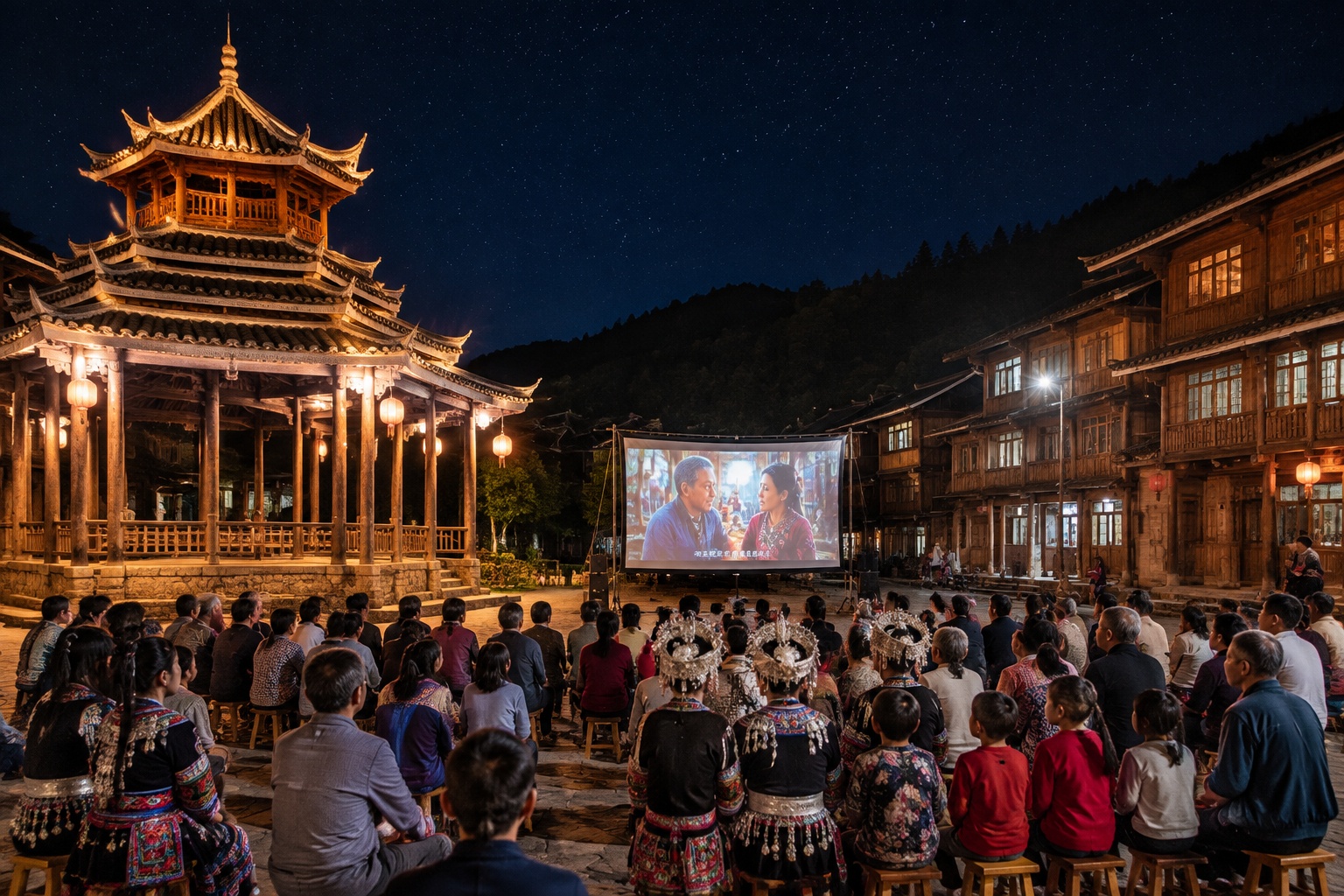
The drum tower, a traditional Miao structure, is more than a historic monument. It was originally a place for meetings, ceremonies, and recreation. When the movie screen goes up next to it, the tower becomes part of the setting. Its wooden beams glow in the projector light, and somehow the ancient and the modern share the same frame.
The presence of a weekly film screening also affects local commerce. The little shop near the court stays open an extra hour, selling cold drinks and watermelon seeds. Families bring their own chairs and leave them outside their doors. ‘The square is no longer empty at night. It feels like the village is full of life,’ says a 70-year-old man who has lived in the village all his life.
After the Screen Goes Dark
The movie ends around ten, and the white screen flickers off. The square slowly empties, but the sounds of conversation persist in the lanes. Lao Yang packs up his gear, helped by a few children who want to be his assistant. The benches are returned to the houses from which they came. Within an hour, the basketball court is just a court again.
But the film is not really over. It will be discussed the next morning at the tea stand, referenced in a joke at the evening meal. It becomes a shared reference point, a tiny piece of the community’s memory. Open-air cinema in this Miao village is not about nostalgia or a grand project. It is about people in the same place, under the same sky, letting a simple screen remind them of what they have in common. For a few hours every week, the village is a little more alive.
Start the discussion at forum.chinacomes.com