


Why a Cultivation Novel Sounds Like a Group Chat About Exams
On a recent evening on Line 2 in Shanghai, the woman beside me was reading a cultivation novel on her phone. The screen was a wall of names, realms and warnings. A comment bubble popped up: “Foundation Building stage is basically postgraduate exam prep with better lighting.” She smiled, kept scrolling, and got off at a station still looking at the page.
For readers outside China, the scene needs a little translation. Cultivation novels, often called xianxia or xiuzhen stories, are a huge part of Chinese web fiction. Their heroes train to move up levels: Qi Refining, Foundation Building, Golden Core, Nascent Soul, and higher. Each step brings longer life, more power and access to better resources. It sounds like pure fantasy. In the comment sections, though, readers keep using a very contemporary word: neijuan.
Neijuan is usually translated as “involution.” It does not simply mean working hard. It describes a competition that gets fiercer without making life better for most people: everyone studies later, buys more test prep, sends more messages after hours, and the ranking hardly moves. The term spread widely in China around 2020, first in academic discussion and then in ordinary online speech. Once you know it, the cultivation novel stops looking like an escape from modern life. It starts looking like a very elaborate way to talk about it.

The Sect Is a Strange but Familiar Institution
A cultivation sect is not a school, but it runs on quotas. Outer disciples get little; inner disciples get teachers, manuals and better caves. Spirit stones buy pills, weapons and travel. A good spiritual vein can decide how fast a character advances. Talent matters. So do a master’s favor, a lucky encounter, a clan connection or being in the right valley when a rare herb ripens.
That is why the ladder feels familiar to Chinese readers. Effort is necessary, but it is not enough. A character can train for decades and still hit a bottleneck. Another can find an ancient relic and jump three realms. Readers do not miss the parallel. Under one popular novel, I saw comments calling the sect entrance test “the gaokao with flying swords.” Another reader wrote: “Qi Refining is graduating. Foundation Building is finding a job. Golden Core is getting the hukou.” The joke is not exact, but it lands because the vocabulary of levels, entry barriers and scarce places is already in the air.
Why Readers See Their Own Ladder
Chinese education and employment are full of named thresholds. The gaokao, the national college entrance exam, remains the most visible one; more than 13 million students took it in 2024. Then come postgraduate exams, civil service exams, teacher recruitment exams, professional certificates and rounds of interviews. Each has its own preparation economy: books, cram schools, study rooms, online courses, motivational posts and quiet competition over who slept less.
Young adults also talk about shangan, literally “getting ashore.” It means finally landing a stable place after swimming in uncertainty: a public-sector job, a graduate school offer, a contract that lasts. In cultivation novels, the equivalent is breaking through to the next realm. The language borrows from both Buddhist and Daoist imagery, but in the comments it becomes something more mundane: exam results, rent, overtime, parents asking when you will settle down.
The comparison has limits. China is vast, and young people do not live one single script. Some chase elite degrees; some leave big cities for smaller towns; some choose freelance work, trade skills, live-streaming, manufacturing jobs or careers their parents do not understand. Others reject the ladder entirely and move to places where rent is lower and life is slower. The novel metaphor is popular because it captures a mood, not because it describes every life.
The Writers Are Grinding Too
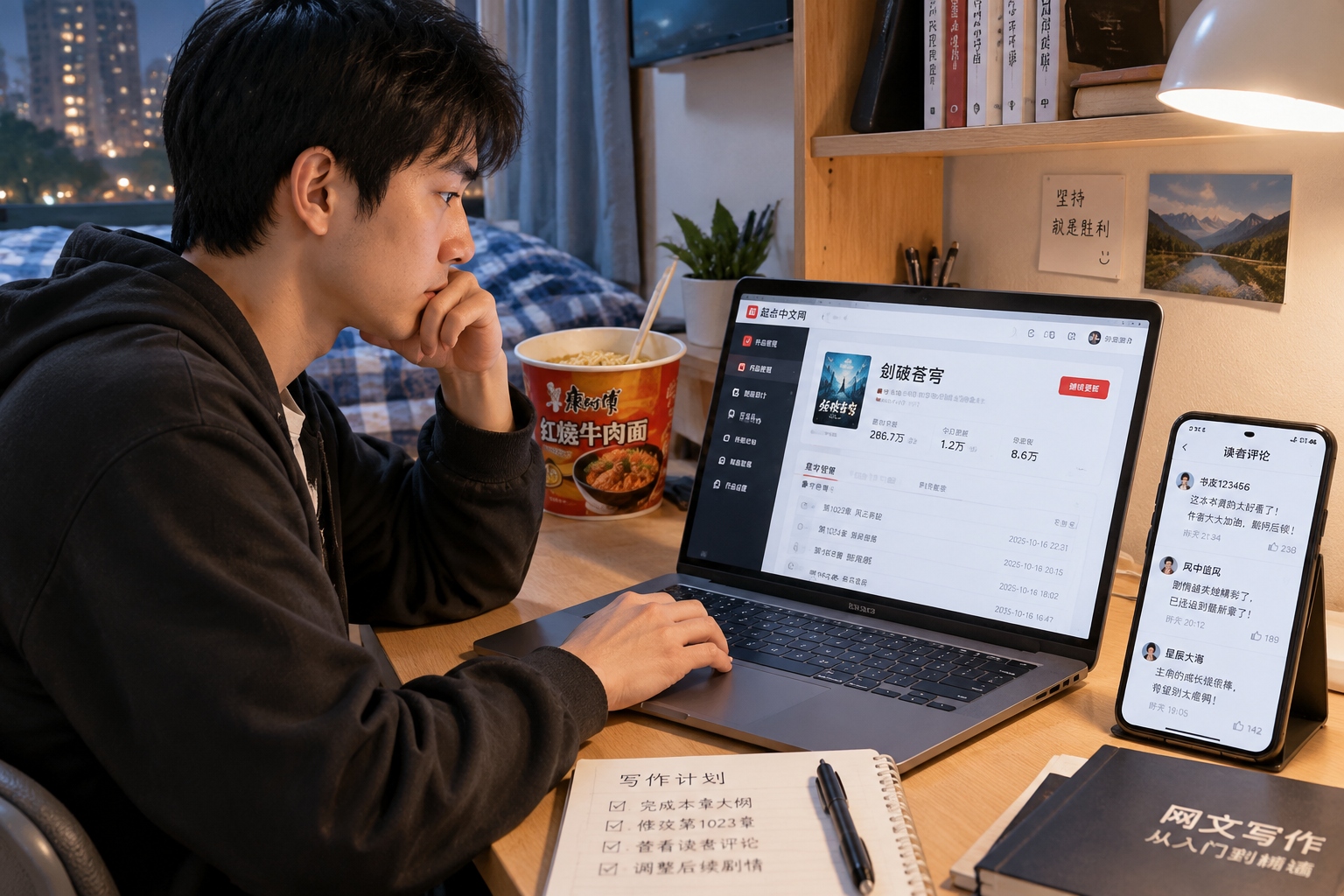
The competition inside the story is matched by the competition that produces it. Chinese web novels are usually serialized, not written in private and published later. Authors post chapters daily or almost daily, often 4,000 to 6,000 Chinese characters at a time. Platforms sell chapters by subscription. Readers vote with monthly tickets, comments and tips. Rankings shape visibility, and visibility shapes income.
This is a demanding job. A successful author may write 8,000 to 10,000 characters a day, keep a plot spreadsheet, answer reader comments and end chapters on a hook. Missing updates can cost momentum. A bad ranking can bury a book. The industry has produced millionaire authors and factory-like studios, but most writers work in the middle, watching data and trying to keep readers subscribed. CNNIC, China’s internet research center, counts more than 500 million online literature users in the country. That is a huge audience, and a huge treadmill.
That material pressure shows up in the fiction. Protagonists often receive a “system,” a cheat-like interface that gives them missions and rewards. They find mysterious teachers, hidden maps and lucky opportunities. Pure grinding is rarely enough. Readers enjoy the fantasy of fairness, but they also know that the unfair advantage is part of the plot. The genre does not pretend that effort alone explains success. It turns that uncomfortable fact into entertainment.
Why “Involution” Travels Beyond China
Neijuan is not a Chinese invention. Korean students compete for a handful of university places. American teenagers build résumés for college admissions. Gig workers in many countries run faster as platforms tighten their algorithms. The feeling of running harder while the finish line moves is global.
What makes the Chinese version specific is scale and texture. The country has a huge education system, dense cities and a platform economy that turns many kinds of competition into visible rankings. A student can compare scores on a phone. A job seeker can see which friend posted an offer. A delivery rider can watch a countdown. A web novel author can check monthly ticket standings at 2 a.m. The numbers are always there, and they make abstract pressure feel personal.
That helps explain why cultivation levels travel so well as a metaphor. The genre offers a clean visual ladder in a society where ladders are often complicated. It lets readers say: I am not lazy; the bottleneck is real. It also lets them imagine a breakthrough — a master, a pill, a hidden path — without pretending that everyone gets one.

A Mirror, Not a Manifesto
Cultivation novels are not sociology. They are fast, emotional, sometimes wildly uneven stories built for daily reading. Their heroes can be petty, lucky or ruthless. Their worlds often reward hierarchy as much as they critique it. A reader can cheer for the underdog and still enjoy the fantasy of becoming the strongest.
But the genre is a useful mirror. It shows how ordinary people turn exhaustion into a shared vocabulary: realms, bottlenecks, resources, breakthroughs. It also shows a desire that is not only about winning. Readers want doors to open for reasons they can understand. They want talent to be seen. They want a chance to rest without falling behind.
That is why the woman on Line 2 kept reading. The novel offered her a world of flying swords and immortal caves, but the comment she smiled at was about exam prep. The fantasy was not a denial of modern competition. It was a way to make it visible, laugh at it for a second, and keep going.
Start the discussion at forum.chinacomes.com