
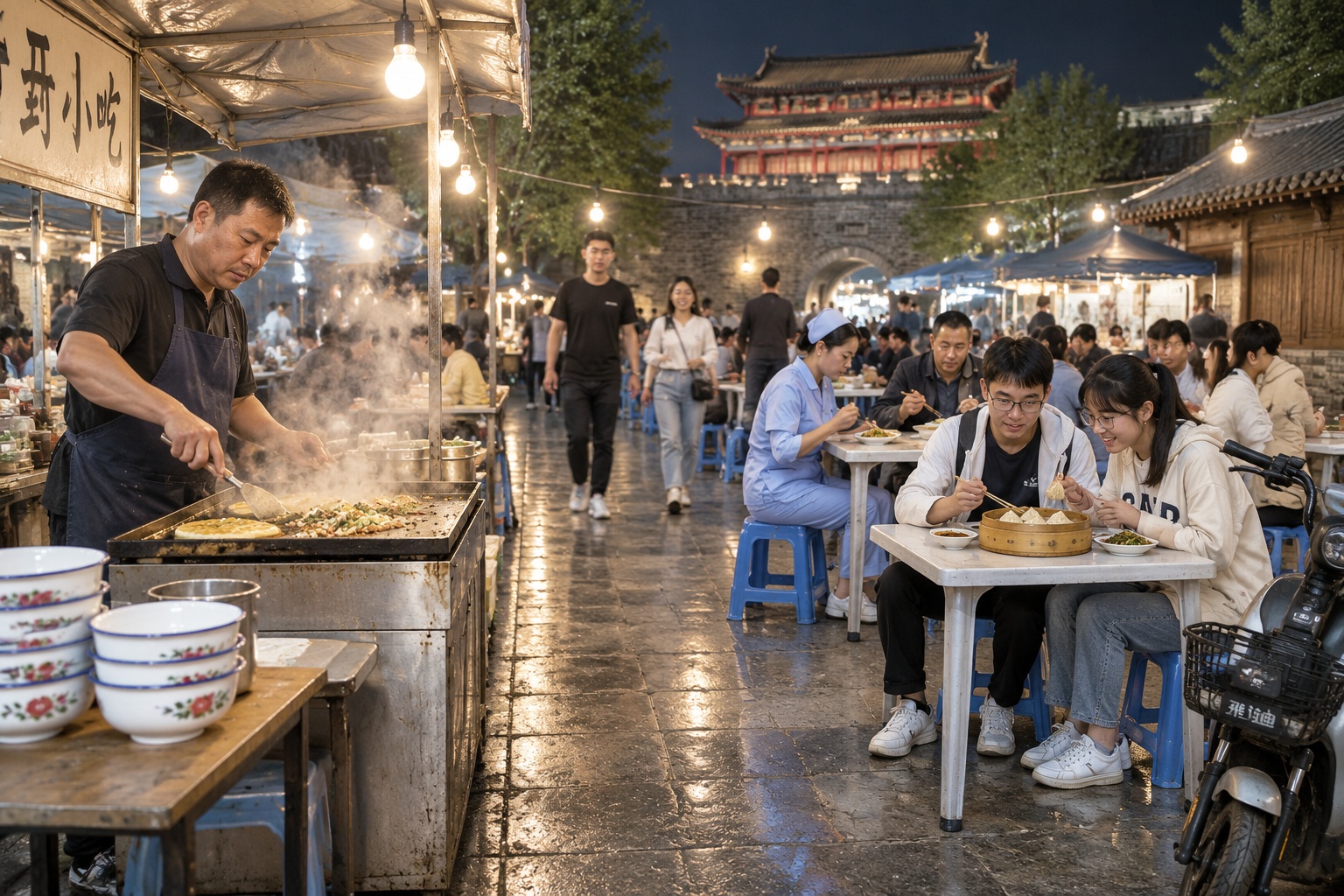

10:40 p.m. at Xisi Square
The smoke off Wang Jianhua’s griddle has already drifted three rows deep into the plastic tables. He works a slab of liangfen — mung-bean jelly, cut into dice — with a flat spatula, pressing it into the oil, scraping it up, flipping it. It makes a short metallic rasp, over and over, like someone sharpening a knife in bursts.
“Two more, extra chili,” a woman says, holding up two fingers without looking away from her phone.
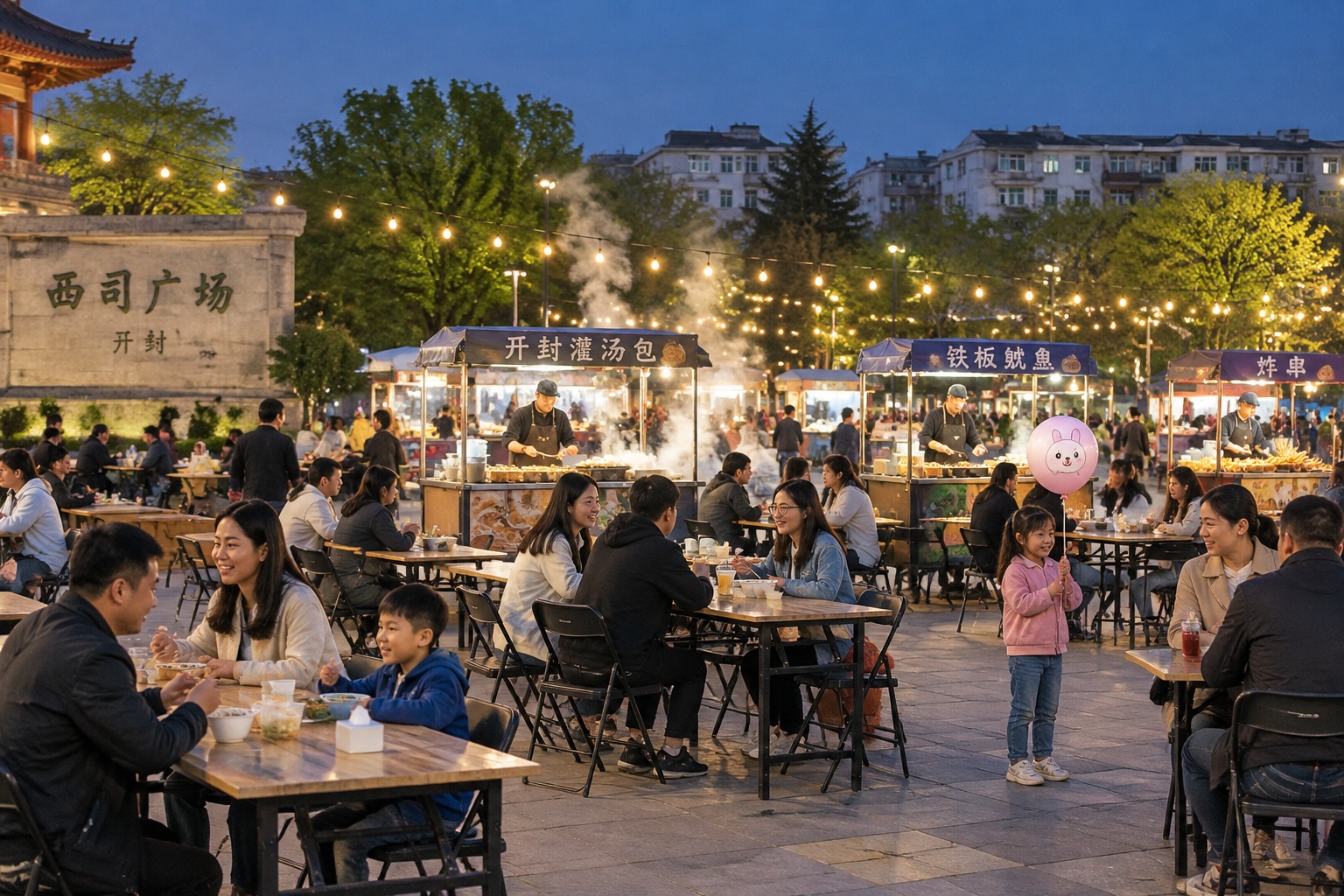
Wang is 46 and has sold fried liangfen at this spot for eleven years. Behind him a lamb-skewer cart throws up a curtain of white smoke. To his left, a man is pressing dough into rounds for mutton kianmo — scallion and chopped lamb folded into a pancake and fried in lamb fat until the edges go crisp and dark. Somewhere in the third row a child is crying about a balloon. The air smells of chili oil, rendered fat, wet cardboard, and the sweet, slightly burnt note of sugar caramelising at an almond-tea stall.
It is a Saturday in late spring, the first week warm enough to sit outside without a jacket.
Kaifeng is not a city that shows up on most foreign itineraries. It sits in eastern Henan, about half an hour by high-speed train from Zhengzhou, with roughly 4.8 million residents. A thousand years ago it was Bianjing, capital of the Northern Song, and by some accounts the largest city on earth. A memoir of that city written in the 1140s, Dongjing Meng Hua Lu, describes a night market near Zhouqiao bridge that stayed open past the third watch — roughly one in the morning. Kaifeng has been citing that passage ever since.
So the question worth asking is not whether Chinese cities have night markets. It is what one actually does, on an ordinary Saturday, for the people standing behind the griddles and the people sitting at the tables.
Two Night Markets, Two Different Cities
Kaifeng runs on two night-market economies that overlap but are not the same.
Around the Drum Tower, in the middle of the old city, is the version on the postcards: several hundred numbered stalls with uniform metal counters, set up after a 2014 renovation, five minutes’ walk from the night-tourist circuit. On a spring weekend it is packed shoulder to shoulder with visitors, and the sound is a steady wash of phone cameras, hawkers calling prices, and children being lifted onto shoulders.
Xisi Square, where Wang works, is a ten-minute walk west near Bao Gong Lake. Fewer tour groups, more neighbours. Rent for a spot is lower, the tables are older, and you hear more Kaifeng dialect than Mandarin. Students from Henan University’s old campus tend to drift toward the west gate crowd instead. Different streets, different customers, different margins.
A Vendor’s Day, Told in Hours
Wang’s day starts at six in the morning, when he rides an electric three-wheeler to a wholesale market on the edge of the city to buy mung-bean starch, chili, oil, and scallions. Prep runs from about ten until three at the family’s flat, where his wife cuts jelly into blocks and his younger brother handles the skewer cart next door. They load up around four thirty and are set up by five.
Selling runs from six in the evening until sometime between midnight and one, depending on the weather and the crowd. Then comes the part tourists never photograph: stacking stools, hauling the gas cylinder, hosing down the pavement, getting home at two.
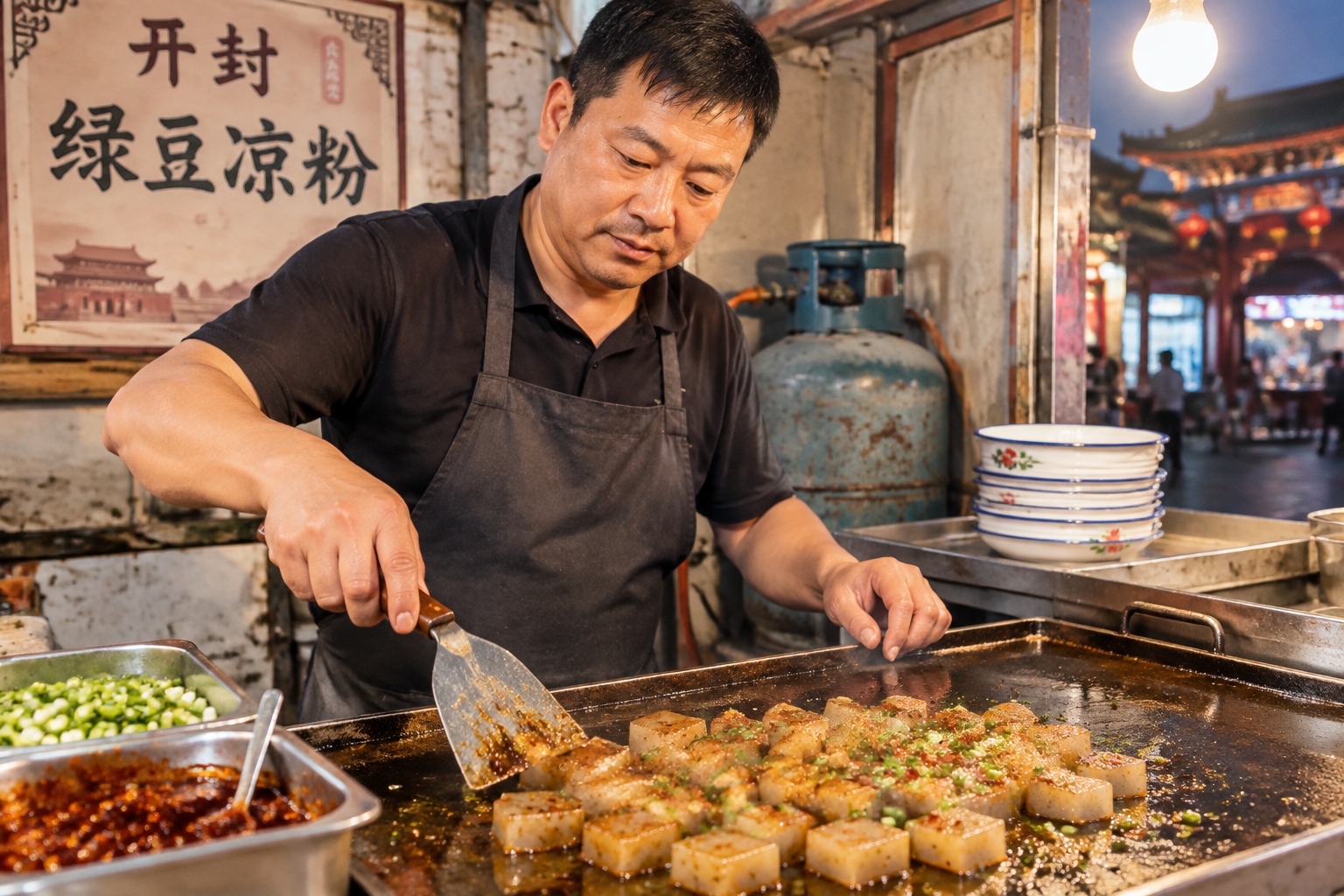
The money is real but thin. A good summer Saturday might bring in 1,200 yuan in sales; a cold, wet Tuesday might bring 200, or nothing at all. Ingredient costs eat roughly 40 percent. A fixed spot at Xisi with a stove and table space runs somewhere between 1,500 and 3,000 yuan a month depending on position, before gas, electricity and the occasional repair. Wang says he clears around 6,000 to 8,000 yuan a month in the season — better than an assembly-line wage in Zhengzhou, with no employer and no insurance.
Winter is the hard part. From December to February, the same street can be half empty by nine o’clock, and some vendors switch to selling roasted sweet potatoes or go home to their villages until spring.
What 60 Yuan Buys
Soup dumplings are Kaifeng’s signature: thin-skinned, filled with pork and hot broth, roughly 18 to 25 yuan for a basket of ten. You lift one by the pleat, bite a small hole, sip, then eat. First-timers usually burn their mouths.
Fried liangfen is 8 to 10 yuan. Mutton kianmo is 12 to 15. A bowl of almond tea — actually lotus-root starch thickened with ground almond and topped with raisins and sesame — is 6 to 8. Half a barrel-cured chicken runs 40 to 60, and most people buy it to take home.
Two adults can eat their fill for 50 to 70 yuan, about seven to ten US dollars. That number matters more than any description of atmosphere. It is cheaper than a mid-range restaurant, cheaper than delivery apps after the delivery fee, and it requires no reservation, no dress code and no plan. You can show up at eleven at night with three friends and a child and nobody will look at you.
Queues form at maybe five or six of the several hundred stalls — usually the ones with a long reputation or a short video. The rest of the street turns over tables every fifteen to twenty minutes, which is the actual business model: not selling the best thing, but selling fast enough.
Who Comes Out at Midnight
By eleven the crowd has changed. The families with small children have gone home. What’s left is nurses off the late shift at the nearby hospital, still in scrubs; delivery riders eating their one proper meal of the day before the midnight order rush; factory workers from counties an hour away who came into the city for the weekend; groups of nineteen-year-olds sharing one basket of dumplings and four bowls of tea.
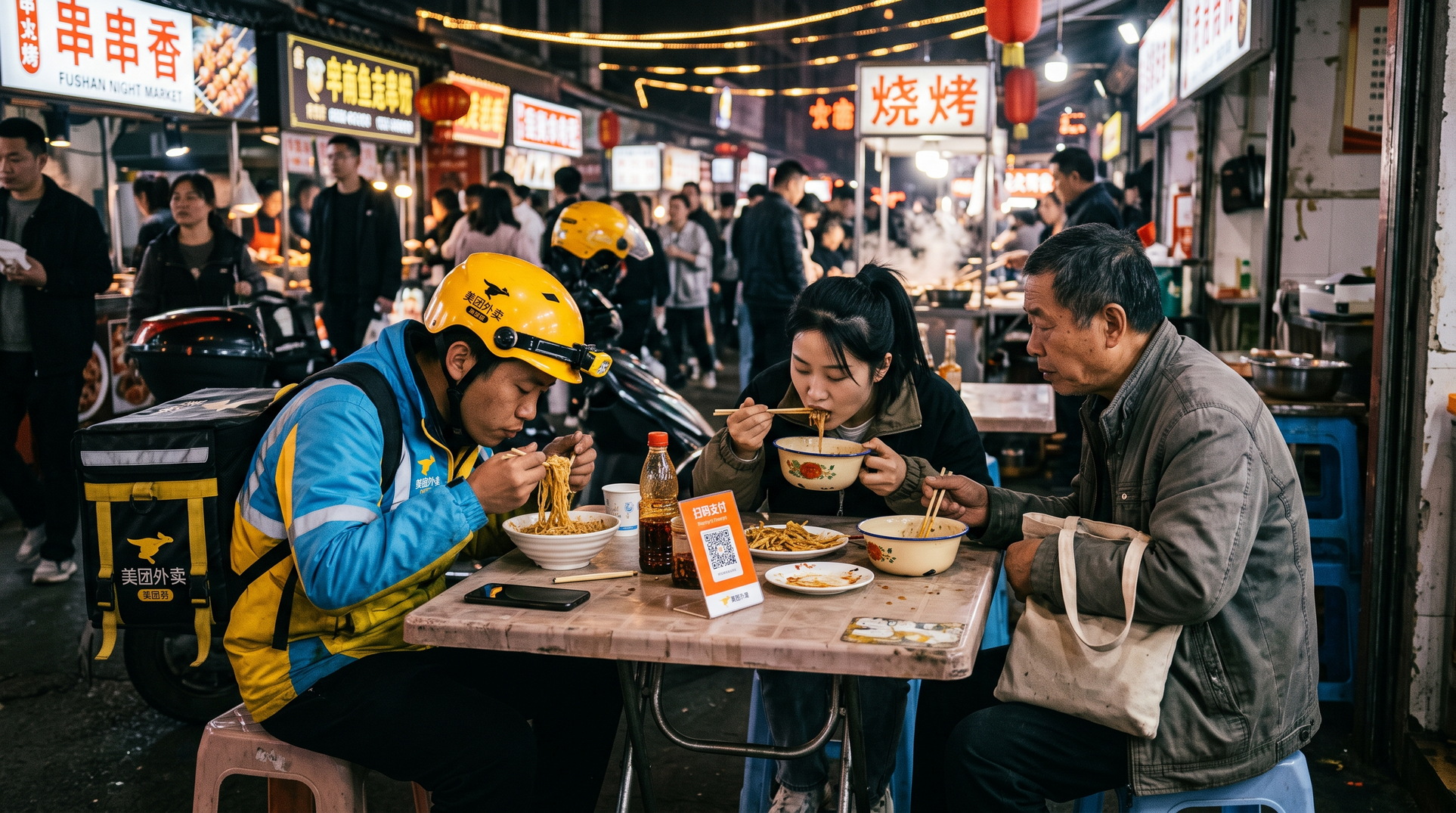
There are also people who come alone. A man in his sixties with a canvas bag sits down most Saturdays with a bowl of almond tea and stays for forty minutes without ordering anything else. Nobody hurries him. In a city where a sit-down restaurant means committing to a meal and a bill, a plastic stool costs almost nothing to occupy.
The Table Is Shared
Strangers get seated together here as a matter of course. If the tables are full, you take the empty chair at someone else’s and nobody says anything. Wang knows perhaps thirty regulars by their order — the woman who wants her liangfen without scallion, the two men who come after their shift and split a chicken.
Phones are everywhere, but they don’t replace the conversation. A group of students will photograph the dumplings, post them, then put the phone face down and argue about a job offer for the next hour. Some younger vendors run their own accounts and film the griddle between customers; one skewer seller near the Drum Tower has a small ring light clipped to his cart. The camera and the gathering are not opposites. The camera is often why the gathering happens.
Who Keeps the Street Running
A market this size does not run on atmosphere. It runs on schedules.
Stalls at the Drum Tower are numbered and assigned, with gas lines, water access and fire extinguishers checked before opening. Health certificates are posted at the front of many carts. City inspection vans with rapid-test kits for cooking oil and meat show up unannounced; vendors describe them the way restaurant owners elsewhere describe a health inspector.
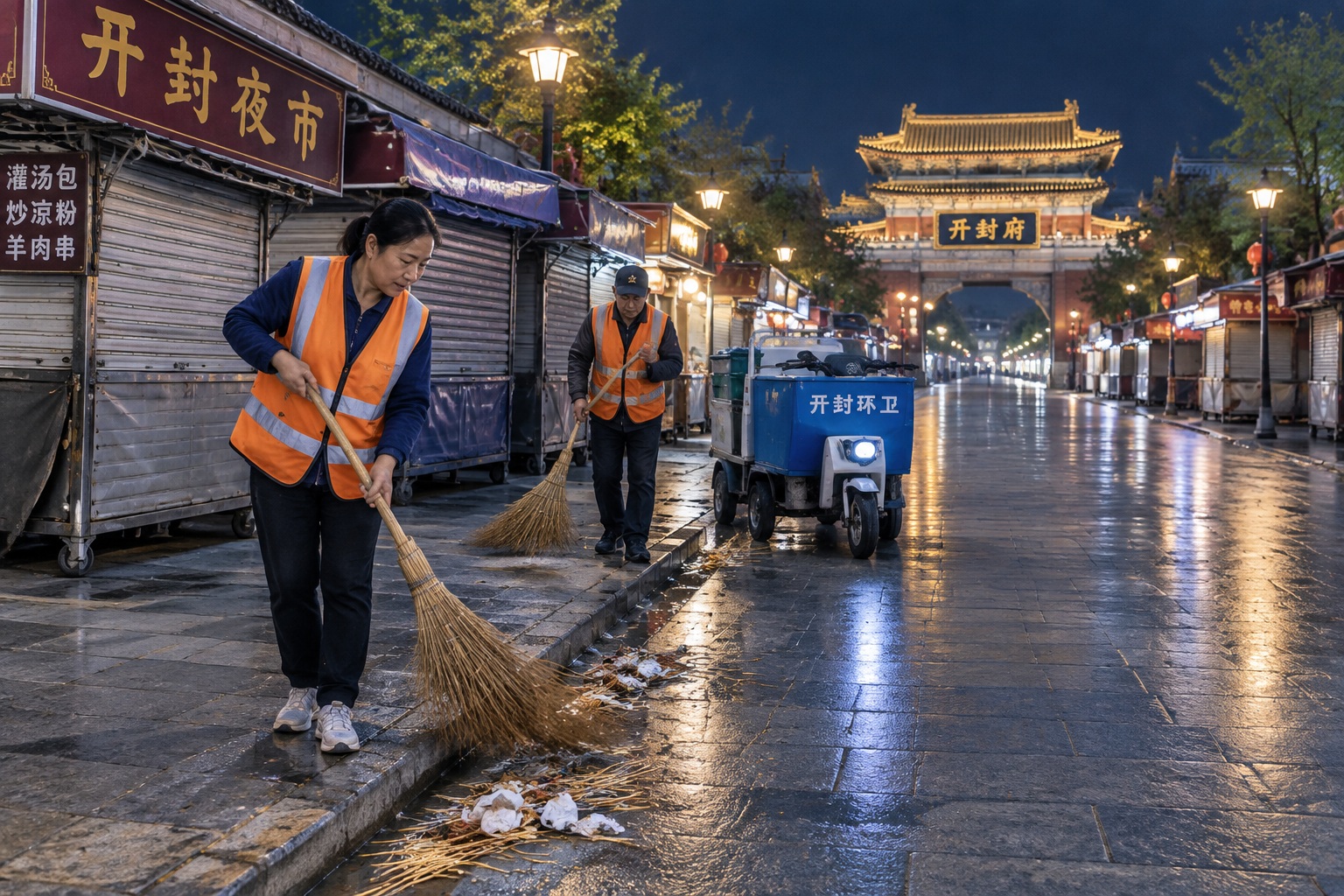
The street closes to cars at six. Cleaning crews of thirty to forty workers per market start working the edges around ten and move in properly after one, with small electric carts and brooms, sweeping ash and skewers into piles. By three in the morning the pavement at Xisi is largely bare, and by six it is a road again.
Payment is almost entirely by phone. A laminated QR code taped to a plastic stand handles both WeChat Pay and Alipay; most vendors keep a few hundred yuan in notes in an apron pocket for the occasional older customer or a dead battery. Noise is the recurring complaint — residents in the flats above the busier streets have pushed for earlier closing times, and some markets have been moved or shrunk as a result.
The Friction Behind the Smoke
Kaifeng’s night markets have changed fast since 2023. A matchmaking show at a theme park on the city’s edge went viral in spring 2024, and weekend visitor numbers jumped; hotel prices in the old city tripled around the Qingming and May Day holidays. Vendors noticed within weeks — more customers, but also higher rents and more competition for the same twenty square metres.
Tourism brings its own flattening. Walk the Drum Tower on a Saturday and you’ll count the same five items at stall after stall: grilled squid, giant sausage, crispy pork belly, tornado potato, milk tea. These are not Kaifeng food. They are food that photographs well and sells at any hour.
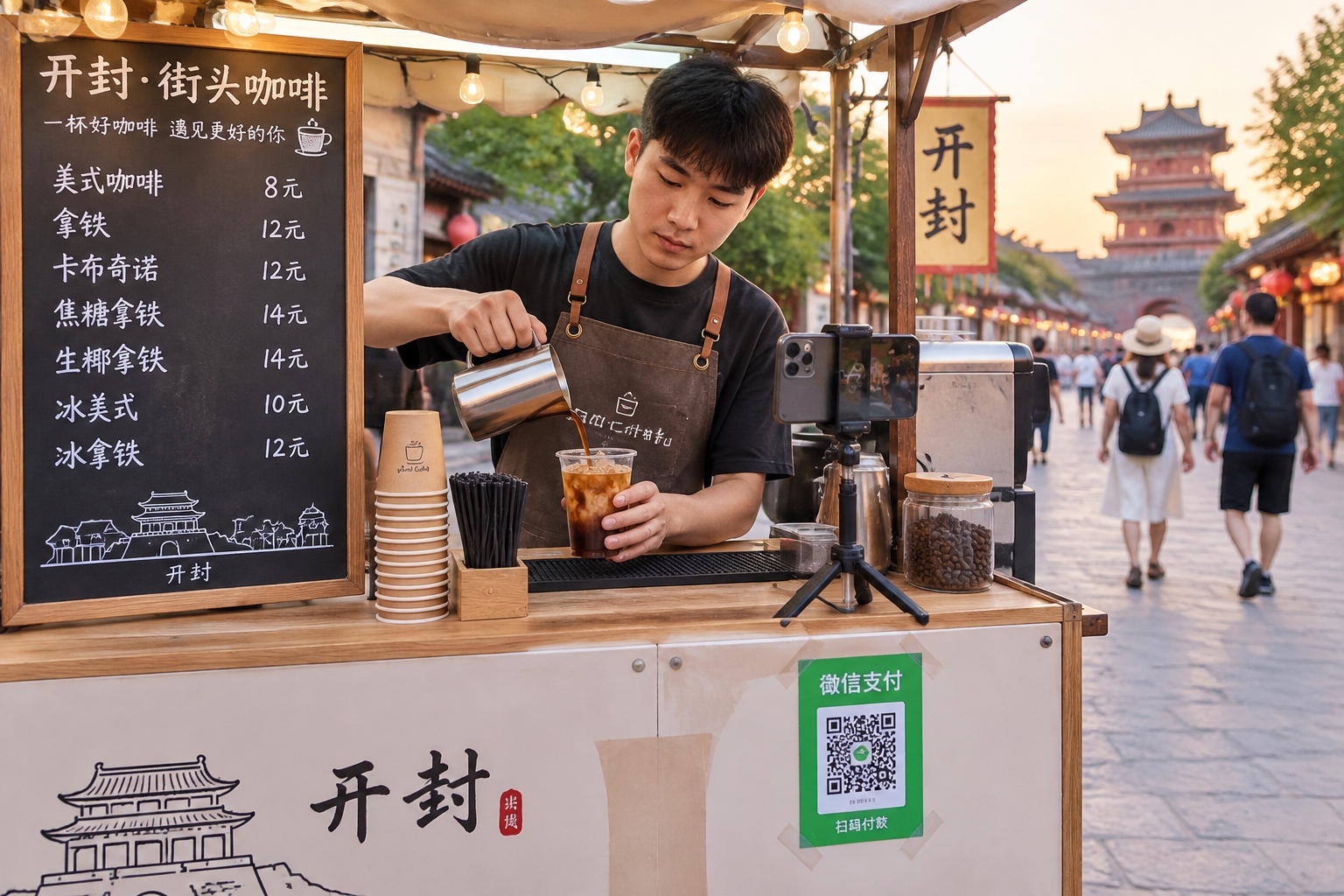
Younger vendors are pushing in a different direction, some of them selling Thai tea, sourdough flatbread or hand-pulled iced coffee from carts designed to look good on camera. It’s a genuine livelihood and also a performance. Meanwhile, plenty of Kaifeng residents now avoid the Drum Tower on weekends entirely and stay with Xisi or the streets near the university — the local market has not disappeared, it has just been sorted by price and patience.
12:50 a.m., Last Two Customers
By half past midnight, Wang’s griddle is scraped clean and the gas is off. Two women in hospital uniforms are finishing a shared plate of dumplings. He counts the evening in his head and checks the total on his phone: a little over 900 yuan for the night, good for a Saturday in May, not enough to make him consider a second stall.
He stacks the last stool and wheels the cart toward the storage alley. Behind him the cleaning crew is already working the row he just left.
For a visitor, the easiest comparison is this: a night market is what a pub is in other countries — the place you go when you want to be around people without spending much and without making a plan. The difference is that in Kaifeng, the person pouring your drink has been standing in the smoke since five in the evening, and the whole thing collapses back into an ordinary road by six in the morning.
Start the discussion at forum.chinacomes.com