

A Tuesday Night in Changsha
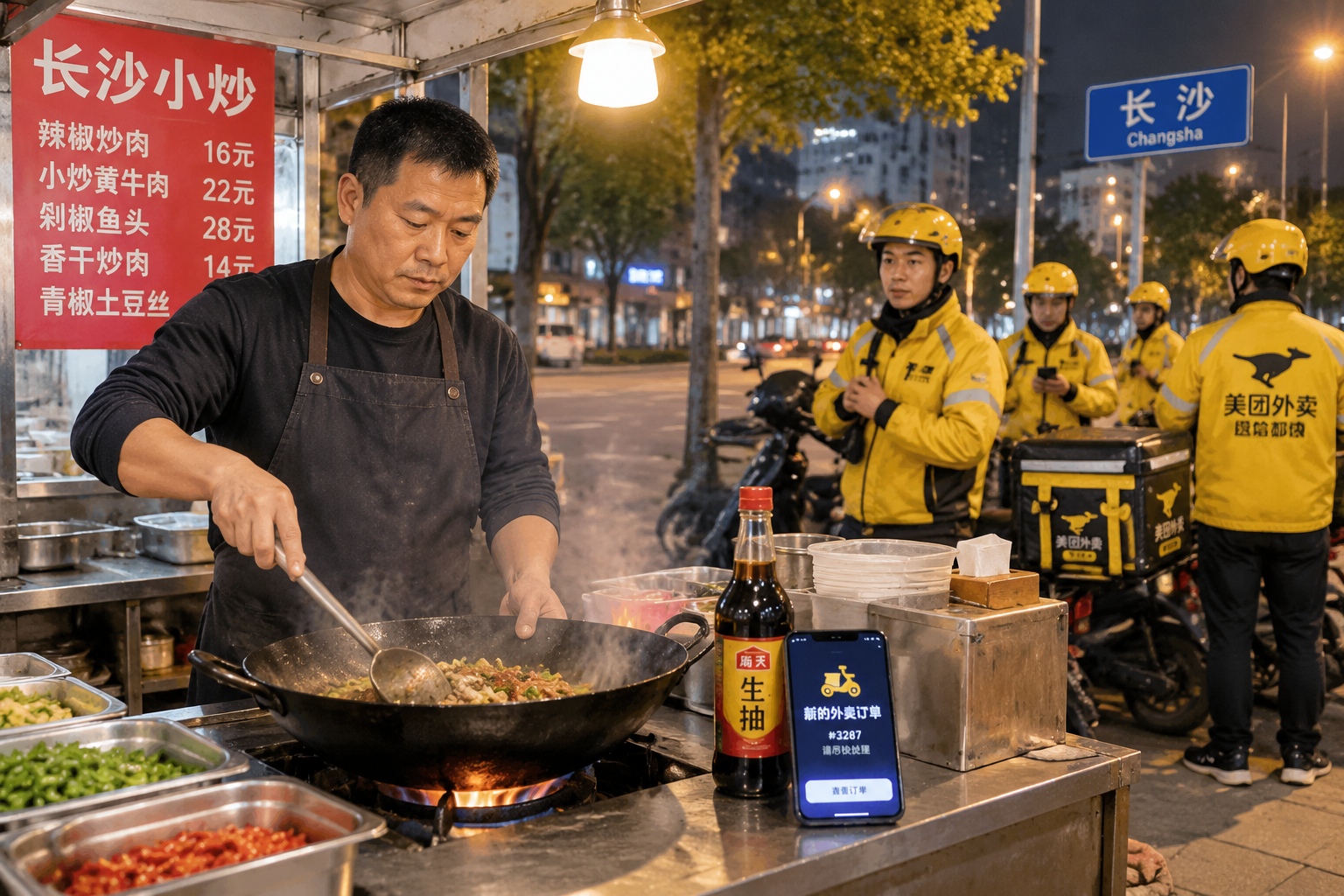
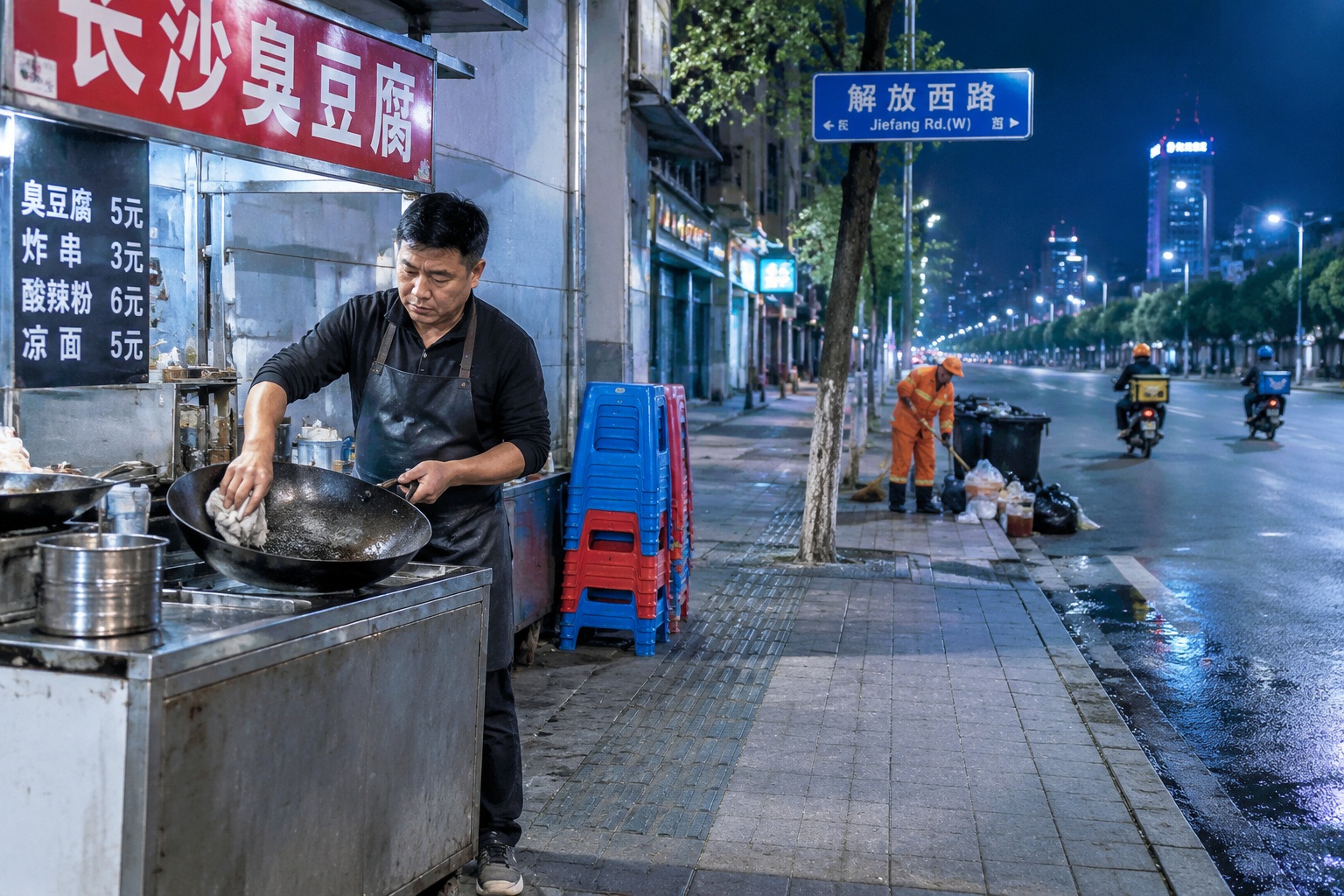
At 11:14 on a Tuesday night in Changsha, Hunan’s capital, Chen Jianping’s food cart has been busy for three hours and is about to get busier. A plastic stool sits empty in front of his stall—the first time all evening. His phone, propped against a bottle of soy sauce, lights up with a new order. Then another. “Six orders stacked,” he says, not looking up from the wok. “The riders will be here in ten minutes.”
His cart sells stinky tofu and fried rice noodles, two staples of Hunan’s late-night food scene. Five years ago, he would have served customers who walked up, sat down, and ate. Tonight, most of his revenue comes from people he never sees—an office worker on the 22nd floor of a nearby tower, a night-shift nurse at a hospital two kilometers away, a group of university students in a dormitory across the river.
This is what the late-night food economy in Hunan looks like now. The street stall hasn’t disappeared. It has become a node in a delivery network that runs until 2 a.m. or later, reshaping how food is cooked, packaged, sold, and eaten.
Who Orders Dinner at Midnight
Hunan’s cities have long been known for their nightlife. Changsha, in particular, has a reputation as one of China’s most sleepless cities. But the people ordering food at midnight are not always the ones sitting in bars or night markets.
Delivery platform data offers a rough map. Meituan, China’s largest food delivery service, reported that orders placed between 10 p.m. and 2 a.m. accounted for more than 20% of its daily total in several provincial capitals in 2023. In Changsha, the figure was higher during summer months. A company spokesperson described late-night orders as “one of the fastest-growing time slots” on the platform.
The customers fall into a few categories. There are the obvious ones: young professionals working late. In Changsha’s high-tech zone, software companies and design studios often keep lights on past 10 p.m. A single order of rice noodles and a side of pickled vegetables, delivered to a 22nd-floor office, costs about 25 yuan (roughly $3.50) including delivery. It’s cheaper than a taxi ride home and faster than cooking.
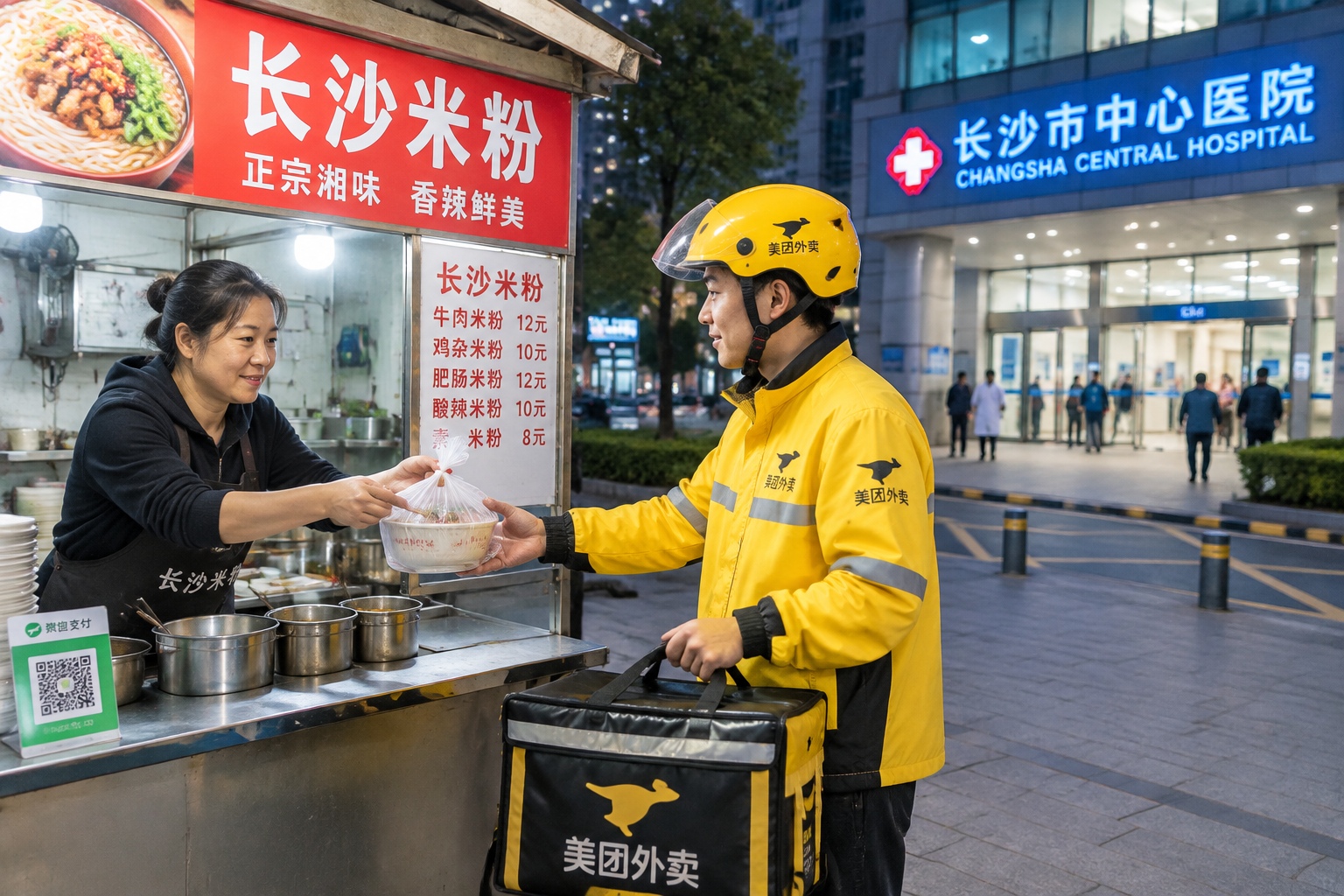
Then there are the shift workers. Nurses, security guards, factory workers on rotating schedules, and convenience store clerks often order food between midnight and 2 a.m. A hospital in Changsha’s Yuhua district has become a regular delivery destination. Riders know to call when they arrive, because the nurses cannot always leave the ward.
Students form another group. Hunan University and Central South University sit on opposite sides of the Xiang River, and dormitory buildings are among the most frequent delivery addresses in the city. A student ordering a late-night bowl of spicy noodles is not just feeding hunger—they are participating in a social ritual. Group orders, shared among roommates, are common.
And then there are the residents who simply don’t want to go out. A family watching television at 10 p.m., a couple who just finished a movie, a man who worked from home all day and never left his apartment—these are customers who might have walked to a street stall a decade ago but now tap a phone instead.
How the Vendors Adapt
Chen Jianping started using Meituan in 2019. At first, he treated it as a side channel—something for rainy nights when foot traffic dropped. “The first month, I got maybe ten orders a week,” he says. “I didn’t change anything.”
That changed quickly. By 2021, delivery orders accounted for more than half of his revenue. Today, he estimates 65% of his sales come through platforms. He has adjusted nearly everything.
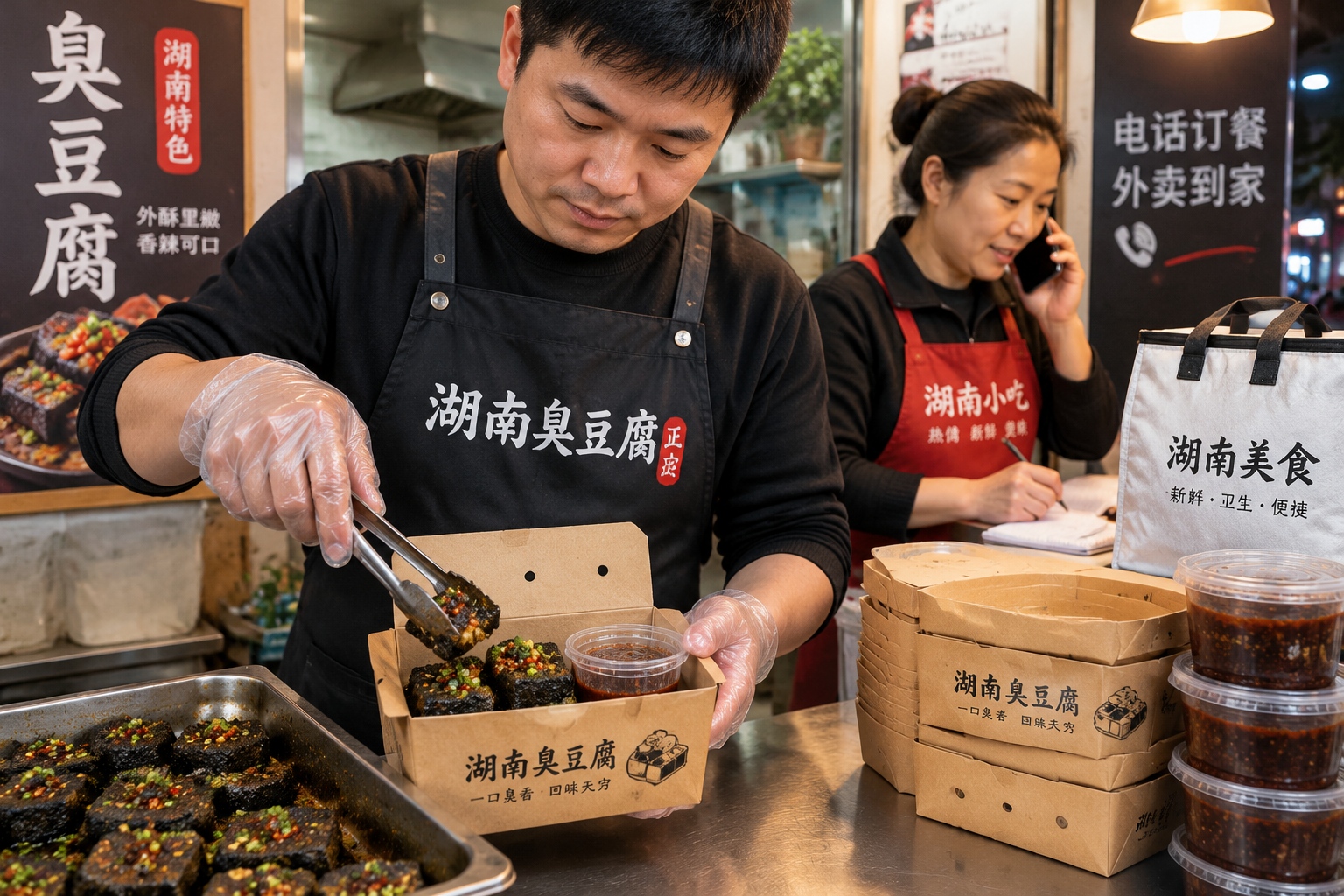
The menu is smaller now. He dropped three items—fried dumplings, a noodle soup that doesn’t travel well, and a cold dish that needs to be eaten immediately. What remains has been optimized for a 20-minute ride. The stinky tofu is packed in a ventilated paper box with a separate sauce container. The rice noodles use a thicker broth so they don’t dry out. He invested in a thermal bag that keeps food above 60°C for the ride.
His cooking rhythm has changed too. He now pre-cooks certain ingredients in batches—fried tofu skins, braised eggs, pickled vegetables—so assembly takes seconds, not minutes. “At the peak, between 11 p.m. and midnight, I need to finish an order every three to four minutes,” he says. “Otherwise the riders wait, and they get angry.”
That pressure has a cost. Platforms charge commission—typically 15% to 20% of each order. Riders who wait too long can leave, which means lower ratings. A single one-star review from a customer can drop his store’s visibility on the platform. “You have to be careful,” he says. “One bad night, and the algorithm pushes you down.”
But the income is real. On a good night, his cart brings in 1,200 to 1,800 yuan (about $170 to $250) in delivery sales alone, compared with 600 to 800 yuan from walk-up customers. “I couldn’t hire a second person without the delivery money,” he says. His wife now works alongside him, handling packaging and phone calls.
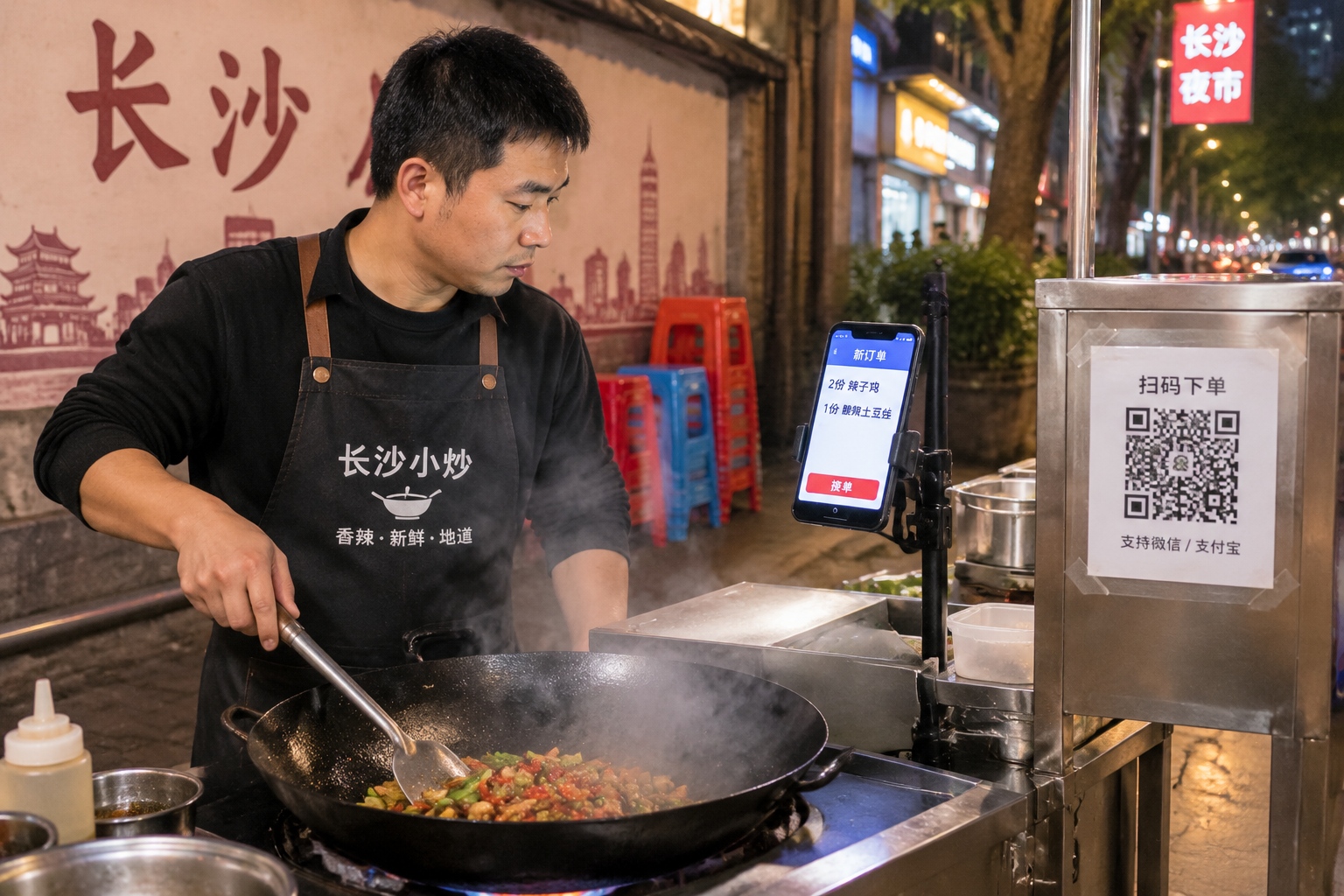
The trade-off is visible in small details. The stall itself has shrunk—a folding table that holds the wok and a cooler, with a separate area for bags. The handwritten menu that once hung above the cart has been replaced by a QR code. And the plastic stools that used to line the sidewalk are stacked against the wall, unused.
The Riders’ Late-Night Route
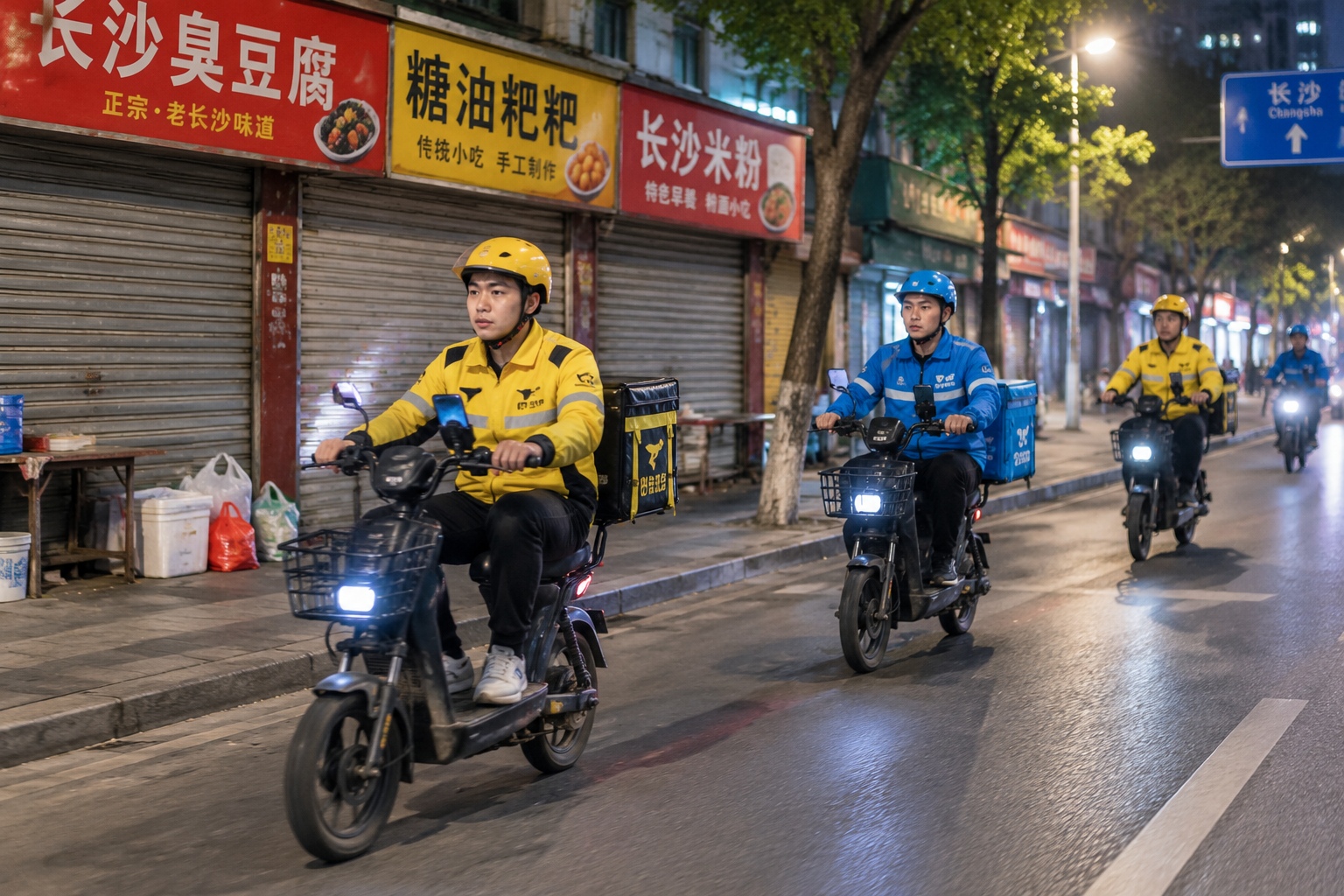
The riders who serve Chen’s street know his cart well. By 11 p.m., a small cluster of electric bikes is parked along the curb. Most riders work for Meituan or Ele.me, the two dominant platforms in China. Their night shifts start around 9 p.m. and end anywhere from 1 to 3 a.m.
A typical night order pays 4 to 8 yuan (roughly $0.55 to $1.10) in delivery fees, depending on distance and weather. Riders receive a small premium for working after 10 p.m.—usually an extra 1 to 2 yuan per order. On a busy night, an experienced rider can complete 15 to 20 deliveries in a four-hour shift, earning 100 to 160 yuan before fuel and phone costs.
The route is not random. Riders cluster near known food streets—Pozi Street in central Changsha, the night market near Hunan University, and the strip of stalls along Shaoshan Road. These are dense pickup zones where multiple orders can be collected in a few minutes. “You don’t want to ride five minutes for one order,” says Liu Wei, a rider who has worked in Changsha for three years. “You want to pick up three, deliver them close together, then go back.”
The relationship between riders and vendors is practical but not warm. Chen keeps a stack of bottled water in his cart for riders who wait. Liu Wei knows which stalls are slow and avoids them during peak hours. “If they take more than five minutes, I cancel and move on,” he says. “There’s always another order.”
By midnight, the cluster grows. A dozen riders stand or sit on their bikes, phones in hand, waiting for the next ping. The street is loud—woks clanging, orders shouted, electric bikes humming. But it is also orderly. Riders know the pickup spots, vendors know the drill, and the whole system runs on timing.
A Street That Never Quite Sleeps
The delivery economy has changed not just how food is sold, but which stalls survive.
On a stretch of road near Changsha’s Kaifu district, ten food carts operated five years ago. Today, six remain. The ones that disappeared are the most traditional—a vendor selling roasted sweet potatoes, a woman who made scallion pancakes by hand, a man who only sold soup. None of them adapted to delivery. “Their food didn’t travel well,” Chen says. “Or they didn’t want to learn the app.”
The ones that stayed have become pickup points. The city has responded, though unevenly. In some neighborhoods, local authorities have painted designated parking zones for delivery bikes. In others, the curbs are a free-for-all, with riders blocking sidewalks and vendors spilling onto the road. Trash is a persistent issue—plastic bags, sauce containers, and chopsticks accumulate near popular pickup spots. Street cleaners in Changsha’s Furong district start their night shifts at 11 p.m. to keep up.
Noise complaints are common. Residents in buildings near night food streets have filed complaints about the sound of electric bikes and loud conversations after midnight. Some neighborhoods have imposed quiet hours; others rely on informal agreements. “We try to keep it down after 1 a.m.,” Chen says. “But when the orders come, you can’t exactly whisper.”
The city government has a complicated position. Changsha has actively promoted “night economy” initiatives since 2019, designating certain streets for late-night commerce and offering tax breaks to vendors who operate until 2 a.m. The goal is to boost consumption and tourism. But the same streets face pressure from residents who want quieter nights. The balance is negotiated block by block.
The Friction Behind the Convenience
Not everyone is happy with the way things have changed. Three tensions run through the late-night delivery ecosystem.
The first is commission. Vendors like Chen accept platform fees as a cost of doing business, but the margin is thin. A bowl of rice noodles that sells for 12 yuan in person brings in about 9.5 yuan through the app after commission, packaging, and delivery discounts. “If I raise prices, customers complain,” Chen says. “If I don’t, I make less per bowl. But I make it up in volume.”
The second is food safety. Delivery food is harder to inspect than a street stall, where customers can see the wok and the ingredients. Platforms have introduced rating systems, photo verification, and random inspections, but enforcement varies. A 2023 report from a consumer advocacy group in Hunan found that 12% of late-night delivery vendors in Changsha had received at least one food safety complaint in the previous year. The number was higher for vendors operating after midnight.
The third is taste. There is a widespread belief among older residents that delivery food is not as good as food eaten at the stall. The noodles are softer, the tofu less crispy, the sauce less fresh. Some of this is physics—food changes in a box. Some of it is economics—vendors cut corners to speed up assembly. “It’s not the same,” says a retired teacher who has eaten at Chen’s cart for a decade. “But I understand why he does it.”
Chen has heard the complaints. He has adjusted where he can—using better containers, separating sauces, refusing to deliver certain items. But he is also pragmatic. “The customers who order at midnight are not looking for a restaurant experience,” he says. “They want something hot and fast. I give them that.”
2 A.M.: Closing Time
At 1:47 a.m., Chen turns off the gas. The last order went out twelve minutes ago—a bowl of rice noodles to a hotel near the railway station. The rider, a young man in a yellow jacket, waited three minutes and left without a word.
Chen wipes down the wok and stacks the plastic containers. His wife counts the cash from walk-up customers—about 400 yuan tonight, lower than usual. The delivery revenue will settle on the app by morning. He estimates 1,500 yuan.
A few riders are still parked nearby, waiting for the last orders of the night. One of them, a woman in her thirties, checks her phone. Nothing. She yawns, starts her bike, and rides toward the next street.
The city is quieter now. The woks are off, the stools are stacked, and the sidewalks are empty except for a few delivery bikes moving slowly through the dark. In a few hours, the breakfast stalls will open. For now, the late-night food economy has done its job—feeding people who work when others sleep, and keeping a small piece of the street alive.
Start the discussion at forum.chinacomes.com