

An Unlikely View
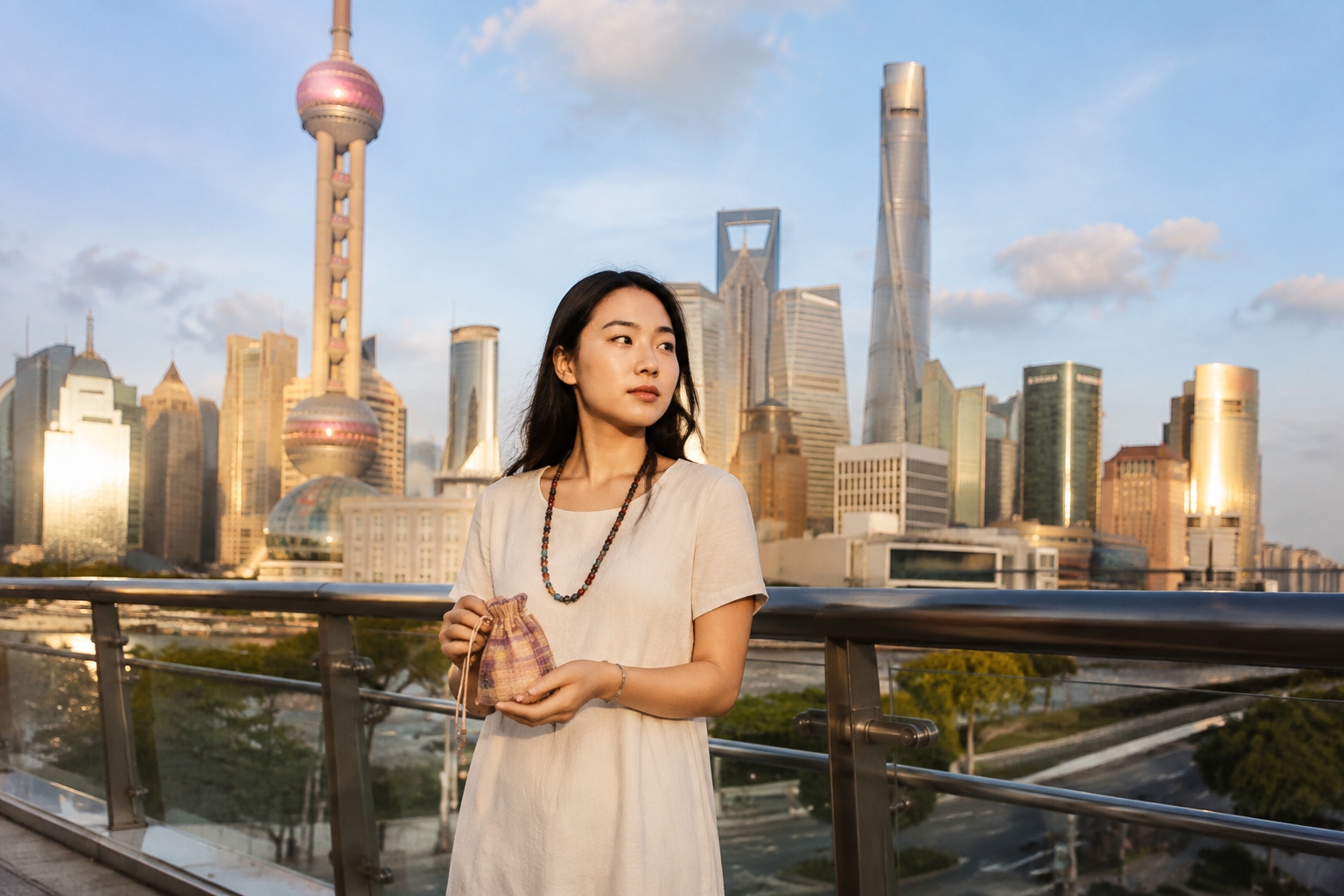
On a humid evening in late August, I met Ayue (not her real name) on a pedestrian bridge in Lujiazui, Shanghai’s financial district. Behind her, the glass towers of the China Minsheng Bank and Shanghai World Financial Center looked like something out of a sci-fi movie. But what drew me to her was the way she held a small cloth pouch, almost like a talisman. “My mother sent me these herbs,” she said. “From the Dulong River valley. Do you know where that is?”
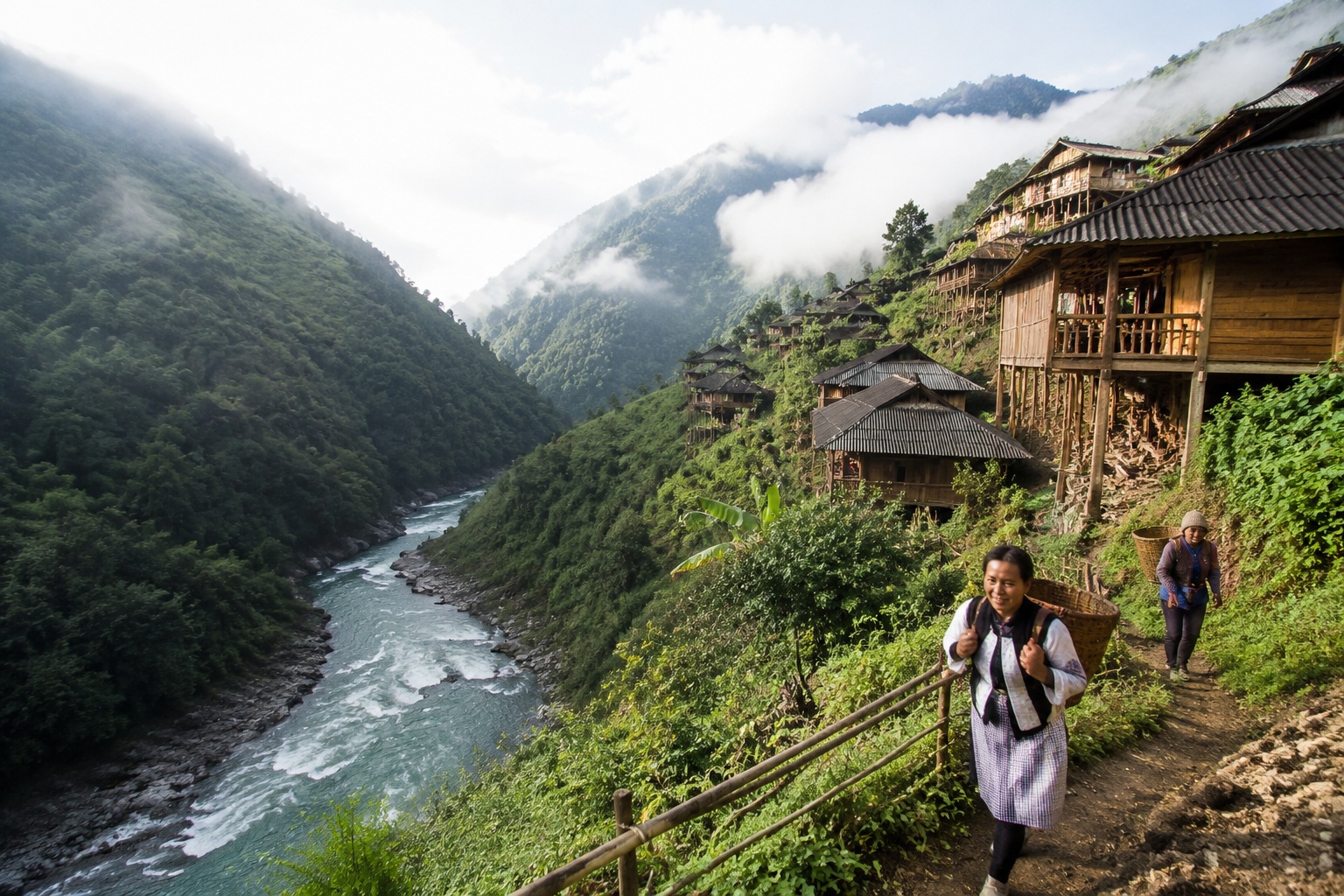
I did. The Dulong River runs through a deep gorge in the high mountains of Yunnan province, near the borders of Myanmar and Tibet. It’s one of the most remote places in China. For centuries, the Dulong people lived there in near isolation. Their own language, their own traditions. Until 2014, the only road into the area was closed for half the year by snow. When I said I knew it, Ayue smiled. “Not many people here do,” she said.
Ayue, 27, is a Dulong. She works as a data analyst at a consulting firm in Lujiazui. She arrived three years ago, after finishing university in Kunming. In many ways, she is like any other white-collar worker in Shanghai: she rides the subway, orders lunch through an app, and works late under fluorescent lights. But her path here is one few outsiders could have imagined.
A Valley That Only Saw the Sun for Three Hours
The Dulong people number only about 7,000, making them one of China’s smallest ethnic minorities. Their home, the Duolong River valley, is so narrow that in some places the sun reaches the bottom for only a few hours a day during winter. Ayue grew up in a village called Kongdang, a scattering of wooden houses on stilts perched above the river.
“When I was little, there was no road,” she told me. “We walked everywhere. To get to the county town, you had to climb over a mountain pass at 2,000 meters. It took two days.” She paused. “If the snow wasn’t too deep.”
Her grandmother had the traditional facial tattoos that older Dulong women once wore. Ayue remembers asking why she had them. “She said it was to make her ugly so the demons wouldn’t take her. But also, I think, so that if strangers came, they would see her as another kind of person. Not someone to be taken.” The custom was banned after 1949 and died out. Her grandmother passed away ten years ago at the age of 82.
For most of her childhood, Ayue’s world was bounded by the river and the mountains. Her mother wove cloth from hemp; her father planted corn and raised a few pigs. The family had no electricity until she was eight. When a small hydropower station was built, they got light for the first time. “I remember lying on the floor, staring at the bulb,” she said. “It didn’t feel real.”
Leaving: A Cow, a Scholarship, and a Dream
Ayue’s life changed when a Chinese government poverty-alleviation team visited her village and noticed her scores in the village school. She received a scholarship to attend a middle school in Gongshan, the county seat. “The first time I saw a computer, I thought it was a television with a keyboard,” she said with a laugh.
At 18, she was admitted to Yunnan University in Kunming — the first person from her village to go to college. Her father sold one of his two cows to buy her a bus ticket and a basic phone. She had never been outside the valley before. When the bus entered the tunnel under the Gaoligong Mountains — the same 6.5-kilometer tunnel that had opened two years earlier and ended the months-long isolation — she began to cry.
“I thought of my grandmother, who never saw a wheel in her life,” she said. “I was sitting in a metal box, moving under a mountain.”
Shanghai: Faster Escalators, Bigger Sky
In Kunming, the provincial capital, she learned to live in a city. She held an umbrella but rarely needed it; the sun was too strong. She ate rice from a bowl instead of from her hands, using chopsticks properly. “I felt like a baby all over again,” she said. After graduation, she was recruited by a consulting firm in Shanghai. She packed one suitcase and flew for the first time.
Shanghai hit her like a wave. Her first few weeks were a blur of new subway lines (she got lost four times), unfamiliar smells (scallion pancakes, diesel from buses, perfumes in the elevator), and the sheer volume of people. “Everyone moved so fast,” she remembers. “I didn’t know how to use a self-checkout counter. I held up the line. Nobody said anything, but I felt the anger.”
She coped by doing small, familiar things. She bought a bag of rice from a store that sold Yunnan products. She called her mother using a phone card. She taught her roommate to say “hello” in Dulong, which sounds a bit like “aa-eh.” She eventually got used to the speed. Now she can walk through Nanjing Road dodging tourists without slowing down.
Living in Two Worlds at Once
Ayue’s apartment is a small studio near the Jinling East Road station, a 30-minute commute to Lujiazui. On the wall, she has a photo of the snowy peak of Kawagarbo, a sacred mountain near the Dulong River. Next to it is a shelf of financial textbooks. She wears business suits on weekdays and cotton shirts on weekends. Her earrings are silver hoops; her necklace is a string of coral beads from her aunt.

“I don’t feel fully from either place,” she said. “When I go home, I fall quiet because my cousins talk about crops and marriages. Here, I fall quiet because people talk about bonuses and stock options. I have two sets of skin.”
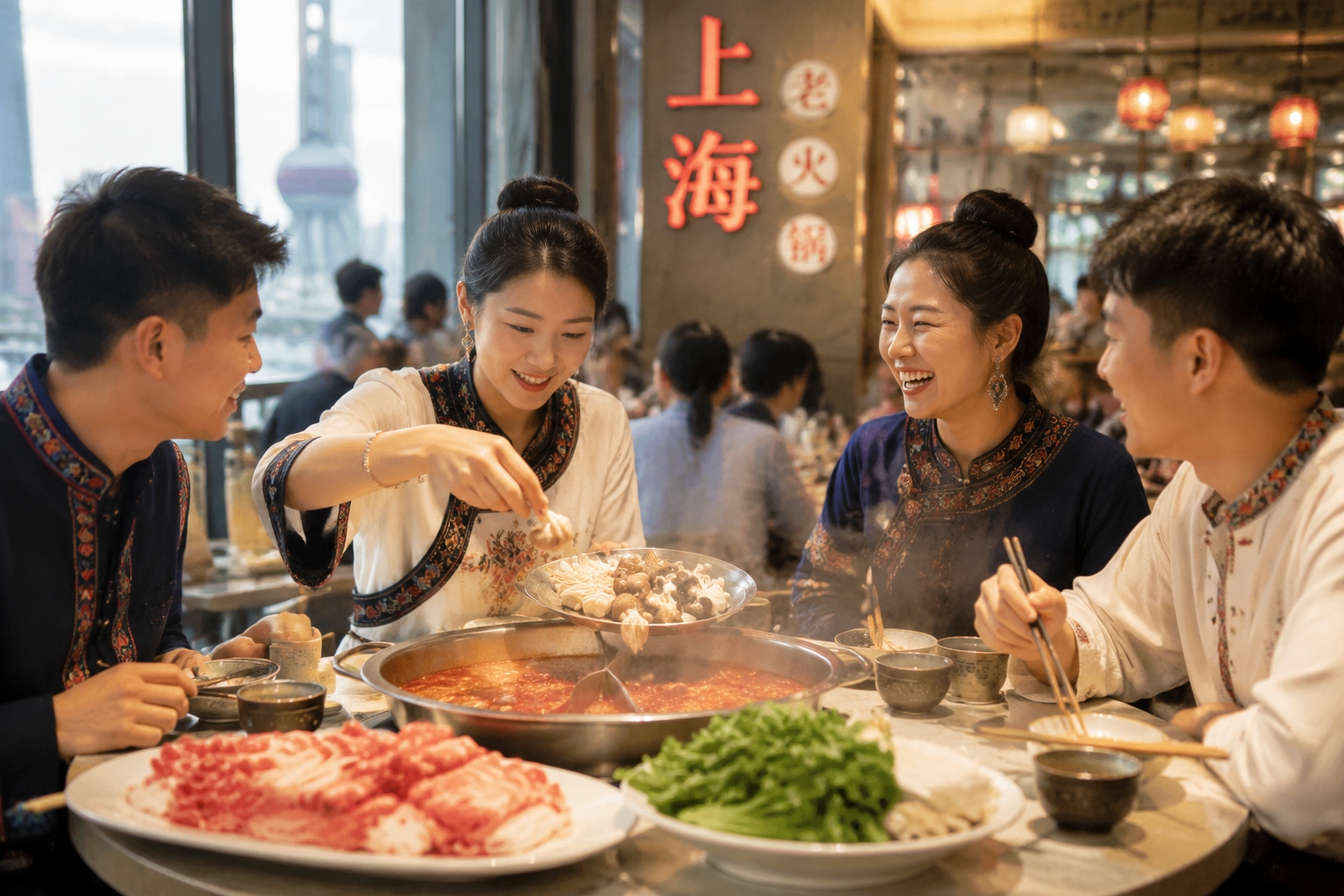
Still, she has found a little community. Every month, a group of Yunnan natives meets in a Sichuan restaurant in the French Concession. They cook dishes like crossing-the-bridge noodles and wild mushroom hotpot. Ayue is the only Dulong in the group, but she finds comfort in the accent and the chili-laced steam. She also volunteers at an NGO that helps migrant children with literacy.
Home Is Changing — Not Always for the Worse
Ayue’s village has transformed in ways she sometimes struggles to understand. Last year, her younger cousin sent her a video: there is now a paved road to every village, and a school bus picks up children in the morning. Solar panels cover the roofs of new brick-and-tile houses. The clinic has a trained nurse, and patients can video-call a doctor in Gongshan.
The Chinese government’s poverty-alleviation program reached every household. In 2018, the whole Dulong ethnic group was declared “lifted out of poverty.” Ayue’s mother no longer needs to pick wild herbs for income; she runs a small guesthouse for the growing number of tourists who come to see the “last secret land of Yunnan.”
But something is lost, too. The Dulong language has no writing system, and now many children speak Mandarin at school all day. When Ayue’s mother calls her, she often speaks in a mix of Dulong and Mandarin words. The youngest generation in the village no longer learns to weave by hand. And the traditional “Ake” New Year festival, once the center of the spiritual calendar, is now performed mostly for tourists.
“I want progress for my people,” Ayue said. “But I don’t want us to disappear. It’s the same problem every indigenous community in every country faces, isn’t it?”
What Comes Next
Ayue is not sure she will stay in Shanghai forever. She is saving money, and she dreams of starting an online store that sells Dulong herbal teas, honey, and woven goods. She has already made some contacts with buyers in Hangzhou. “My grandmother used to say that the river follows the mountain, but it never goes back to the same place,” she said. “I can’t go back to the old life. But I can carry the river with me.”
As we finish talking, Ayue looks at her phone. Her mother is trying to video-call her. She answers, and on the small screen I see a woman in a knitted hat standing against a valley of still-dense green. They exchange a few words. Then Ayue turns to me and says, “My mother just asked me when I’m coming home for the winter. I said I’ll try after the Spring Festival.” She smiles. “I’ve been saying that for three years.”
A Story, Not a Statistic
Ayue’s journey is one of hundreds of thousands in China. Since the opening of roads, railways, and high-speed trains, millions of young people from remote regions have moved to cities for work or study. What makes her story worth telling is not the distance or the numbers, but the fact that she holds two versions of China in a single heart. One is the China she remembers — a place of snow-blocked passes and moonlit river valleys. The other is the China she lives in — a place of elevators and stock prices.
Neither cancels out the other. That middle space, uncomfortable and rich, is where she defines her life. And in telling her story, maybe we see our own.
Start the discussion at forum.chinacomes.com