

The Morning I Heard a Trash Song
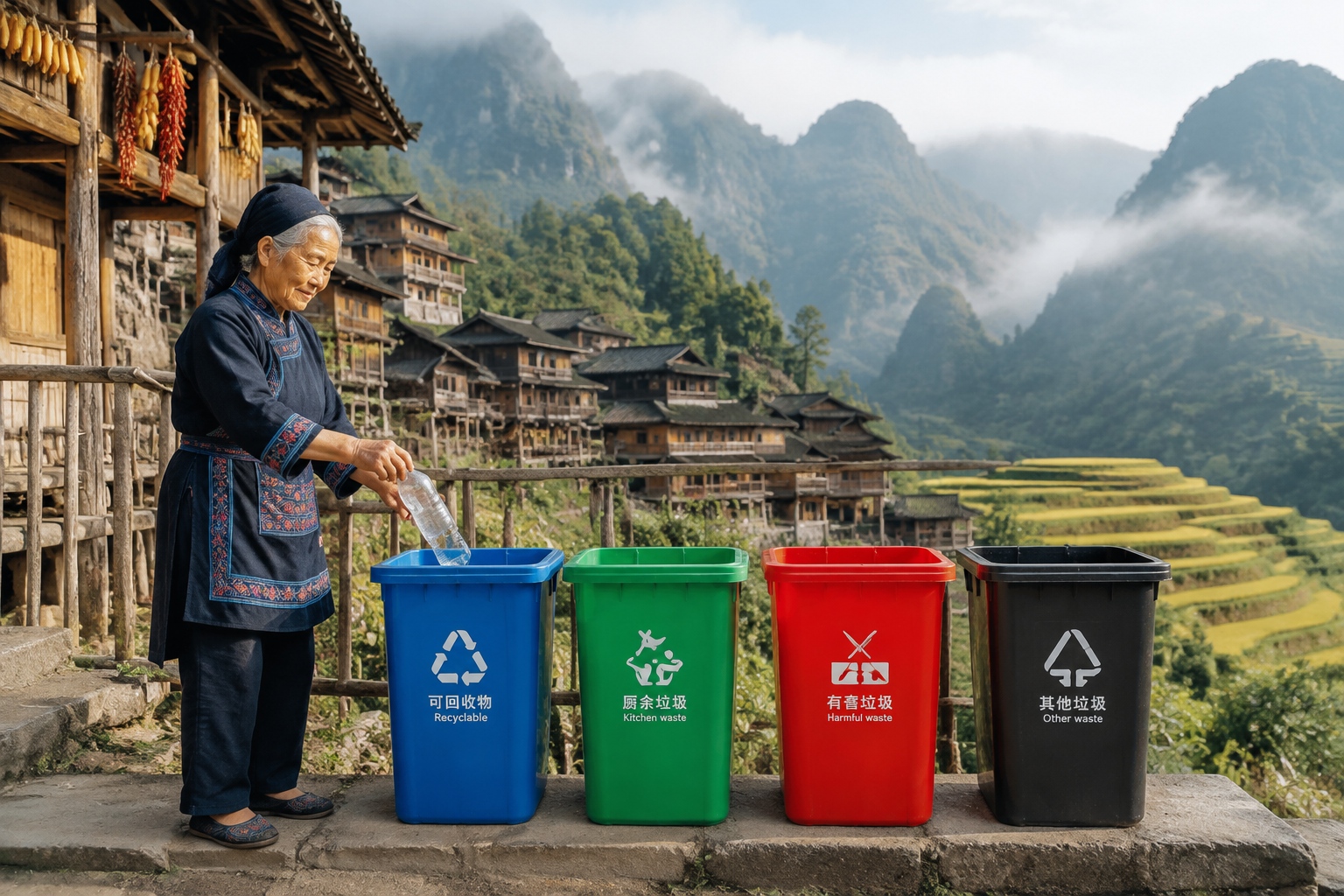
When I visited a Buyi village in the hills of Qianxinan, a Buyi and Miao Autonomous Prefecture in Guizhou, I thought I knew what to expect. Wooden stilt houses, terraced rice paddies, silver jewelry worn for festivals. I did see those things. But at 7:30 in the morning, what woke me was a song on a loudspeaker. In Buyi language, four women’s voices sang about plastic bottles, leftover noodles and dead batteries. It sounded like a folk song, because it was. The village had turned waste sorting into a local tune.
A Village With a Waste Problem
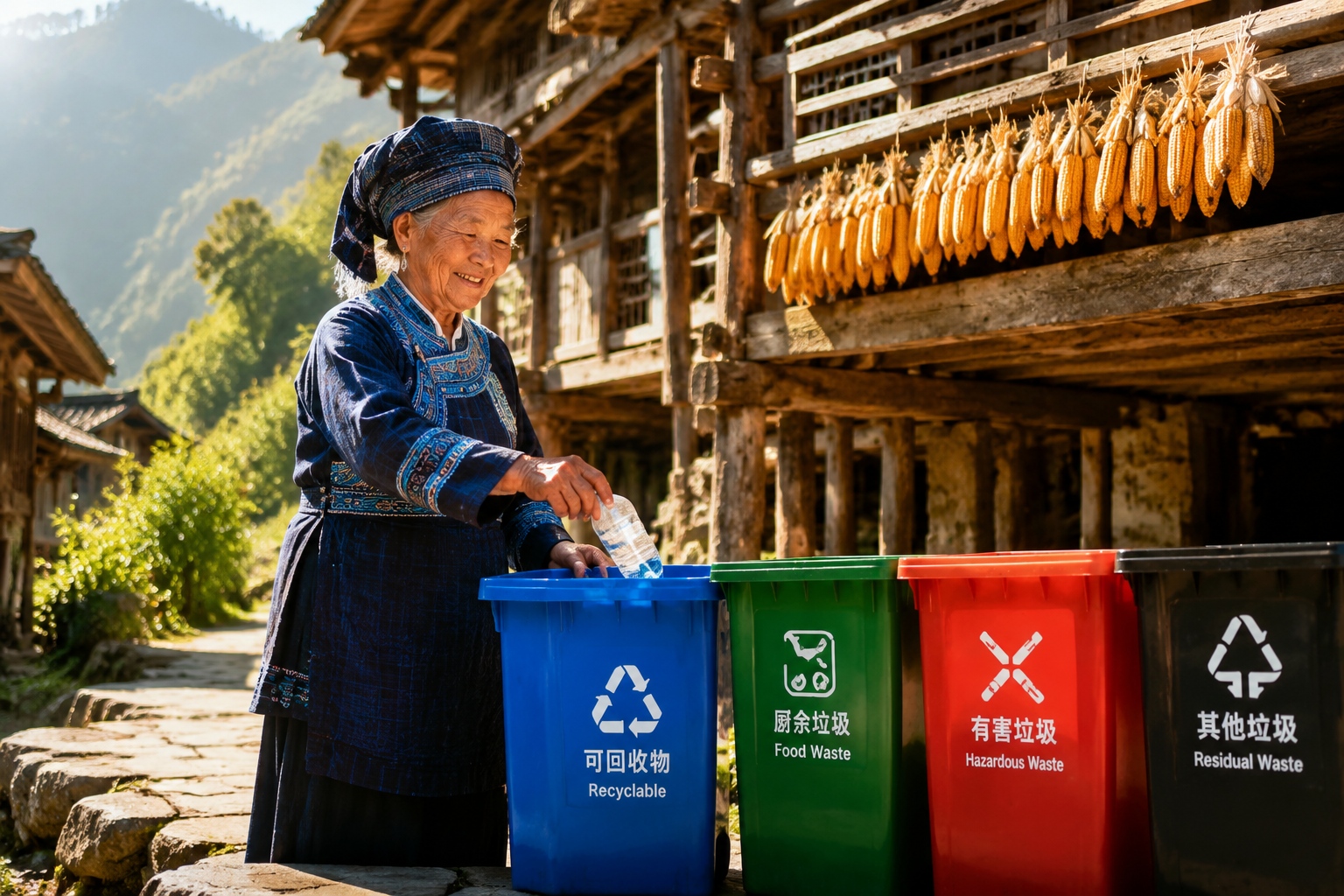
The Buyi people, one of China’s 56 officially recognized ethnic groups, have lived in this mountain region for centuries. For a long time, they produced almost no non-degradable waste. Food scraps fed pigs, cloth was reused until it became quilt patches, and broken tools were burned in a safe corner. But better roads and tourism changed that. Instant noodle bags, yogurt cups, plastic water bottles, snack wrappers and even old batteries started showing up in the fields.
In a village where many older women weave cloth and speak the Buyi language more often than Mandarin, centralized city-style waste collection did not arrive overnight. At first, trash was buried in shallow pits or tossed into the ravine. During the “June Sixth” festival, when families gather on the mountainside for rituals, the path to the ancestral site was covered with bright-colored plastic bags. That was the moment the elders started to say something had to change.
Why Posters Didn’t Work
When the local government tried to introduce waste sorting in the traditional way, they started with colored bins, printed leaflets and a public lecture. The bins were delivered to 58 households. The leaflets explained organic waste, recyclables, hazardous waste and residual waste. But most elderly residents could not read the Chinese labels. One grandmother I spoke to laughed and said: “At first I thought the blue bin was for holding rice.”
The lecture hall was empty. The posters got wet on the wall. The instruction didn’t stop because people didn’t care — it stopped because the message was not connected to their daily language or their sense of belonging.
From Festival Songs to Four Bins
The solution came from inside the village. Luo Deying, a woman in her seventies who used to sing at Buyi weddings and festivals, rewrote the lyrics of a familiar mountain tune. The melody was one everyone already knew from the March Third Festival, one of the most important Buyi holidays. Her new lyrics were simple:
Blue bin for things worth money again, / green bin for food scraps from the kitchen. / Red bin for batteries, pills and bulbs, / black bag the rest, tie it up tight.
The village committee recorded her voice with a group of women. Every morning, the song plays through the village loudspeakers, the same device used for weather warnings and holiday announcements. Now a 70-year-old woman who cannot read Mandarin can stand in front of the bins and hum the tune to decide where a bottle goes. A grandmother might not remember the city slogan, but she remembers the melody her mother sang.
Village Rules With a “Green Account”
The song alone did not do all the work. The village also updated an old custom — the village compact. These public rules, written on a board at the entrance of most rural communities, have long governed things like water use and public cleanliness. This time, the village added waste sorting. Every family signed an agreement to keep their courtyard clean, separate household waste into four categories, and place the bags out on the morning when the garbage truck arrives.
To make the rules meaningful, the village started a “green account” ledger system. Households could earn points each week if their bins were sorted correctly. A volunteer team checked bins on a fixed schedule. Neighbors could see each other’s results, and the points were recorded openly. Points could be exchanged at a small “eco-exchange” counter for washing powder, cooking oil, toothpaste, rice, or notebooks for children.
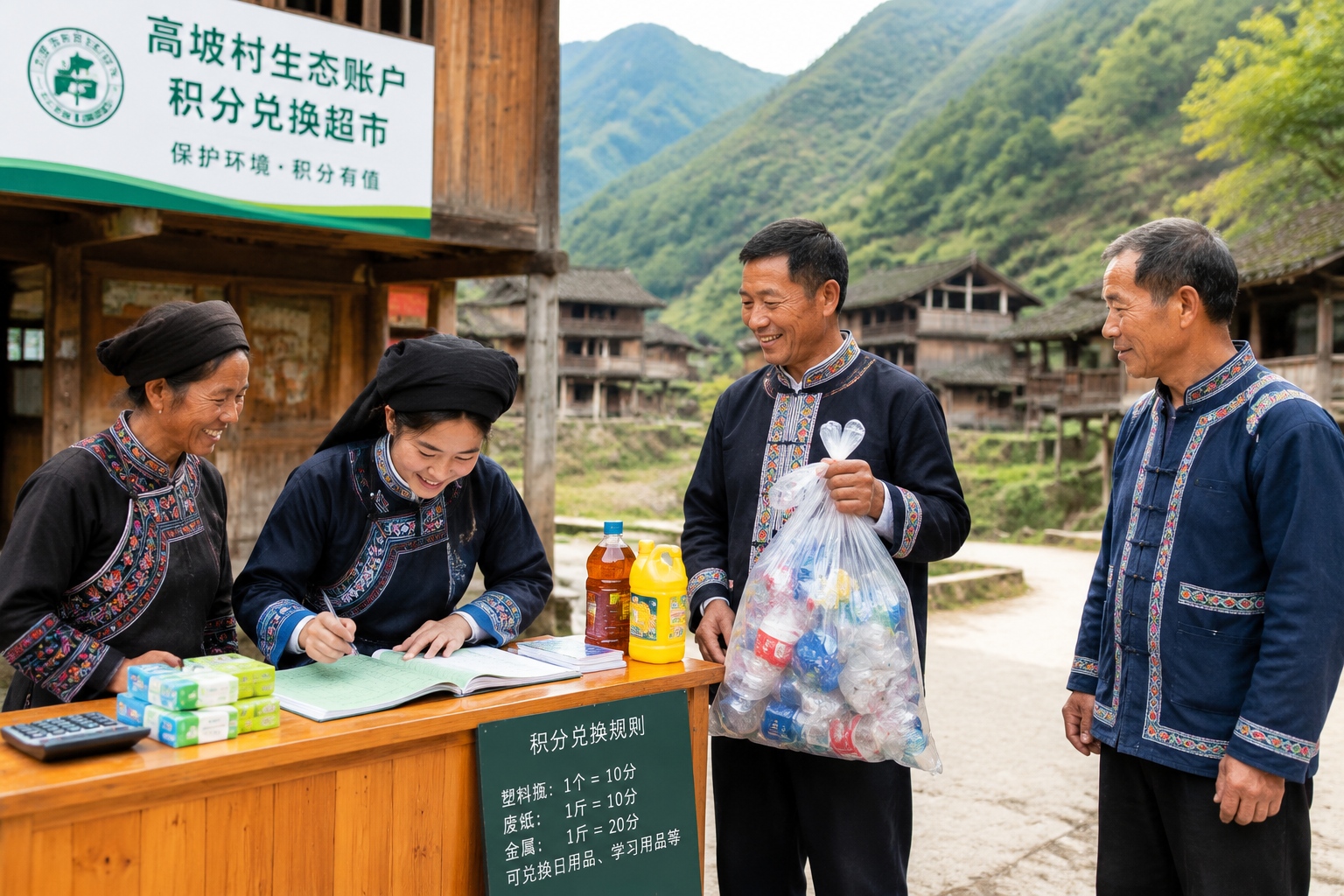
No police, no heavy fines. The pressure came from social visibility and shared promises. In a village where everyone knows everyone, this matters more than a remote law.
Ancestors, Springs and a Different Kind of Motivation
Why did this work when a top-down regulation often fades? The answer lies in Buyi cultural values. Springs and rivers hold spiritual meaning in Buyi tradition. The ancestors’ graves are on the mountain, and the mountain is not dead space; it is inherited memory. When environmental officers and village elders explained waste sorting, they did not say “protect the global environment.” They said: “Keep the mountain clean for our ancestors’ spirits, and keep the stream clean for our grandchildren’s water.”
That message landed. In Buyi ritual practice, walking up to a grave site and seeing litter is not just an ugly view — it feels like disrespect to the people who are still present in the memory of the community. So when the village began holding small ceremonies before the ravine cleaning day, the action became a continuation of tradition, not a break from it.
Not Perfect, but Getting There
Let’s not romanticize this. In the first month, only about ten of the 58 households participated seriously. Some older men said the four bins were too much trouble. Young people who had migrated to cities for work were not around to help. Then the children got involved. An elementary school teacher in the village asked her students to bring one used battery from home. The next morning, nearly 300 old batteries arrived in the school yard. The children went home and told their grandparents: “If you throw batteries into the field, the water we drink is poisoned.”
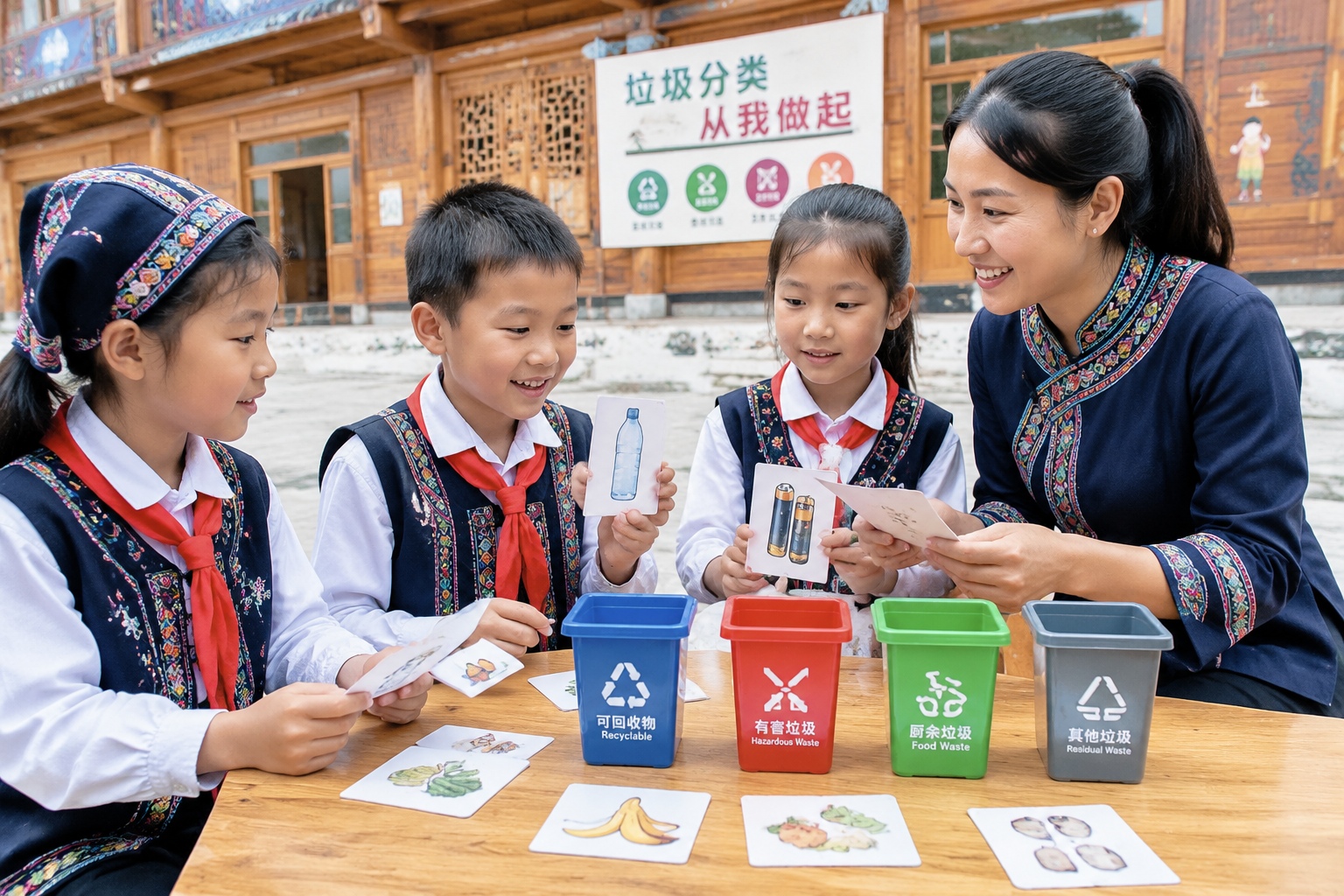
That family channel did what official brochures could not. By the third month, around 80 percent of households were regularly sorting their waste well enough to earn points. It is still not perfect. On the busiest days, someone will throw a wet noodle cup into the wrong bin. But when I walked down to the stream that used to collect plastic yogurt cups, I saw no blue wrapper lodged in the rocks. The water ran over clean stones.
Turning Kitchen Scraps Into Garden Soil
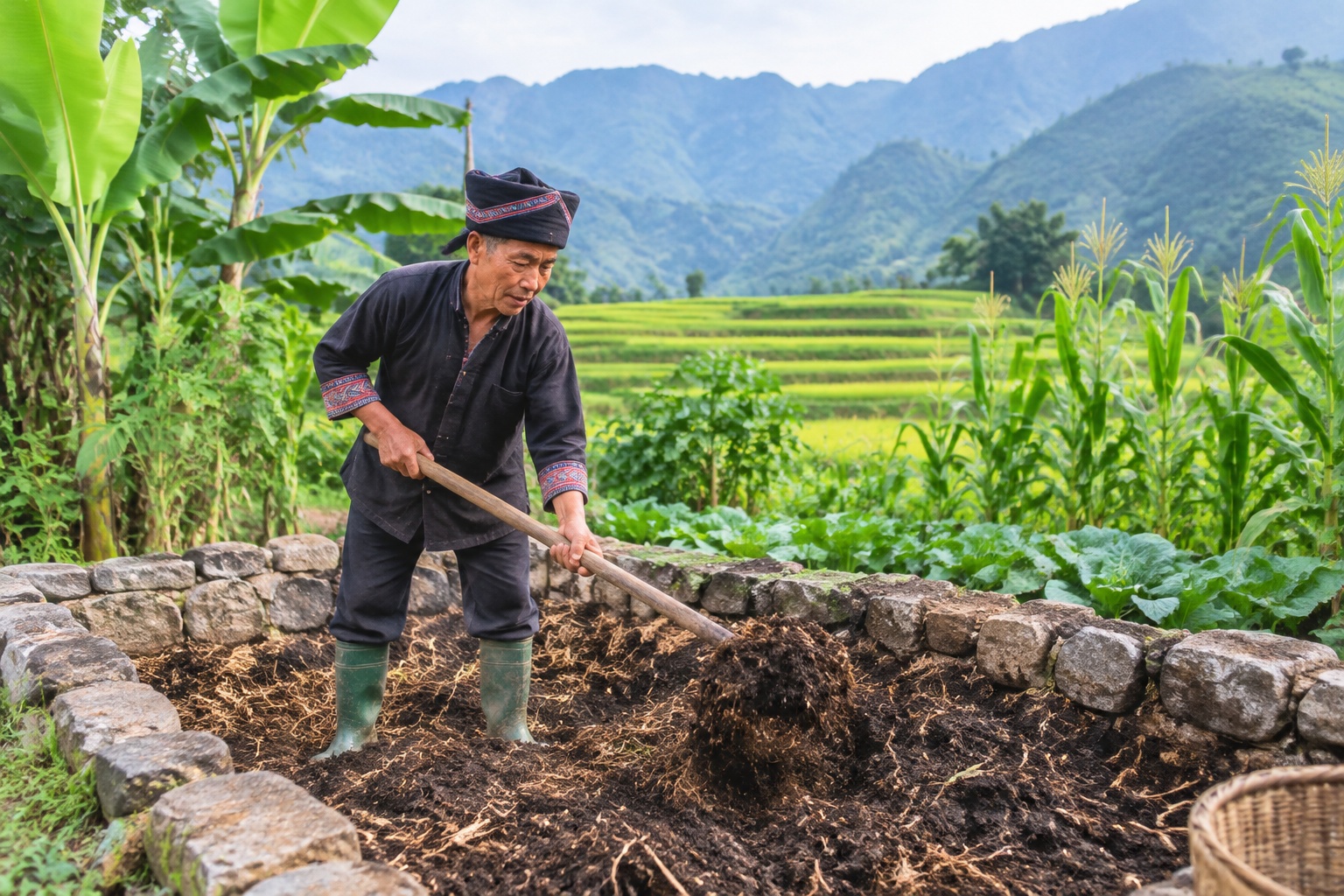
The green bins were not just a symbol. Behind the village, the community built a simple composting area using local stone. Kitchen waste — vegetable peels, leftover rice, fruit skins — is carried there and mixed with dry leaves. After two months, the compost becomes dark, crumbly soil that the village uses on small vegetable plots and in front of their stilt houses. For people who grow their own food, seeing the loop from pan to bin to garden makes the sorting easier to understand.
What This Teaches Rural China
This Buyi village is a small example, but it points to something national. In rural China, waste management is a real challenge. Villages are spread out, transportation is difficult, and a large part of the population is older. Building a big centralized recycling plant is often impossible. What works better is a two-step system: villagers first separate and reduce waste at the household level; then the government trucks carry the bags to treatment points.
The Buyi experiment worked because it matched the first step with a cultural format the villagers already trusted. A song, an agreement, a green account, and a respected elder’s voice. That combination is more powerful than any imported campaign.
Why This Is the China I Want You to See
Many people outside China imagine environmental progress only in big cities like Shanghai or Shenzhen. But the countryside is where the difficulty is greatest, and often where the most creative solutions appear. This Buyi village did not need a smart trash can. It needed a smart use of traditional song, community memory, and patience.
If you travel to Guizhou, you can see Buyi villages without treating them as timeless relics. Look at the side of the house. You will see a row of blue, green, red and black bins. Ask an old woman about the sorting song. She might sing it for you on the spot, and then point to your empty water bottle to see if you place it into the right one. That is today’s China — still deeply rooted, yet quietly figuring out how to handle the plastic we all leave behind.
Start the discussion at forum.chinacomes.com