


A Quiet Morning in a Nanjing Clinic
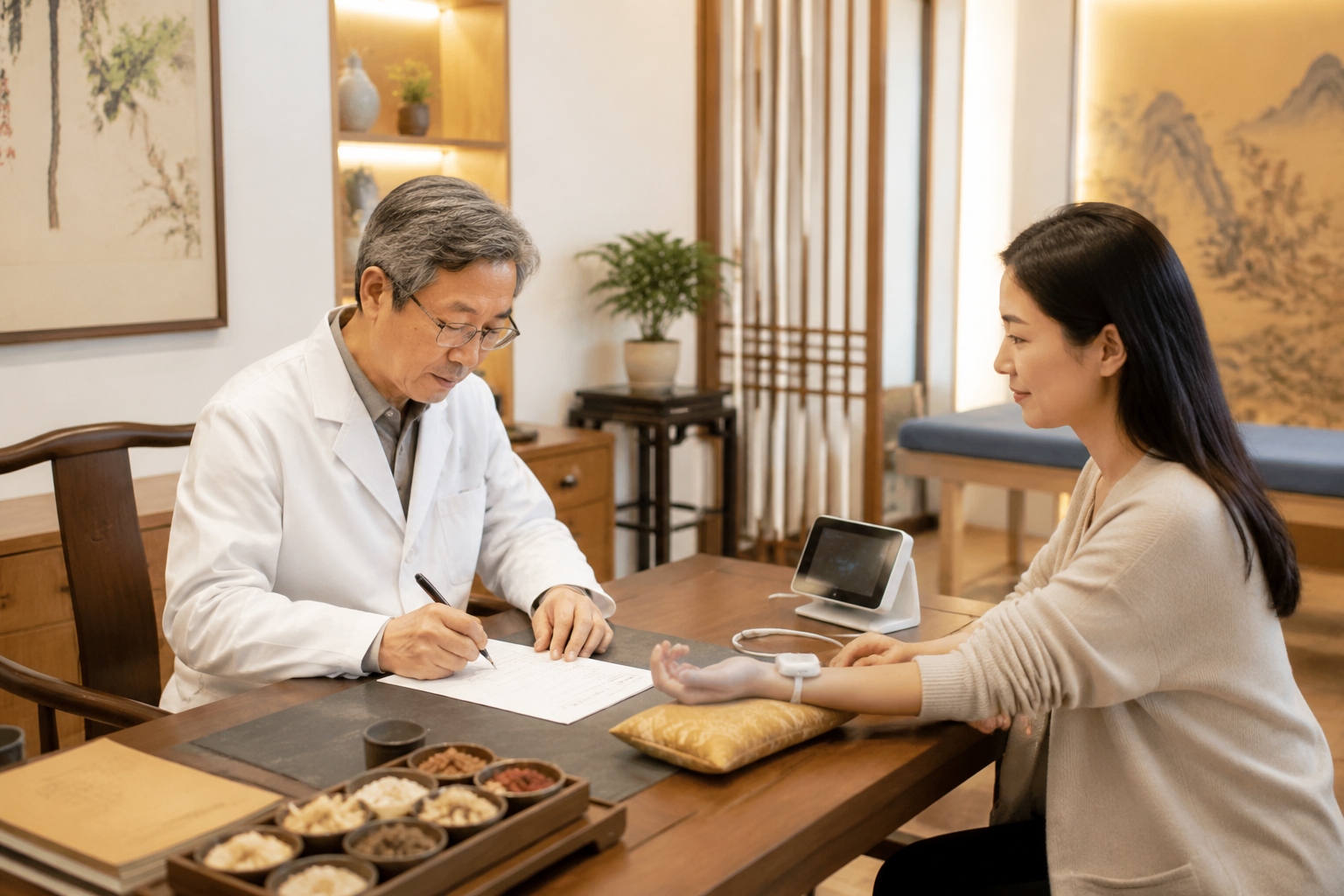
On a humid Tuesday morning, Dr. Wang, a 68-year-old traditional Chinese medicine physician, sits in his small clinic near Nanjing’s Qinhuai River. A young woman in her 30s extends her right arm, resting it on a worn velvet cushion. Dr. Wang places three fingers on her wrist, closes his eyes, and falls silent. For two minutes, the only sound is the hum of an air conditioner.
The woman, a first-time visitor, later tells me, “I honestly expected him to read my mind. When he said I’d been losing sleep and feeling anxious, I was stunned. It felt like magic.”
But Dr. Wang shakes his head. “There’s no magic here,” he says with a smile. “I just listen to what the pulse tells me.”

What Is Pulse Diagnosis Really About?
Pulse diagnosis, or mài zhěn, is one of the oldest diagnostic techniques in traditional Chinese medicine (TCM). Its roots go back more than 2,000 years, but its logic is far less mysterious than many people assume.
When a TCM doctor places fingers on your wrist, they are not scanning for hidden spirits. They are using their sense of touch to gather information about your blood flow, heart rate, and vascular tone. Modern physiology tells us that the pulse reflects cardiac output, arterial elasticity, blood viscosity, and even autonomic nervous system activity. A skilled doctor can detect subtle irregularities in rhythm, depth, speed, and intensity that many of us would simply not notice.
In TCM terms, these qualities are classified into 28 traditional pulse patterns. Some are easy to grasp: a floating pulse feels light and strong, like a piece of driftwood on water, often indicating an early-stage cold or flu. A deep pulse can only be felt with heavy pressure, hinting at issues deeper inside the body. A slow pulse beats fewer than 60 times per minute, while a rapid pulse exceeds 90. Each pattern is linked to a set of symptoms and suggested treatment approaches.
But here’s the crucial point: reading a pulse is not like running a blood test. There are no numbers displayed on a screen. The doctor’s fingers become the instrument, and the brain does the analysis. It is a pattern recognition skill, built on years of practice.
Why Decades of Practice Matter
Dr. Wang began studying TCM at 19, after graduating from a provincial medical school. He spent the first five years memorizing the classic texts, the next ten years simply feeling pulses under the supervision of his mentor, and the following decades refining his judgment.
“Every patient is different,” he explains. “A young athlete’s pulse is naturally stronger. An elderly diabetic patient’s pulse may be wiry. You have to know what ‘normal’ means for each person. That comes from seeing thousands of cases.”
This experiential learning is similar to how a master perfumer identifies hundreds of scent notes or how a sommelier distinguishes a subtle oak finish in wine. It is not mystical intuition; it is calibrated perception.

Not Magic, but Not Infallible
Dr. Wang is quick to point out what pulse diagnosis cannot do. “I can’t tell if you have cancer. I can’t estimate your blood sugar level. I cannot replace a CT scan or an MRI.”
In fact, modern Chinese hospitals often combine TCM and Western medicine. A patient may see a TCM doctor for chronic pain or fatigue, but the same hospital will offer blood tests, imaging, and emergency surgery. The Chinese government has invested heavily in both systems; most public hospitals have dedicated TCM departments alongside modern equipment.
This integration reflects a pragmatic approach rather than blind faith. A 2019 study published in the Journal of the American Medical Association found that while TCM can help with conditions like irritable bowel syndrome, its efficacy varies widely and rigorous research is still needed. Dr. Wang himself says, “If I suspect a serious problem, I tell the patient to see a Western doctor immediately.”
So why does the myth of “magic” persist? Partly because TCM treats the whole person—the patient’s lifestyle, emotional state, and physical symptoms together—which can feel uncanny when described in poetic terms like “liver qi stagnation” or “blood deficiency.” These terms sound esoteric, but they are metaphors for complex physiological states we are still learning to measure.
From Skepticism to Understanding
Zhang Li, a 29-year-old engineer, first came to Dr. Wang after months of unexplained headaches. “I grew up with Western medicine,” she says. “I thought TCM was for older people.” She tried acupuncture and herbal decoctions, but it was the pulse reading that changed her mind.
“He asked me if I’d been under stress at work. I almost cried. I hadn’t told him anything about my life.” She pauses, then adds, “Later, my sister told me he probably noticed the calluses on my fingers from typing, the tense muscles in my shoulders, and the dark circles under my eyes. That made sense. He wasn’t psychic—he was observant.”
That observation is the heart of the matter. A good TCM doctor is a master of noticing details that others overlook: the tone of your voice, the color of your face, the moisture of your tongue, the way you breathe. Pulse reading is one tool in this broader diagnostic framework.
What Pulse Reading Teaches Us About China
For the average Chinese person today, visiting a TCM doctor is not about rejecting modernity. It’s about adding another layer of care. A national survey in 2021 found that over 75% of Chinese urban residents had used TCM services at some point, whether for a massage, a herbal remedy, or a pulse consultation.
The practice is also evolving. Some TCM hospitals now use electronic sensors to detect pulse waves, turning the doctor’s fingertips into a data-driven measurement. But even the most advanced device cannot replace the judgment of a seasoned physician—because pulse diagnosis is not purely objective. It is a dialogue between the patient’s body and the doctor’s experience.
When you understand that, the so-called mystery fades away. The old doctor’s closed eyes are not an attempt to see into your soul. Like a detective studying a crime scene, he is simply looking—and feeling—for clues that your story has left behind.
Conclusion: A Skill Worth Respecting
Pulse reading is not magic. It is a diagnostic technique refined over millennia, rooted in careful observation and clinical experience. It has limits, but it also has value—especially as part of a broader healthcare system that combines the best of tradition and science.
Dr. Wang sees about 30 patients a day. He usually takes their pulse twice: once at the beginning and once before writing the final prescription. “The pulse changes during the consultation,” he says. “It tells me whether the patient is relaxing or getting more anxious. In a way, it’s like having an honest conversation with the body.”
And that maybe is the closest thing to magic: the ability to listen to a body with such attention that the body starts to speak.
Start the discussion at forum.chinacomes.com