
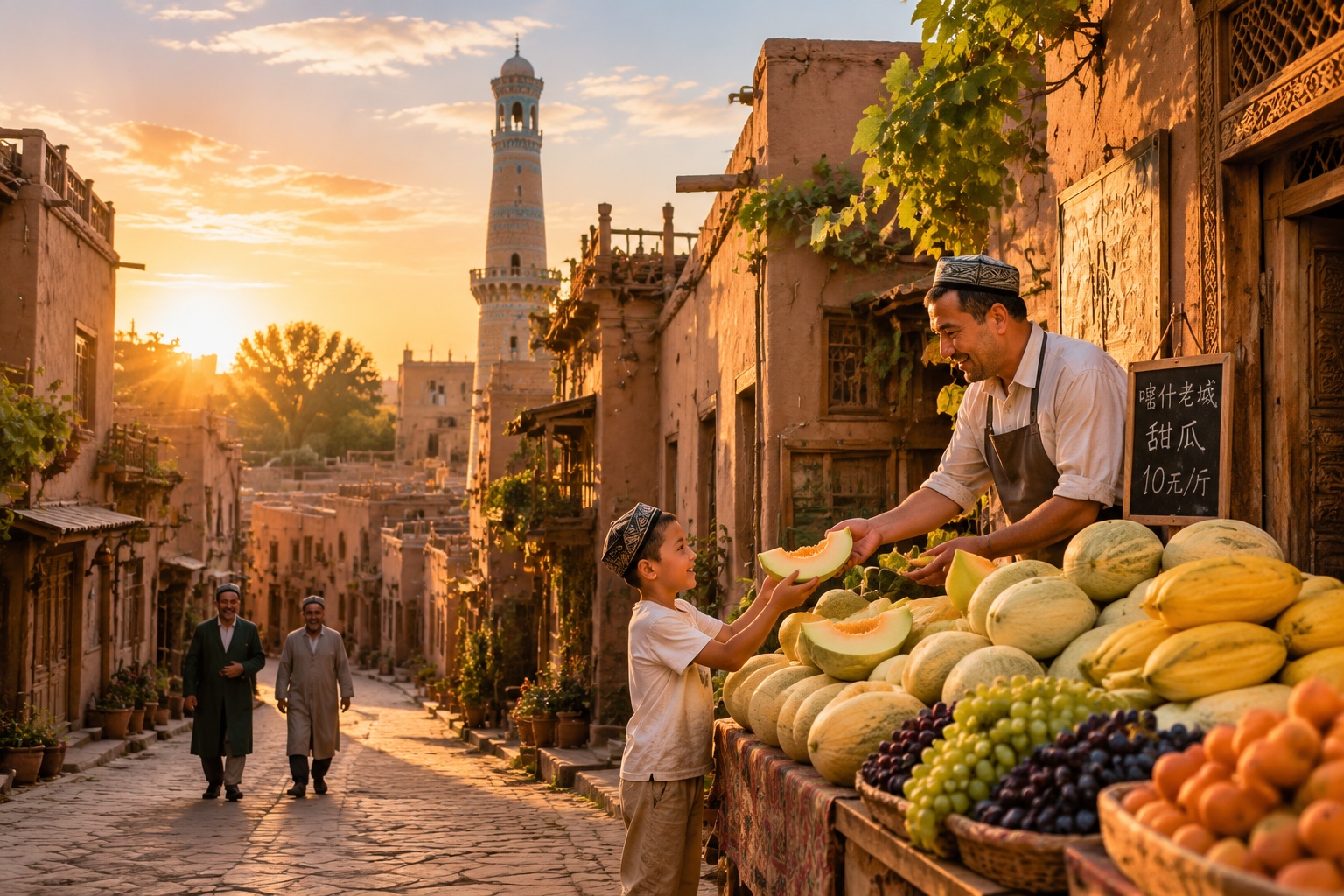

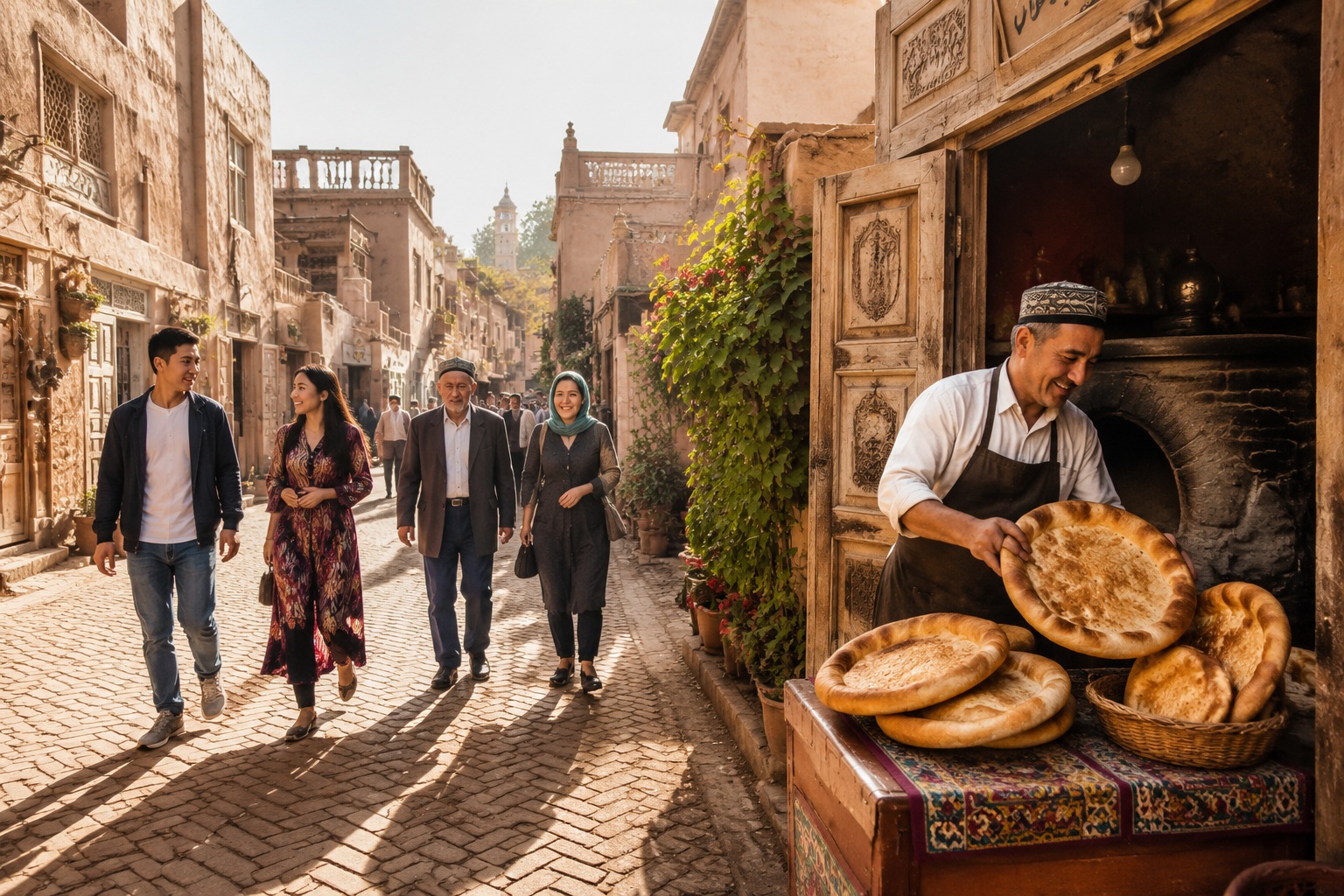
The first light creeps over the old city of Kashgar, painting the flat rooftops in a warm shade of apricot. From my guesthouse window, I can see the minarets of the Id Kah Mosque and, closer, a maze of mud-brick lanes still half in shadow. It’s early, but the city is already stirring. In the street below, a baker pulls the first batch of naan from a clay oven with a long hook, and the bread lands on the wooden counter with a soft thud.
I wash my face and step out. The air is dry and crisp, but there’s a sweet scent – like a ripe melon that’s just been cut. It seems to come from every stall and every corner of this ancient town. I have come to Kashgar not only to see the famous old city but to follow its flavours, especially the legendary sweetness of local fruits. I want to learn how to find the sweetest melons and grapes, and to understand why they taste so good here.
Labyrinth of History
It helps to know a little context. Kashgar sits at the edge of the Taklamakan Desert, in the western part of China’s Xinjiang region. For more than two thousand years, it has been a trading hub where caravan routes from Central Asia, Persia, and even Europe met the roads from China’s interior. Marco Polo is said to have passed through in the 13th century, and he described the city as a place of rich trade.
The old city itself is known as ‘Kashgar Old Town’ or ‘Tusi’ in Uyghur. It’s a maze of narrow alleys, covered passages, and dead-end courtyards. The walls are made of rammed earth, a mixture of clay, sand, and straw, kept cool in the scorching summer. Following these winding paths, it’s easy to get lost, but that’s part of the charm. You never know what you might discover – a hidden mosque, a tiny bakery, or a craftsman’s workshop.
This layout has a historical purpose. The labyrinthine design made it difficult for invaders to find their way through, while also providing shade and a sense of intimacy. Walking through it feels like stepping back in time. Yet, just a few minutes’ walk away, you’ll find the modern city with its wide boulevards and bustling shops. The contrast is striking.
The old city is also home to the Id Kah Mosque, the largest mosque in China, which was rebuilt in the 15th century and expanded later. Its yellow-tiled courtyard and intricate wooden carvings are a reminder of the region’s deep Islamic heritage. On Fridays, thousands of worshippers gather here, their voices echoing through the narrow streets.
Following a Local’s Nose
To truly navigate this maze and find the best fruit, you need a local guide. I’m lucky to have Alim, a young Uyghur man who studied tourism in Urumqi but returned to his hometown to be part of the old city’s revival. He knows everyone: the tea-shop owner, the carpenter, and especially the fruit vendors.
"Don’t just buy from the first stall," he says, leading me through the bazaar. "The best melons come from a farm near Turpan, a day’s drive away. But the real treasures are sometimes hidden in the back alleys."
We pass by stacks of delicately patterned carpets and shiny copper objects. The market is full of colours and sounds: a melon seller taps his goods rhythmically, a knife sharpener drags his blade across a stone, and the smell of sizzling lamb skewers over charcoal is impossible to ignore.
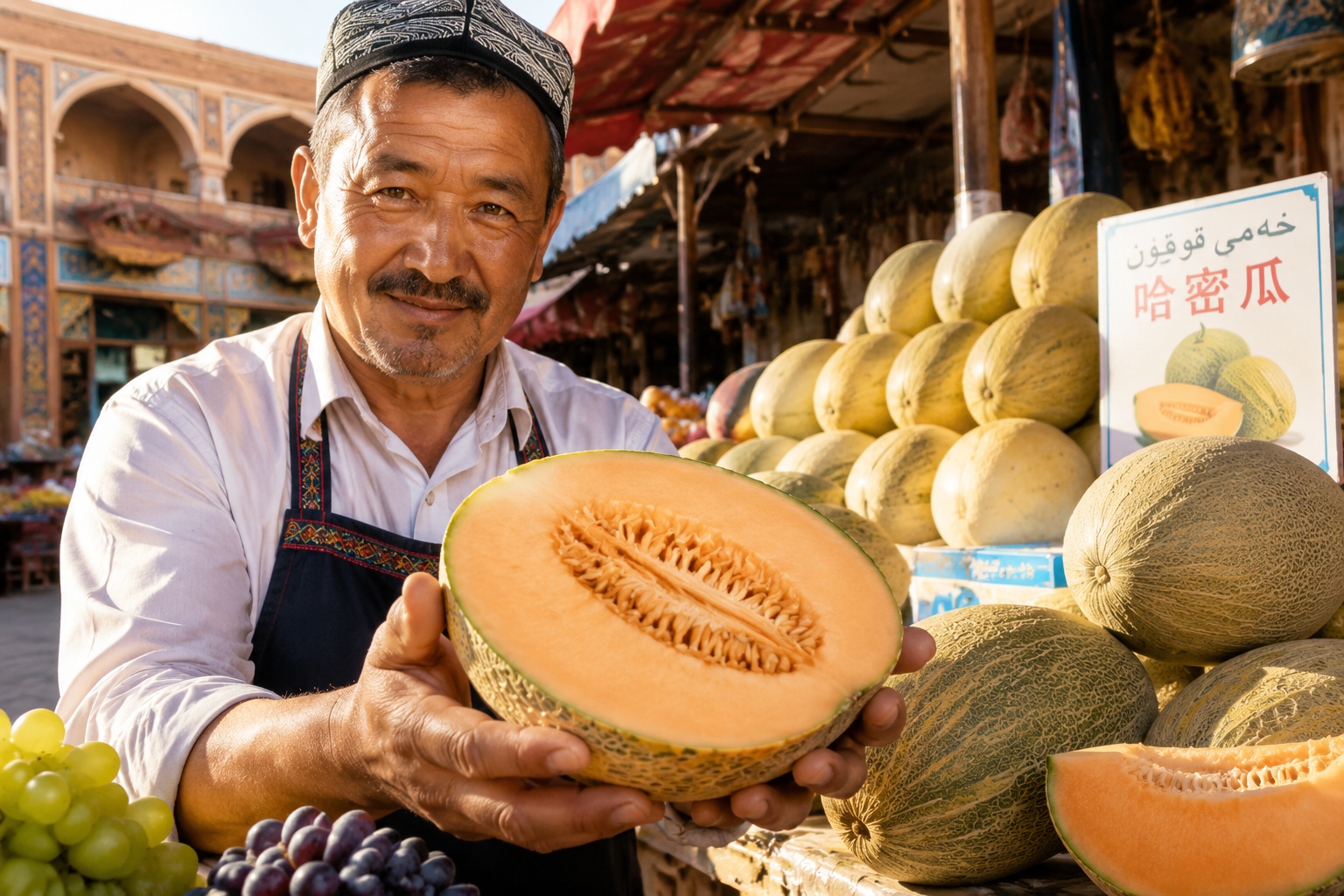
We finally stop at a stall that looks no different from the others. Alim introduces me to the vendor, a man with a thick beard named Rahmat, who has been selling melons for over twenty years. "His uncle grows them, and his grandfather grew them before that," Alim explains.
Rahmat picks up a green-striped Hami melon and sniffs it carefully. He taps it with his fingers, listening to the sound. "You want a deep, dull sound," he says. "If it’s too hollow, it’s overripe. If it sounds too bright, it’s not ripe." He also tells me to look at the stem, which should be slightly dry and corky. Then he opens one with a quick, precise cut. The flesh is pale orange, juicy and glistening in the sun. I take a piece and close my eyes. The sweetness is so intense that it buzzes on my tongue – a mix of honey, rosewater, and fruit.
Alim then pulls down a cluster of small green grapes from a nearby hook. He hands me one. It’s so sweet it almost feels like candy, with a thin skin and a slight crunch. "These are called kudurbai, or ‘little pearls’," he says. "They’re grown near the Tianshan mountains, and the water from melting snow gives them a special taste."
Sweet Secrets of the Bazaar
Beyond the melons, the bazaar is a treasure trove of sweets. There are juicy pomegranates that bleed bright red juice, fragrant figs with a shimmering purple skin, and clusters of small green grapes known as ‘little pearls’. Alim tells me that these grapes are especially prized because they are grown in the foothills, where the temperature difference between day and night is extreme. That contrast is what makes them so concentrated in sugar.
We stop at a stall dedicated to figs. The figs are soft and sticky, bursting with jam-like sweetness. A stack of pomegranates sits beside them, their crowns dark red. The vendor cuts one open, revealing a cluster of ruby-red seeds. "This is the famous Kashgar pomegranate," he says. "The seeds are sweet and the juice is so dark it looks like wine."
We wander deeper into the market. I’m drawn to a coppersmith’s workshop, where a young man is hammering a decorative teapot. He tells me his family has been doing this for generations. "People say tea tastes better in copper," he smiles. A few doors down, a man carves a wooden dutar, a traditional lute. He plays a few notes for us, and the music echoes through the archway.
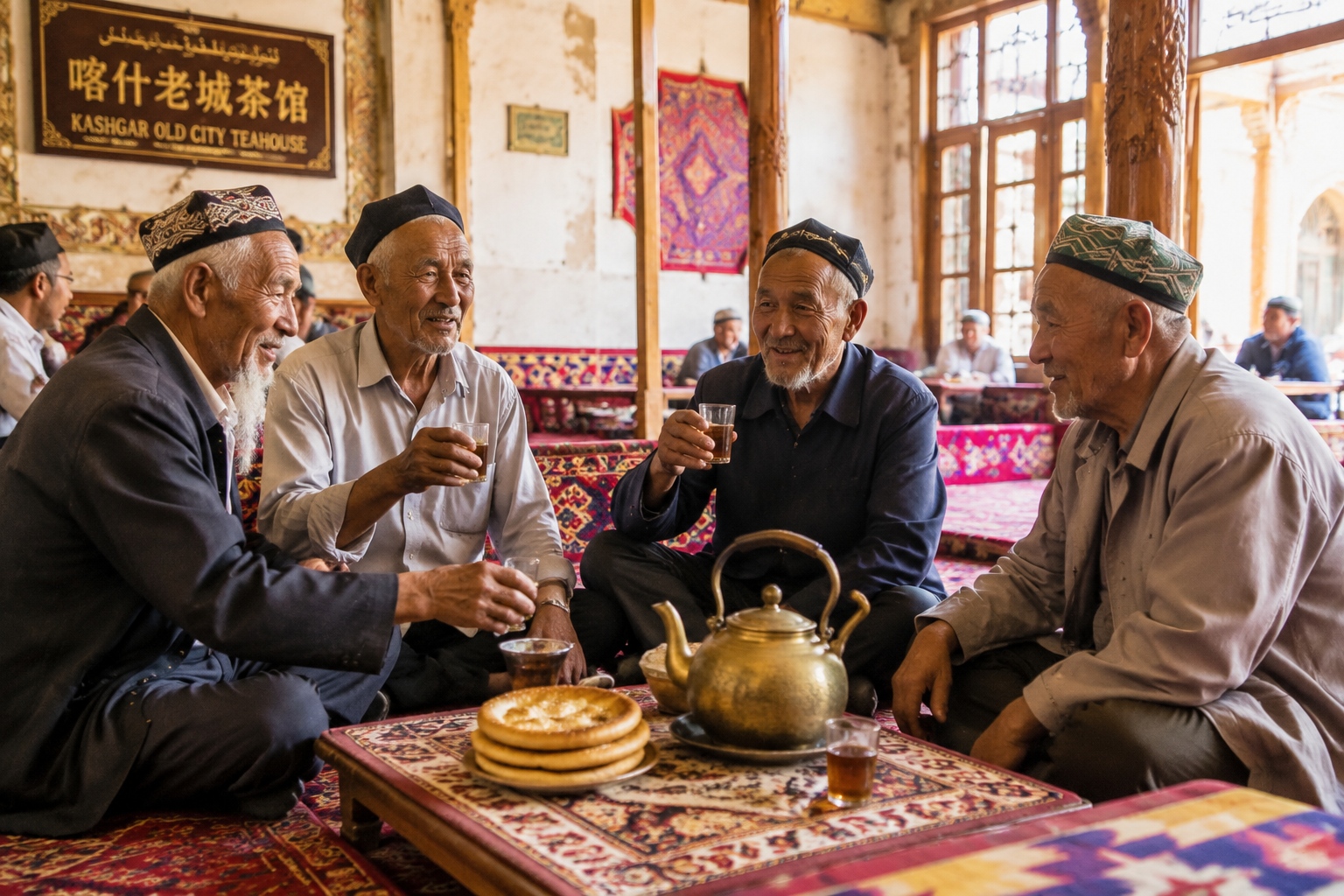
After the tour, Alim takes me to a quiet teahouse. We sit on a low bench, and an elderly waiter pours amber tea into small glasses. Sweet cloves, cinnamon, and the smoky aroma of dried fruit fill the air. We nibble on a piece of locally produced honeycomb, which balances the tea’s astringency. "This is how we unwind," Alim says. "The bazaar is exciting, but the tea house is where we talk about life."
Old Walls, New Lives
Kashgar’s old city has changed dramatically in the past decade. For many years, the area suffered from poor infrastructure: inadequate water supply, ancient sewage systems, and cramped, dusty houses. A large-scale renovation project, started in 2010, changed all that. Old buildings were restored layer by layer, with new concrete and steel injected behind the original facades. Residents were moved out temporarily and then returned to more comfortable homes, with modern bathrooms and kitchens.
The renovation project was careful to preserve the original street pattern, even the dead ends and S-shaped curves. Local artisans were hired to rebuild facades using traditional techniques, while hidden metal beams support the walls. This means the old city remains a treasure trove for visitors, but with significantly better living conditions.
I meet a retired teacher, Gulnara, who has lived in these lanes for decades. She tells me that while the renovation is welcome, it also brought challenges. "The neighbourhood is cleaner now, and our kids can study better. But the rent is also higher, and some of the old shops have disappeared." She still keeps her front door open, and her courtyard is filled with potted plants and a dog that barks at strangers.
The old city is also becoming a tourist destination. A growing number of visitors from all over China and the world come to experience the maze-like streets, buy handicrafts, and enjoy the food. Young entrepreneurs have set up guesthouses, boutiques, and art studios in restored buildings. There’s even a café that serves espresso alongside traditional Uyghur pastry. It’s a mix that can be odd, but mostly it adds energy without wiping out the old vibe.
A Final Sweet Bite
As the sun heads toward the western horizon, I stand on a rooftop at the edge of the old city. The labyrinth below is bathed in golden light, with the occasional pale smoke rising from a chimney. I hold a slice of Hami melon, one last piece of the fruit we bought earlier. It’s still cold, still crunchy, and still intensely sweet.
We give thanks to Alim and wave goodbye as we descend the rooftop. The streets are quieter now, the market stalls closed and the last few tourists heading back to their hotels. The scent of melons still lingers, mixing with the earthy smell of mud walls cooling down in the evening breeze. It’s a scent that will stay with me long after I leave Kashgar.
This walk through the old city has been a lot more than a tourist experience. It’s been a journey into the heart of a place that has preserved its past while navigating the future. The sweetness of the melon isn’t just a matter of soil and water; it’s also a legacy of trade, culture, and the simple pleasure of sharing good food. If you ever find yourself in western China, follow your nose and your curiosity. The old city of Kashgar will reward you with a taste you won’t forget.
Start the discussion at forum.chinacomes.com