

Morning Market in the New Town
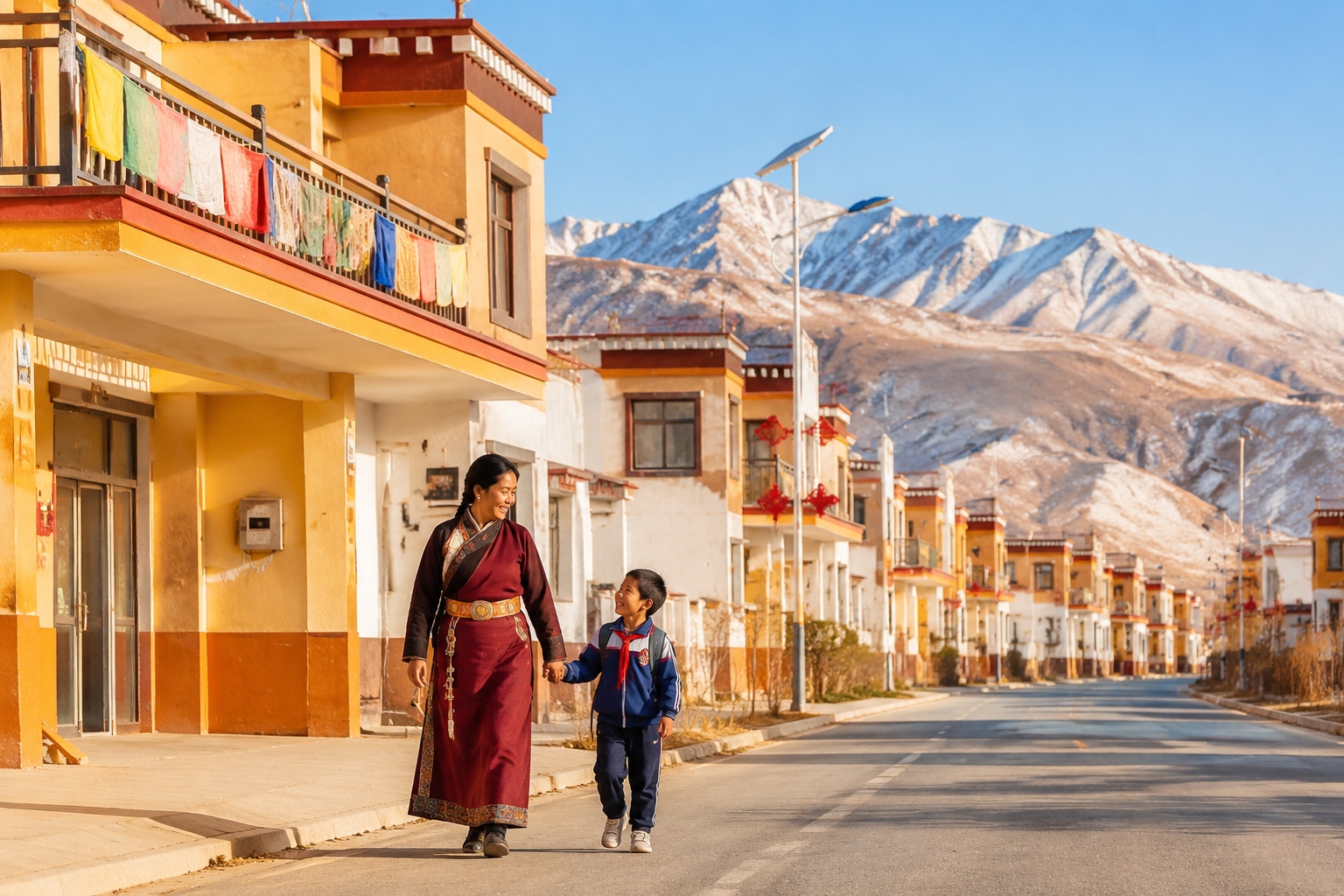
The market street in Tsonyi New Town starts early. Around seven, the headlights of a delivery truck cut through the thin mountain air, and vendors begin arranging potatoes, cabbages, and frozen mutton on worn plywood tables. A man with a dark, weathered face and braided hair studies a digital scale outside a spice stall. His name is Phuntso. He wears a tan down jacket over a traditional Tibetan chuba. In one hand, he holds a string of prayer beads; in the other, a smartphone showing his daughter’s homework photos.
Eight years ago, Phuntso lived in a black yak-hair tent on open pasture reachable only by horse. Today, he is one of about 3,000 former herders who have settled in this town, built where the grassland meets the highway in northwest Qinghai Province, China. The town is called Tsonyi, a name that feels new and old at once — “grass lake.”
Why Did They Move?
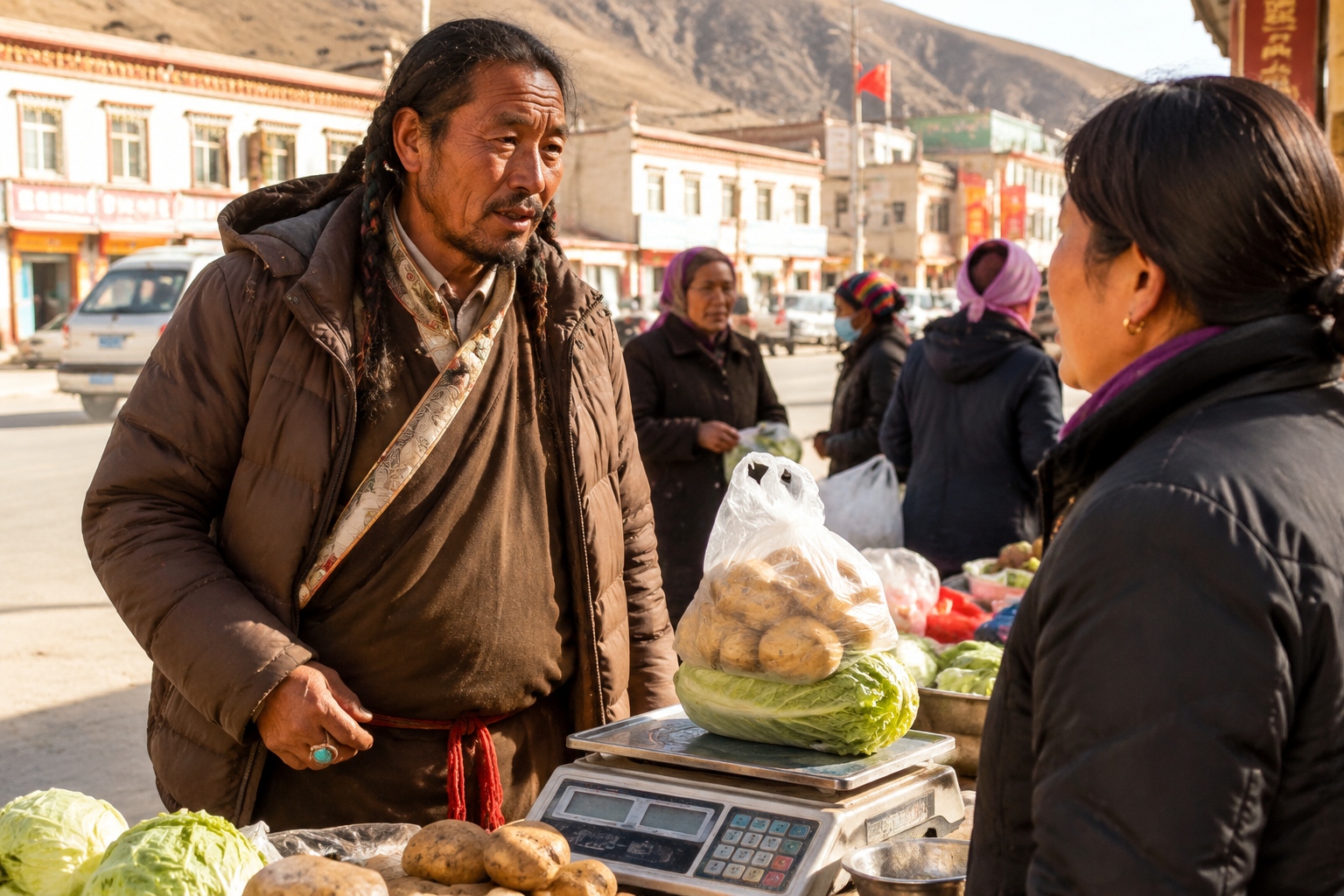
Tsonyi New Town was created as part of the Sanjiangyuan ecological relocation program, one of China’s largest efforts to protect the source of the Yangtze, Yellow, and Lancang rivers. Over the past decade, tens of thousands of Tibetan herders in Qinghai and parts of Tibet have moved from scattered tents and winter shelters into town houses. The goal is to reduce grazing pressure on the fragile high-altitude grasslands and to adapt to climate change, which has made spring snowstorms more destructive.
Most families were not forced — but life on the high plateau had become increasingly harsh. Winter weather grew more erratic. When a blizzard struck, herders could lose half their animals in a few days. Phuntso remembers the 2010 disaster that killed many of his yaks. “After that, I knew I couldn’t keep going the old way,” he says. Local officials came to the village with a proposal: an apartment in town, a heating system, a school within walking distance, and access to training programs.
The compensation package differs by county, but here each household received an 80-square-meter flat, a one-time moving allowance, and monthly living subsidies for three years. The government also offered skills classes. It wasn’t a promise of gold on the streets, but for many it was a chance to stop gambling with snow.
Learning to Microwave: The Household Transition
Moving from a tent into a third-story apartment is more than a change of walls. It’s a change of water, fire, and space. Phuntso’s mother-in-law, Drolma, remembers the first week: “We didn’t know how to use the toilet. The flush button felt like a machine gun.” Her husband, now 72, stayed in the stairwell for two days because the elevator made him dizzy.
The county organized a “household transition class” in the community hall. Social workers demonstrated how to use an induction cooker, how to stop a running toilet, and how to scan a QR code to pay an electricity bill. Teaching videos were translated into Tibetan. In the beginning, some families kept their yaks in the underground parking garage and others hung meat to dry on balconies. Over time, rules were adjusted — some wet markets got a drying room, and the apartment management built fenced areas for small animals.
The biggest lesson was time. Herding has no clock; a lambing day can last until sunrise. Town jobs have fixed hours, and electricity costs money. Phuntso admits that the first winter was tough. They still made a fire on the balcony in a steel brazier, but the apartment’s central heating was actually warmer. “After February, we stopped using the brazier. The floor heating won,” he laughs.
From Pasture to Paycheck: New Jobs Emerge
Once settled, the main question was work. In the first two years, many relied on subsidies and odd jobs. Eventually, the county created a mix of public and social jobs: rangers, sanitation workers, drivers, and staff for the new school.
Phuntso now works as a wetland ranger. Every morning he clocks in at the nature reserve station and drives an electric motorcycle along fixed routes. He checks for poaching, reports dead animals, and uses a smartphone app to record wildlife observations. “It’s still close to land,” he says. “But now the grass grows without my herds on it.” He earns about 3,000 yuan a month, about half what he made in a good herding year, but consistent.
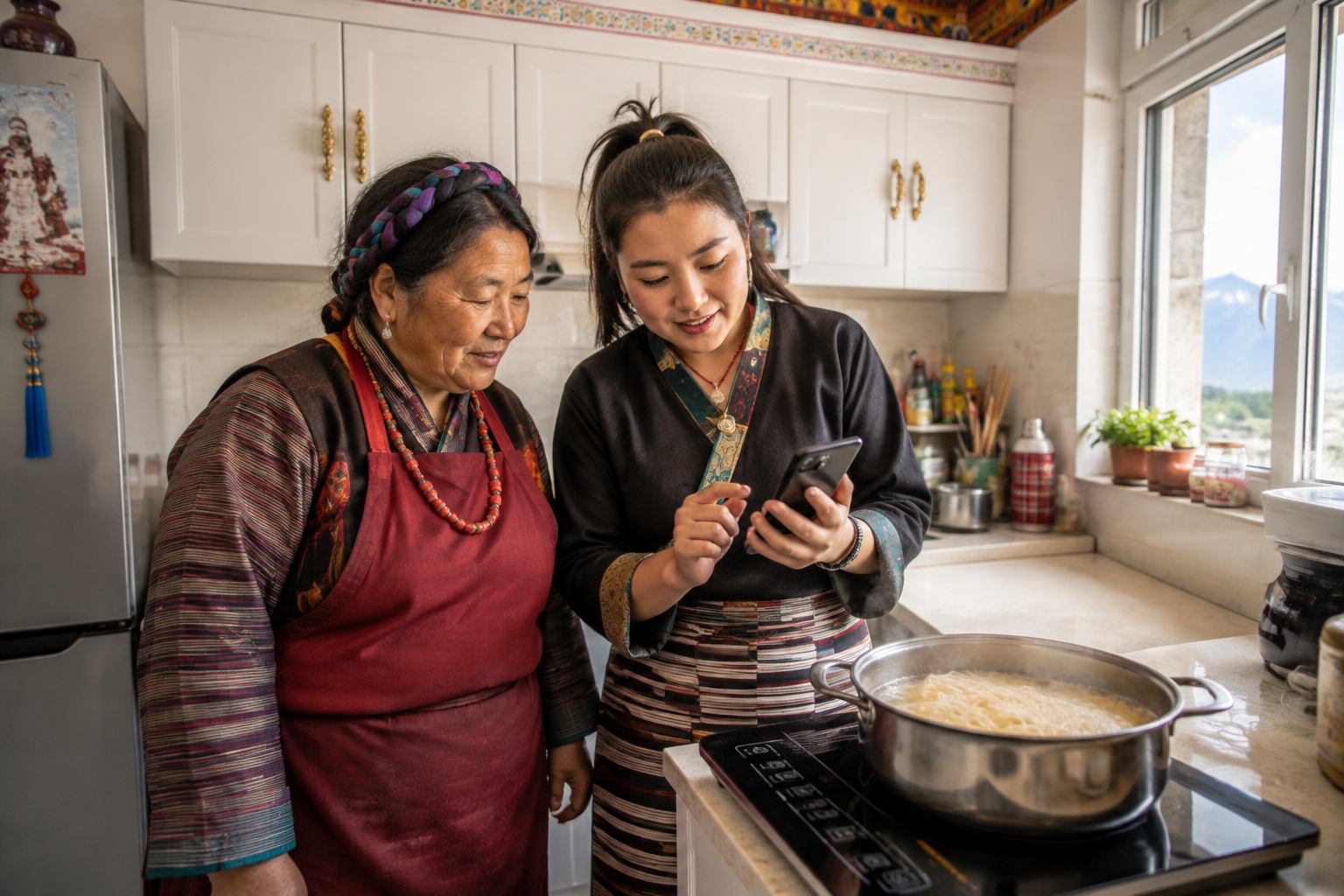
His wife, Drolma, took a leather-working course and produces Tibetan-style cushions and satchels for a workshop owned by a local cooperative. The cooperative sells through e-commerce platforms and a travel agency in Xining. “I never imagined I could sell things through a phone,” Drolma says. She now makes around 2,600 yuan per month.
These are not high-income jobs. But they include social insurance, health coverage, and annual training. The town’s employment service centre reports that roughly 90% of the relocated working-age residents have at least a basic job. Some work so-called “eco-post” roles, partly subsidized by environmental funds. Others have started small restaurants or grocery stores along the main street.
Not everything is smooth. Some older former herders struggle with the rhythm of shift work. Others lack Mandarin skills and find it harder to access services. A young community official, Tsegyi, who is herself the daughter of relocated herders, says the challenge is not training but trust: “We are still learning what people need, and they are learning that we are not going to disappear.”
The Kids Are the Fastest to Change
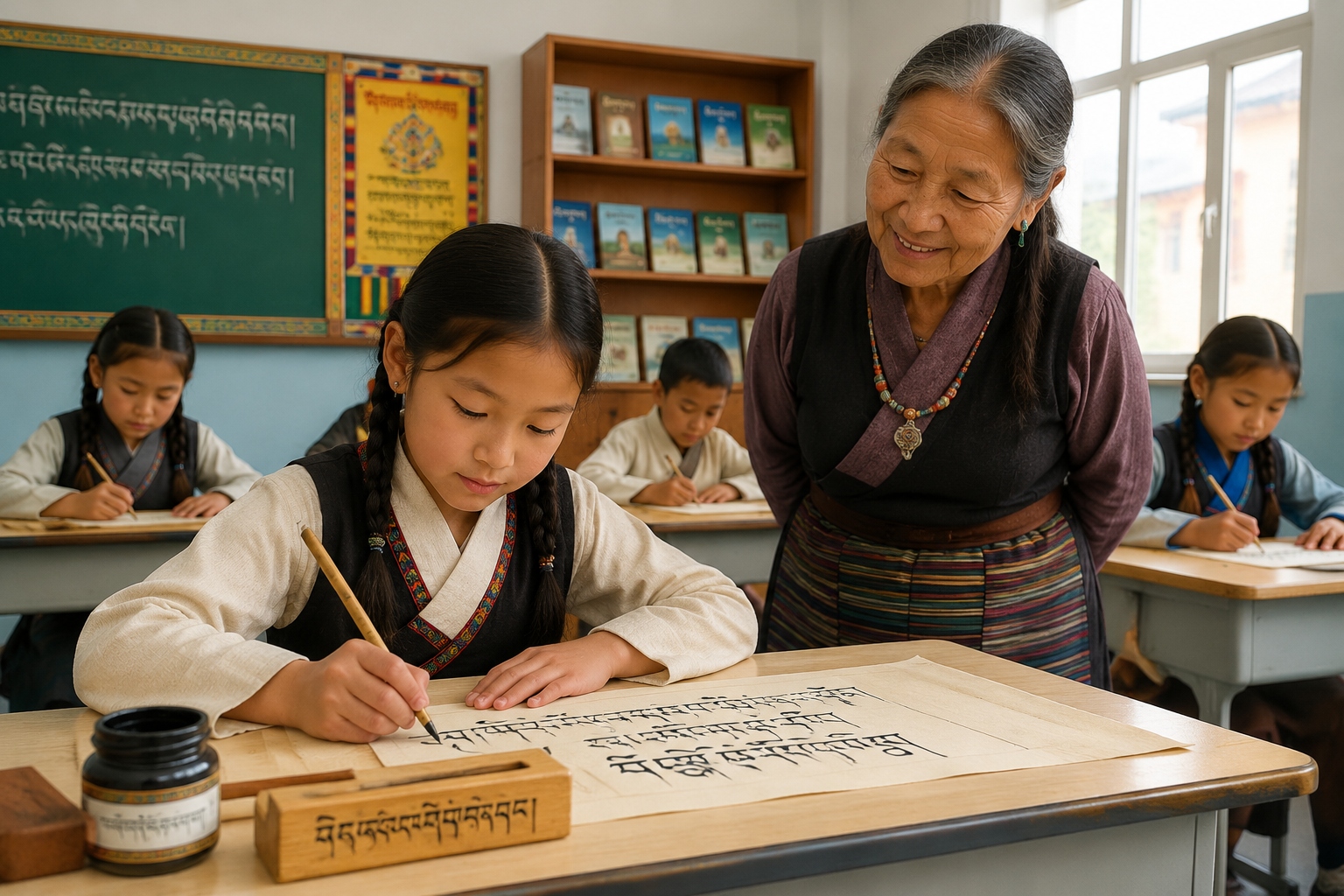
In Tsonyi, the classrooms feel like the future. The elementary school, built in 2016, has clean classrooms, an internet-connected computer lab, and a small library with Tibetan and Chinese picture books. Children study Mandarin as the main language and Tibetan as a second language. They also have physical education, art, and music.
Phuntso’s ten-year-old daughter Pempa is in the fifth grade. When she was born, her grandmother counted her first numbers using yak dung patties. Now she can solve math problems with a calculator and has learned to type Tibetan on a tablet. “She knows how to write words I cannot read,” Phuntso says with mixed pride and envy.
The school runs an after-hours club where pupils learn Tibetan calligraphy, dance, and horse-related crafts. Pempa just joined the future-science club; her most recent project is a model of a weather station. When asked what she wants to be, she answers without hesitating: “A doctor for babies.” That ambition was impossible when the closest clinic was two days away by horse.
Keeping Tibetan Heritage Alive Inside Concrete
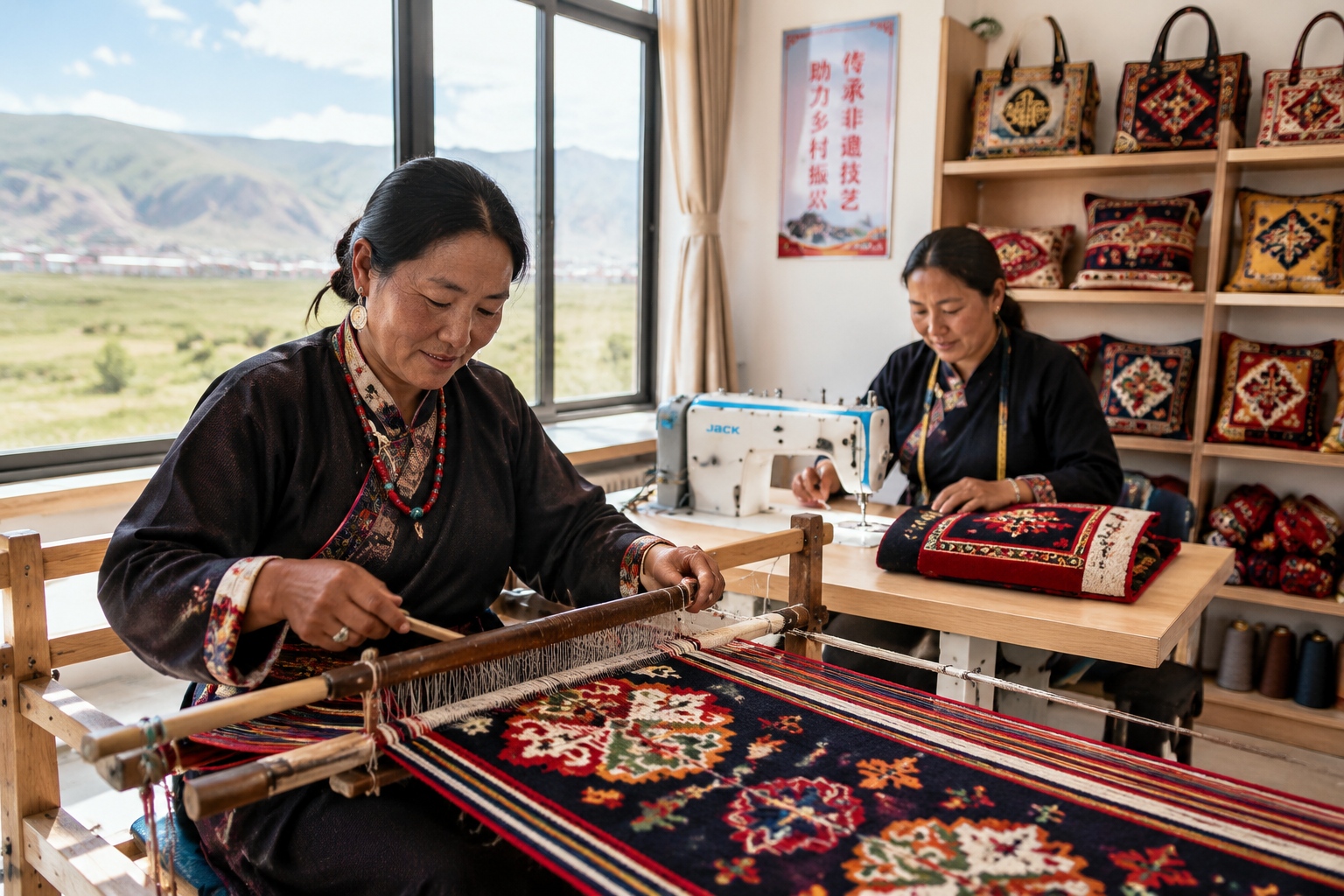
At first glance, Tsonyi New Town could be any small Chinese town: wide asphalt roads, metal shop signs, convenience stores selling instant noodles and phone chargers. But the prairie slips back in small ways.
The community centre has a long prayer-wheel corridor, and every morning you can see elderly residents circumambulating it, their lips moving silently. A Tibetan incense shop sells juniper and conifer bundles, and the smell of smoke often mixes with the smell of boiled milk from the noodle shop. During the Losar (Tibetan New Year), families hang prayer flags on their balconies, and the streets fill with men and women in their finest chubas.
The town has also built a tiny heritage museum. Inside is a collection of objects donated by residents: a wooden milk pail, a saddle with silver decorations, a manual butter churn, and an old iron tripod used for cooking over an open flame. The exhibits are not separated by glass; visitors can touch them. “These items are not relics yet,” explains the museum’s volunteer guide, a retired herder in his 60s. “They remind us where we came from, even if we no longer use them every day.”
Each summer, the county organizes a horse-racing festival outside the town. Many former herders join as participants, reviving skills that have no place in town. Children learn to ride ponies; grandmothers sit on tatami and teach how to make butter tea and fermented barley drink. At the festival, the town feels like a temporary nomadic camp again, but with loudspeakers and a medical tent.
What’s Lost, What’s Gained
Not everything is rosy. For some older people, the town is a kind of soft prison. They miss the open, the smell of damp grass after rain, the total darkness of night. Their daily ritual of moving with the stock gave them a physical sense of purpose that an apartment cannot replace. “There is nothing outside the block to do,” says one elderly woman who spent 40 years as a herder. “I feel like I am waiting for something all the time.”
The town’s social workers have established a seniors’ centre with table tennis, TV, and a small vegetable garden. But not everyone uses it. Some move back to the grassland during the summer, staying with relatives and helping in their herding camps. Others experience what some researchers call “resettlement loneliness” — a quiet, long-term sadness.
Nevertheless, the gains are hard to ignore. Health stats in Tsonyi County show a significant decline in maternal deaths and infant mortality since relocation. The township health clinic now has two doctors, a nurse, and an ambulance driver; before, a herder woman in labour would often have to lie in a tent if the weather didn’t allow a journey. Medical insurance covers nearly all town residents, and chronic diseases like high blood pressure are now monitored with regular check-ups.
Phuntso acknowledges the ambivalence. “I miss the silence,” he says. “But not when a child is sick and there’s no doctor.” He points to his own father, who suffered from a lung illness two years ago. The old man was rushed to the county hospital in 30 minutes. He recovered. “In a tent, we would have lost him,” Phuntso says quietly.
An Opening, Not an Ending
At dusk, Phuntso walks me to the edge of town, where the pavement gives way to a dirt path and the grassland rolls into the horizon. A single-engine plane drones overhead — not an aircraft for tourism, but one of the small drones operated by a local ecological monitoring team to measure grassland health. It is a realistic metaphor for the new life here: not the old world and the new replacing each other wholesale, but technology adjusting itself to the plateau’s ancient relationship between people and land.
Later, back in the apartment, his mother-in-law is teaching Pempa to twist colorful threads into a keychain — a craft she herself learned from her mother. On the wall is a photo of the old family tent, taken the day they left. “Sometimes I look at that photo and forget how cold it was,” she says. “The town is warmer, in every way.”
Tsonyi is not a perfect story. It is an unfinished negotiation between memory and adaptation, between leaving and belonging. But the families here have done what humans have always done: they take what is useful from the old, learn what is needed for the new, and teach the next generation that roots are not only made of soil.
Start the discussion at forum.chinacomes.com