

At dawn, the canal chief is already walking the ditch
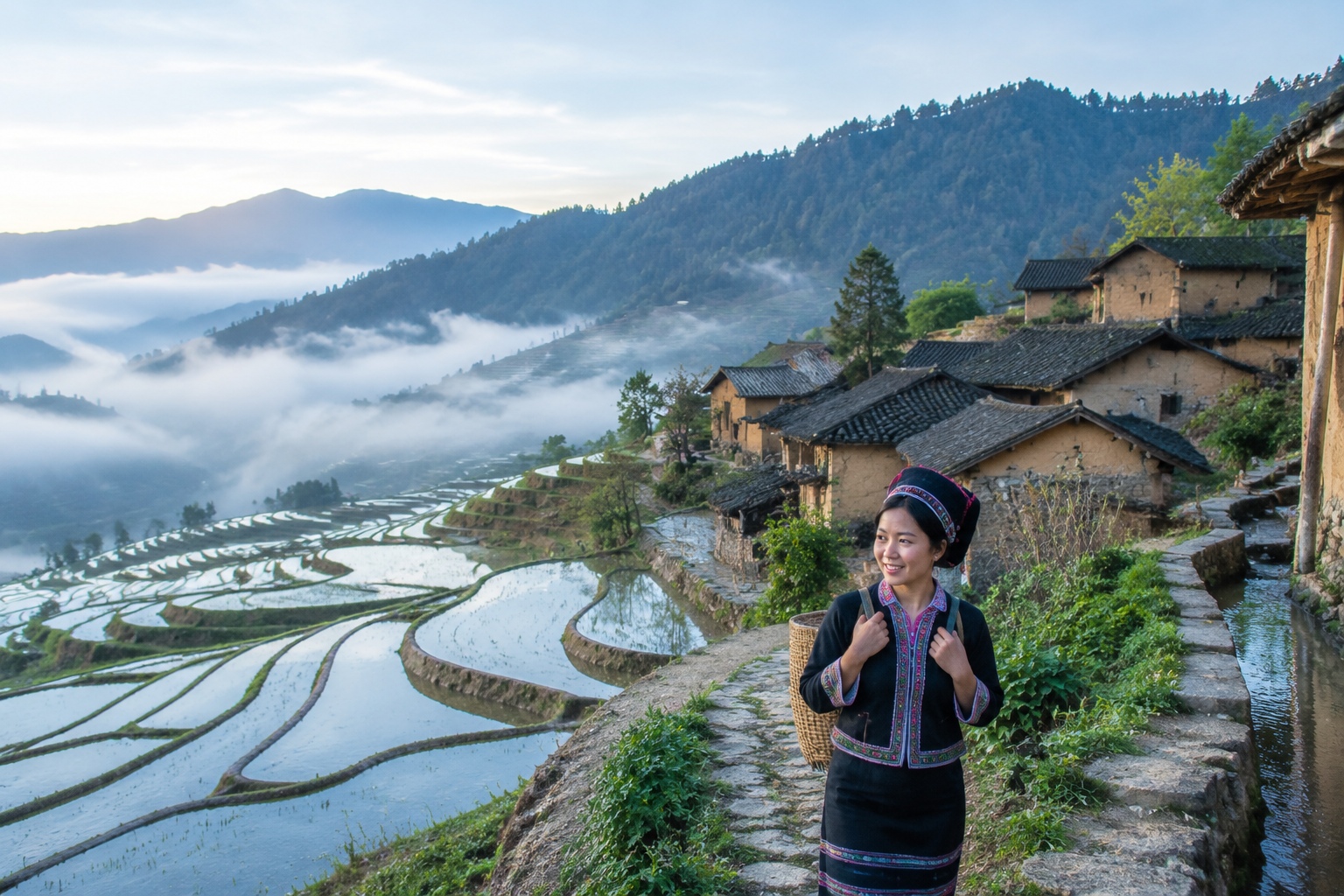
By 6:40 a.m. in Azheke, a village of about sixty households in Yuanyang County, Yunnan Province, the fog has not lifted off the paddies. It lies in the terraces in flat grey sheets, and the mountainside below disappears into it. The village sits at roughly 1,900 metres, halfway up the Ailao Mountains, with old forest above the rooftops and a staircase of flooded fields dropping away beneath.
A man in his fifties — everyone here knows him by his job title, 沟长 (gouzhang), “canal chief” — walks the ditch behind the houses with a hoe over one shoulder and a flashlight in his hand. The channel is about thirty centimetres wide and ankle-deep. It runs downhill on purpose. Nothing here is pumped or lifted; rain and fog caught by the forest above the village feed the channel, and gravity does the rest.
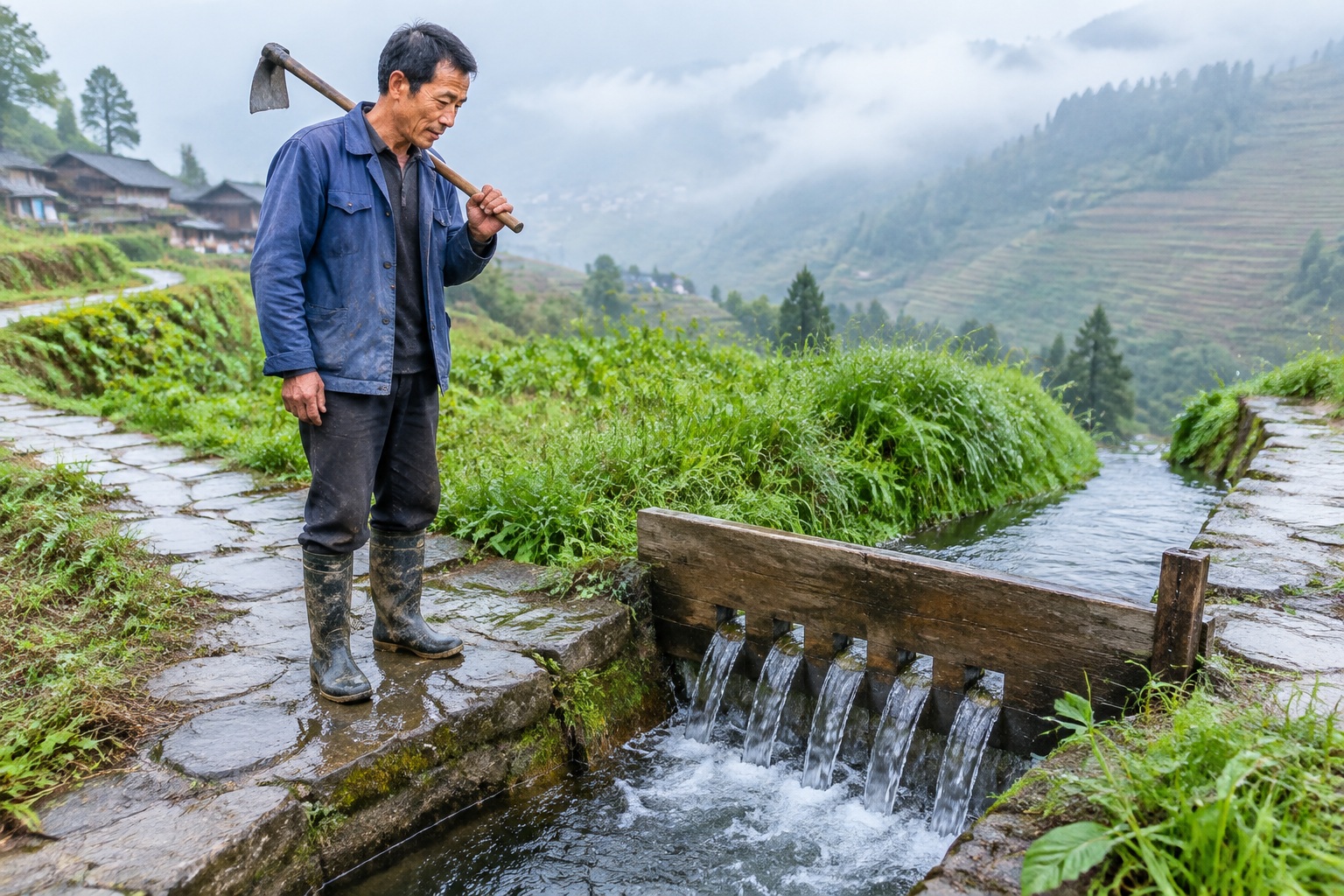
He stops where the ditch forks into three. Jammed into the fork is a plank of wood about the length of his forearm, its top edge cut with notches of different widths. Water spills through them — more through the wide one, less through the narrow ones. Whoever farms the fields below each branch gets the share their notch allows. On this morning nobody argues about it, because nobody has to.
Forest on top, village in the middle, fields below
The vertical order is the reason these terraces exist. The Hani people — an officially recognised ethnic minority group of about 1.66 million in China, most of them in southern Yunnan — began cutting steps into these slopes roughly 1,300 years ago. UNESCO inscribed the Cultural Landscape of Honghe Hani Rice Terraces in 2013; the protected property covers 16,603 hectares, with a buffer zone of 29,501 hectares spread across Yuanyang, Honghe, Jinping and Lüchun counties. In Yuanyang itself, Hani and Yi households make up about half the population.
Locals describe the system in four words: 林、寨、田、江 — forest, village, field, river. Fog and monsoon rain hit the ridge first, and the forest’s leaf litter and soil hold that water and release it slowly, weeks after the rain has gone. Someone worked out centuries ago that cutting the forest above a village stops the water. So the headwater woods are protected, and in many villages they are sacred groves where felling a tree is not merely illegal but taboo.
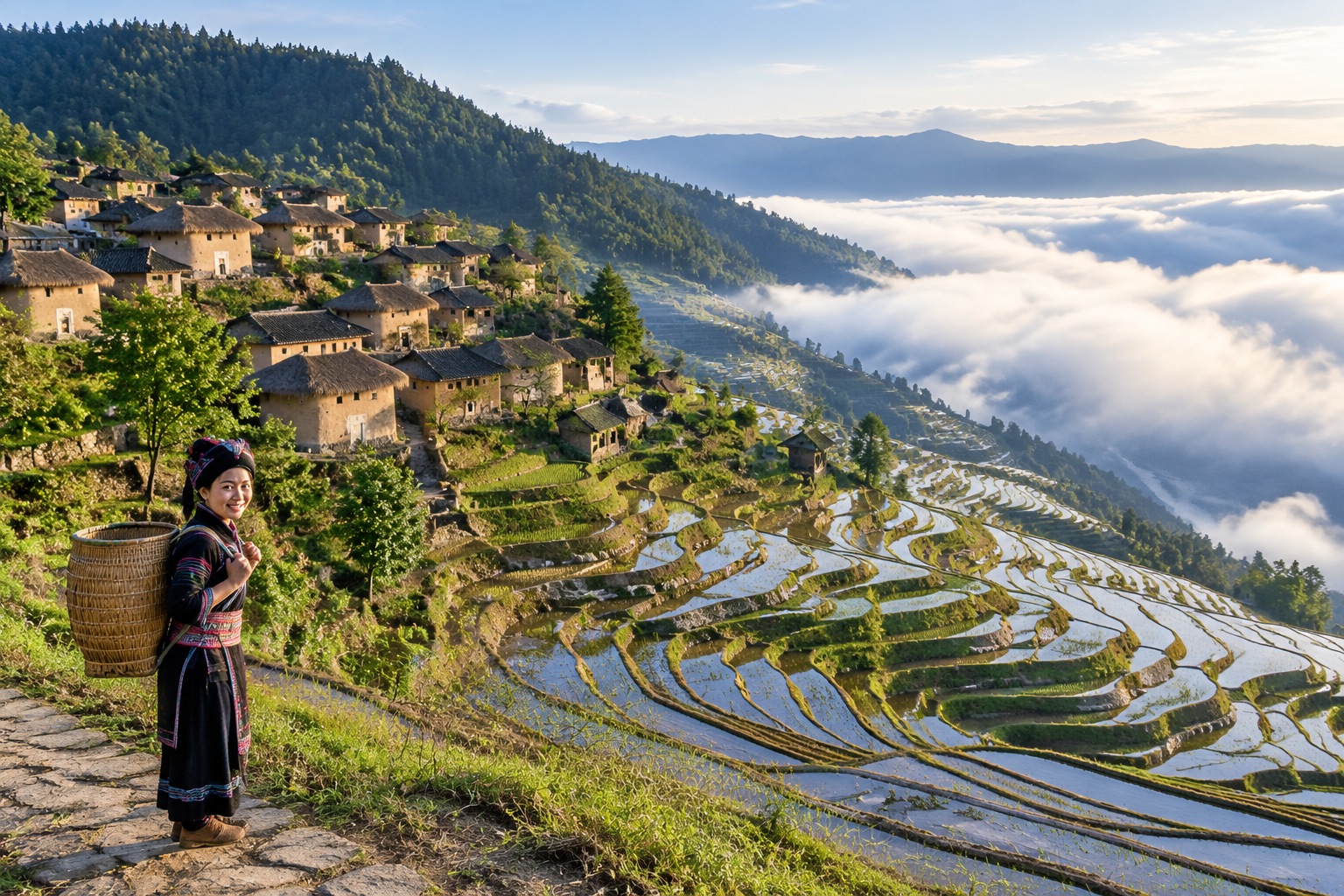
Below the forest sits the village — traditionally mushroom-shaped houses of mud brick and thatch, though many now have concrete and tile roofs. Below the village, the fields. Each paddy spills water into the one beneath it, so the same water is used again and again before it finally reaches the Red River at the floor of the valley, more than a thousand metres below.
A notch in a plank decides who gets how much
The best-known piece of engineering here is 木刻分水, “wood-carved water division.” Where a main channel splits among several households, a wooden plank with measured notches is fitted across the fork. Flow is divided in proportion to the area each family farms — a household working four mu gets a wider notch than a household working two. (One mu is about 667 square metres, roughly a sixth of an acre.)
Historically the notches were negotiated among village elders and the plank was fixed permanently in place. Moving it, widening a notch with a knife, or blocking someone else’s slot was treated as theft. Some villages still use the wooden plank; others have replaced it with concrete weirs and iron plates cut to the same proportions. The arithmetic has not changed.
Fixed shares are not the only method. Where the source is small, villages use timed rotation instead — the upper village takes the channel during daylight, the lower village at night, or households take turns across several days. Demand peaks in March and April, when every paddy must be flooded before seedlings can go in, and again in the dry weeks before the summer rains. That is when the ditch becomes the most argued-over infrastructure in the valley.
The rules are written by the village, not the county
Each village elects a canal chief, usually for a year or a few years at a time. The pay is small or nonexistent — a share of the harvest, or a modest allowance. The job itself is unglamorous and precise: walk the whole channel every day or two, clear leaves and silt, watch for a wall leaking or slipping, organise repairs before the planting season, and settle disputes before they turn into feuds.
Enforcement runs through 村规民约 — village regulations drawn up by residents themselves rather than handed down from above. The old penalty for stealing water was a fine paid in rice, wine and a pig, enough to feed the village for a day. In most places the fine matters less than the public accounting: everyone knows who took more than their notch. Reputation is the real currency.
In April, villages hold 开秧门, “opening the seedling gate,” a ceremony that marks the start of transplanting. It is part ritual, part schedule: the water has to be ready, the canal has to be sound, and the whole village has to move at roughly the same time, or the season is lost.
Planting season runs on favours, not contracts
Transplanting happens in late April and May, and it cannot be done household by household. A family farming two hectares needs more hands inside a two-week window than it has. So they swap: 换工, labour exchange. Neighbours plant your field today; you plant theirs tomorrow. The debt is remembered for years, sometimes notched into a stick.
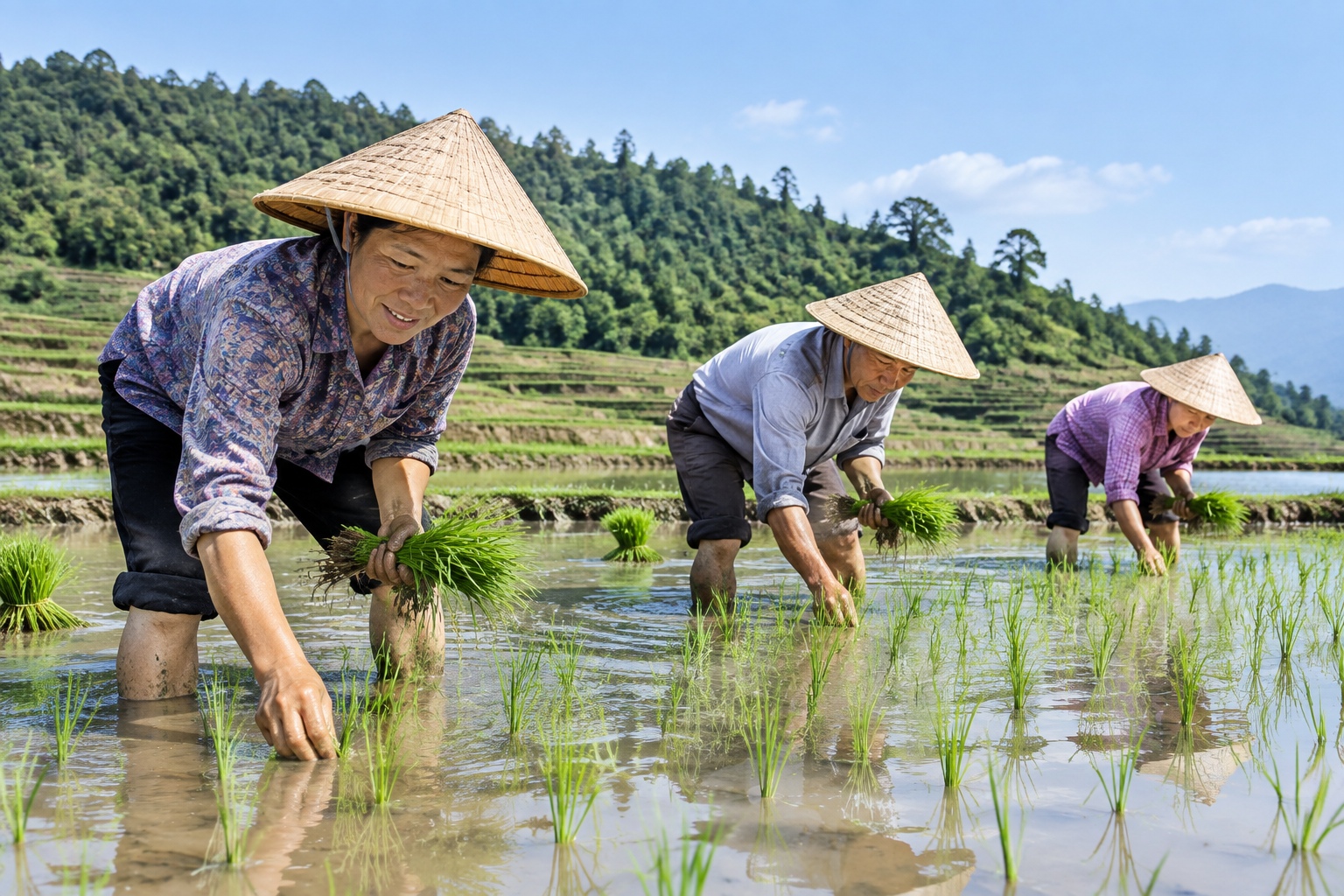
People work bent double in water up to the calf, pressing red rice seedlings into the mud. The paddies are not only rice fields. Fish are raised in them — the fish eat insects and weeds, their waste feeds the rice, and at harvest they end up on the table. Ducks work the same shift. The terrace walls, though, are the fragile part. Every rainy season some of them slump. If a wall fails, the terrace above drains and the one below is buried, so wall repair is almost always collective work.
What is changing on the mountain
Wages in the cities are the biggest force on the terraces now. A young worker in Kunming or Dongguan can earn four to six thousand yuan a month in a factory or a restaurant; a family here might clear a few thousand yuan a year from rice, even at the premium price red rice commands. Many young people leave. Fields far from a road, or on slopes too steep to reach with a machine, are sometimes left to go dry.
Tourism cuts the other way. Since the UNESCO listing, and as domestic travel has grown, guesthouses have opened in viewing villages such as Duoyishu and Pugaolao. A combined ticket for the main scenic viewpoints costs around 100 yuan (about US$14), and in some villages a share of that revenue reaches households. In Azheke, a university-led tourism plan launched in 2018 pays household dividends partly tied to one condition: keep farming your fields. The logic is blunt. If the farming stops, the water stops — and if the water stops, there is no landscape left for anyone to come and see.
There are quieter problems too. Fertiliser and pesticide runoff, plastic sheeting and tourist waste all end up in a system that recycles its water many times over. Some channels have been lined with concrete, which moves water faster but removes the seepage that once fed the edges of a paddy. In dry years, everyone downstream notices.
The water arrives because someone walks the ditch
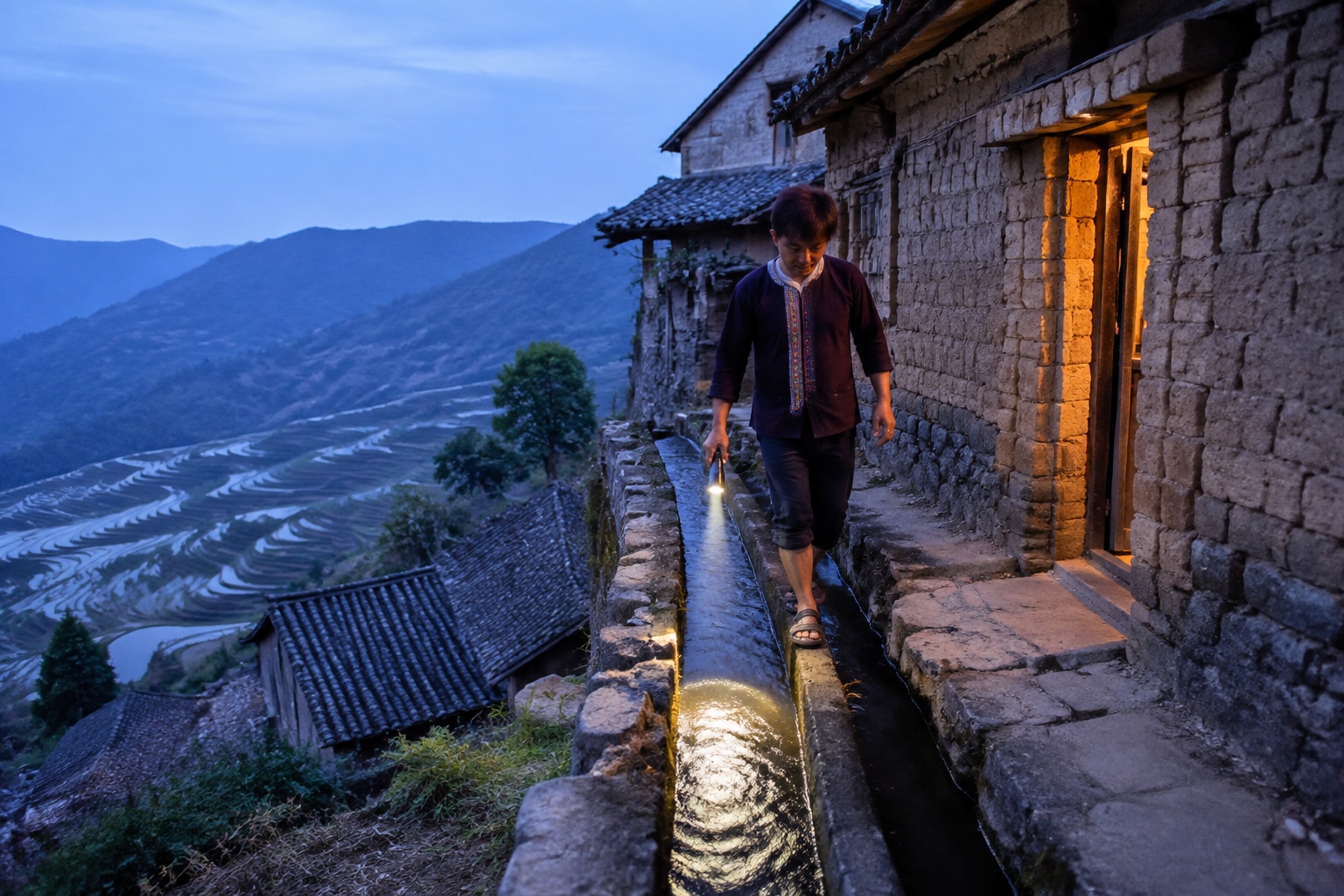
After dark, the canal chief goes out again. A household at the bottom of the village has reported that its flow is thin, and thin flow in April means seedlings that will not take. He walks the channel with a flashlight, checking each fork and each notch, and finds a mat of leaves and a small stone wedged under one of them. He pulls both out with his hands. The water rises in the branch below and starts to move.
Nobody will send him a bill for this, and nobody will thank him at length. At dinner there is red rice from last year’s harvest, a fish from the paddy, a bowl of vegetables, and talk about the weather. The terraces are not preserved because they are beautiful. They are preserved because, on this mountain, somebody still has to walk the ditch at night — and because the village has agreed, over centuries, on how the water gets divided when it arrives.
Start the discussion at forum.chinacomes.com