
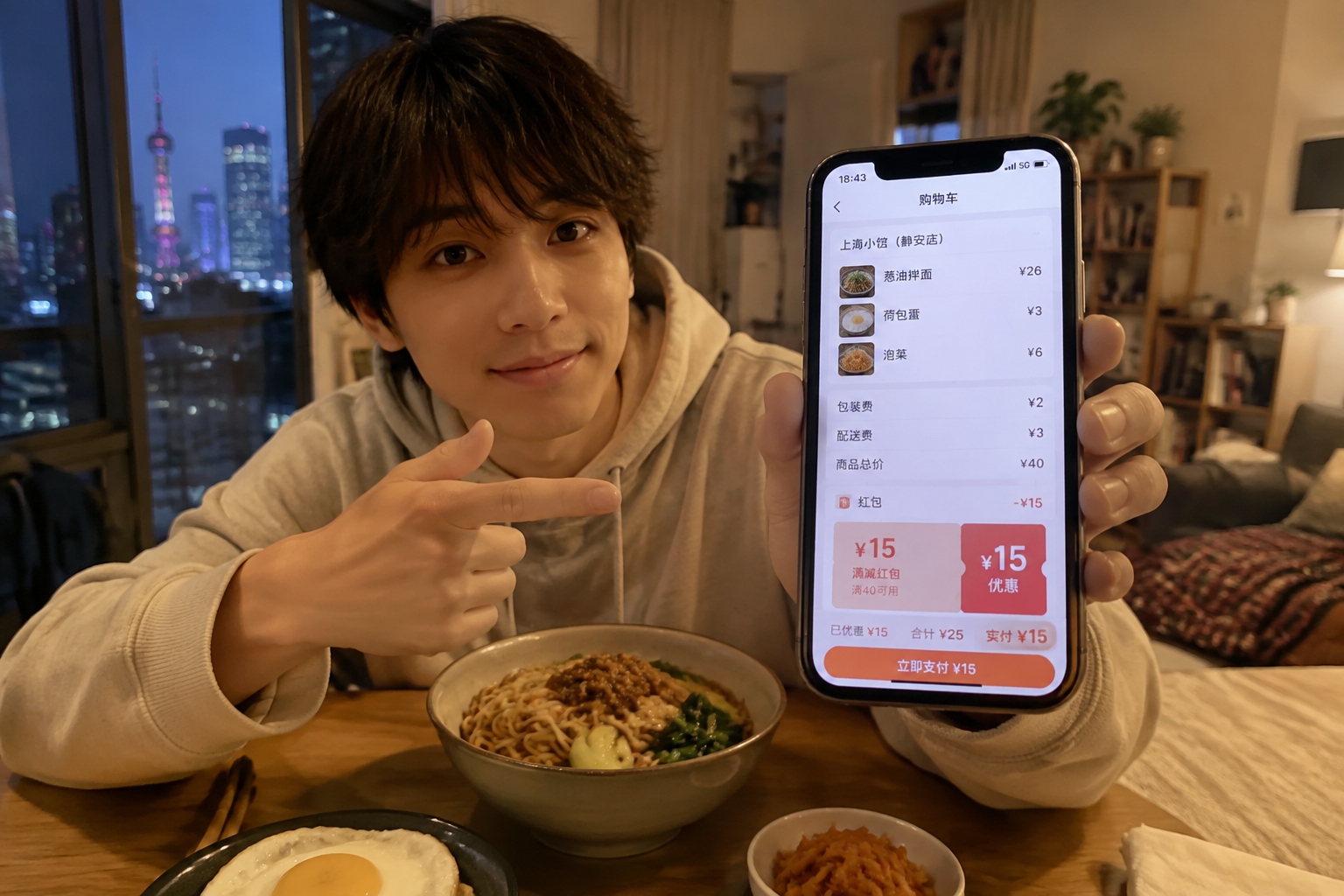

It’s 7 PM in Shanghai, and You’re Hungry
You open your favorite food delivery app—Meituan or Ele.me—and a banner catches your eye: “Spend ¥30, get ¥15 off.” You’ve already picked a bowl of noodles, a side of veggies, and a drink, but your cart total sits at ¥22. Do you just pay ¥22? Or do you find something to push your order to ¥30? This is the daily puzzle millions of Chinese people solve. It’s called “满减” (mǎn jiǎn), meaning “full reduction,” and mastering it can cut your meal costs in half.
In China, food delivery is a battleground of discounts, coupons, and red packets. The apps want your order; restaurants want your loyalty; and you want a cheap, tasty meal. Understanding the rules of this game turns ordering from a passive habit into a strategic calculation. Let’s break it down.
How Full-Reduction Discounts Work
A full-reduction offer works like this: a restaurant sets a spending threshold, and if your order reaches that amount (before delivery and packaging fees), you get a fixed yuan discount. For example, “满30减15” means that if your cart total is at least ¥30, you pay ¥15 less. If your cart is exactly ¥30, you pay ¥15 for food—a 50% discount. If your cart is ¥40, you pay ¥25, which is 37.5% off.
The math gets interesting when your cart is just below the threshold. Say you’ve picked items worth ¥28. You’re missing ¥2 to unlock the ¥15 discount. If you add a ¥3 snack or a drink, your cart becomes ¥31. You now get ¥15 off, so you pay ¥16 for everything—less than the ¥28 you would have paid without the discount. You got more food and paid less. That’s the core of the delivery game.
The Art of Topping Up Your Cart
To play this game well, you need to know your options. Delivery apps usually have a “凑单” (còu dān) feature that shows you cheap add-ons: a bowl of rice, a soft drink, a small dessert, or a side dish. These items are priced just low enough to make it tempting to add them.
But not all add-ons are good deals. Your goal is to maximize the discount relative to your final spending. A good rule: compare the price of the add-on with the extra discount you unlock. If you’re ¥3 short of a ¥15 discount, adding a ¥3 item is a no-brainer—you save ¥12. If you’re ¥10 short and the only add-on is a ¥12 dessert, then your “saving” of ¥15 is really only ¥3 after paying ¥12 extra—that’s still a slight win if you wanted the dessert, but it’s not a huge bargain.
Another smart trick: order from a restaurant with multiple tiers. For instance, “满30减15, 满50减25”—you might aim for the second tier if you’re sharing with a friend. The discount per yuan spent increases with higher thresholds: at ¥50, you pay ¥25, which is a 50% discount; at ¥30, you also pay 50%, so it’s equal. But if the second tier were “满50减28,” you’d get a 56% discount, making it worth ordering more. Always compare the effective percentage, not just the absolute amount.
Stacking Red Packets and Coupons
Full-reduction discounts are just the beginning. On top of that, you can apply coupons and red packets. Here’s the hierarchy:
- Restaurant coupons (店铺券): issued by the restaurant, often as “满20减3” or “减5 without threshold.” They’re applied to your order before the full-reduction.
- Platform coupons (平台券): issued by the delivery app, such as “full reduction for all restaurants” or “discount for specific categories.”
- Red packets (红包): small cash vouchers you earn from games, daily check-ins, or promotions. They can be universal or category-specific.
The key question: can you stack them? In most cases, yes, but the order matters. Usually, the app automatically combines the highest applicable discounts, but you can also manually choose. A typical calculation: first apply the restaurant’s full-reduction, then subtract the restaurant coupon, then the platform coupon, and finally the red packet. Some are mutually exclusive, so you may need to test different combinations.
For example, a meal worth ¥35 at a restaurant with “满30减15” (¥15 off) plus a restaurant coupon “满35减5” (¥5 off) plus a platform red packet of ¥3. After the full-reduction, your order is ¥20. The restaurant coupon may only be valid on the original price, so it might not stack. In practice, apps often show you the best deal automatically, but it’s worth peeking at the pricing breakdown to ensure you’ve applied everything.
Real-World Example: A ¥15 Dinner
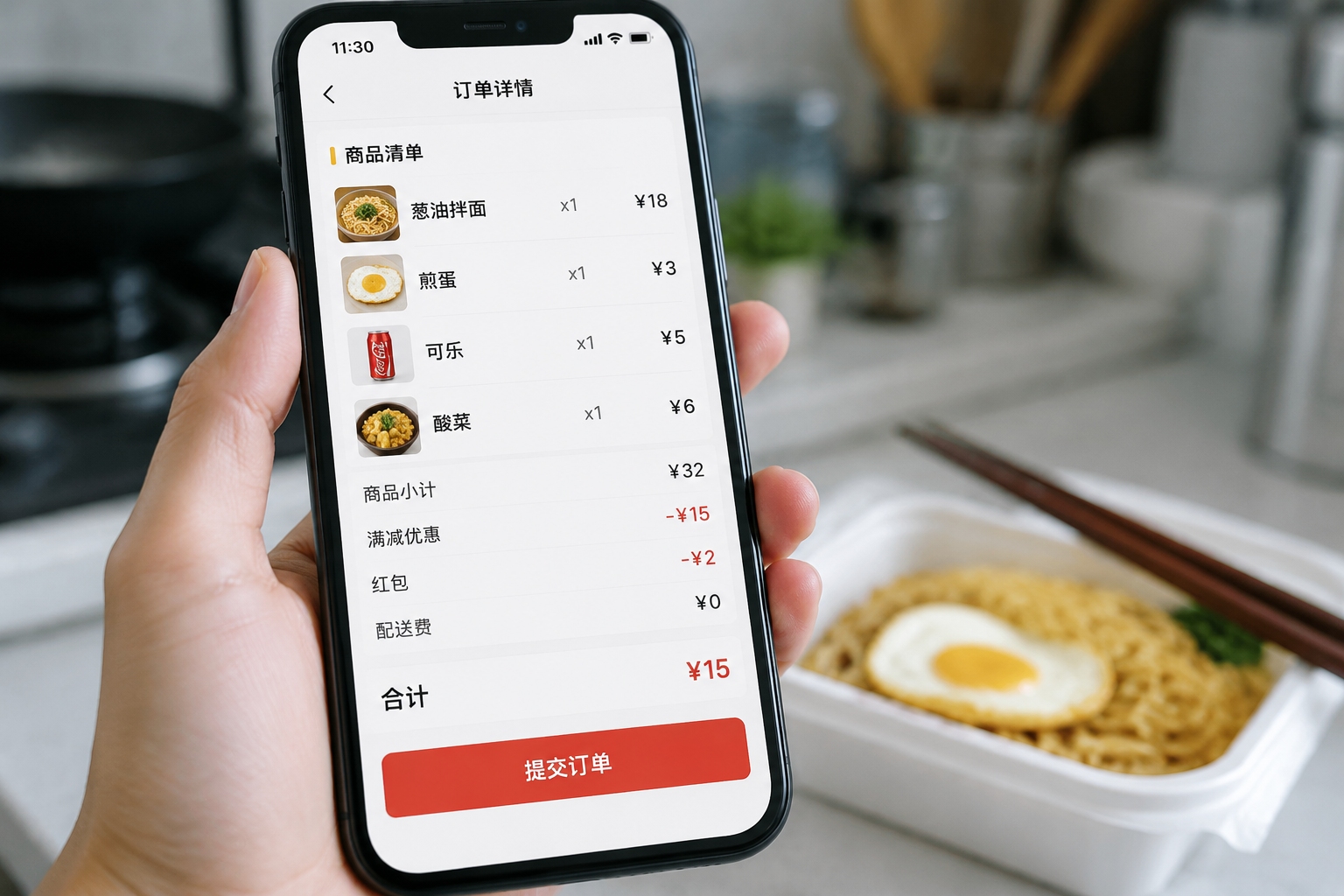
Let’s walk through a real scenario. Imagine you’re ordering a noodle dish that costs ¥18, a fried egg for ¥3, and a Coke for ¥5. That’s ¥26 total. The restaurant has a “满30减15” deal, so you need ¥4 more. You add a small side dish (like pickled vegetables) for ¥6. Your cart is now ¥32. After the full-reduction, you pay ¥17. Then you apply a ¥2 red packet from the app’s daily check-in, bringing your final bill to ¥15. The delivery fee? Many apps offer free delivery with a subscription (like Meituan’s “monthly pass”), or you can spend enough to waive it. If there’s a ¥3 delivery fee, you’d still be at ¥18—still an excellent deal for noodles, egg, drink, and a side.
This isn’t a theoretical example; it’s how millions of Chinese students and office workers eat on a budget every day. A little planning turns a ¥32 cart into a ¥15 payment.
Common Pitfalls to Avoid
The delivery game isn’t without traps. Here are the most common mistakes:
- Over-topping just to save: If the cheapest item to reach the threshold costs more than the discount you unlock, you’re wasting money. Always do the math: stop if the discount divided by the add-on price is less than 1—meaning you’re paying more for the add-on than the extra discount you get.
- Ignoring delivery and packaging fees: A ¥15 discount looks great, but if the restaurant charges ¥5 for packaging and the delivery fee is ¥6, your “savings” shrink. Factor in all fees before celebrating.
- Buying food you won’t eat: The last thing you need is a mountain of dumplings just because they pushed you over the threshold. If you can’t eat it, it’s not savings—it’s waste.
- Assuming bigger discounts are always better: A “满20减10” (50% off) is better than “满50减20” (40% off) if you only want ¥20 worth of food. Don’t let the absolute number sway you; compare percentages.
Master the Game, Eat Well
The delivery game in China is a fascinating mix of behavioral economics and daily life. Once you understand the mechanics—full-reductions, top-ups, and stacking—you’ll never look at a menu the same way. And you’ll never pay full price for a meal again.
Start the discussion at forum.chinacomes.com