

The 7-Day Blind Test: How It Was Done
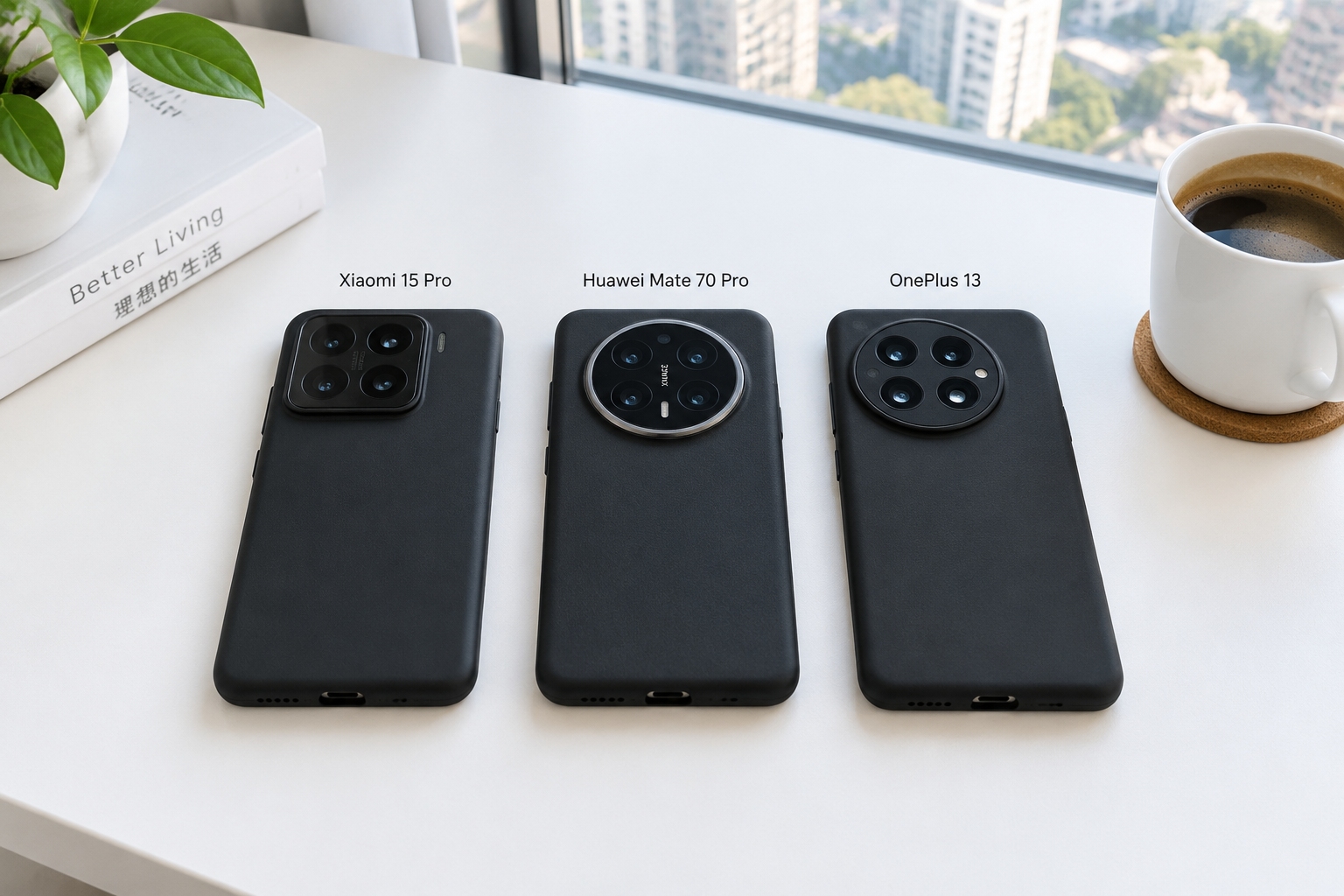
Three flagship phones sat on my desk in Shenzhen, each wrapped in a plain black silicone case with the back label covered. For seven days, I swapped my SIM card between them, used them as my primary device, and forced myself to ignore every spec sheet and marketing slogan I’d ever read. The goal wasn’t to crown “the best” Chinese phone—it was to answer a practical question: if you live outside China, which one gives you the least headache when you travel back home?

The three phones were the Xiaomi 15 Pro, the Huawei Mate 70 Pro, and the OnePlus 13. All three were China-versions (not global editions), which is what you’d normally buy at a Chinese retail store or online mall. I also invited two friends—one from Germany, one from Canada—to spend a day with each phone and share raw impressions. No brand names were mentioned until after they rated everything.
Google Services: The Dealbreaker Most People Ignore
Let’s start with the elephant in the room. For most international users, a phone without Google Mobile Services (GMS) is like a car without fuel. You need Google Maps, Gmail, WhatsApp backup, Chrome, and the Google Play Store for banking apps. Only one of the three phones—the OnePlus 13—ships with GMS out of the box, because its operating system (OxygenOS/ColorOS) is based on Android and holds a proper Google license. The Xiaomi 15 Pro also runs on Android (via Xiaomi’s HyperOS) and includes GMS, though you may need to enable it in the settings the first time you buy it from China. Both phones allowed me to sign into my Google account, open the Play Store, and download apps without any extra surgery.
Then came the Huawei Mate 70 Pro. Huawei still cannot use Google services due to U.S. trade sanctions. It runs HarmonyOS NEXT today, which does not include any Android compatibility layer. In China that’s fine, because most local apps have their own distributions—but for an international user, it means no Gmail, no Google Maps, no WhatsApp notifications unless you sideload tricky “microG” workarounds, which often break after updates. Even for reading messages from my bank back in Germany, it was a mess. If you’re not hyper-tech-savvy and ready to spend hours on forums, the Mate 70 Pro simply isn’t a practical choice abroad.
System Experience: HyperOS vs. HarmonyOS vs. OxygenOS
After three days of non-Google testing, my German friend said, “The Huawei feels smooth, but it’s a different planet.” That’s accurate. HarmonyOS NEXT has its own design language, with swipe gestures and a control center that borrows from both iOS and Android. It’s fast, notifications are well-organized, and the widget system is attractive. But it forces you into Huawei’s ecosystem—the AppGallery is sparse in English content, apps like banking or transport in Europe are often missing. Even when I installed a local Chinese news app, it felt like I had entered a closed world.
The Xiaomi’s HyperOS felt closest to stock Android but with more clutter on the first boot. There’s a “Security” app that scans everything, baked-in advertising–I don’t mean ads in apps, but ads in system apps like the file manager and weather widget. It took me half an hour to turn off most of the ad recommendations. After that, it was a solid, customizable experience. The OnePlus 13’s OxygenOS (actually ColorOS in China, but the overseas version is OxygenOS) was the cleanest. No ads in system apps, everything felt faster, and the settings menu was intuitive. My Canadian friend picked it up and started using every feature without a tutorial—he said it felt just like his old Samsung but snappier.
Camera: A Week of Shots Across Three Phones
I took about 200 photos on each phone during the week—daytime walks along the Shenzhen Bay, night-time street food stalls, portraits of my friends, and some indoor book-reading shots. In bright daylight, the three phones were shockingly close. The Xiaomi 15 Pro produced punchy colors that made the sky a bit too blue; the Huawei Mate 70 Pro had the most natural tonal range, especially in skin tones; the OnePlus 13 rendered details sharply with slightly colder contrast. If you only looked at daytime photos, you’d be hard-pressed to tell which one cost more.
Things changed after sunset. The Xiaomi and OnePlus leaned on night-mode software processing, which could brighten the scene so much that neon signs looked artificially altered. The Huawei, by contrast, kept shutter speeds longer but produced cleaner shadows. For video, the OnePlus 13 had the steadiest handheld clips thanks to its dedicated camera stabilization; the Xiaomi slipped a bit when I ran after a taxi; the Huawei had excellent color but sometimes over-smoothed highlights on street lamps.

Battery Life and Charging: Who Lasts the Full Day?
All three phones easily lasted a full day on a single charge with mixed usage—music streaming, messaging, occasional photography, and commuting by subway. But the margins are noticeable. The Huawei Mate 70 Pro, with its 5,500mAh battery, had around 25% left when I got home at 10 p.m. The Xiaomi 15 Pro, with a slightly smaller 5,250mAh battery, was around 15%, and it charged fastest—the included 90W charger refilled it to 70% in just 15 minutes. The OnePlus 13 had 25% left too, but its 100W charging shattered records when I used its bundled SUPERVOOC charger: went from 3% to full in 22 minutes. For an international traveler, that stamina is reassuring: you can pack a small power bank and never think about battery anxiety.
After-Sales and Warranty: What Happens When It Breaks
Warranty is the least glamorous but most practical part. If you buy these phones in China, the manufacturer’s warranty only applies in the mainland. If you drop your phone in Berlin, you can’t walk into a local Xiaomi, Huawei, or OnePlus service center and claim warranty service—even if the brand officially operates in Germany. The first thing you’ll need is the Chinese proof of purchase, and the repair often requires sending the device back to China through a third-party mail-forwarding service, which adds weeks and shipping costs. All three brands have global versions that come with warranty in your home country, but those versions cost more and may not include some China-specific features (like IR remote control on Xiaomi, or a satellite SOS feature on Huawei).
That doesn’t mean the situation is equal across brands. Xiaomi and OnePlus have physical stores in many Western European and Southeast Asian cities, so if you carry a “Global Version” phone, on-site repairs are usually available within a few days. Huawei’s global presence has shrunk due to sanctions, so its service network outside China is thinner—though still present in some emerging markets. If you buy the China version and later return home, Huawei’s app store and update servers may be blocked or slow in certain regions, which directly impacts usability.
The Verdict: Which One Should You Buy?
After seven days of blind testing, I gave each phone a score based on the experience that an international user would actually feel. Here’s a rough breakdown:
- OnePlus 13 — Most friction-free for a foreigner. Full Google compatibility, clean system, minimal ads, all-region bands included, and blazing-fast charging. The camera is good, not category-leading, and the brand’s after-sales service is expanding globally. If you want a “just works” phone without needing to tinker, this is the safe bet.
- Xiaomi 15 Pro — Incredible hardware for the price and the fastest wired charging. But the software experience is marred by system ads and pre-installed bloatware, and the Chinese version lacks one or two LTE bands that are common in Europe or North America. If you’re comfortable disabling ads and flash a global ROM (if allowed), you get a killer deal. Otherwise, expect some daily friction.
- Huawei Mate 70 Pro — The pinnacle of camera hardware and battery life, especially in zoom and low light. But without Google services and a compatible app ecosystem, it’s a hard sell for international users. If most of your digital life doesn’t rely on Google, and you’re happy in the Huawei universe, the phone is superb. For everyone else, the missing applications will drive you insane eventually.
Now, before you spend your money, my advice: read the small print on “China Version” vs. “Global Version,” check the exact 4G/5G bands your mobile operator needs, and if possible, use the phone with its Chinese ROM for 48 hours before you cut the original packaging. The real winners aren’t always the flagships; they’re the phones that let you go about your life without having to think about the phone itself.
Start the discussion at forum.chinacomes.com