


One Nation, Many Voices
You’re on a high-speed train from Beijing to Guangzhou. The woman across the aisle is on the phone, and you catch fragments of what sounds like singing. It’s not Mandarin—at least not the Mandarin you learned in a textbook. It’s Cantonese, one of hundreds of regional dialects spoken across China.
Here’s a quick reality check: China’s official language is Mandarin (Putonghua, or common speech). It’s what you hear on TV, in schools, and in government offices. But step off the main streets, and you’ll encounter a mosaic of local languages—Cantonese, Sichuanese, Northeastern dialect, Shanghainese, Hokkien, and many more. Some are so different that speakers of one may not understand another, even if they come from neighboring provinces.

To foreign visitors, this can be confusing. You might wonder: How do people communicate? The answer is that virtually everyone under 60 speaks Mandarin, thanks to decades of language standardization. But dialects are far from dying—they’re thriving as markers of identity, humor, and belonging. Think of it like this: Mandarin is the standard English you hear on BBC News, while dialects are like Scottish, Jamaican, or Appalachian English—except with far more dramatic differences.
Why so many dialects? China’s geography—mountain ranges, rivers, and vast plains—naturally isolated communities for centuries. Before mass media and migration, a village spoke its own language, often unintelligible just a few valleys away. Today, even as Beijing pushes for Mandarin in education and media, local languages remain a source of pride and connection.
China’s linguistic map is usually divided into seven major dialect groups. Cantonese, Wu (Shanghainese), Min (Hokkien), Xiang, Gan, Hakka, and Mandarin. Within these, there are hundreds of sub-dialects. The written script, however, remains largely the same across all of them—which means a Cantonese speaker and a Mandarin speaker can read the same newspaper but not converse easily.
Cantonese: The Sound of the South
Head to Guangdong province, Hong Kong, or Macau, and you’ll hear Cantonese (粤语, yuèyǔ). It’s one of the most widely spoken Chinese dialects globally, with a huge presence in overseas Chinese communities. Cantonese has a reputation for sounding musical, partly because it preserves ancient Chinese pronunciation features that Mandarin has lost.
Try these two phrases to get started:
唔该 (m4 goi, pronounced like mm goy) – Thank you or excuse me. It’s the Swiss army knife of polite Cantonese.
你好 (nei5 hou2, like nay hoe) – Hello. Notice the rising and falling tones—Cantonese has at least six tones, compared to Mandarin’s four.

Cantonese is also the backbone of Hong Kong cinema and Cantopop, so it carries a cultural weight far beyond daily conversation. If you’re ordering dim sum in Guangzhou, asking for 虾饺 (ha gaau, shrimp dumplings) with a decent accent will earn you smiles from the aunties pushing the carts.
Cantonese even has its own written form for colloquial expressions, using characters like 唔 that don’t appear in standard Mandarin textbooks. If you’re learning, don’t worry too much about the tones; locals will appreciate any effort.
Sichuanese: Laid-Back and Lively
Fly inland to Chengdu, the capital of Sichuan province, and you’ll hear a dialect that feels softer and more relaxed than Mandarin. Sichuanese (四川话, Sìchuān huà) is spoken by over 100 million people across Sichuan, Chongqing, and parts of Yunnan and Guizhou. It’s the language of hotpot restaurants, teahouses, and witty banter.
Two essential words:
巴适 (bā shì, pronounced bah shrr) – Great or comfortable. After a good meal, locals sigh 巴适! to express pure satisfaction.
雄起 (xióng qǐ, pronounced shyong chee) – Come on! or Charge! You’ll hear this shouted at soccer matches and mahjong tables when someone needs encouragement.

Sichuanese grammar is similar to Mandarin, but the tones are flatter and the rhythm faster. It’s a perfect match for the local stereotype: direct, warm, and ready to complain about the weather over a bowl of spicy noodles.
One fun difference: Sichuanese often uses the character 啥子 (shá zi, meaning what) instead of 什么 (shénme). You’ll hear it everywhere, from market stalls to office conversations.
Northeastern Dialect: Blunt and Funny
Now fly northeast to Harbin or Shenyang. The dialect there, called Dongbeihua (东北话, Dōngběi huà), is famous for its humor. It’s the closest dialect to Mandarin in terms of vocabulary, but the intonation is unmistakable—a rising, sing-song drawl that makes even ordinary statements sound like you’re about to tell a joke.
Key phrases:
整 (zhěng, pronounced jeng) – This is a wildcard verb meaning do, make, fix, or organize. Instead of saying cook (做饭), a Northeasterner might say 整饭 (zhěng fàn, pronounced jeng fan). You can 整 almost anything: 整一个 (let’s get one), 整明白了 (figure it out).
咋地 (zǎ dì, pronounced zah dee) – What happened? or What’s up? It’s the go-to question when something surprising occurs.
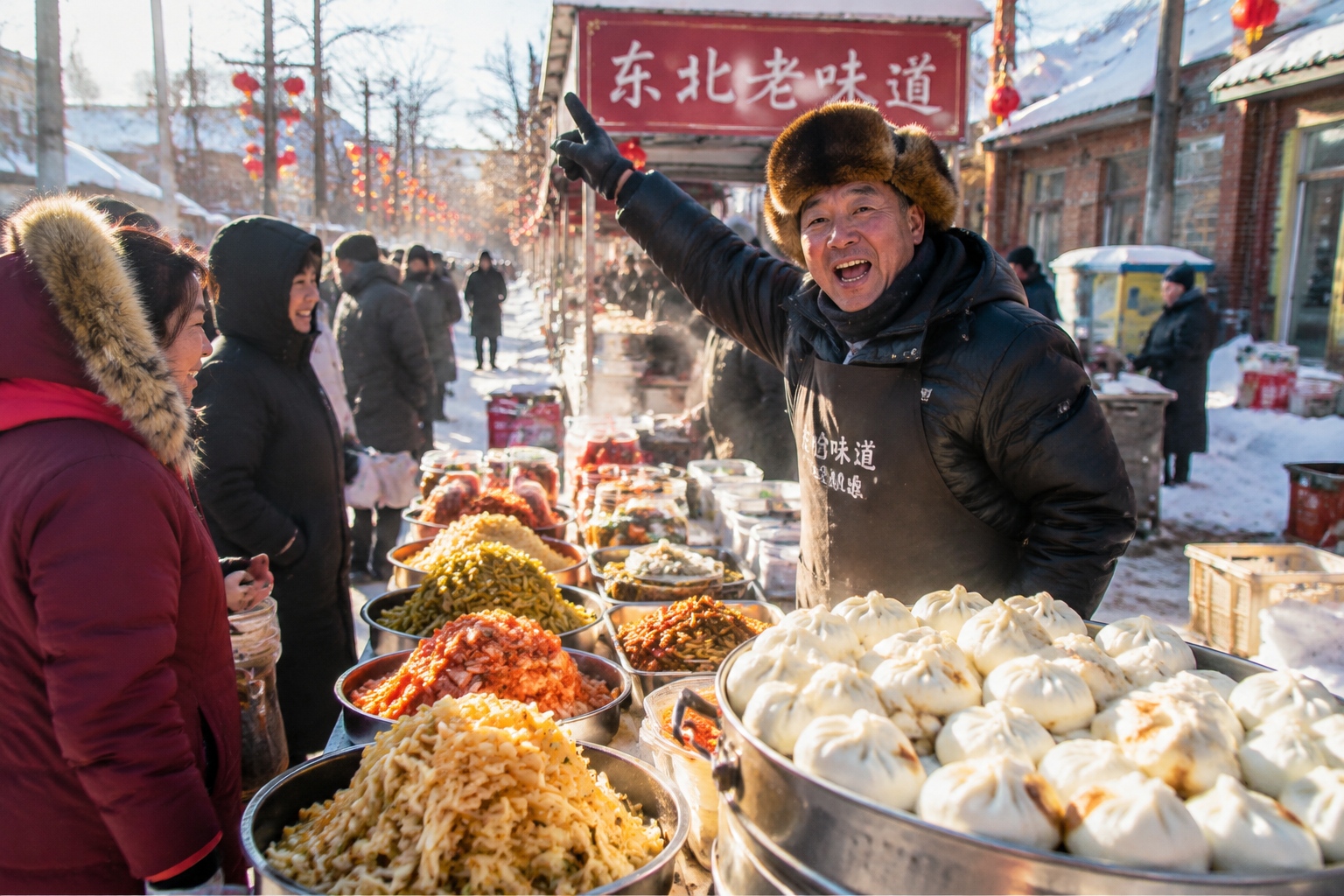
Northeasterners are known across China for their comedic timing—many of the country’s most beloved sketch comedians grew up speaking this dialect. If someone in Dalian tells you a story, prepare to laugh, even if the topic is mundane.
The dialect also loves adding the suffix -er to words, a feature borrowed from Beijing Mandarin. This makes it sound even more playful, like saying quickly as quickly-er.
What If You Don’t Understand?
First, breathe. You’re not expected to understand every regional language. Even Chinese people from different provinces struggle sometimes. The secret is a simple phrase that works everywhere:
我听不懂,你能再说一遍吗? (wǒ tīng bù dǒng, nǐ néng zài shuō yī biàn ma?) – I don’t understand, could you say it again?
In my experience, almost every Chinese person will immediately switch to Mandarin after hearing this. They’ll say, Sorry, sorry, I forgot you’re a foreigner. Then they’ll repeat themselves in clear, standard Mandarin—often speaking more slowly for you.
If you’re in a rural area where older locals have heavy accents, don’t panic. Point at what you need, or pull out your phone and type. Translation apps handle Mandarin fine, and some even support major dialects like Cantonese or Sichuanese.
Remember, Mandarin is required in all Chinese schools, so even a grandparent in a remote village can usually manage basic Mandarin. It might be accented, but it’s understandable. Don’t be shy about asking for clarification—it’s seen as polite, not rude.
Also, learn how to say I don’t speak Chinese in Mandarin: 我不会说中文 (wǒ bù huì shuō zhōngwén). This can prompt people to get creative. You might be surprised how many people know a few English phrases or at least are willing to use hand gestures.
Dialects as Keys
Learning a few phrases in a local dialect isn’t just about practicality—it’s a sign of respect. When you order coffee in Yunnan with a Yunnanese twist, or say thanks in Minnan in Fujian, the person across from you will likely light up. It shows you see them as individuals, not just the locals from the guidebook.
Of course, dialect fluency is not expected. But a single word dropped at the right moment can break the ice. Last year, I was in a noodle shop in Xi’an and said ‘biangbiang’ (the name of a noodle) with an exaggerated local accent. The cook laughed and gave me extra chili.
Dialects are not barriers; they’re keys to a deeper layer of Chinese culture. They carry history, humor, and hometown pride. So the next time you’re in China and hear a melody you don’t quite catch, lean in. Maybe you’ll pick up a phrase or two. And who knows? That 巴适 might become your favorite word.
Start the discussion at forum.chinacomes.com