
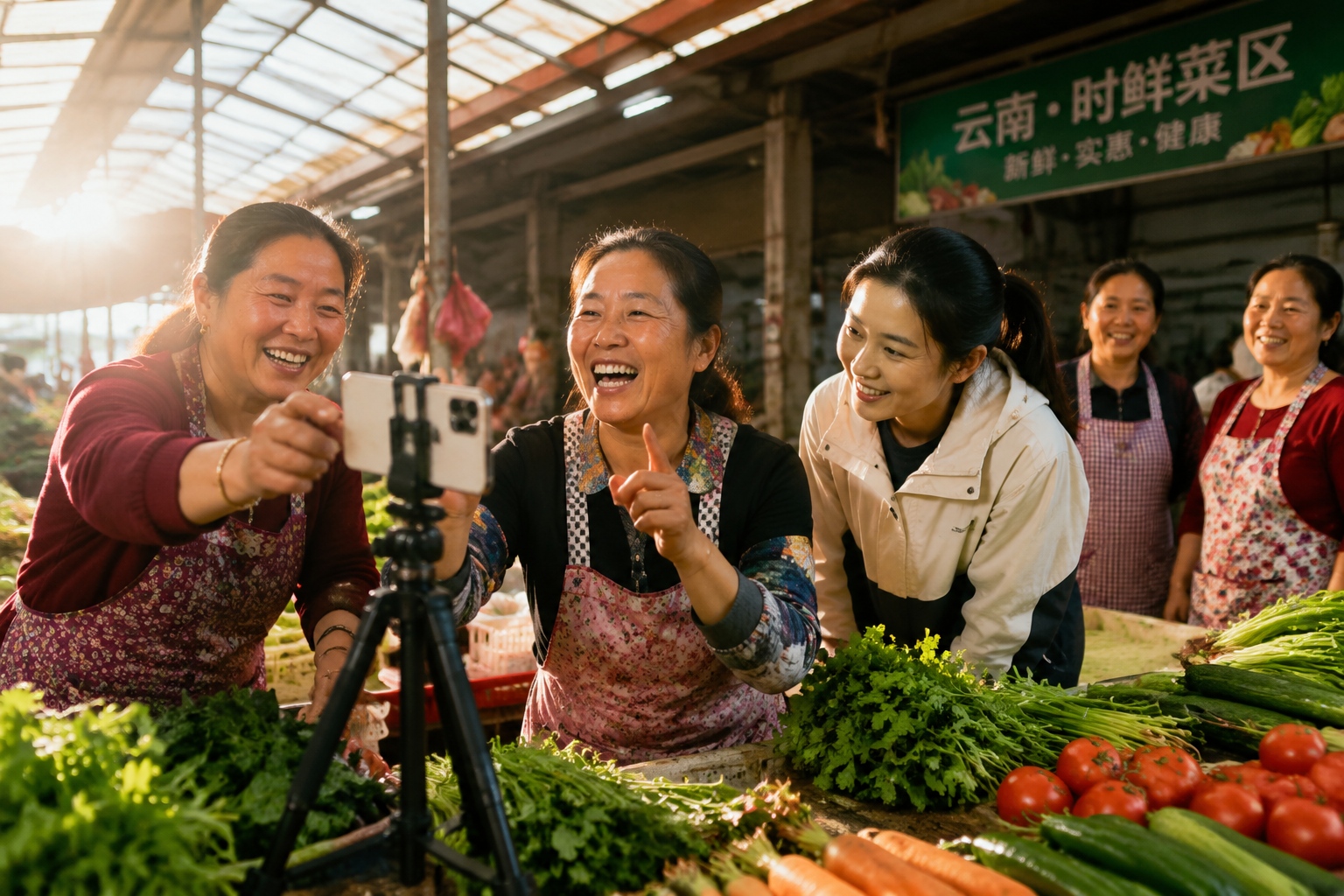

An Unusual Morning at the Wet Market
It was 7 a.m. at the Daguan Wet Market in Kunming, a southwestern Chinese city known for its mild climate and fresh produce. The morning crowd was just beginning to trickle in. But one stall looked different. A small crowd of aunties – women in their fifties and sixties with patterned aprons – huddled around a phone mounted on a small tripod. One of them, a plump woman with a bright smile, was speaking into the screen: “Morning, friends! Today’s greens come from Dali, picked at dawn. Look how crisp they are!”
She was not on a TV set. She was livestreaming her vegetable stall to a small but loyal audience on a Chinese short-video app. Two years ago, she didn’t even own a smartphone with internet data. Now she has a catchphrase, a few hundred followers, and a daily ritual that has changed the economics of her stall.
Standing beside her, quietly adjusting the small light and checking the chat, was 28-year-old Xie Ling. Xie Ling is the person who taught these aunties to sell vegetables by livestream. She is part of a quiet digital revolution that is taking place not in China’s gleaming tech hubs, but in its oldest, most human spaces: the wet markets.
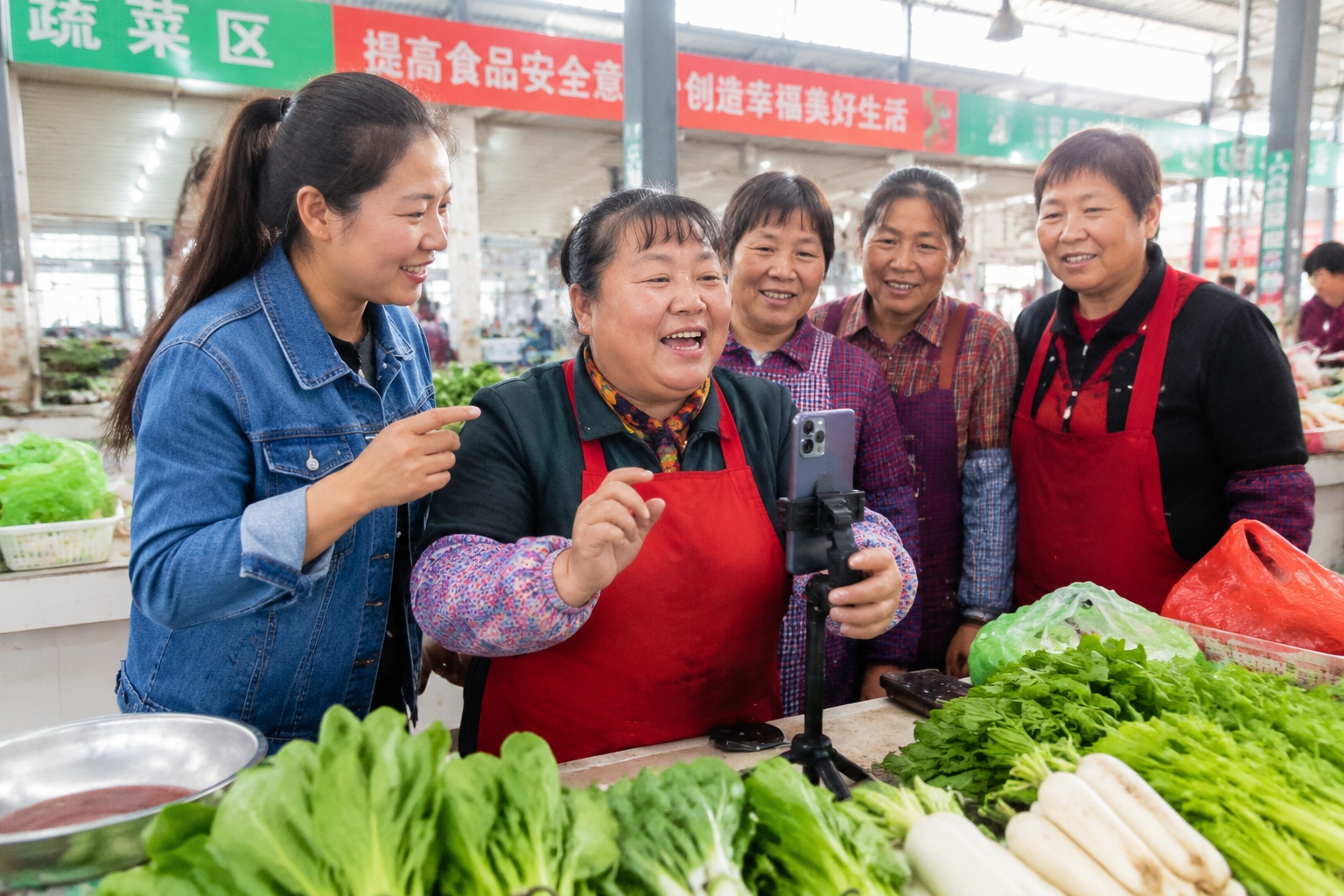
The Teacher Who Brought the Internet to the Stalls
Xie Ling grew up in Kunming. She studied marketing at a university, then spent four years working at an internet company in Shanghai, helping brands grow their online stores. When she returned home in 2022, she was struck by how much had changed – and how much had not. Her mother still got up at 4 a.m. to buy stock from wholesale markets and stood behind her stall for ten hours, competing with supermarkets and online grocery delivery services that could undercut her prices and deliver to doorsteps.
“My mother would complain that business was getting worse,” Xie Ling told me, “but she had no idea how to find customers online. She only knew how to use WeChat for chatting, and even then she asked me to delete her old voicemails to free up storage.”
Xie wanted to help, not only her mother but also the other vendors, many of whom were women her mother’s age. She suggested they set up accounts on Douyin (the Chinese version of TikTok) and try livestreaming. The initial reaction was a mixture of fear and amusement. “Why would anyone watch an old woman selling cabbage?” one auntie said. Xie didn’t push. Instead, she started streaming her mother’s stall for fun, showing how to pick fresh beans and how to tell a local tomato from a greenhouse one. Within a week, a handful of regular viewers began to appear, and more importantly, some started placing orders for pick-up.
One thing that surprised Xie was how much the women didn’t know about even basic phone settings. Many were using old phones with little storage, and some had no idea how to put money on their data plans. So the training included simple lessons on clearing cache, using Wi-Fi when available, and adjusting brightness for better videos.
From Fear of the Camera to a Livestream Routine
That proof was enough for a few brave aunties to sign up for Xie’s informal training program. The program was simple: they met twice a week at an empty corner of the market, right after the rush hour, with a stack of fresh vegetables as props. Xie taught them the basics: how to hold the phone so the produce looked full; how to talk about freshness, price and sourcing; how to read comments and answer questions without freezing; and, crucially, how to handle negative remarks or trolls.
The first sessions were awkward. Aunties would stare at the lens and forget their lines. They would cover the microphone with their thumbs or turn the video upside down. One woman accidentally went live on her own face for twenty minutes, not realizing the broadcast had started. But Xie was patient. She taught them to treat the camera like a customer leaning over the stall: look at it, speak clearly, and always show the product.
Slowly, things began to click. Wang Ling, a 58-year-old who sells potatoes and tomatoes, told me, “I was afraid I would say something wrong on the internet. But Xie Xiāo Jie said, ‘Just say what you say to a customer.’ So I started saying, ‘Don’t buy this tomato if you want a watery one – that one over there is better.’ People actually liked that honesty.”
Wang Ling’s breakthrough came when she learned to demonstrate her produce on camera. She cut open a tomato to show the seeds and said, “Look at this, sweet and thick. Not those thin-walled ones from the supermarket.” Her audience loved it. Within a month, she had over 800 followers. Her daily sales increased by roughly a third, and some customers now come to the market specifically to ask for “the auntie who streams.”
More Than Selling Vegetables: A Quiet Empowerment
For these women, the benefits are far greater than a few extra yuan. Many of them are not habitually online; they use cheap Android phones and pay for data mostly to chat with their children. Learning to livestream means learning a new digital vocabulary, a new sense of confidence. It also gave them a say in their own work. They decide what to show, what to say, what price to mention. They are no longer just passive sellers waiting for foot traffic; they are curators of their own small stage.
“I feel younger,” says Li Guizhen, a 63-year-old greens vendor. “My son respects me because I do something he thinks is ‘cool’.” She proudly showed me her profile page, where she had chosen the username “Mountain Green Sisters” and a little cartoon avatar.
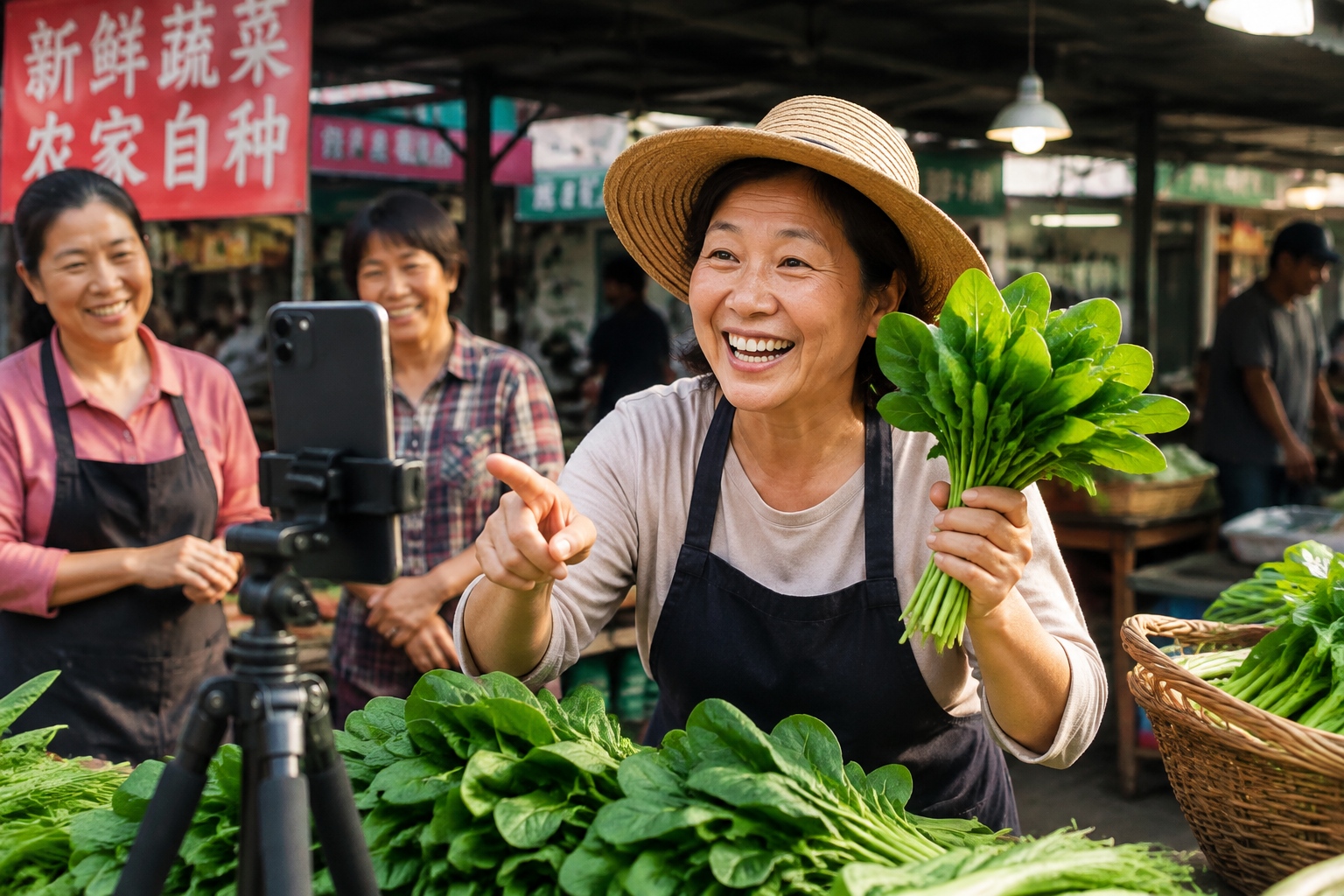
For many of these women, earning money through the livestream is not just about income. It shifts their place at the family table. When you contribute money that you earned by mastering a new skill, you’re no longer just the person who cooks and cleans. You’re a decision-maker.
This quiet empowerment also carries economic weight. Many of the aunties have doubled their waste reduction: they can pre-sell items that would otherwise go unsold, and they can close stalls earlier because customers come at predefined times. Some have pooled resources to buy a shared tripod and ring light for each other.
Xie Ling’s initiative has since grown into a small community project. She has trained over 40 vendors, mostly women, and her example has spread to other markets in Kunming. Local street offices, noticing the effect, have even provided free Wi-Fi hotspots around the market area, making it easier for these impromptu broadcasts to run smoothly.
The Bigger Picture: China’s Digital Transformation at Street Level
Stories like this might seem small, but they are the stitching of China’s massive digital adoption. According to the China Internet Network Information Center, the number of livestreaming users in China had surpassed 700 million by mid-2023, with food and produce a major category. What’s new is not the technology, but how it is being appropriated by people who are often on the wrong side of the digital gap.
China’s e-commerce regulators and platforms have pushed for “digital poverty alleviation” schemes, but the real success stories are born on the ground, when a young person comes back home and shares what they know. The wet market is a great equalizer: everyone needs to eat, and a phone is now a stall, a sign and a salesperson all at once.
China has more than 1 billion internet users, and nearly 60% of them use mobile shopping apps. What often gets overlooked is the way rural and older populations have been fast adopters, not because of some top-down policy, but because the apps solve real problems: information asymmetry, middleman costs, and lack of choice.
To be fair, not every vendor thrives. Livestreaming is a skill, and it comes easier to the extroverted. Some of the aunties still find it exhausting and prefer the old way. But for those who embraced it, the results have been life-changing in small but visible ways: a new ability to show their work, a sense of social connection, and a direct line to a customer who might otherwise walk past them.
Morning Again
I remembered something Wang Ling said as she closed her livestream after an hour. She had just sold a dozen bundles of spinach to viewers who would pick them up before noon. “I used to think the internet belonged to young people,” she said, her face still lit from the phone light. “But it turns out the internet belongs to anyone who has something true to show.”
The next morning, when I passed the market again, Wang Ling was already live. She was talking to a viewer about the proper way to store ginger. Her voice was bright, and her hair, for the first time, was carefully combed. The phone had become a window, and through that window, the world had come in.
Start the discussion at forum.chinacomes.com