
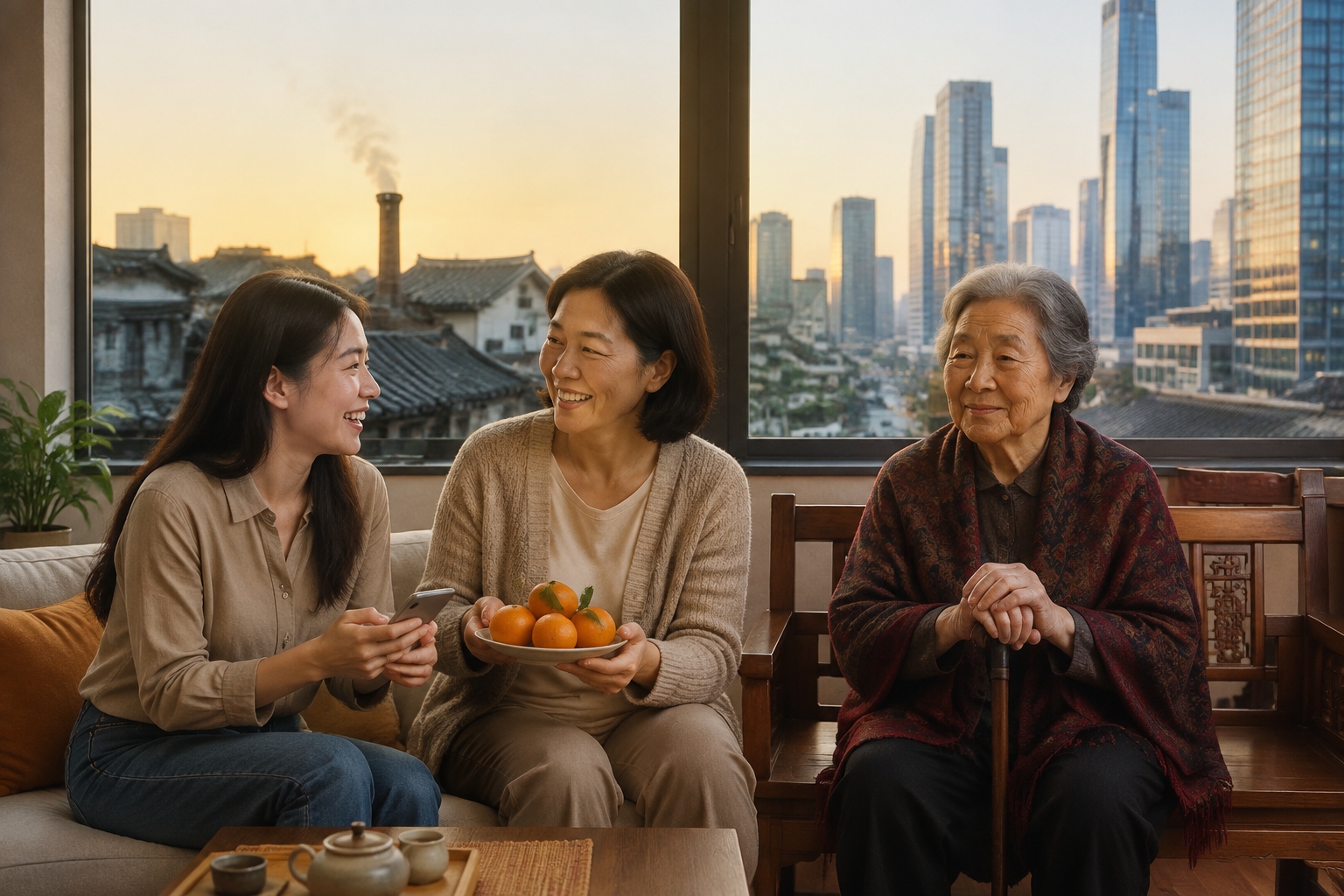

A Window at Sunset, a Memory of Smoke
At six in the evening, Lin Yue presses ‘send’ on an email and swivels her chair toward the window. The view from the 31st floor of a Shanghai office tower is a grid of glass and concrete, with the Huangpu River curling through like a dark ribbon. Her phone lights up. It’s a WeChat message from her mother: ‘Your grandmother is talking about you again.’ Lin Yue smiles. For a moment, the air-conditioned hum of the office fades, and she is eight years old again, lying on a warm brick bed in northern Shaanxi, the smell of burning firewood and steamed buns filling the tiny cave dwelling.
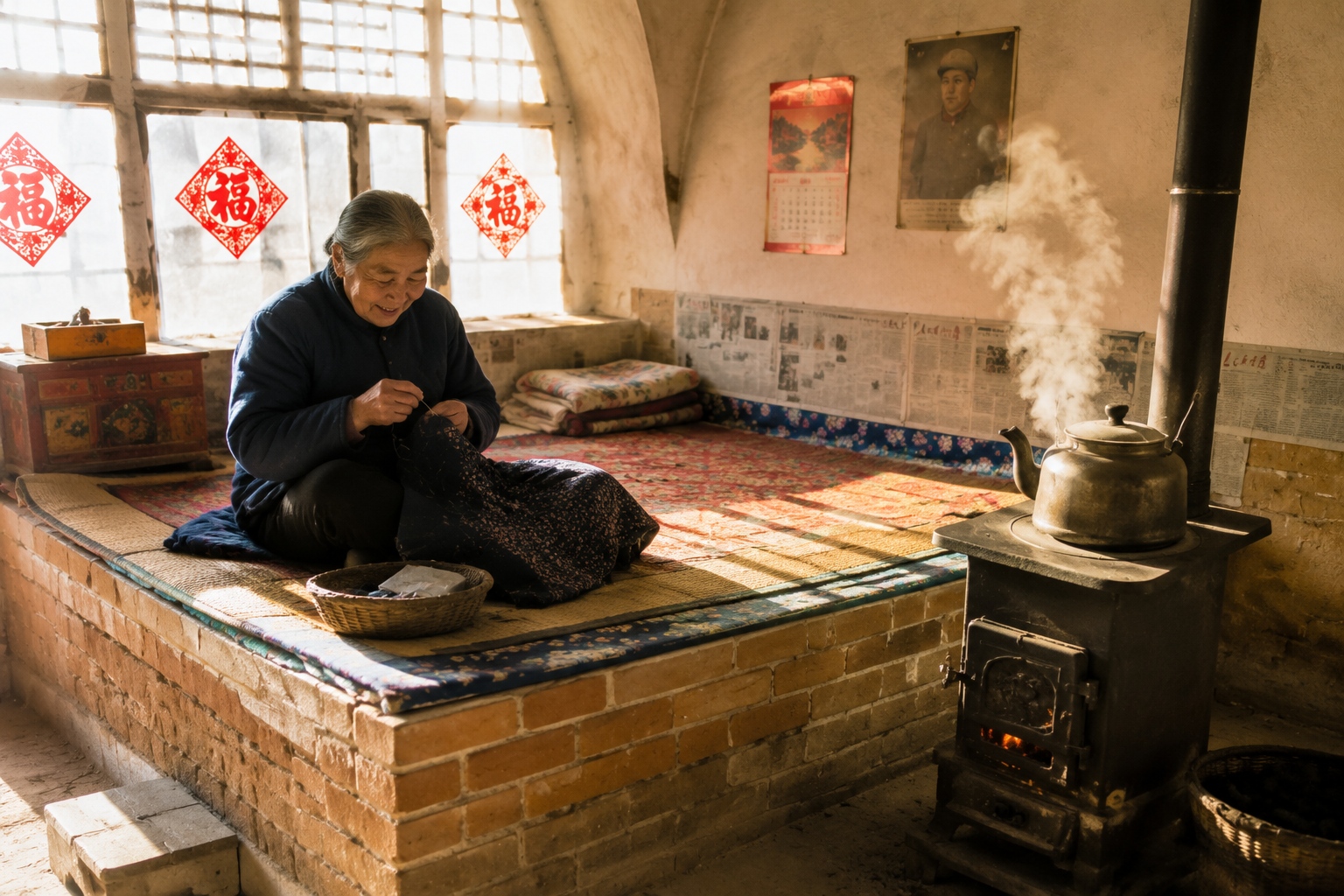
The Kang: The Warm Heart of Rural China
In the rural north of China, home was once built around a kang—a platform made of brick and clay, with tunnels underneath that carried heat from a stove. The kang was the center of life. The whole family slept on it, ate on it, sewed and argued on it. In the long, freezing winters, it kept everyone alive.
Lin Yue’s grandmother, Wang Xiuqin, was born in 1948 in a village outside Yan’an, the cradle of the Chinese revolution. She was the fourth child of a poor farming family. She never went to school. At eighteen, she married a man from a neighboring village and moved into a three-room cave house where the kang took up half the floor. There, she gave birth to six children, two of whom died young. She spent her days fetching water, grinding grain, making shoes, tending a small vegetable plot—most of it within a hundred meters of her front door. The kang was both her world and her cage. In winter, she kept the fire going; in summer, she cooled it with ashes. Her body stooped from years of crouching on that hard surface.
Wang Xiuqin’s life did not change much until the 1980s, when a township road was built and a television appeared. She learned to write her name in an adult literacy class. She watched weather forecasts and heard about cities where women wore skirts and worked in offices. She never visited one, but she knew the world was broader than a village.
The Concrete Flat: A Room of Her Own
Lin Yue’s mother, Chen Hong, was born in 1976. By then, China’s planned economy had begun to industrialize even county towns. Chen Hong’s father was a mechanic at a state-owned textile factory, and the family lived in a company apartment block made of gray brick. They had a shared kitchen and a communal tap in the courtyard, but also an indoor pit toilet—a luxury at the time. Chen Hong remembers carrying a small stool to the public bathhouse every week, because their apartment had no bathtub.
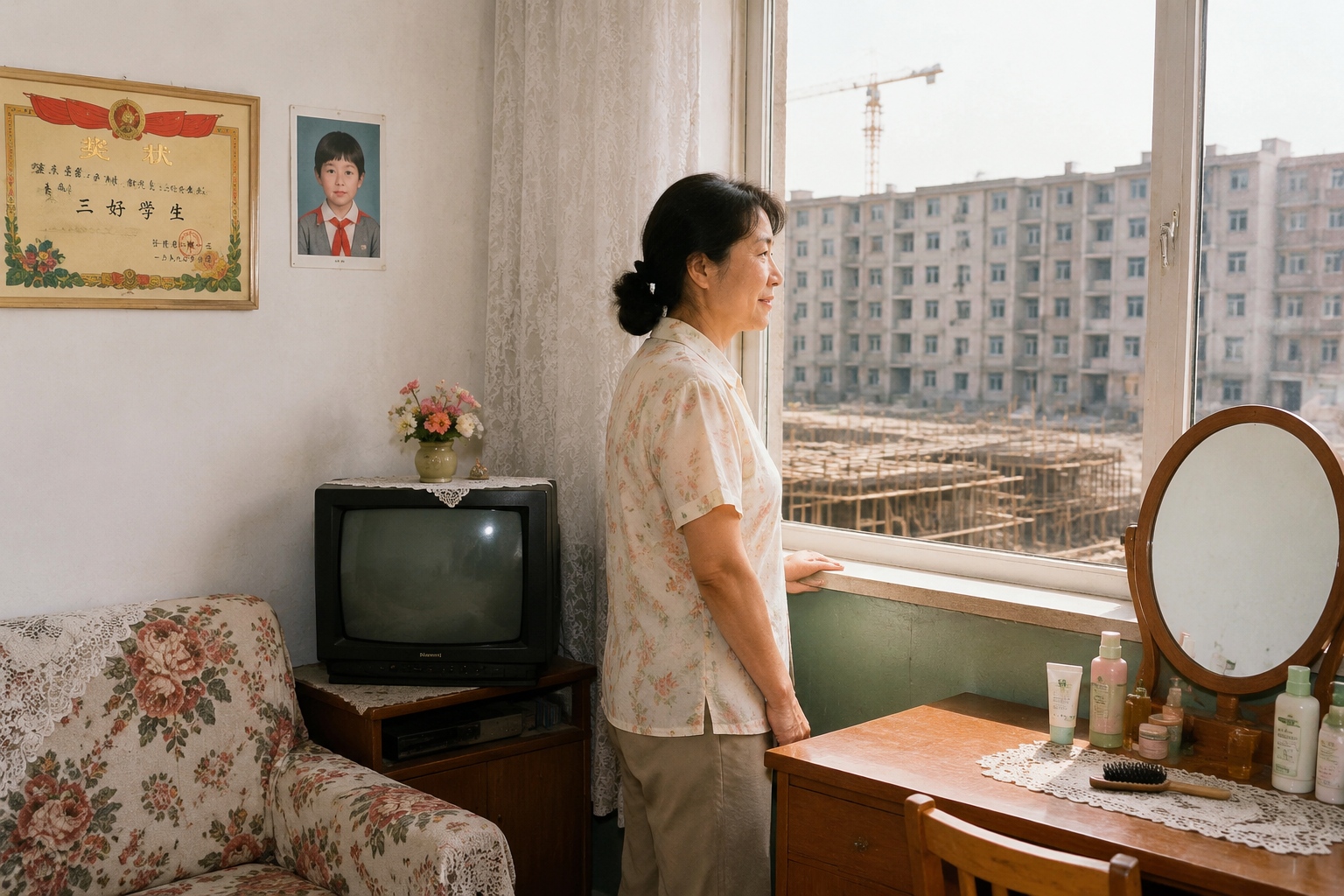
At sixteen, Chen Hong entered a technical vocational school and became an electrician’s apprentice. She worked in the factory, wearing blue overalls and heavy leather shoes. In 1996, she married a railroad worker and moved into a 60-square-meter flat with a balcony, a gas stove, and a proper bathroom. For the first time in her life, she had a room that was truly hers. She bought patterned curtains and placed a small dressing table by the window. ‘I used to dream about having a full-length mirror,’ she told her daughter later. ‘When I finally got one, I just cried.’
Her apartment was modern by local standards, but it was still a product of the planned system. Every unit looked the same; the furniture came from the same state store. Her job was fixed, her schedule was fixed, and her home was a concrete box that separated her from the workplace, but offered little privacy—the walls were thin enough to hear a neighbor coughing.
The Skyscraper Office: Freedom and Its Price
Lin Yue was born in 2001, an only child. She grew up in that 60-square-meter flat, studied hard, and entered a university in Xi’an with a degree in economics. In 2023, she moved to Shanghai and found a job at an asset management company. She now rents a 12-square-meter room in a shared apartment, twenty minutes by metro from her office. The office is on the 31st floor of a glass tower, with floor-to-ceiling windows, a pantry stocked with single-origin coffee, and an air-conditioning system that keeps the temperature at exactly 23 degrees Celsius in every season.
Her grandmother’s world was horizontal—a low hut, a dirt yard, a narrow road. Lin Yue’s world is vertical: elevator rides, suspended meeting rooms, views of clouds. She earns a salary that could buy her grandmother’s entire village. She has health insurance, a retirement fund, and a paid gym membership. She can dye her hair purple, live alone, and pursue a promotion that her grandmother would not even understand as a possibility.
But the vertical life has its own weight. She works late because the market never sleeps. Her room is so small that her dining table is a folding tray on her bed. She often orders takeout from apps because there is no stove in her shared kitchen. She is officially independent, but she still feels tethered to her mother’s WeChat messages and to a housing market that makes ownership feel like a fantasy for people under thirty.

Three Women, Three Ideas of Home
During Chinese New Year, the family always returns to the village. The cave house has been renovated; the old kang has been replaced by a big bed with electric blanket. Wang Xiuqin, now in her late seventies, still prefers to sit on the edge of the heated platform, her legs swinging like a child. The three generations gather around a round table. Wang Xiuqin talks about how she used to stuff cotton into the kang’s seams to stop the smoke from leaking. Chen Hong talks about the long wait for a subsidized apartment in the 1990s. Lin Yue talks about her team’s quarterly targets and a blind date her mother arranged.
The older women ask, ‘Is your office warm in winter?’ Lin Yue says yes, but also that it’s too cold in summer. They laugh. The conversation drifts to marriage. Wang Xiuqin, married at eighteen, cannot understand why her granddaughter is still single at twenty-three. Chen Hong defends Lin Yue: ‘Let her settle down first.’ Lin Yue argues that her career is going well and that she wants to be truly ready. ‘What is truly ready?’ her grandmother asks. Lin Yue looks around the warm room and says, ‘Ready to choose where I live.’
What Has Changed, What Hasn’t
The journey from the kang to the skyscraper is a story of tectonic social change. In seventy years, Chinese women have gone from being largely illiterate and homebound to making up nearly half of the labor force and the majority of new university graduates. The physical spaces they inhabit—rural huts, state-built apartments, corporate offices—have expanded and transformed. The 18th-century poet’s line, ‘women should stay at home,’ is now, for many, a faded echo.
Yet some obstacles remain. The glass ceiling is real. The burden of child care still falls heavily on mothers. In villages, some families still value sons over daughters, and domestic violence continues in the shadows. Even in Shanghai, Lin Yue’s company has only two female partners out of twenty. Her own mother, a supervisor at a local company, often reminds her: ‘You’ve gone further than I did, but there’s still a long way to go.’
Lin Yue steps out of the office building into a muggy night. She looks up at thousands of lit windows. Each one is a bedroom, a living room, or an office—a different kind of home for a different generation of women. They are all, in their own way, still searching for a place that feels both warm and free, just like her grandmother did, long ago, on a bed of heated brick.
Start the discussion at forum.chinacomes.com