
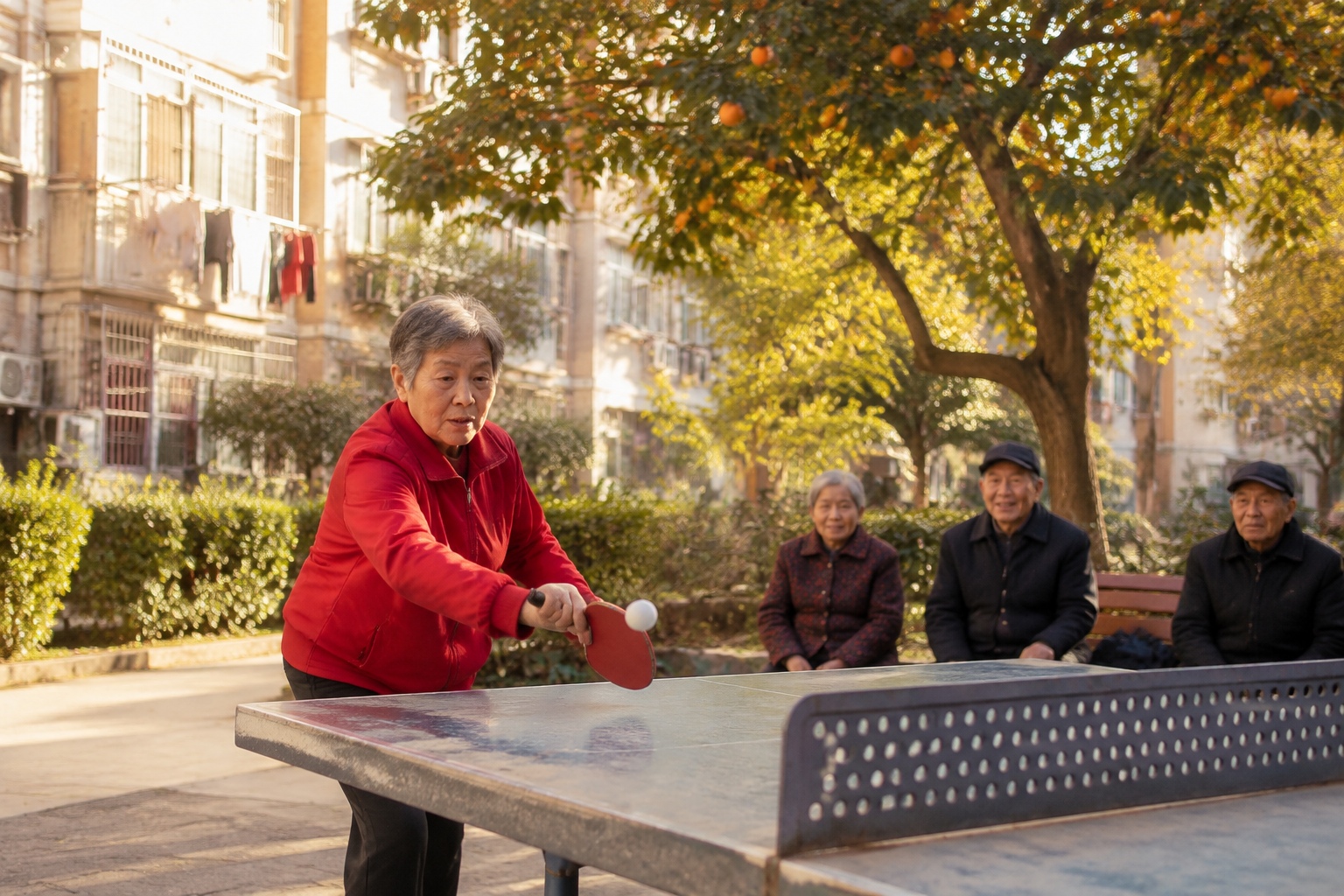

Six a.m., east of Nanjing. The morning air is still cool, but the concrete square between two apartment blocks is already in motion. Under a persimmon tree, a woman with short gray hair raises a red paddle and sends a white ball slamming across the faded blue table. The sound – a sharp “tok” – echoes against the walls and mixes with the clatter of a nearby breakfast stall.
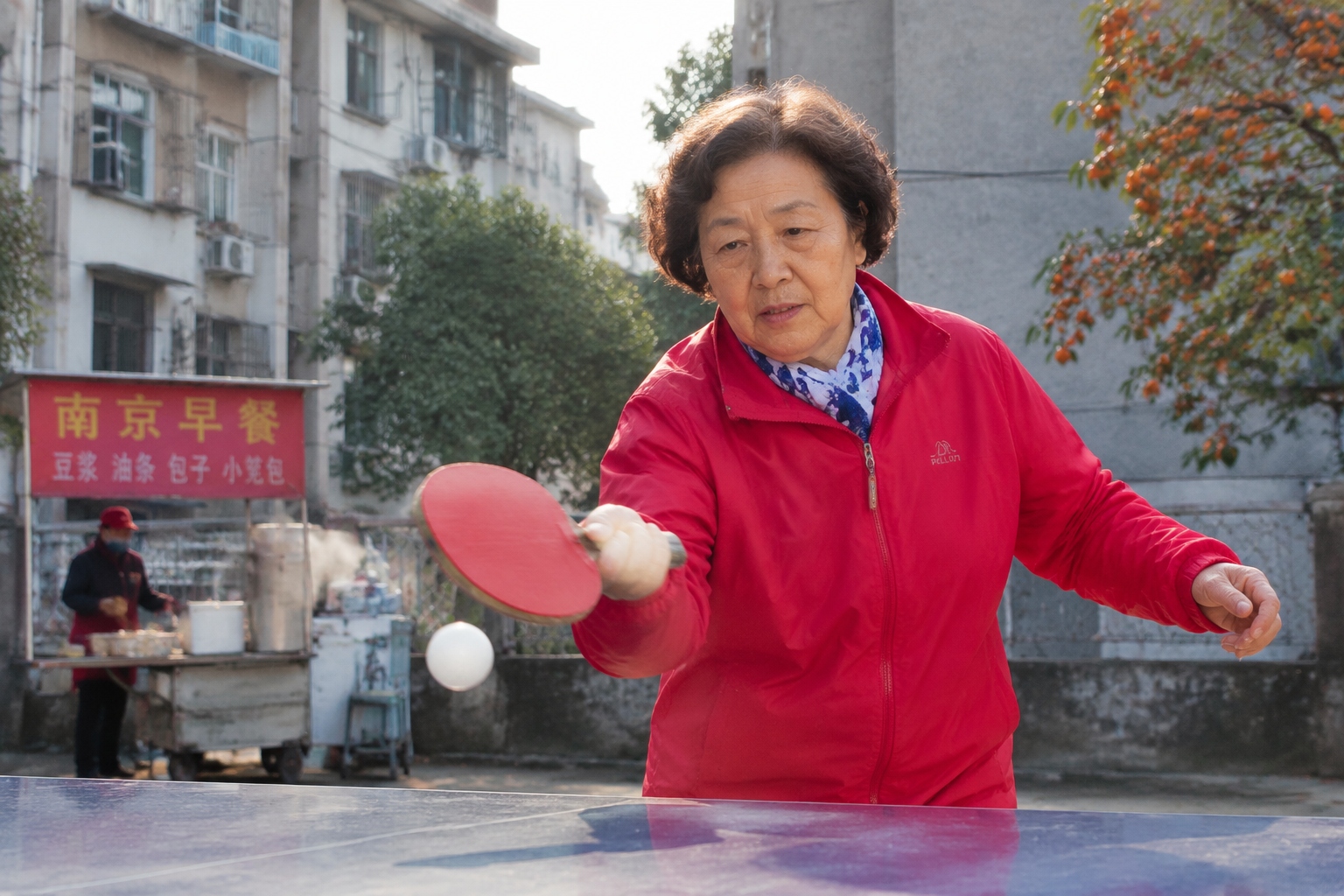
Her name is Wang Guifang. At 68, she has been retired for nearly two decades from the Nanjing No. 2 Textile Factory, where she worked as a loom operator for 30 years. On this court, smaller than a parking space, she has become something else: a local fixture, an unofficial coach, and a stubborn force who refuses to let age become an excuse.
“This table is my stage,” she says, wiping her face with a towel that still carries the logo of the factory. “In the factory, I made cloth. Here, I make a connection.”
From Factory Sound to Court Silence
Wang Guifang began at the factory in 1976, a time when Chinese industry was roaring back after the Cultural Revolution. She ran looms that wove cotton and polyester, moving between giant machines whose noise made conversation impossible. Workers developed a kind of sign language. “I could read lips,” she says, laughing. “That skill still helps me, because the person across the table is always hiding what they’ll do next.”
She retired in 2005. Her husband, a retired construction worker, had his own routines. Their daughter, now a schoolteacher, invited them to live with her, but they preferred the old apartment. For years, Wang Guifang found little to do. “I cooked. I watched TV. I didn’t leave the house much.” Her knees stiffened, her energy dropped, and she felt a strange loneliness that she couldn’t explain to her family.
“One day, my neighbor, Lao Song, pulled me to this table,” she recalls. “He said, ‘You look bored. Come hit the ball with me.’” She picked up a paddle for the first time since her twenties, when she played casually on a school cement table. It felt awkward, but the movement – the step, the rebound, the focus – brought back something she had forgotten: a sense of play.
Learning to Flow
At first, her body resisted. Her hip hurt after ten minutes. She couldn’t track the ball’s bounce on the rough concrete. But Wang Guifang was never someone who could walk away from a puzzle. She started going early in the morning, before the crowd, to practice the same stroke over and over. She would aim at a cracked brick on the wall and try to hit it from ten feet away. “A ball isn’t like a piece of cloth,” she says. “You can’t just fold it. You have to follow its path.”
Over months, she improved. She learned to bend her knees, to move her feet, to read the opponent’s shoulder. Her strokes grew smoother, no longer a desperate flick but a deliberate arc. By 2020, she was beating most of the men on the block. “They didn’t like it,” she says with a sly grin. “But I always say, if I can operate a loom, I can learn this.”
More Than a Game, a Living Room
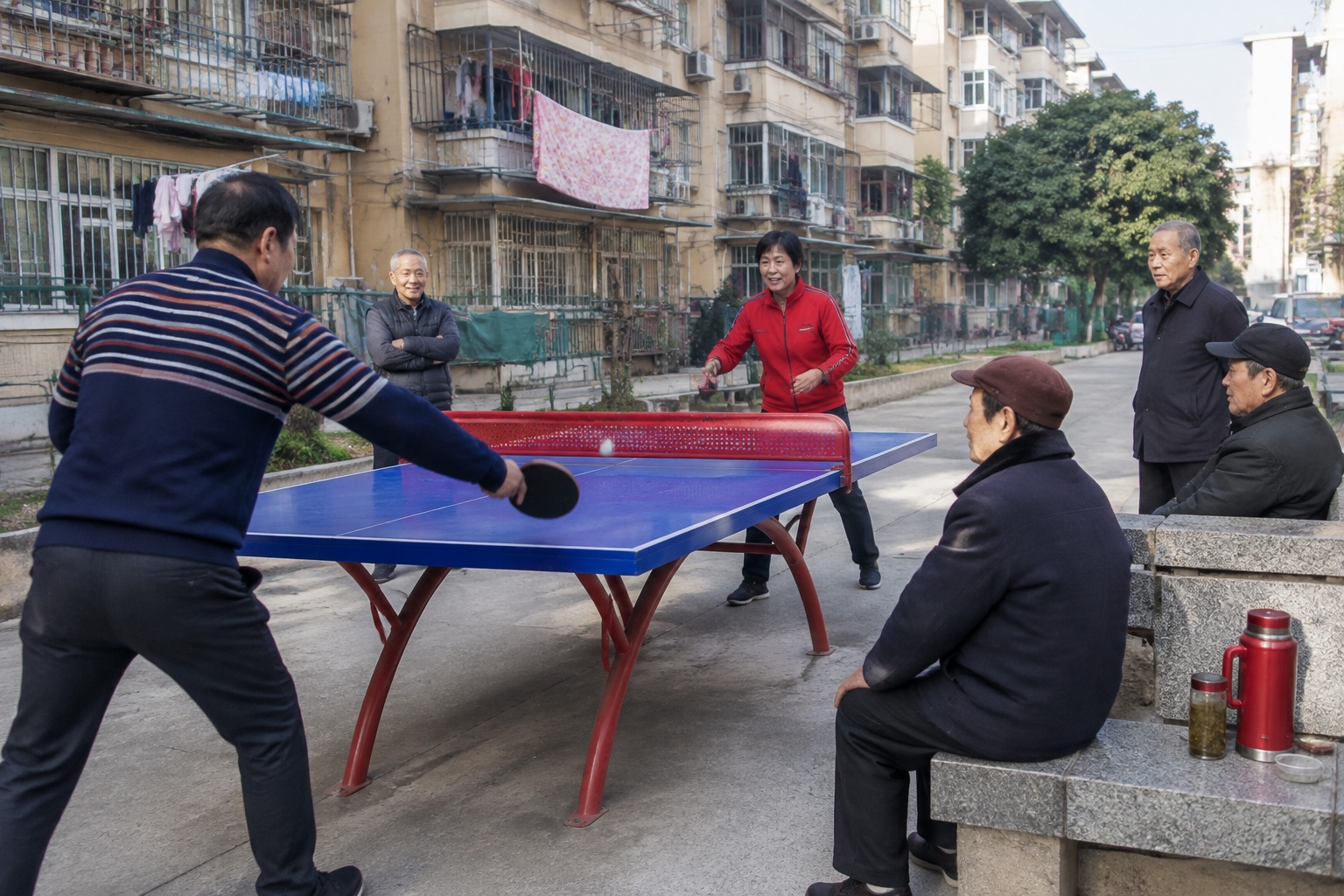
The court on Changle Road is not a grand sports park. It’s a slab of concrete between two buildings, with one net and a few worn benches. But when the weather is mild, it becomes the living room of the entire community. Retired workers bring thermoses of tea, share breakfast, and cheer every point. Some people come just to sit and take in the movement.
“This is our social spot,” says Liu Meiling, a 71-year-old former nurse who plays three mornings a week. “In the past, you’d only see your neighbors when someone moved or died. Now, I know which grandkid is sick, which family bought a car, all because we play together.”
Wang Guifang has taken on the role of caretaker. She brings an old biscuit tin stuffed with balls, a set of repair tools, and a spare paddle she lends to kids. When the net sags, she reties it with a piece of wire. She even paints the lines after they fade, using a small pot of white paint from the hardware store. Her watchfulness keeps the court usable, and it earns her affection.
Why Ping-Pong?
Table tennis is often described as China’s national sport. Its popularity runs deep: school tables, community centers, and even a series of Olympic golds. For older people, the appeal is practical. The game is cheap, doesn’t require much space, and can be played at a slow or fast pace. It works on reflexes, balance, and coordination, all while being gentler on the knees than badminton or jogging.
Government fitness programs have supported this. Over the past decade, cities across China have installed sports equipment in parks and residential districts. A quick walk through Nanjing shows plenty of concrete ping-pong tables, often shaded by trees or tucked between apartment blocks. Not every table is perfect – some are cracked, some lack nets – but they are everywhere.
“We’re not playing to become champions,” Wang Guifang says. “We play because it keeps us from feeling old. The body needs a reason to move.”
Daily Rituals
Her routine is almost monastic. She wakes at 5:40, boils water for jasmine tea, and arrives at the court by six. She does a few stretches on the concrete, then practices serves until her first opponent shows up. She keeps a small notepad in her pocket, filled with scribbles about angles, footwork, and weaknesses she’s noticed in regular partners. The notes are written in a precise, tidy hand.
“See this?” she points to a small diagram of a table with an X on the left side. “That’s where I kept losing against Lao Chen. He has a tricky spin. So I made a note to practice my cross-court return.”
This meticulousness came from a life of careful work. She mentions her factory days: “We had to check every meter of cloth for flaws. If you miss something, it ends up on the rack of a store. I still can’t push anything past my eyes.”
Her physical health has benefited. “I used to take painkillers for my back almost every day. Now I might take one a month. The doctor said, ‘Keep moving, make the joints work.’” At 68, she moves with a lightness that surprises her own family. Her daughter once visited and watched her dive for a ball. “She almost had a heart attack, she said,” Wang laughs. “But I got the ball.”
A Wider Circle
The table has also expanded her world. Wang Guifang now knows most of the regulars by their nicknames – “Fatty Zhang,” “Old Monkey,” “the Doctor.” She celebrates their birthdays, buys melon seeds for everyone, and sometimes hosts a small “tea party” under the tree.
Younger people, too, get pulled into her orbit. On weekends, schoolchildren stream over to the court. Wang Guifang teaches them the basics, not because she was asked, but because she wants the community to stay alive. “If the kids play, the table will still be here in ten years,” she says.
Her husband, initially skeptical, now plays doubles with her on Sunday afternoons. “He’s terrible,” she jokes. “But he’s learning.” Even her granddaughter, who lives in a different city, calls her “Coach Wang” after seeing a photo of her with a trophy from a local seniors’ tournament.
Limits and Criticisms
It would be easy to romanticize all of this. There are real patches of difficulty. The table at Changle Road is cracked, and the paint is so worn that the lines are barely visible. The net was replaced three times, but the new nets are flimsy. City authorities have promised to upgrade the court, but funding moves slowly.
“It’s still okay,” Wang Guifang says, tracing a finger along the table’s surface. “A few cracks aren’t going to stop us. You just need to know where the ball bounces.”
There are also days when she feels her age. Some mornings, her knees hurt, and she doesn’t want to walk out. But she says a habit is harder to break than youth. “If I stayed home, I’d just watch TV. Here, I get a little sun and a lot of laughs.”
Continuation, Not a Comeback
Wang Guifang rejects the phrase “second act.” “It’s not a new chapter,” she says. “It’s the same book, just a different page.” In a culture that tends to value youth and productivity, she has found a way to remain visible, useful, and connected. Her stage is a slab of concrete, but she performs there with the seriousness of a concert pianist.
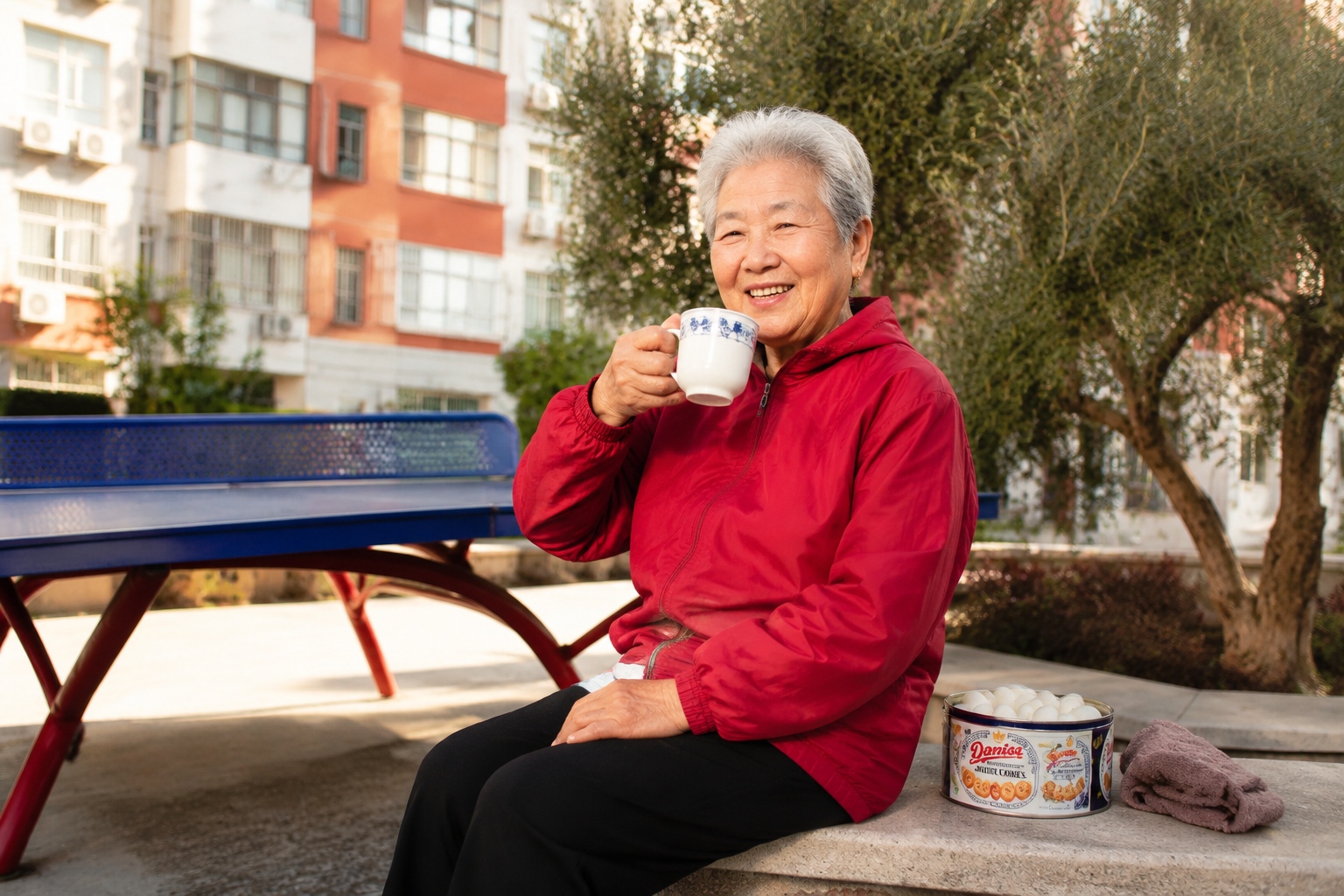
At 6:45, the morning sun climbs above the apartment buildings. The square is now full, with two more tables in shade. Wang Guifang hands her paddle to a friend and steps back to the bench, watching the pattern of the game. She takes a sip of tea. Her face is a calm map of wrinkles, and there’s a sense of belonging in the way she rests her hands on her knees.
“Someone asked me once if I missed the factory,” she says. “I told them, yes, I miss the people. But now I have new people to miss me.”
And then she puts on her jacket, picks up her padded bat, and returns to the table for one more round.
Start the discussion at forum.chinacomes.com