
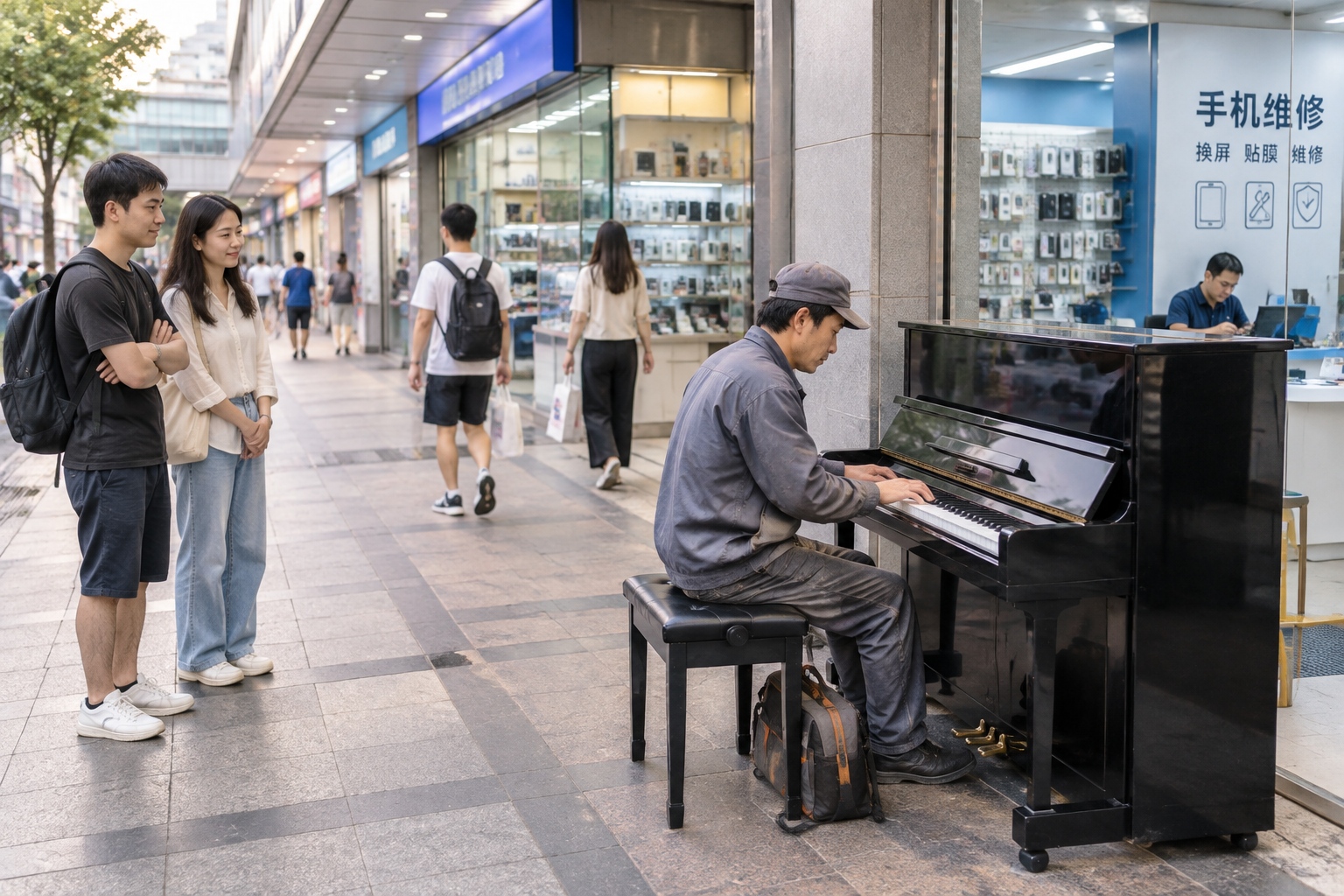

The camera holds two things in the same frame: a man’s work clothes and his hands moving across a piano keyboard. Around him is Huaqiangbei, Shenzhen’s electronics district, where shopping, deliveries, repairs, and the journey home share the pavement. For a few minutes, a public piano gives those passing through another reason to stop.
In 2023, Chinese media covered Yi Qunlin, a construction worker from Hunan whose playing at a public piano in Huaqiangbei attracted attention online. His story offers a concrete starting point for understanding an aspect of Shenzhen that disappears behind photographs of office towers: the private interests people carry into a city built around work.
A reporting distinction matters here: the available material does not establish that Yi performed a particular Chopin nocturne after a particular shift. That scene should not be presented as a verified event. His reported encounter with a public piano anchors this article; the Chopin reference raises the broader question of who gets to play classical music in public.
A public piano in Shenzhen’s electronics district
Huaqiangbei is associated with electronic components, mobile phones, and the dense network of businesses that sell, repair, and assemble them. A piano brings a different rhythm into that environment. It occupies space where people are generally expected to keep moving or buy something.
Public pianos are instruments made available for shared use, usually subject to a venue’s rules and opening hours. Shenzhen’s examples have appeared in reporting and social media, but those individual appearances do not establish a comprehensive, permanent network. A piano seen in an older video may have moved, become unavailable, or acquired different access arrangements.
It would therefore be misleading to promise visitors that pianos are waiting throughout the city’s metro stations and parks. Huaqiangbei is the relevant setting for Yi’s reported story. Other locations require their own checks. A street installation, a shopping centre’s instrument, and a piano reserved for organised performances offer different kinds of access.
The practical appeal of a genuinely accessible instrument is straightforward: someone can play without owning a piano or hiring a rehearsal room. Passersby can listen without buying a ticket. Whether that opportunity feels welcoming depends on smaller details—permission, seating, maintenance, nearby signs, and how staff respond when someone approaches.
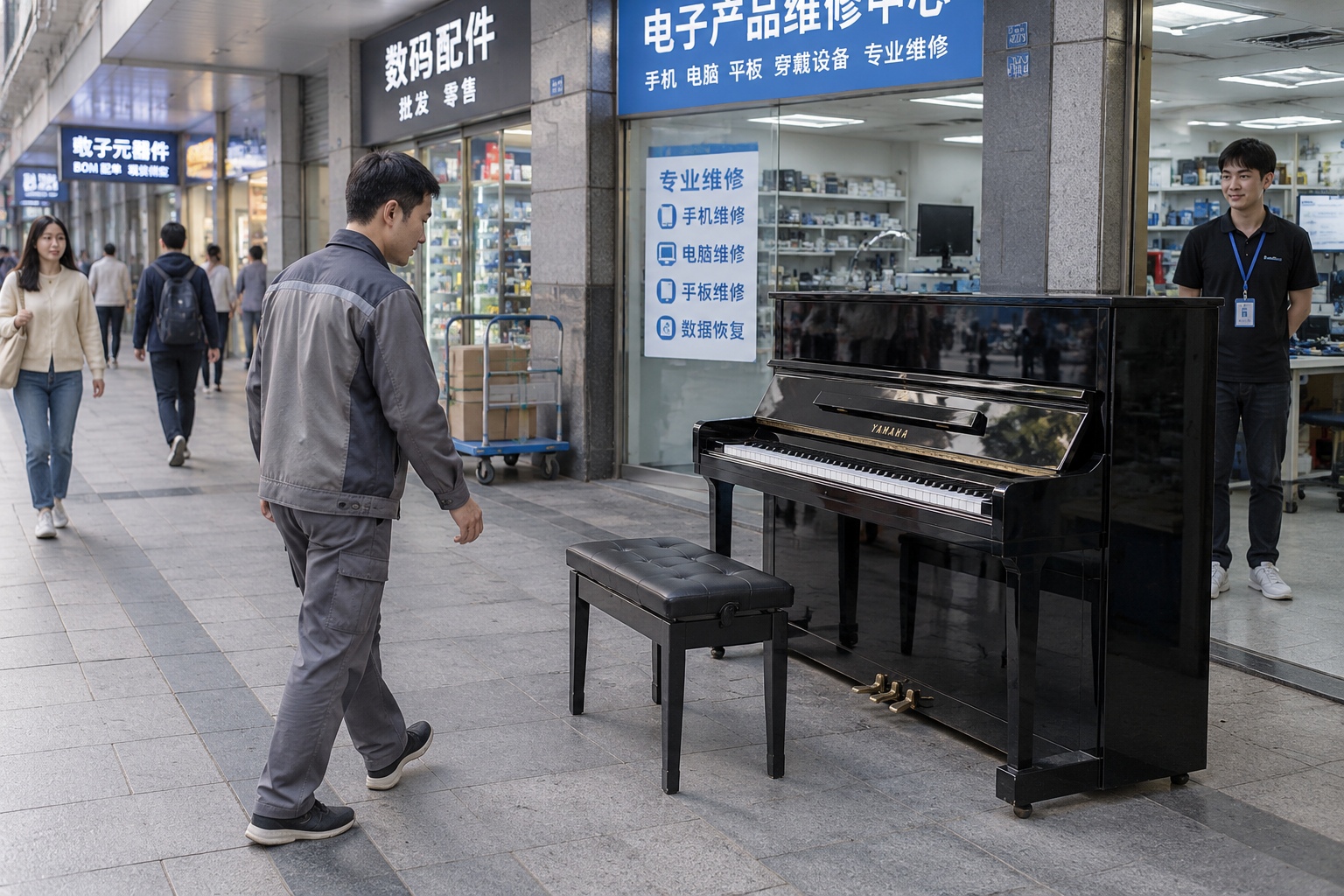
Yi Qunlin: a worker with a musical life
Reporting identified Yi as a worker from Hunan, a province in south-central China, who had come to Shenzhen for employment. Accounts of his musical background described an interest reaching back to his younger years. The attention arrived when that longstanding interest became visible in a public place.
That sequence matters. An online audience encountered him through a brief performance, but the performance did not create his attachment to music. Nor does working in construction explain everything about how he learned, what he enjoys playing, or what he hopes to learn next.
For someone living in shared accommodation or moving between jobs, access to an instrument can be a more immediate problem than enthusiasm. An acoustic piano costs money, takes up floor space, and makes sound that travels through walls. A digital keyboard reduces some of those difficulties but still requires money, somewhere to keep it, and time to practise.
These are practical constraints rather than a complete account of Yi’s circumstances. Without a direct interview or reliable supporting detail, it would be wrong to supply his daily schedule, wages, housing arrangements, or thoughts at the keyboard. His story does not need invented hardship to make his interest in music significant.
What can we say about the Chopin nocturne?
Chopin’s nocturnes are short piano works often associated with a singing melody above an accompanying left hand. Making that melody sound unforced requires control of touch, timing, balance, and pedal. Familiarity with a tune is only the beginning of playing it convincingly.
A worker performing one would be an entirely plausible scene. Plausibility, however, cannot identify a piece in a video or confirm the biography attached to it. Before naming a nocturne, an editor would need the original recording, a reliable identification of the music, and confirmation that the person and location match the account.
The distinction protects the musician as much as the reader. Viral captions can turn several different performers into one inspirational character. They can also make a modest, enjoyable performance carry claims about exceptional talent or personal struggle that its player never made.
There is still a worthwhile question behind the title: why should a construction worker playing Chopin seem surprising? Part of the answer lies in access to lessons and instruments. Another part lies in the narrow range of interests strangers tend to imagine for people wearing work clothes.
Who stops to listen—and who keeps walking?
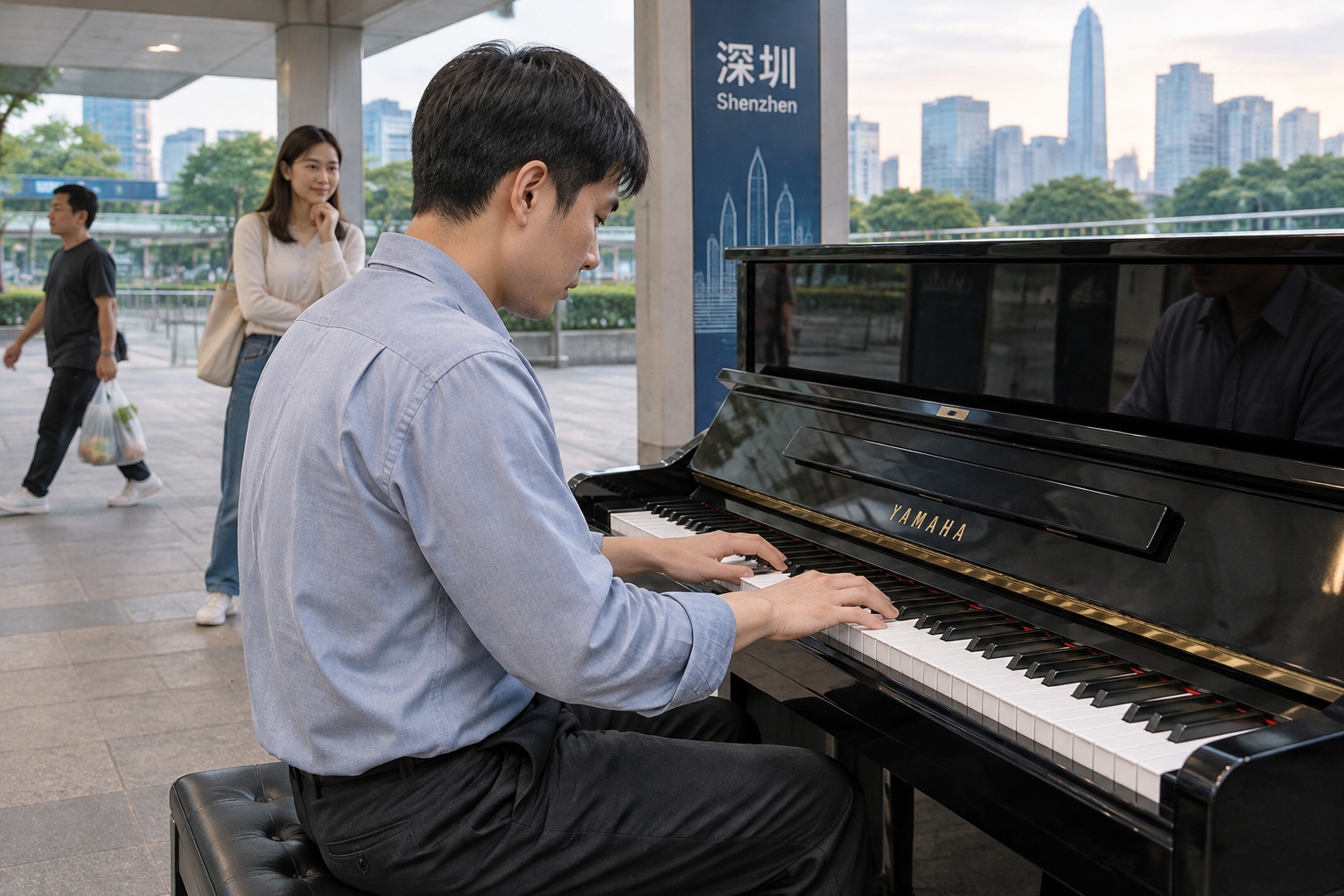
A public piano shares its surroundings with people who have other purposes. Someone may pause through an entire piece. Someone else may listen while checking a message. Another person may pass without looking up because a train, a delivery, or a child is waiting.
Those are possible responses in such a setting, not a reconstructed audience for Yi’s performance. A short recording cannot establish what everyone nearby felt. Even when phones and attentive faces appear in the frame, the camera leaves other reactions outside it.
Keeping that uncertainty allows a more useful view of public space. A successful shared space can accommodate both attention and indifference. The player can enjoy being heard; a passerby can continue home. Nobody needs to produce a visibly moving reaction to justify the piano’s presence.
Sound also creates obligations. Nearby shop staff may hear an instrument for hours, while a visitor hears it for minutes. Clear playing times, reasonable volume, and a way to resolve complaints help keep an installation usable. So do tuning, repairs, and a fair opportunity for the next person to sit down.
The limits of the surprising-worker story
The phrase “construction worker plays classical piano” travels easily because it sets up an expectation and overturns it. That can draw welcome attention to a person’s ability. It can also preserve the assumption that musical sensitivity is unusual among people who work with their hands.
In China, the term nongmingong, commonly translated as “migrant worker,” usually refers to workers with rural origins who take jobs away from their home areas, often in cities. They are generally internal migrants, not people arriving from another country. The label describes a social and employment position; it says little about an individual’s tastes.
Neither musical accomplishment nor online popularity should become a test of whose life deserves attention. A worker who cannot play a note has the same claim to decent employment and accessible public space. Admiring a performance does not tell us whether wages arrive on time, work is safe, or housing is secure.
There is also a question of consent. Playing in public makes a performance visible, but it does not necessarily mean the player wants close-up filming, persistent interviews, or personal details circulated online. Asking before recording is a small courtesy that keeps the person at the keyboard involved in what happens next.
A migrant city’s room for other interests
Shenzhen became a special economic zone in 1980, and migration has been central to its growth. People arrived from across China for factory work, construction, trade, services, and professional careers. Their languages, family connections, habits, and interests arrived with them.
The city’s 2020 census recorded about 17.56 million permanent residents. In Chinese statistics, that category describes people living in a place under the census rules; it is not the same as holding local household registration, or hukou. The distinction helps overseas readers understand how belonging to a city can have both an everyday meaning and an administrative one.
A public piano cannot resolve those differences. It can provide a specific opening: an instrument available to someone whose job title tells strangers very little about his musical life. Its value rests on that ordinary opportunity, including on days when nobody records a video.
Yi’s reported appearance at a Huaqiangbei piano is compelling enough without an invented evening, an unverified nocturne, or a crowd assigned a single emotion. A worker sat down to play. For the people who heard him, there was briefly more to know about a stranger sharing their city.
Start the discussion at forum.chinacomes.com