
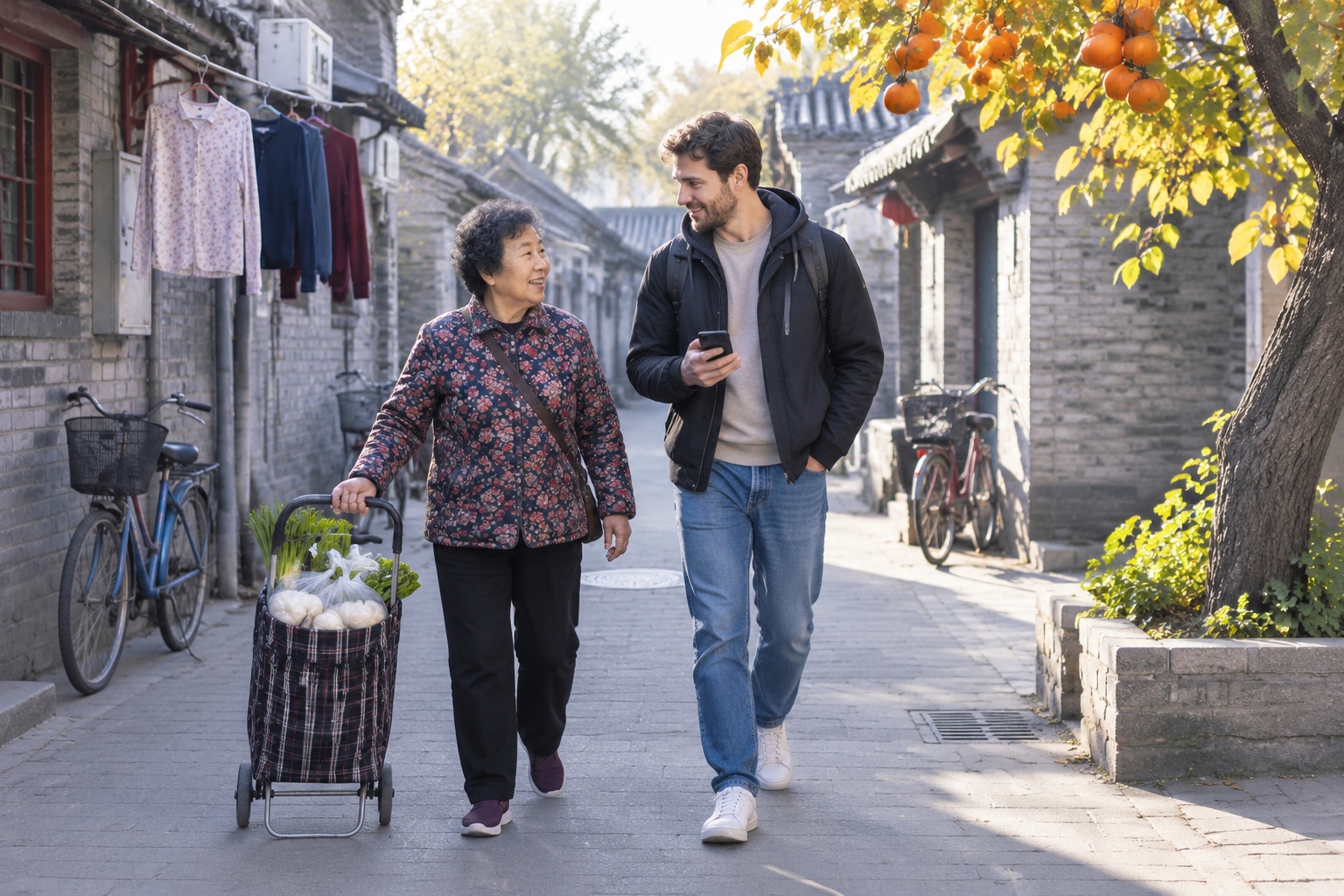

A grey-brick maze at 8:40 in the morning
My phone said the subway was four minutes away. Forty minutes later, I was still turning corners.
It was a Tuesday in late October, and I was somewhere north of the White Pagoda in Xicheng district, the old western half of central Beijing. The lane I stood in was about three metres wide. Grey brick on both sides, grey tile roofs above, a smell of fried dough sticks and wet stone and, faintly, the drain. A cat watched me from a windowsill and did not blink.
On the back of a receipt I had an address: a small guesthouse I had checked into the night before. I had walked out for breakfast, taken two turns I thought I remembered, and now the blue dot on my screen was floating in a grey smudge with no streets in it.
Why hutong addresses break every map app
Beijing’s hutongs are the lanes of the old city, and they were never designed to be navigated by strangers. Most of the ones I was lost in run east to west, packed shoulder to shoulder, with narrower passages between them. Some dead-end at a courtyard wall. Some bend around a tree older than the map. House numbers jump and repeat: No. 12, then 甲 12, then 12 后门 — a back door that opens onto a completely different lane.
GPS struggles here for a simple reason. The buildings are low, the lanes are narrow, and the signal bounces. The blue dot jumps a hundred metres and lands you on somebody’s roof.
Numbers are slippery in another way, too. Estimates commonly cited put Beijing’s hutong count above 3,000 in the 1950s. In the old city today it is closer to 1,000. Names change, lanes get closed, and what looks like a street on a phone can turn out to be a doorway.
The woman with the shopping trolley
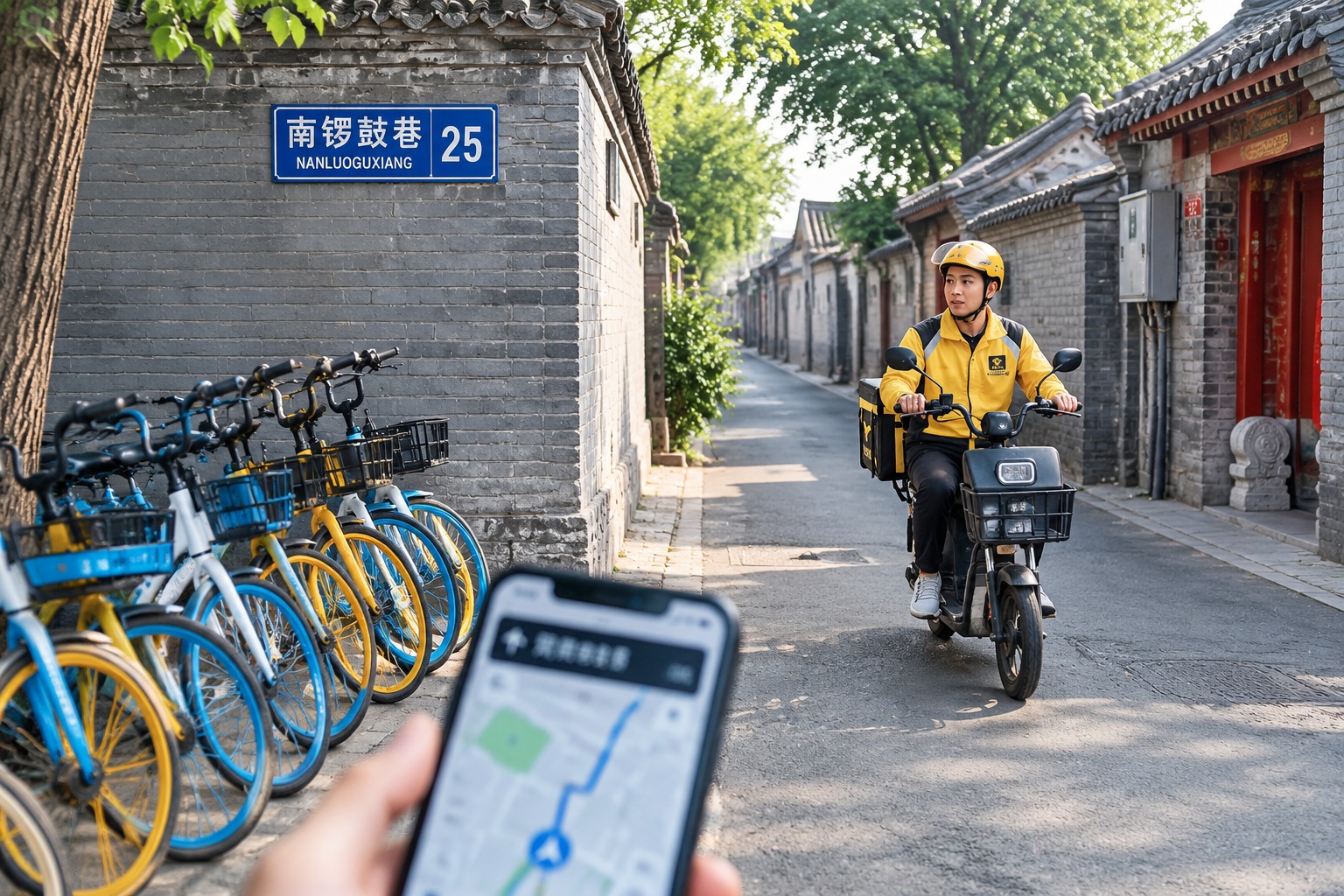
She came around the corner pulling a two-wheeled shopping trolley: two bunches of celery, a bag of steamed buns, a carton of milk wedged in sideways. Floral cotton jacket, short grey hair, canvas shoes.
She looked at my phone, then at my face, and stopped.
“你找哪儿啊?” — What are you looking for?
I showed her the receipt. She turned it sideways, read it twice, said something I didn’t catch, and then produced the sentence that reorganised my entire morning. “走吧,我顺路。” Come on, I’m going that way.
She was not, as it turned out, going that way. I only worked that out two kilometres later.
Two kilometres, four turns, one persimmon tree
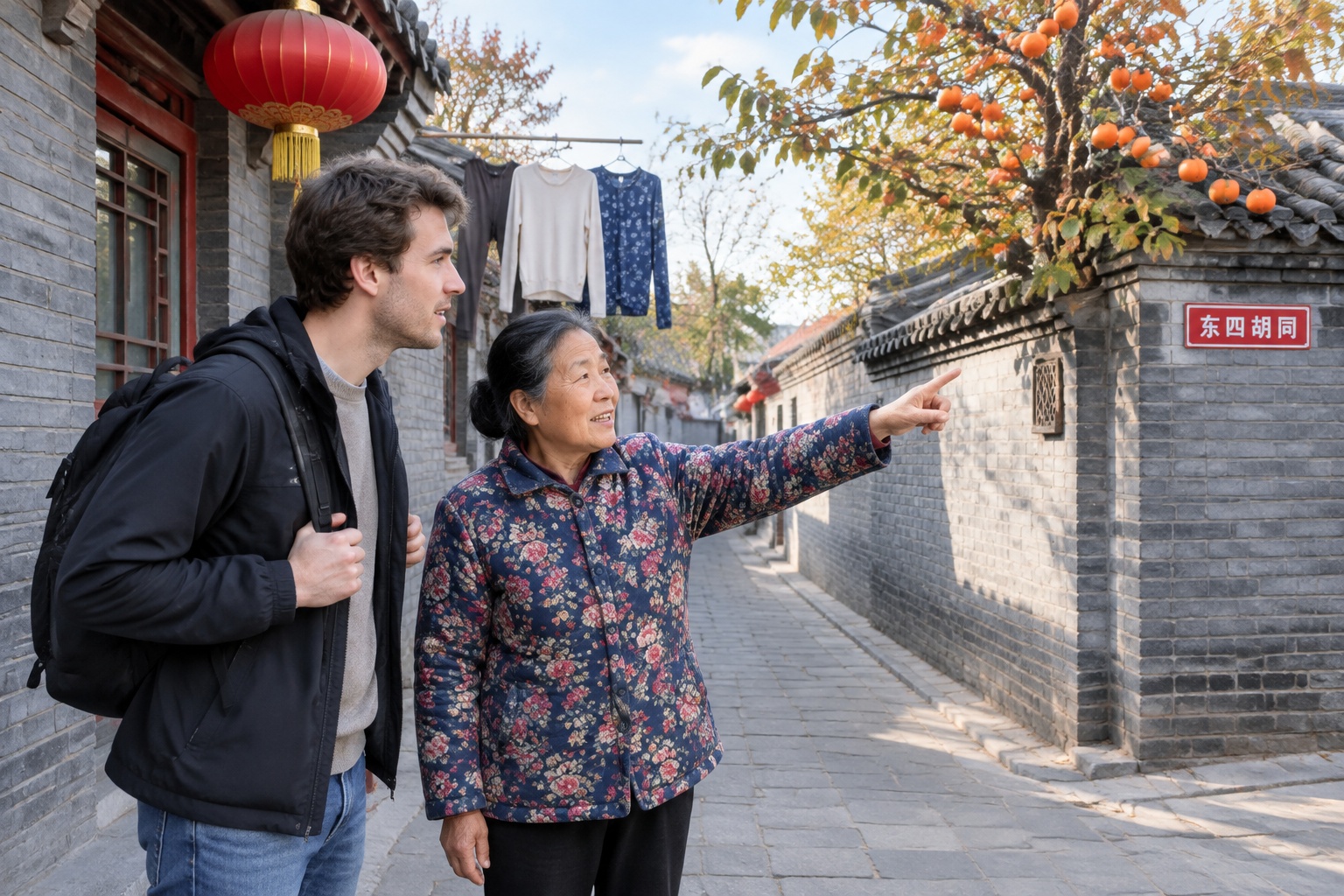
We walked. She set a brisk pace and the trolley rattled over the paving stones. Every twenty metres or so she said something; every twenty metres or so I understood about half of it. Her Beijing accent swallowed the ends of words, the way the city swallows its own streets.
She has lived in the same courtyard for 41 years. Her son works in an office park out in Wangjing, northeast of here, and comes back on Sundays. Three families share the courtyard now. When she moved in, it was five.
Things I saw along the way, roughly in order:
A man washing a white car with a bucket and a rag, because there is nowhere in a hutong to park a hose.
An old man on a bicycle with two birdcages balanced on the handlebars, heading for the park, the birds chirping the whole way down the lane.
Four rubbish bins with laminated signs above them — kitchen waste, recyclables, other, hazardous — and a retired man in a blue vest sitting nearby, whose job is to make sure the bags go into the right one.
A red-and-white notice on a brick wall: 院内有老人,请勿喧哗. There are elderly people in this courtyard, please keep your voice down.
A delivery rider on an electric scooter, insulated box strapped to the back, threading between us with ten centimetres to spare and a cheerful “借过借过.”
A vegetable shop one room deep, prices chalked on a board, where the shopkeeper knows what each customer wants before they ask.
A coffee shop in a renovated courtyard house: glass door, plants, English on the menu, three people on laptops. Two doors down, a woman was frying something in oil and the smell filled the entire lane.
At the corner where we turned left, she pointed at a persimmon tree. “记住这棵树,” she said. Remember this tree. She said it like it was the most obvious navigation aid in the world — which, in a place with no straight lines, it probably is.
What she told me about living there now

Her house used to be heated with coal. Since the neighbourhood switched to electric heating, she has a thermostat, and electricity is cheap between 8 p.m. and 8 a.m., so she runs it at night. The winter air is cleaner than it was ten years ago, she said. That wasn’t a talking point. It was just something she had noticed.
The shared toilet, about thirty metres from her door, was rebuilt a few years ago: tiles, heating, a cleaner. She still doesn’t have a bathroom inside her own home — plenty of courtyard houses in the old city don’t — and she talks about the shared one the way you’d talk about a slightly annoying neighbour you’re fond of.
The lanes got repainted and the overhead cables went underground in a citywide tidying of backstreets that began around 2017. What it meant for her, concretely: fewer wires above her head, clearer house numbers, and more tourists with cameras.
Some neighbours took the buyout offered under the city’s voluntary relocation programme and moved to larger flats beyond the Fifth Ring Road. She thought about it. Her son told her the new building has an elevator and a car park underneath. She stayed. “住惯了” — I’m used to it here. Then, after a pause: “买菜方便.” The food shopping is convenient.
Some days her lunch comes from a community canteen for older residents a few lanes away, where a set meal costs a few yuan. Ten years ago that canteen didn’t exist. Now it’s where she and her old neighbours argue about whose grandson is taller.
The last hundred metres
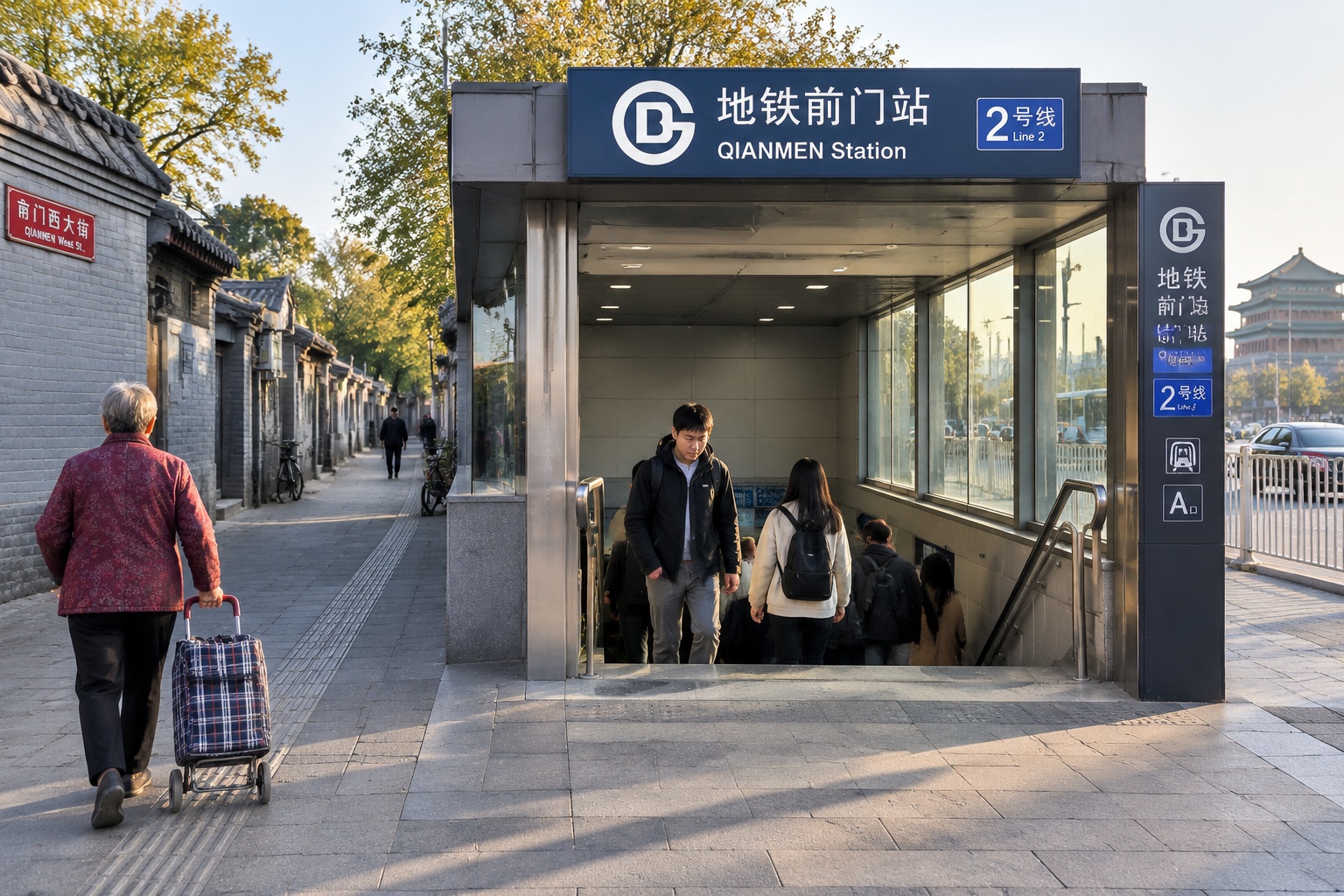
We came out onto a wider street. She stopped, pointed across the road with her chin and said, “地铁口,那边.” Subway entrance, over there.
I offered to buy her coffee. She looked genuinely offended by the suggestion, then laughed and said she doesn’t drink that bitter stuff. I asked for her name. “叫我大妈就行.” Just call me auntie.
And then she was gone, trolley rattling, turning back into the lane.
Two weeks later
I went back and tried to retrace the route. I found the corner with the persimmon tree, the coffee shop, the vegetable shop with the chalkboard. I did not find her.
What I found instead was that the neighbourhood had become legible. Once you understand that a hutong isn’t a maze but a grid with holes punched in it, once someone has shown you that the persimmon tree means turn left and the blank grey wall means dead end, the streets stop being scenery and start being a place where people actually live.
The guesthouse owner, when I told him the story, wasn’t surprised. “北京大妈就这样,” he said — Beijing aunties are like that — and went back to repairing a bicycle.
In a city of 21.8 million people, a map is the least of it. Someone walking two kilometres in the wrong direction so that a stranger goes the right way — that part never shows up on a screen.
Start the discussion at forum.chinacomes.com