
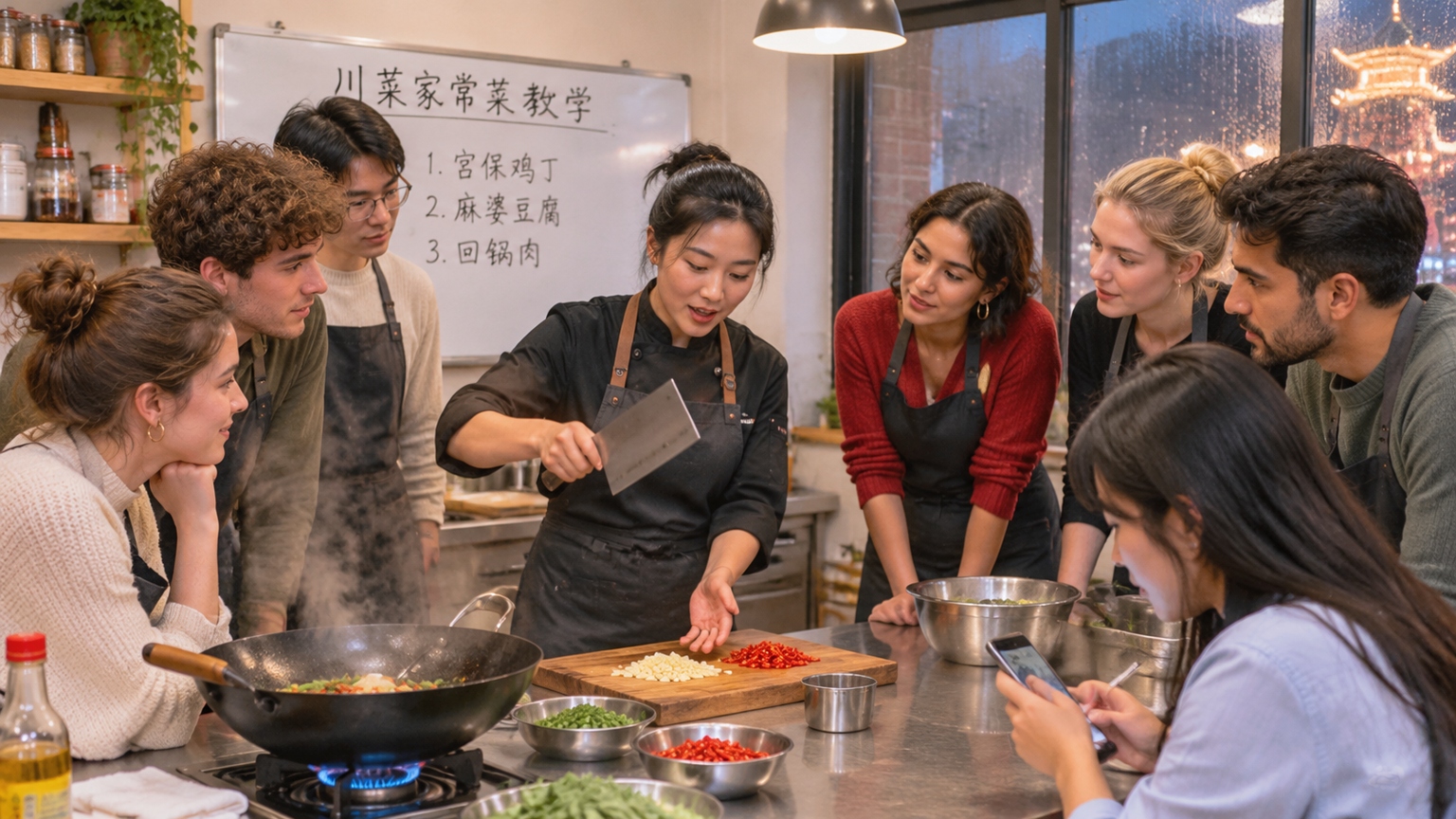

At seven on a Friday evening, the second-floor kitchen studio on a side street in Chengdu’s Yulin neighborhood smells of garlic and fermented broad bean paste. Eight people stand around a stainless-steel counter. Liu Wei, who runs the class, lifts a cleaver, says “切” slowly, then in English, “cut.” The room repeats the word first, then the motion.
Half of them landed in China within the past four days. One is a product designer from Barcelona on her first trip outside Europe. One is a retired geography teacher from Leeds who has been reading about Sichuan food for a decade. Another runs a small coffee-equipment business in Nairobi and wants to understand why Chinese supply chains move so fast.
None is enrolled at a university. None is on a coach tour. They paid somewhere between 400 and 900 yuan for a week of evening classes, and most will be on a plane home before their visa-free window is half used.
From landmark-hopping to skill-learning
The mechanics behind this are unglamorous: paperwork. Since late 2023, China has been steadily expanding unilateral visa-free entry. The list now covers citizens of more than 40 countries, and the permitted stay was stretched from 15 days to 30. A separate 240-hour visa-free transit rule covers travelers passing through dozens of ports. Immigration authorities reported about 27 million foreign entries in 2024, roughly double the year before.
Most of those arrivals are still doing what visitors have always done: three cities, five days, a lot of photographs. Chinese media have repeatedly cited an average stay of under five days for visa-free entrants. That number is the interesting part. If the average is around 4.7 days, then a five-day course is not a niche hobby — it is precisely the shape of the window most travelers actually have.
What has changed is the menu of reasons. A decade ago, learning something in China usually meant a semester abroad, a student visa, a university dormitory and a language program measured in months. Study tours existed, but they were mostly for teenagers, booked by agencies, and moved in groups. Visa-free entry collapsed the entry cost to almost nothing, and a new format filled the gap: short, skills-based, self-booked, and short enough to fit inside a normal person’s annual leave.
Why one week and not three months
Ask the students and the answer is almost always arithmetic. Most working adults can take five to seven consecutive days off without a negotiation. Flights are the biggest fixed cost, so people want to make the trip count. A week of classes is dense enough to feel like progress and short enough to be affordable.
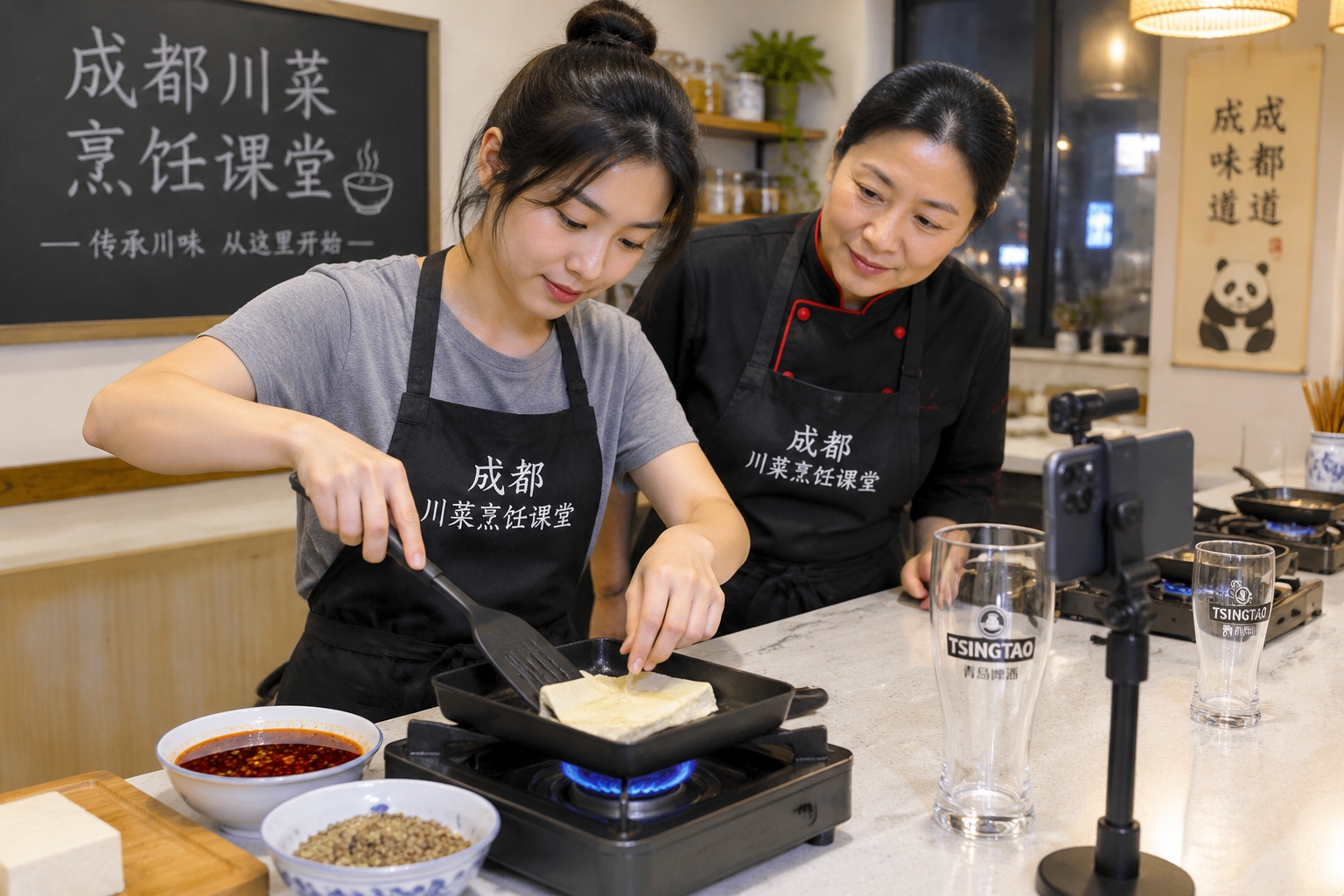
The prices are ordinary. A week of evening cooking classes in Chengdu generally runs a few hundred to under a thousand yuan. A ceramics week in Jingdezhen — clay, glazes, firing, sometimes accommodation — typically falls in the low thousands, with finished pieces shipped later. A wing chun beginner week in Foshan can cost less than a mid-range hotel stay in London. Add a budget flight, a cheap high-speed rail ticket and a guesthouse, and the total often lands below a two-week organized tour of the same country.
The difference from a traditional study tour is who is paying and who is deciding. These travelers book directly, by email or through a small platform, usually in English, often after watching a video of someone’s hands throwing a pot. There is no group leader. They get a schedule, an address, and a WeChat contact.
The short-course map
The geography of these courses follows local competence, not tourism marketing. Mandarin crash weeks cluster in Beijing, Shanghai and Chengdu, where teachers are used to adults who will only ever need survival Chinese. Cooking classes are strongest in Chengdu, Guangzhou and Xi’an. Ceramics people go to Jingdezhen, a small city in Jiangxi that has been firing porcelain for a thousand years and now hosts hundreds of small studios, many of them run by graduates who will teach a foreigner to center clay for a week. Wing chun and dragon dance draw people to Foshan and the Pearl River Delta. Suzhou sells embroidery and garden design; Dali sells tie-dye and mountain slow time; Wudang and Chenjiagou sell tai chi to people with bad backs and busy minds.
A fourth category is newer and less about craft: Yiwu for small-scale trade, Hangzhou for e-commerce and livestreaming, Shenzhen for hardware. The people signing up are not tourists so much as small business owners doing reconnaissance.
Three students, three reasons
Anna, 29, the designer from Barcelona, chose Jingdezhen because her job had become entirely screen-based. Her week: two days learning to center and pull, one day glazing, one day wandering the old imperial kiln district, one day on a train to the ceramics museum in Nanchang. What she actually produced was four slightly lopsided bowls and one cup. “I know now how hard it is,” she said, holding a bowl up to the window. “Before, I only knew how it looked.”
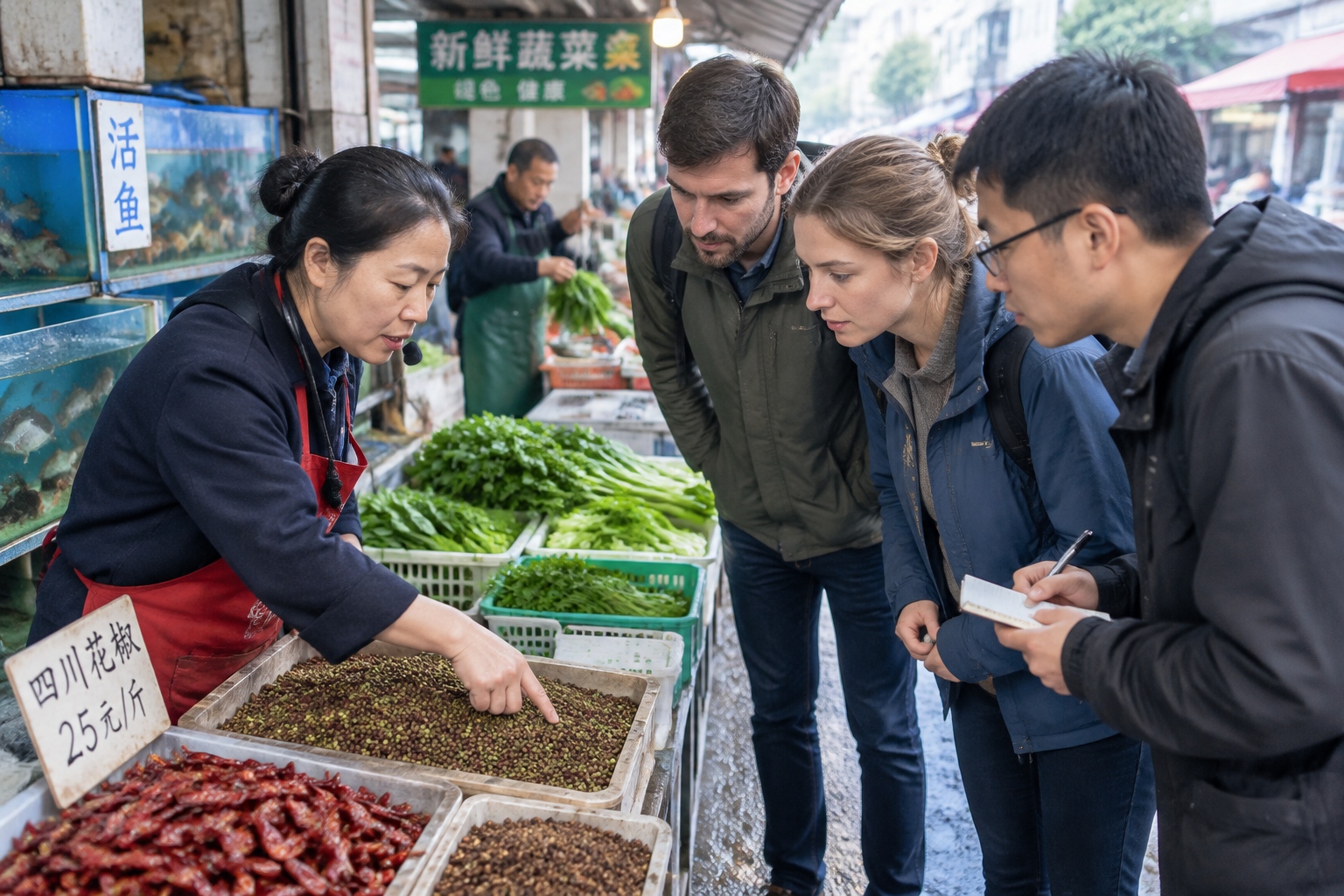
Graham, 68, the retired teacher, took a Chengdu cooking week: mornings in a wet market, afternoons at the wok. He learned six dishes well enough to repeat two. He also learned that the market vendor who sells him peppercorns will not accept his card, and that his phone, with an international card loaded into Alipay, works almost everywhere else.
Peris, 34, from Nairobi, spent her week between a Mandarin class in the morning and factory visits in the afternoon. She came for supplier relationships and left with a hundred characters, a stack of business cards, and a new appreciation for how quickly a small workshop can turn around a sample.

What happens on the teaching side
The teachers who do this well are careful about one thing: not turning the week into a performance. Liu, in Chengdu, starts the first session in a market rather than a kitchen, so students see prices, smell the fish counter and understand that the dishes they will cook come out of a normal Tuesday, not a banquet. Payment is taught on the spot, because buying vegetables is the fastest way to learn to scan a code.
In Jingdezhen, studios have adapted to people who cannot wait six weeks for a kiln. Many now schedule a bisque firing midweek and a glaze firing at the end, or ship work internationally after the student has flown home. Language schools have built one-week formats that skip grammar tables and concentrate on numbers, directions, food and apologies.
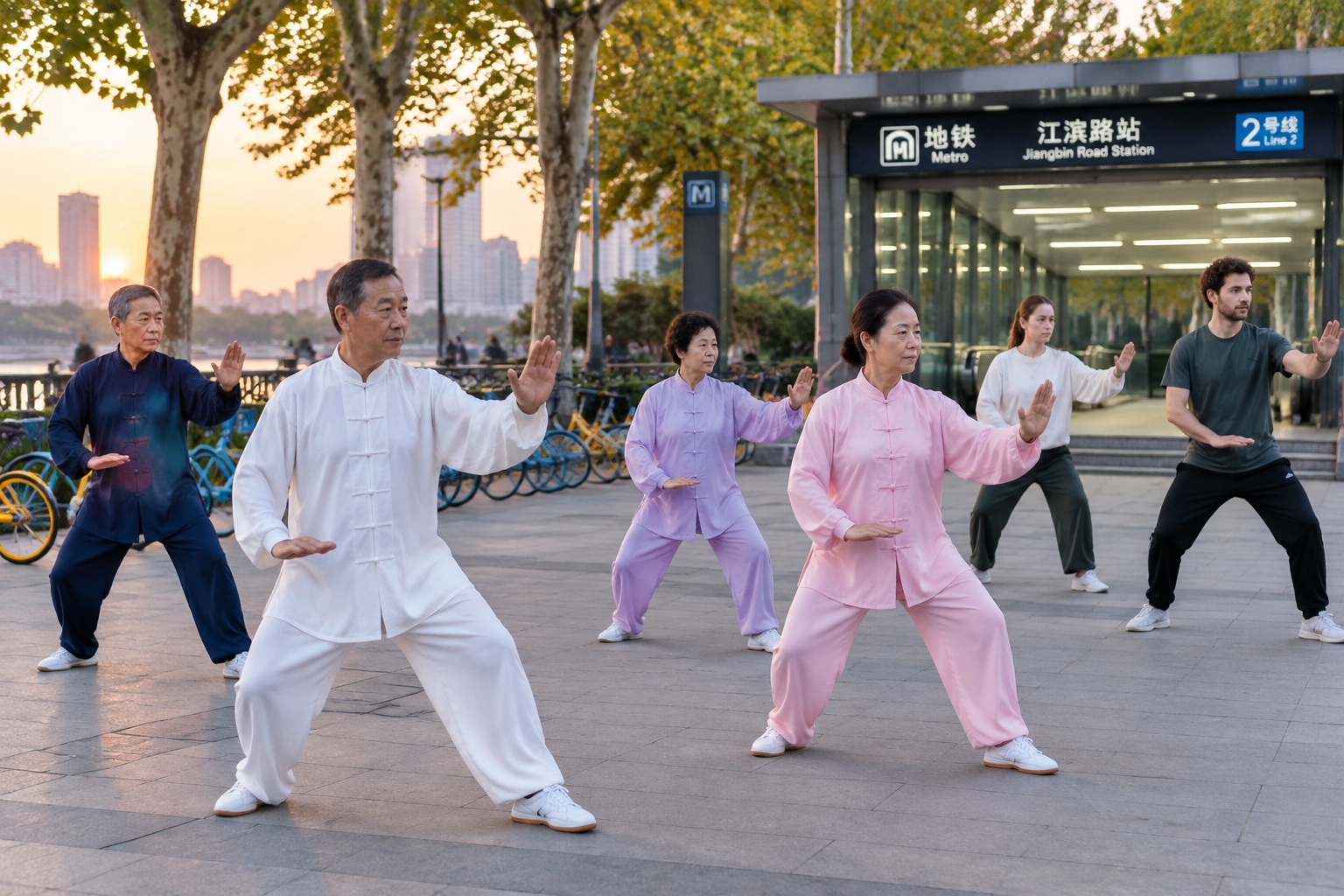
The good classes also take people out of the classroom on purpose: onto a subway, into a pharmacy, into a park where a group of retirees does something at 6:30 a.m. that no guidebook lists.
A week of ordinary city life
For a visitor, the texture of the week is not the lesson. It is everything around it. Shared bicycles lined up outside a metro entrance at 8:40 a.m. A delivery rider threading between them. A hotpot restaurant where the menu is only reachable through a QR code, and the waiter patiently bringing a paper one when the code refuses to load.
Breakfast costs eight yuan and takes ninety seconds. The high-speed train that would be an international journey elsewhere is a 70-minute commute between two cities. In the evening, the same public square holds line dancing, a badminton game and somebody’s grandfather practising calligraphy with water on the pavement.
That ordinariness is the part most visitors say they did not expect. China, in the imagination of many first-timers, is either ancient or futuristic. In practice it is a place where a ceramics student from Barcelona and a retiree from Leeds stand in the same noodle shop at 11 p.m. and pay with their phones.
Where it grinds
None of this is frictionless, and the friction is worth naming. Plenty of small restaurants and museums still require a Chinese mobile number to book through a mini-program. Some booking platforms assume a domestic ID. Signing up for a course sometimes means an email exchange in broken English over four days.
Payment is the classic hurdle: foreign cards now link to Alipay and WeChat Pay, but not every merchant accepts them, and a traveler without a Chinese bank account can hit a wall at an unlucky moment. Language schools advertise “beginner-friendly” classes that turn out to be taught almost entirely in Chinese. Ceramics students sometimes discover that the kiln schedule does not match their flight. And a week is genuinely short: most people leave able to order lunch and shape a pot, not to converse or throw a cylinder.
What they take home
Graham flew back to Leeds with two recipes, a bag of peppercorns and the name of a noodle shop near his hotel. Anna’s four bowls arrived in Barcelona by post six weeks later, one of them cracked. Peris still messages her Mandarin teacher on WeChat, mostly in characters she has to look up.
Nobody describes the trip as a revelation about a civilization. They describe a street, a teacher, a meal, a small humiliation over a QR code, and a reason to come back — usually a specific one, like finishing the glaze, or getting through a whole conversation without switching to English. A visa-free week does not produce experts. It produces people with a return address.
Start the discussion at forum.chinacomes.com