

The 7 A.M. Handoff
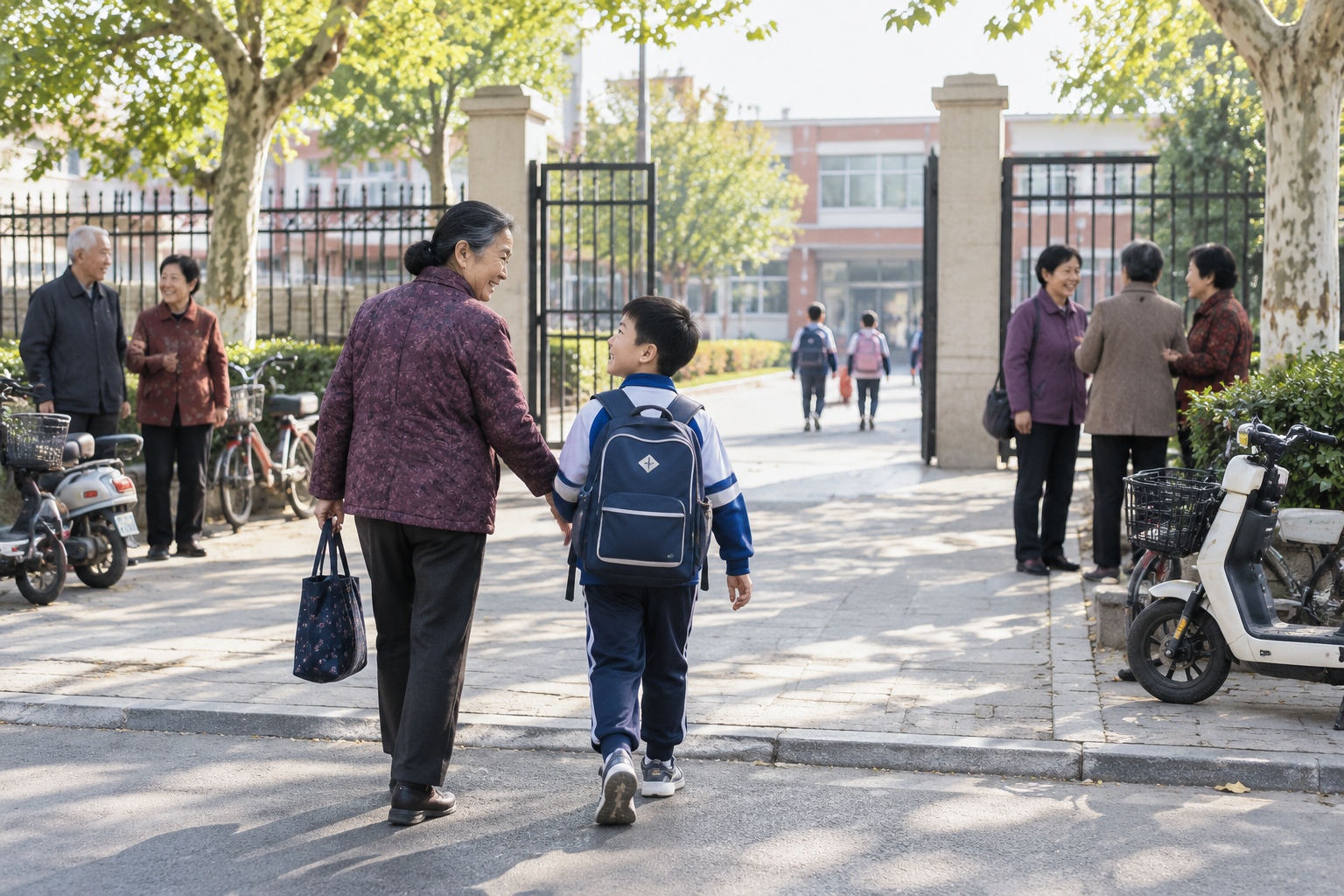
At 7:15 on a Tuesday morning, the sidewalk outside a primary school in Hefei, Anhui province, looks like an open-air retirement club that happens to have children in it. A few hundred adults, almost all of them past 60, stand in loose clusters holding backpacks, water bottles and plastic bags of steamed buns. At 7:40 the bell goes. The kids peel off through the gate. The adults watch for a second, then turn around — home, wet market, or the low wall by the fence, where they sit and rest their knees and compare notes on whose grandchild actually ate breakfast.
Zhou Guiying, 63, is one of them. Her son and daughter-in-law both leave the apartment before seven; her grandson is eight and cannot be left alone. She has made this walk every school morning for four years, except in 2022, when she had her gallbladder out and her sister-in-law filled in for six weeks. Her husband is still in the village 300 kilometers away, looking after his own 88-year-old mother.
The Chinese phrase for what Zhou does is 隔代抚养 — “skip-generation parenting.” It is not a fringe arrangement here. It is one of the load-bearing walls of ordinary family life.
Why it isn’t really a choice
Foreign readers often assume this is cultural preference: Chinese families simply like living together. Warmth and habit are part of it. But the arithmetic matters more.
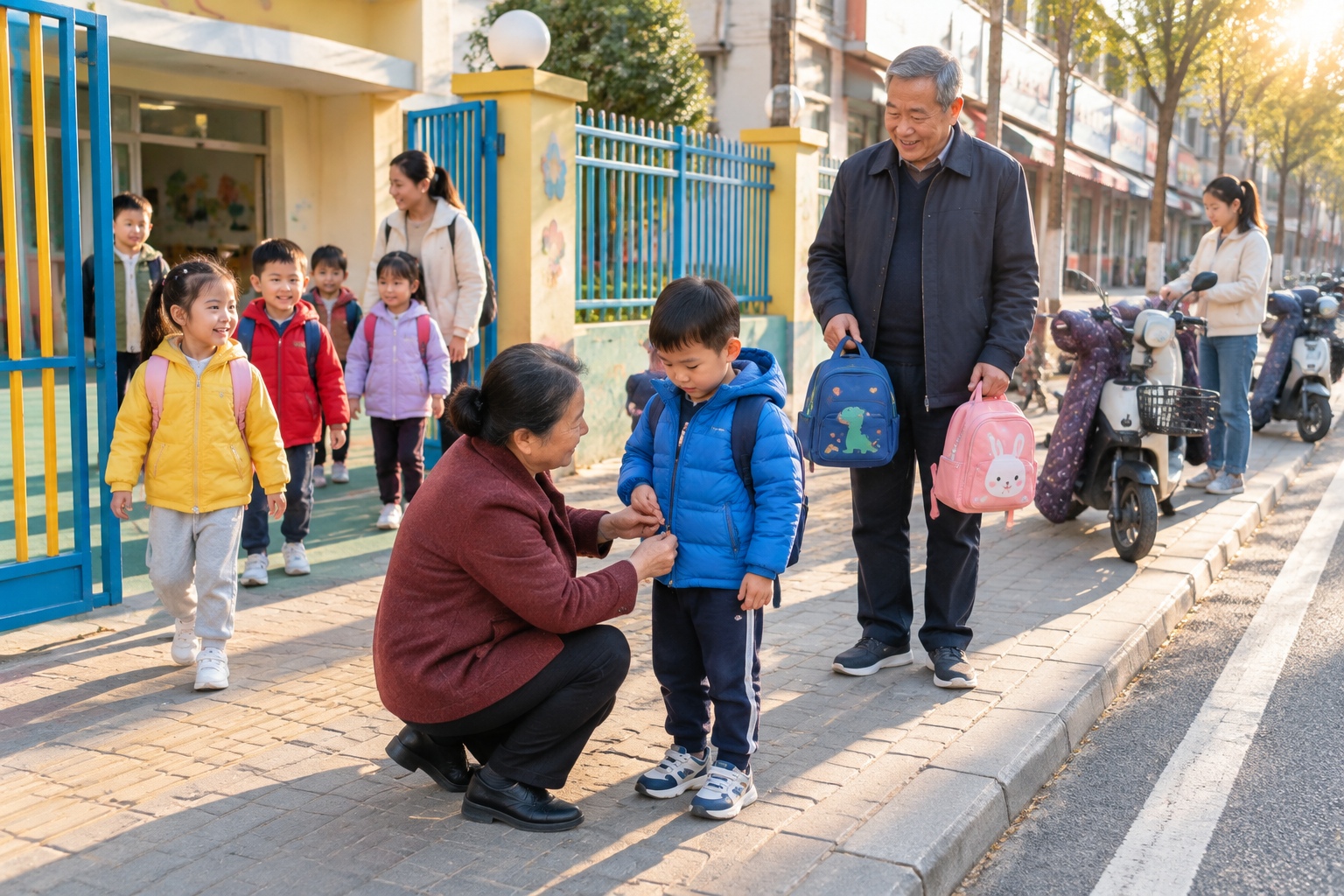
A typical office day in a Chinese city ends around 18:00, and the commute home can add another hour. A primary school lets out between 16:00 and 17:00. A kindergarten can close at 16:30. That gap is not a small inconvenience; it’s three hours that somebody has to cover, five days a week, roughly 190 days a year.
Paid alternatives exist, but they are expensive. A full-time ayi (nanny) in a first-tier city can cost 6,000–9,000 yuan — roughly $850 to $1,250 — a month, often more than a young mother’s take-home pay. Organized care for children under three barely exists: as recently as 2022 China had fewer than 3 nursery slots per 1,000 people, against a government target of 4.5 per 1,000 by 2025. Maternity leave, typically 98 days plus a provincial extension, ends long before a child can walk into a classroom.
Then there’s retirement. Under the rules that applied until recently, many urban women retired at 50 or 55 — decades earlier than in most rich countries. By the standards of the Chinese labor market, a 55-year-old with a grandchild is a free, experienced, trustworthy, full-time caregiver who already loves the child. From a household budget’s point of view, the decision almost makes itself.
A grandmother’s honest ledger
Ask grandparents about it and you rarely get a simple answer.
Chen Xiulan, 61, lives in a mid-sized city in Hunan and keeps a schedule that would exhaust a management consultant. Up at 6:10. Breakfast. Walk the child to school. Groceries. A standing lunch. Pickup at 16:20. Snacks, homework, the endless negotiation over screens. Cook dinner. Bathe the child. Hand over to her daughter at 20:30, then wash up. “Honestly?” she said, laughing, when I asked how it compares with her old job at a textile plant. “The factory had shifts. This has no shifts.”
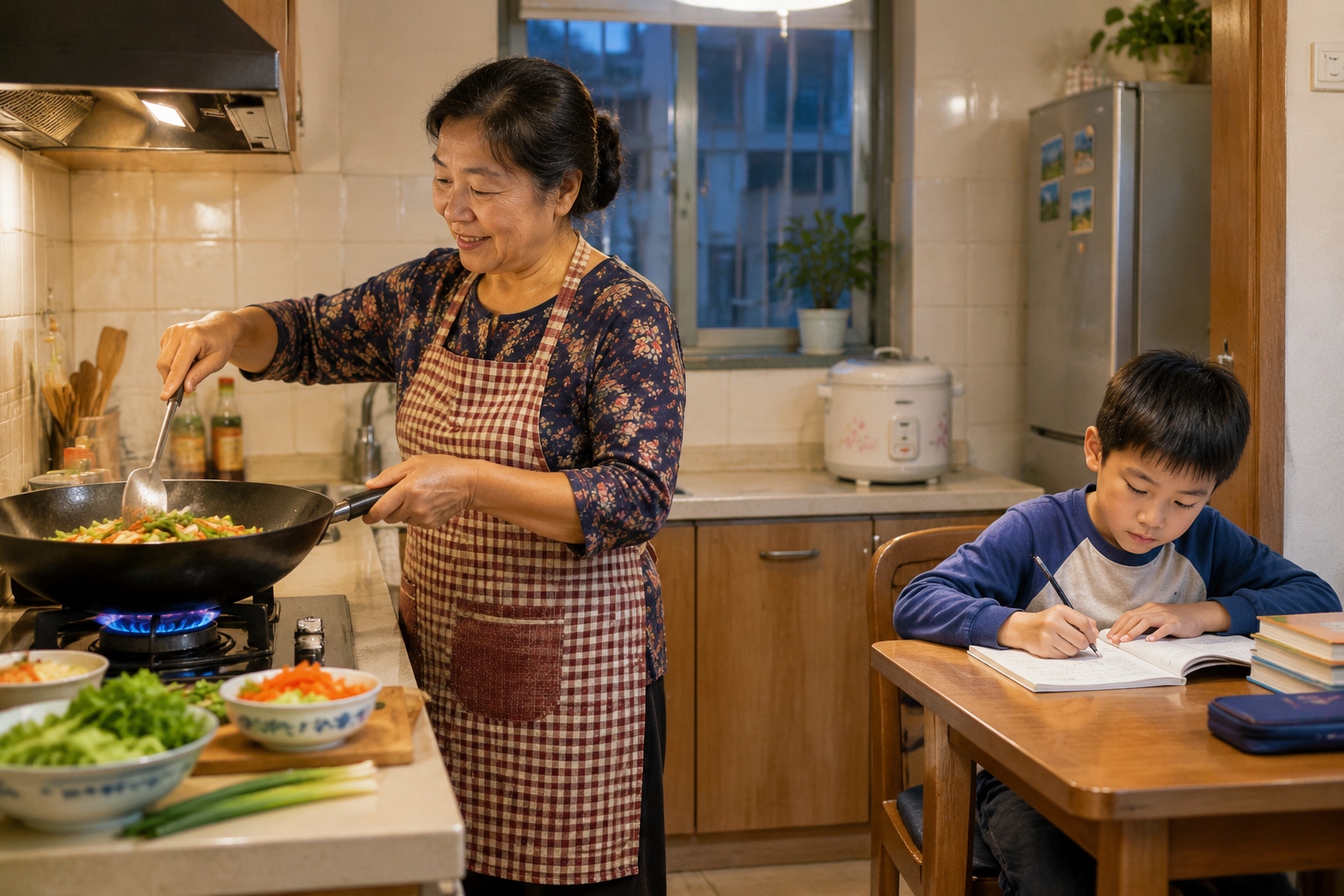
And yet she wouldn’t stop. Her reasons are specific: she loves the child; she is needed; her voice in family decisions carries weight because she is carrying real weight. Grandparents who provide childcare are not volunteers. In the family’s internal accounting, they are important.
The costs are real too. Knees and backs. Sleep. Friendships that quietly fade. In cities there is even a name for those who move across provinces to do this — 老漂族, the “drifting elderly.” They arrive in a city where they know nobody, spend their days in parks and canteens among strangers, and often live in their child’s apartment, where the kitchen rules belong to their daughter-in-law. Most estimates put their number in the millions.
Filial piety, kept and quietly updated
The Chinese idea of 孝 — usually translated as filial piety — is often presented in the West as one-directional obedience: children honor their parents. In most real families it works as a long-term exchange. You help with my children now, when I have no time and no money; I look after you later, when you can’t manage alone. Childcare and eldercare are the same transaction, thirty years apart.
That exchange is strongest where the safety net is thinnest. Urban workers’ pensions are measured in the thousands of yuan a month; the rural basic pension is often a couple of hundred. In a farming village in Henan or Guizhou, a grandparent’s help isn’t a lifestyle choice — it is the family’s only functioning childcare system.
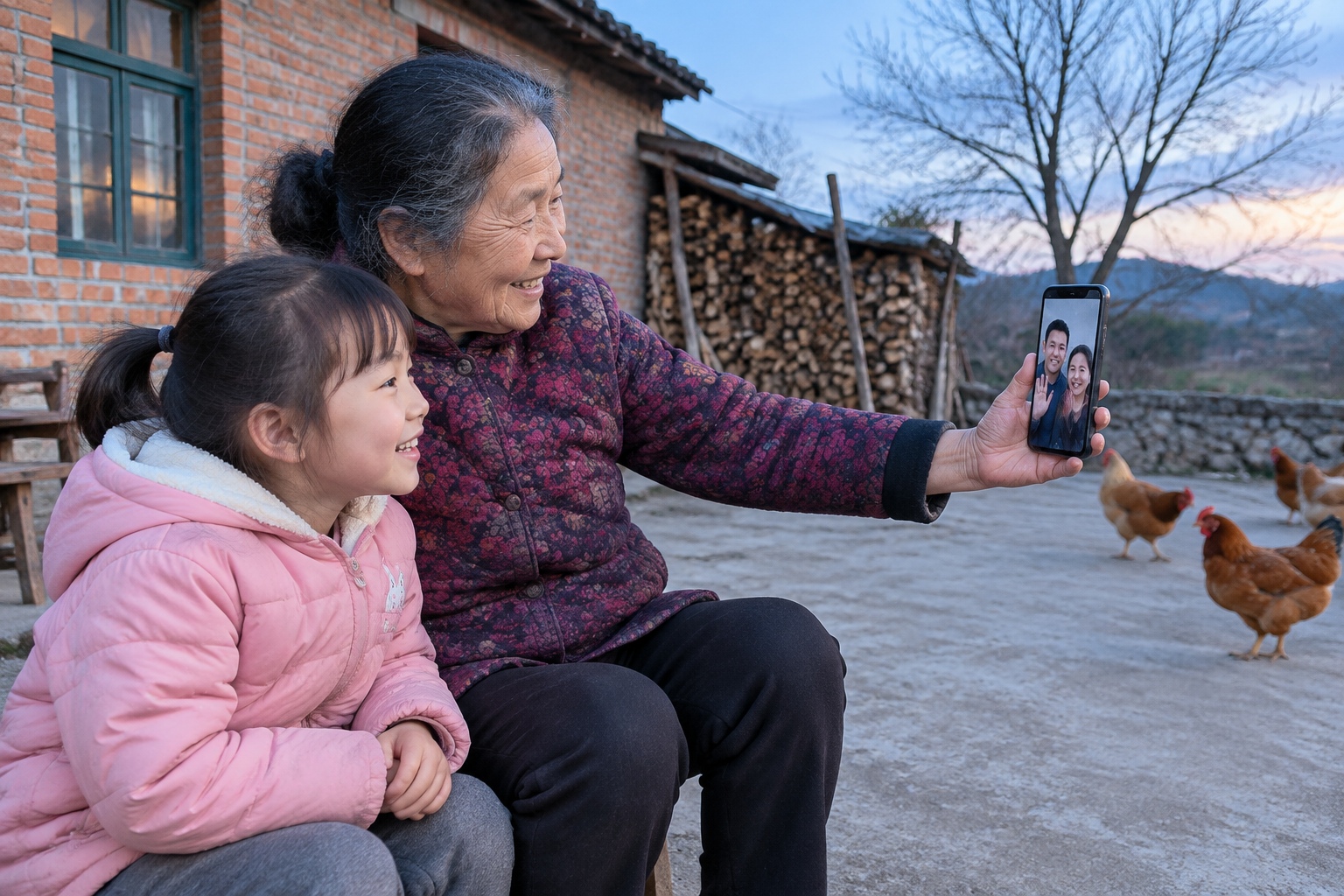
Which brings the other half of the picture: left-behind children. When both parents migrate to factories in Guangdong or Zhejiang, the children usually stay in the village with grandparents. In 2016 the Ministry of Civil Affairs counted about 9 million rural children under 16 living without both parents, using a narrow definition; earlier estimates under a wider definition ran above 60 million. Parents come home for Spring Festival. The rest of the year is an evening phone call, a grandmother checking homework she may not be able to help with, and a boy talking to his mother on video from the courtyard.
This is where the model genuinely strains. Supervision gaps, emotional distance, and grandparents whose own schooling ended in primary school trying to steer a teenager through middle school are real problems — widely reported in Chinese media and taken seriously by teachers and social workers.
What it costs the country, and what is changing
China now has roughly 310 million people over 60 — about 22 percent of the population, and rising. Set that against a birth rate that has fallen for years, and skip-generation care starts to look less like a charming tradition and more like unpaid labor propping up a welfare system. Economists estimate the value of the childcare grandparents provide at hundreds of billions of yuan a year in services that would otherwise have to be bought. None of it shows up in GDP.
Policy is moving, though unevenly. Cities are subsidizing nursery places and paying cash bonuses for second and third children. Community canteens for the elderly — cheap hot meals, partly subsidized — have spread quickly, relieving the daily burden of cooking for a whole household. “15-minute community life circles” are being built to put clinics, daycare and groceries within walking distance.
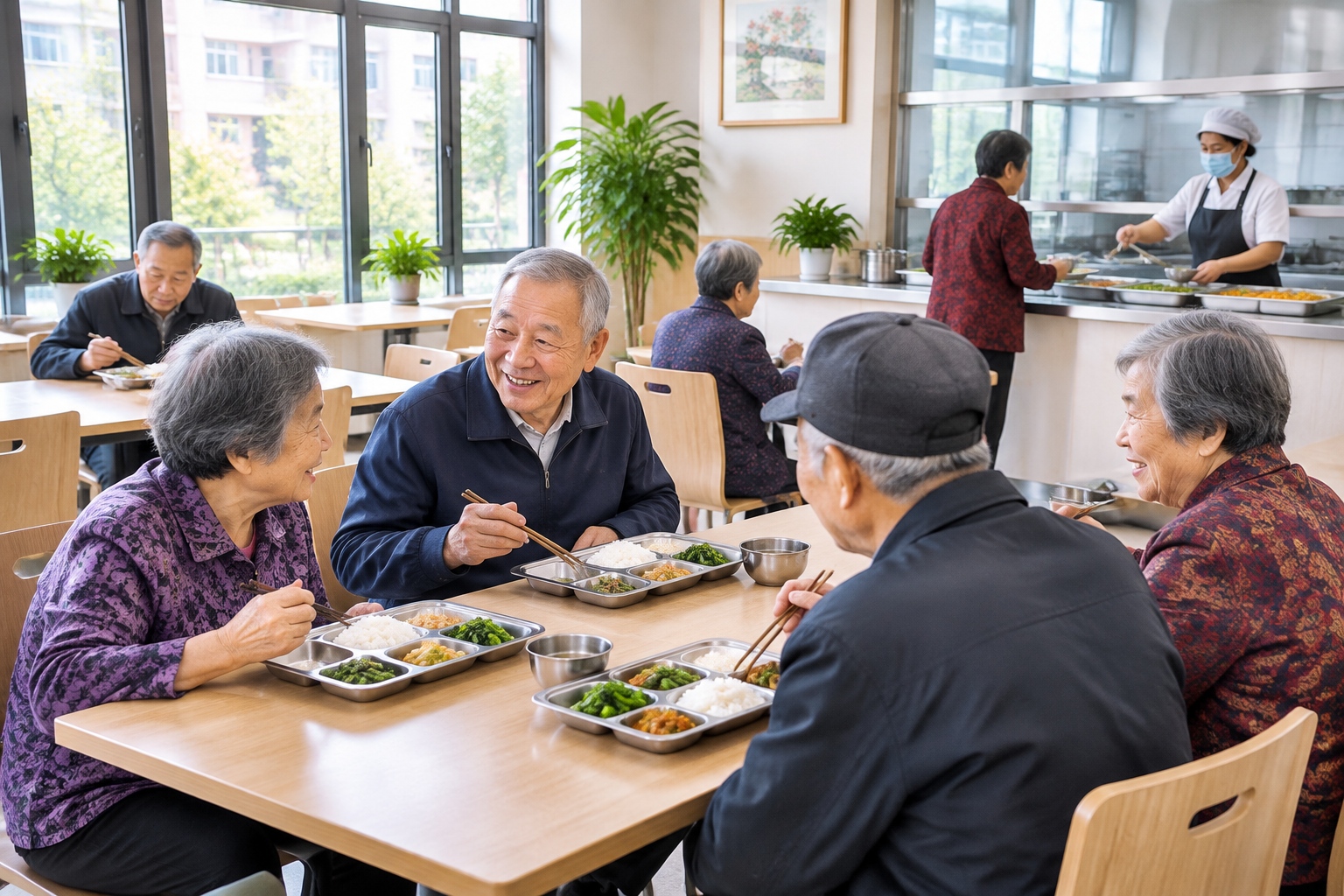
Attitudes are shifting too. Some grandparents from the 1960s generation, who worked through the boom years, are firmer about boundaries: three days a week, not seven. Others would take the child for a year without being asked. A conversation I overheard in a Chengdu park summed up the split. One woman said she had told her son to go find a nursery. Her friend, halfway through a push on the swing, said: “And what else would I do all day?”
The quiet load-bearing wall
So when a visitor asks why grandparents are raising children in China, the honest answer has three layers: a school day that doesn’t match a work day, a care market most young families can’t afford, and a family ethic in which helping is neither pure generosity nor pure obligation, but simply how the whole thing is designed to hold together.
Most evenings, around six, you can see it working. A woman in her sixties walks a small child home along a sidewalk, backpack on her own shoulder, asking whether the math test was hard. Nothing about it looks like national policy. But it is.
Start the discussion at forum.chinacomes.com