
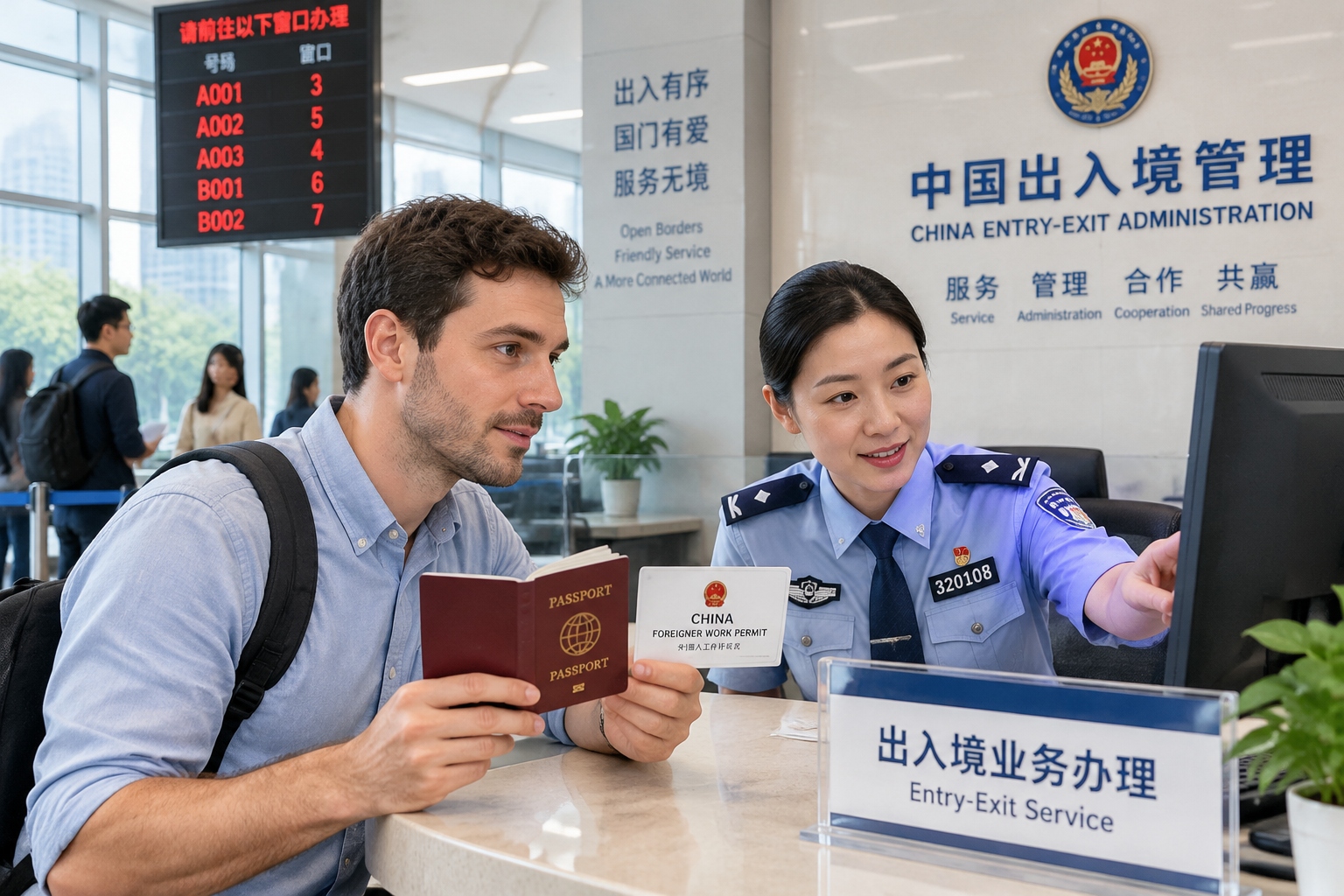

Carlos, an industrial designer from Mexico, had spent two years in Shenzhen working for a consumer-electronics company. When a Shanghai design studio offered him a more senior role, he thought the transition was just about handing over projects and taking a high-speed rail ticket. Then his company’s HR spelled out a rule he had never noticed: his Chinese work visa didn’t belong to him. It belonged to his employer.
That simple fact – a visa tied to an employer – shapes the whole experience of changing jobs in China. It doesn’t matter whether you’ve been working in the country for five months or fifteen years; the system treats every job placement as a fresh application. So before you sign that new contract, here is what you need to understand about the documents in your passport.
Two documents, one employer
For almost all foreign employees in China, your “visa” is actually two documents working together. The first is a Foreigner’s Work Permit – a physical card or approved notification issued by the government after your employer submits details about your degree, salary, job title and the hiring company. The second is a work-type Residence Permit – the sticker in your passport that allows you to live in China and work for the employer named on the sticker. In daily life, the residence permit is the real “visa”: it sets how long you can stay and what you may do.
Both documents are tied to one specific employer. The work permit is created by the employer, renewed by the employer and cancelled by the employer. The residence permit repeats the employer’s name on it. There is no legal mechanism to “transfer” either document to another company – when you leave your job, both must be replaced.
Why you can’t keep your visa when you switch jobs
The Chinese system intentionally ties your legal working status to an employer so that the government can easily check who is hiring foreigners. If a work permit is issued for Company A, the system assumes you work inside Company A’s office, are paid from Company A’s account and are helping Company A meet its hiring quota. To allow you to work for Company B, the immigration authorities need to re-evaluate nearly everything:
Company B’s licence, your salary, the classification of your job, your contract terms, and even your city of residence. The central database allows one active work permit per foreign person. A new employer cannot create a new record until the old employer closes yours.
In practice, when you hand in your resignation, your old employer files a cancellation request in the same online system that first created your permit. As soon as the cancellation is approved, your work permit is no longer valid. The residence permit in your passport becomes invalid too, because it was granted on the basis of that work permit. If you want to stay in China, you must ask the local entry-exit administration for a temporary visa or stay permit while your next work permit is processed. If you want to work during your notice period, don’t – that would be treated as illegal employment.
The 30-day transition window
HR people call it the “30-day window”. After your old work permit is cancelled, many Chinese cities give you roughly 30 days to settle your future legal status. This is not a single national law on the books; it is the common administrative practice that local entry-exit authorities follow when they give a foreigner a temporary stay stamp after a work permit cancellation.
Here is what normally happens. You resign, your old employer submits the cancellation, and you receive a system notice that your work permit is closed. You then visit the local Entry-Exit Administration with your passport, your previous residence permit and proof that a new Chinese company wants to hire you. The officer may convert your residence permit into a temporary stay permit for about 30 days, with a note saying “do not work” until your next permit is granted. If you live in a smaller city or your new job classification is very different, the officer might instead tell you to leave China and re-enter on a fresh Z visa.
No matter which route you get, the 30 days are not a holiday. If you exceed the period without obtaining a new work permit, you cross the line from legal to illegal. A new work-permit application can easily take two to three weeks just for the government decision, not including the days your new HR needs to gather documents. That is why so many experienced foreign staff ask their new employer to file the application before the old permit is cancelled.
A real-world timeline: Shenzhen to Shanghai
Carlos was lucky. His new company had an experienced HR team, and he kept all his original certificates in a folder at home. Here is how his transition actually progressed.

- Day 1: He gave his Shenzhen employer the required one-month notice. On the same day, he sent scanned copies of his passport, university degree and employment contract to the Shanghai HR team.
- Day 5: The Shenzhen HR submitted the online cancellation form for his work permit. It was approved the next day, and Carlos received a confirmation email.
- Day 7: Carlos visited the Shenzhen Entry-Exit Administration. Because he already had a written offer from Shanghai, the officer gave him a 30-day temporary stay permit and told him not to start working at the new job until the permit arrived.
- Day 10: Shanghai HR filed a new Foreigner’s Work Permit application. They uploaded Carlos’s new employment contract, his notarised degree, a health-check report and his Shanghai rental agreement.
- Day 22: The Shanghai authority approved the work permit. Carlos received an electronic notice.
- Day 27: He travelled to Shanghai, presented the notice at the Entry-Exit Administration and applied for a new work-type residence permit. Two working days later, his passport carried a fresh residence permit good for one year.
In total, the switch took about a month, and it would have been stressful if the HR teams had been slower. Most foreign professionals I know have taken at least one “visa run” – flying to Hong Kong, Bangkok or Tokyo – when their old permit was cancelled faster than the new one was approved.
Ways your transition can go sideways
Not every job change follows Carlos’s smooth timeline. Three common problems are easy to underestimate.
First, the new company’s HR may not have experience with foreign employees. Some firms recruit a foreign professional once a decade and have no idea how to use the national work-permit system. Ask exactly who will handle your paperwork and whether that person has submitted a permit application in the past year. If the answer sounds vague, plan for delays.
Second, your new job category might not match your old one. China divides foreign workers into three classes: A for high-end talent, B for skilled professionals, and C for limited quotas of other workers. Moving from a teacher to an engineer, for example, can change your class and trigger a more complicated review. Even if the class number is the same, the evaluation criteria may be different. This extra review consumes days from your 30-day window.
Third, the old employer might deliberately drag its feet. A work permit cancellation is quick once it is submitted, but some companies wait until a departing employee signs a non-compete agreement or pays back training costs. Your new employer cannot start until the old record is closed. If you suspect this is happening, tell your new HR immediately and ask whether they can file a query with the local foreign-worker bureau.
What happens if you get it wrong
When the 30-day window closes and you have no new work permit, you become an “overstayer.” China’s exit-entry law fines overstayers at 500 RMB per day, usually capped at 10,000 RMB (about 1,400 USD) for simple cases. If the police discover that you continued to work without a valid permit, you also face a fine for “illegal employment” – often 10,000 RMB or more – and in serious cases detention and deportation with a one- to five-year re-entry ban.
This is not a paperwork scare story. A friend of mine once missed the window by three days because his new HR went on sick leave and forgot to submit the application. He flew to Bangkok, waited for the new work permit, came back on a Z visa and lost only his paid leave for two weeks. It was inconvenient, but it kept his record clean. People who try to ignore the rules pay much more.
Three survival tips for changing jobs
After watching friends change employers in Shenzhen, Beijing, Shanghai and Chengdu, I have reduced the entire experience to three pieces of advice.

1. Talk to both HR teams early and in writing. The moment you accept the offer, send a clear email to both the old HR and the new HR. State your intended last working day, the day you would like the old work permit to be cancelled, and the day you want the new application to be submitted. Make it easy for the new HR by sending clean scans of your passport, degree, criminal record certificate and employment history. If the new employer is experienced, they will know to start the application while you are still serving your notice period.
2. Begin notarisation before you sign the new contract. Chinese authorities usually require your university degree and sometimes your police clearance to be notarised and authenticated by the Chinese embassy in the country where they were issued. This can take two to four weeks – or longer when embassies have appointment backlogs. If you wait until the new HR asks for them, your 30-day window will almost certainly run out.
3. Prepare a “leave China” plan B. If the 30 days are ticking and the new permit is not ready, voluntarily leave China before becoming an overstayer. Fly to Hong Kong, Bangkok or Tokyo, wait for the new Foreigner’s Work Permit Notice, and re-enter on a fresh Z visa. This resets the clock and removes the risk of a fine or an entry ban. It feels dramatic, but it is legal, cheaper than paying an immigration lawyer, and far safer than overstaying.
Z-visa newcomers: four things to finish in your first 30 days
If you are reading this because you are about to start your first job in China on a Z visa, complete these four tasks within 30 days of arriving:
- Get your Foreigner’s Work Permit. Your employer applies for it electronically; you will normally receive the card or an electronic confirmation within two weeks. Do not wait for HR to remind you to collect it.
- Convert your Z visa into a work-type residence permit. The Z visa is just a single-entry ticket; it does not allow you to live in China for years. Go to the local Entry-Exit Administration with your passport, work permit notice, a recent photo and your accommodation registration form. You will leave with a residence permit that can be valid for one to five years based on your contract.
- Register your address with the local police. If you live in a hotel, the hotel front desk does this. If you rent an apartment, go to the nearest police station within 24 hours of moving in, with your lease and passport. This requirement is put into law and schools or employers often ask for proof of it.
- Complete the health check before your residence permit appointment. Many cities refuse to issue a work-type residence permit without a health certificate from a designated Chinese hospital. Bring a passport photo, your passport and around 500 RMB. Do this early, because some hospitals only do the tests on certain mornings.
Once the final stamp is in your passport, you can breathe. But remember: that stamp is now your career’s anchor. Every job offer you take after this will require going through the same process one more time.
Start the discussion at forum.chinacomes.com