

6:40 a.m. in Pingtian
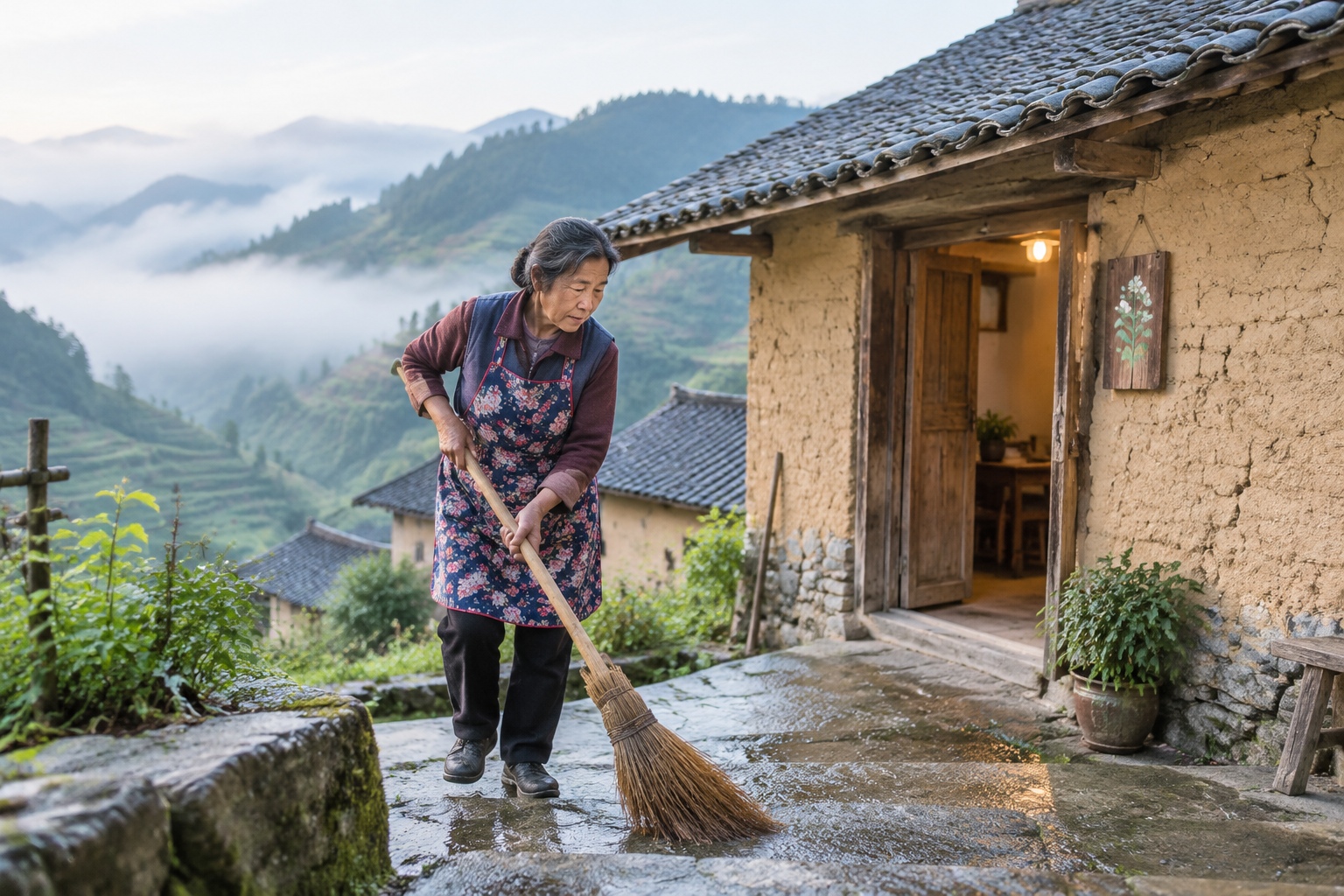
At 6:40 on a November morning, the fog in Pingtian is thick enough that the houses on the far side of the valley look like they are dissolving. Wood smoke drifts sideways. Somewhere below, a broom scrapes wet flagstones, and a pressure cooker hisses behind a half-open door.
Ye Lianxiang, 63, is sweeping the step in front of a house her grandfather built. The step is about 120 years old. The roof above it is two years old: new grey tiles, new beams, and a small skylight that lets in just enough light to show the grain of the old timber. Half the house is now a guest room that rents for 680 yuan (about $95) on a Saturday night. She sleeps in the other half, next to the kitchen.
“Before, the rain came in. I put basins on the floor,” she says, pointing at a corner. “Now people pay to sleep here. I don’t really understand it. But I’m not complaining.”
Pingtian sits at roughly 600 meters in Songyang County, in the mountains of southwestern Zhejiang. It is not a theme park and nobody here calls it one. It is what rural revitalization looks like when architects, county officials and villagers spend ten years arguing about roofs, drains and who gets to park where.
The emptying
Twenty years ago the story here was the same as in tens of thousands of Chinese villages. Young people left for factories in Wenzhou or offices in Hangzhou. The village primary school closed, and children now take a van to the township. By 2012, fewer than a hundred people lived in Pingtian year-round, most of them over sixty. Roughly a third of the houses had nobody in them.
Once a roof leaks in a rammed-earth house, the walls follow. That is how a village dies: not in one dramatic moment, but one winter at a time.
This was national, not local. Between 2000 and 2010, China lost roughly 900,000 natural villages — about a quarter of the total — according to a survey by the Ministry of Housing and Urban-Rural Development that is still widely cited. In 2017, “rural revitalization” became a national strategy. The hard question was what to actually do with a place that has a hundred old people, a few dozen empty houses and no industry.
What “design” actually meant
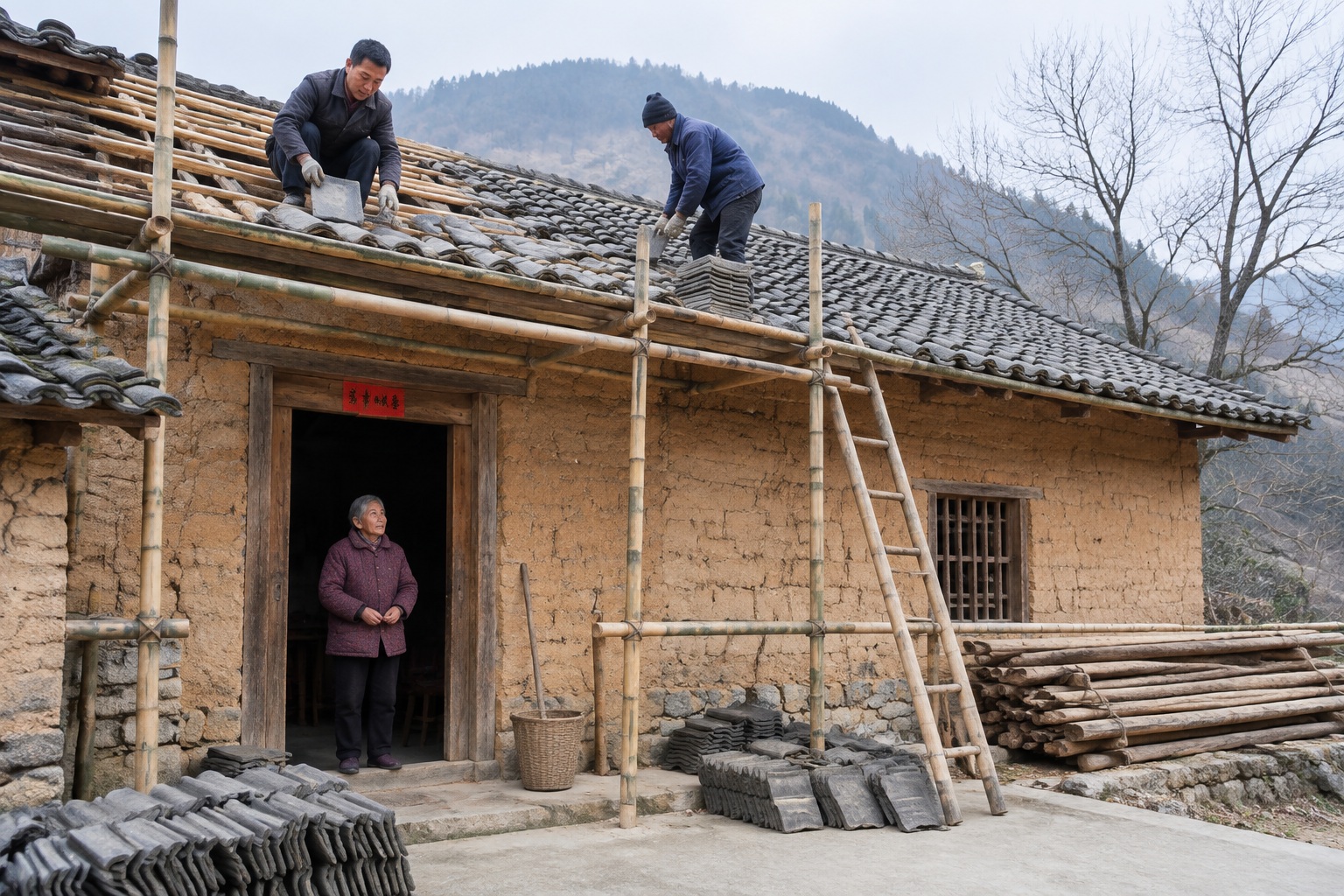
Songyang’s answer started with a roof, not a masterplan.
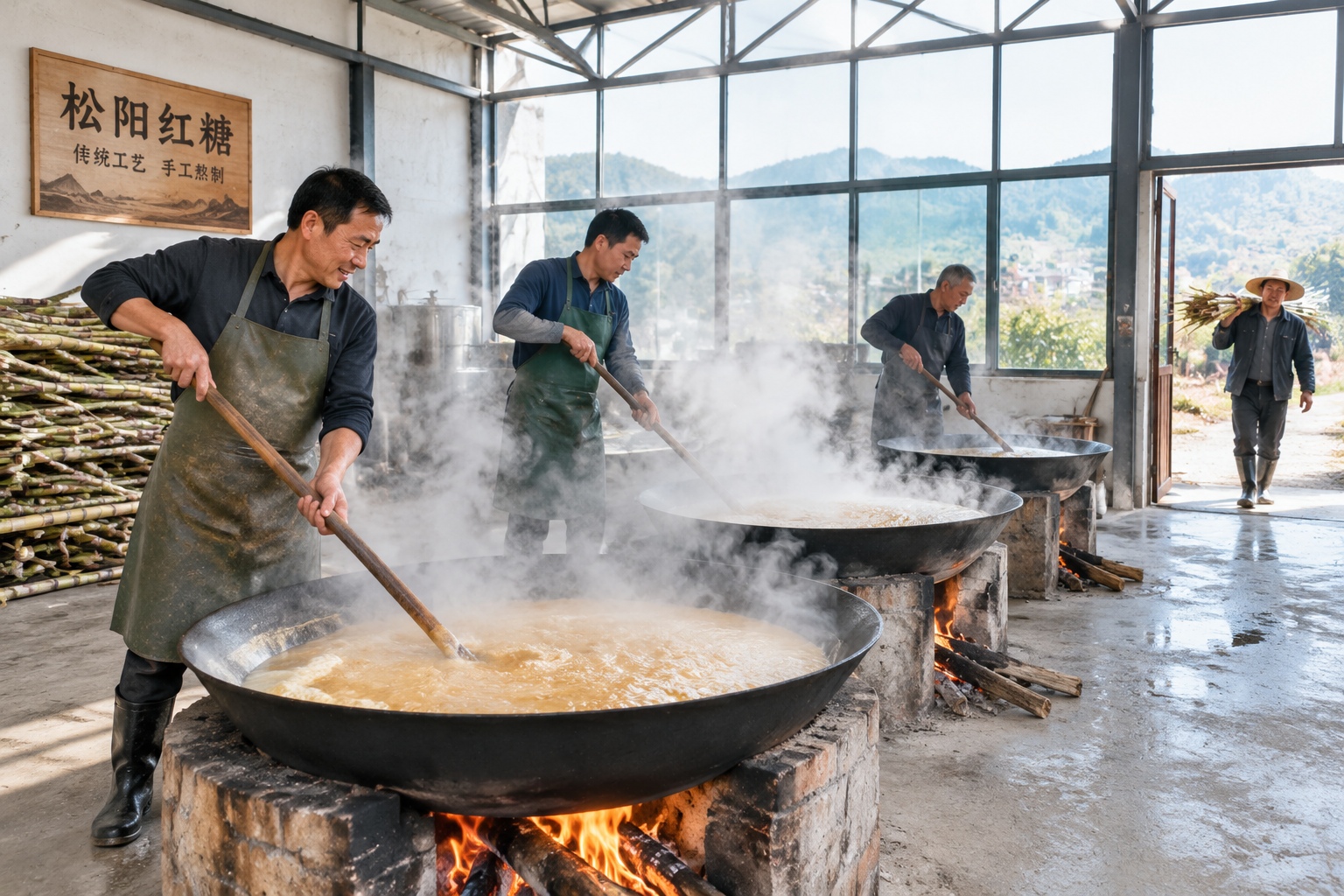
In 2014 the county invited architect Xu Tiantian and her studio DnA to work in its villages. Over the following years they built around twenty small structures: a brown-sugar workshop, a tofu workshop, a memorial hall, a covered bridge, a bamboo pavilion in a tea field. None of them are large. All of them are in use.
The brown-sugar workshop in Xingcun is the clearest example. It is a working factory, not a museum. Every winter, farmers bring sugarcane and men boil it down in wide iron woks over wood fires, filling the room with steam and a smell like burnt caramel. The new building wraps a steel frame and glass around the old hearth, so the boiling is visible from the road. Tourists stop and take photos. The farmers keep working.
Meanwhile a separate program called “Rescuing Old Houses” began in 2016, run by the county with the China Cultural Heritage Foundation. Owners of listed old houses can apply for a subsidy covering roughly half the cost of a proper repair, on one condition: the work must use traditional materials and methods. Lime, not cement. Clay tiles, not steel sheeting. More than a hundred houses have been repaired this way.
Cooperatives, leases and who gets the money
This is the part that decides whether a pretty village is also a good village: who owns the upside?
The mechanism in most Songyang villages is a lease. A villager signs a long-term contract — typically 15 to 20 years — with the village collective, for a few thousand yuan a year. The collective then renovates the building or subleases it to an operator: a guesthouse company, a bookstore, a coffee brand.
That rent sounds insultingly low, and in some ways it is. An old wood-frame house with a leaking roof might have sold for 30,000 yuan in 2010, if anyone had wanted to buy it. A few thousand a year is more than the owner was getting from an empty building, and the collective carries the repair costs. For a 70-year-old whose son drives for a delivery company in Hangzhou, that is often enough.
The bigger money is in wages and in what villagers sell. At one guesthouse I stopped at, eight of the eleven staff had grown up within three kilometers. Cleaning, cooking, gardening, front desk. Young women who would once have left after middle school now have a reason to stay — or at least a reason to come back after two years in a city.
The cliff edge is this: once those leases are signed, the village’s next twenty years belong to whoever holds them.
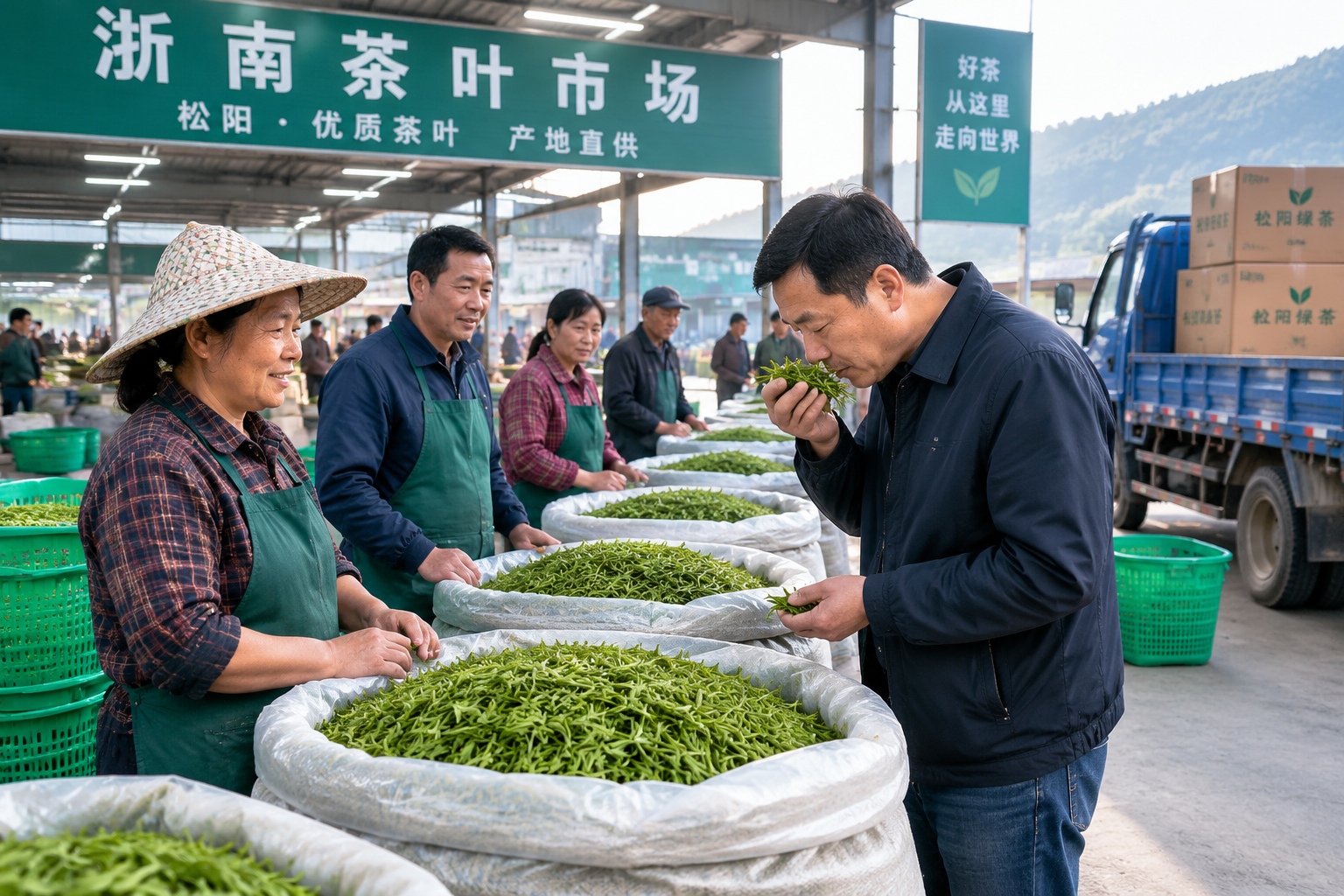
Songyang also has something most “designed villages” lack — an actual economy. The county has roughly 130,000 mu (about 8,700 hectares) of tea, and the Southern Zhejiang Tea Market in the county seat is one of the largest green tea trading floors in the country. In spring, the price of fresh leaves can change three times before lunch. A household with five mu of tea can clear 40,000 to 60,000 yuan in a good season. Tourism is the icing. Tea is the cake.
What changed, and what didn’t
Walk around on a Tuesday and the limits are obvious. The bookstore in Chenjiapu — a village perched at about 800 meters and reached by a single winding road — does most of its business on weekends. On a wet Wednesday in March it may have four customers, two of whom are staff. Two cafés opened in one hamlet; one shut within a year.
Nationally, income is still the point. In 2023, rural residents’ per-capita disposable income was about 21,700 yuan, against 51,800 yuan for urban residents — a ratio of roughly 2.4 to 1. A village can be beautiful and still be poor.
The tension residents actually talk about is aesthetic. Villagers with money want to rebuild in concrete, with aluminum windows and a tiled facade: cheap, dry, easy to clean. The county wants rammed-earth walls and grey tiles, because that is what visitors come for. Both sides have a point, and the county usually wins, because it controls the subsidy and the building permit.
“If I want to fix my house, they tell me what color,” a man in his fifties told me, half joking. He was repainting a wooden window frame anyway.
There are quieter problems too. Weekend traffic jams on one-lane mountain roads. Waste water that a small village treatment plant struggles to handle in peak season. And a nagging worry among officials themselves: how much of this depends on government money that will not flow forever.

The honest measure
The people who return are still few. A county of about 200,000 residents may count a few hundred returnees in a year — enough to fill a WeChat group, not enough to fill a school. Children still ride a van to the township. Elderly residents are still the majority in most hamlets, and coffee shops will not close that demographic gap.
What has changed is subtler. A village that had been written off now has a reason to be maintained. Roofs get fixed because there is income to fix them. A woman of 63 can stay in her grandfather’s house and earn money from it. Her son, who drives in Hangzhou, calls more often than he used to. He has started asking whether the empty room at the back could be rented out too.
What other villages can copy
Not the buildings. Songyang worked because of a stack of ordinary things: a paved road, a functioning tea trade, a county government willing to spend a decade on one strategy, and lease rules that let villagers keep a share. Design was the multiplier, not the base. A beautiful building in a village with no income, no road and no school becomes a beautiful empty building — and China has plenty of those.
By seven in the evening, Pingtian is dark and quiet again. One light is on in the guesthouse kitchen. A dog barks at nothing up the hill, and the fog comes back the way it came.
Start the discussion at forum.chinacomes.com