


Marco, an Italian architect, landed at Shanghai’s Pudong airport on a Z visa last November. He took a photo of the passport page, sent it to his family, and walked outside into the cold air. A notification from his company’s HR landed: “Your 30-day window starts now.” He didn’t know what that meant.
It’s one of the most common misunderstandings for foreigners arriving in China for work. A Z visa is your key to enter the country, but it does not automatically give you the right to live or work there. Think of it as a boarding pass that expires after 30 days. Within that window, you must convert it into a residence permit — otherwise, your stay can become illegal, even if your intentions are perfectly honest.
Many call this the “30-day newbie quest.” The good news: it’s a well-trodden path, and if you follow a checklist, the administration is largely tedious rather than difficult. Here’s how to finish your side quest on time.
Check your passport stamp first
Within an hour of landing, look at the entry stamp in your passport. It usually says “Duration of stay: 30 days” (or 60 days, depending on the visa type and port). This is your deadline. It doesn’t mean the visa is valid for 30 days from the date of issue — it means 30 days from the day of entry. Mark that date on your calendar.
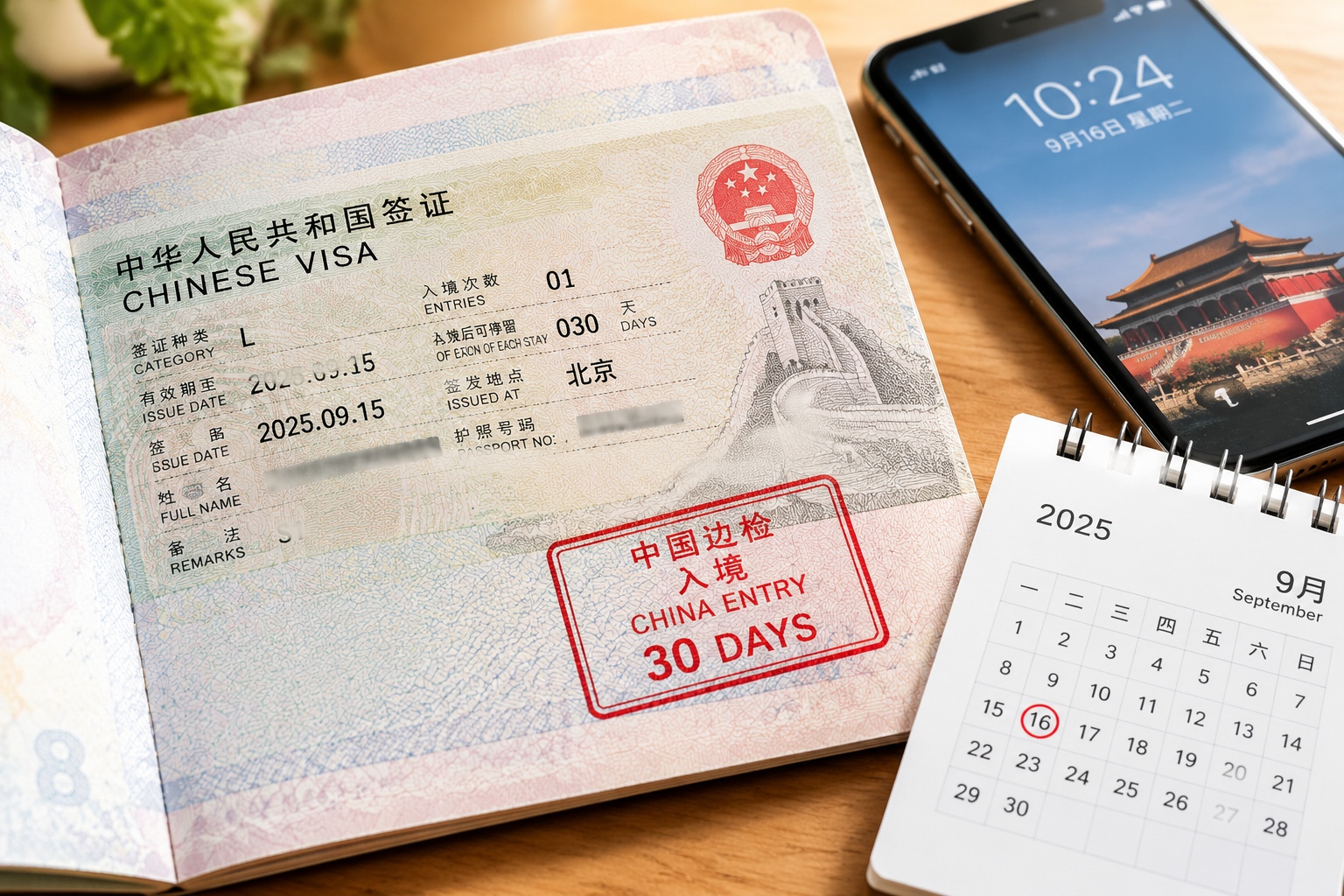
The four tasks on your to-do list
You have four main administrative duties:
- Register your accommodation with the local police.
- Undergo a medical exam at an approved hospital.
- Have your employer apply for the Foreigner’s Work Permit.
- Apply for a Residence Permit at the Exit-Entry Administration Bureau.
These are not fully sequential tasks. Some can overlap. But there is a logical chain: the medical report feeds into the work permit application, and the work permit is required before you can apply for the residence permit. Accommodation registration can be done in parallel.
Task 1: Accommodation registration (0–24 hours)
In China, both host and guest have a responsibility for registration. If you are staying in a licensed hotel, the front desk will usually automatically report your info. Do not worry about this step. If you are renting an apartment or living with friends, you must go to the local police station (派出所) or sometimes the community service center within 24 hours after arrival (or within 24 hours after moving to a new address).
Bring your passport, rental contract, the property owner’s ID and proof of property ownership, and a landlord willing to help. If the landlord cannot accompany you, they can often confirm by phone in front of police. The process takes 15 minutes. You’ll receive a white slip of paper called the “Registration of Temporary Accommodation for Foreign Nationals,” which will be needed in Task 4. Keep it safe.

Task 2: Medical exam (days 1–3)
China makes sure you are healthy before issuing you a work permit and, later, a residence permit. You must be examined at a designated medical institution — not just any hospital. Your employer or an immigration agency can give you a list. Examples include the International Travel Health Care Center in major cities such as Beijing, Shanghai, and Guangzhou, or one of a few approved public hospitals.
Usually, you need to bring your passport, two or three photos, and sometimes the “Foreigner Physical Examination Record” form downloaded from your local authority’s website. The exam includes chest X-ray, blood test, ECG, and general check. It costs about 300–600 RMB (or more for private clinics), payable in cash or via Chinese digital payment apps. Many places process in one morning, but the final medical report takes two to five working days. Download the hospital hotline: some hospitals allow you to pull the electronic version online; others require a physical pick-up.
Task 3: Work Permit (days 1–10)
Your employer must log into the online “Foreigner Work Management Service System,” submit an application for a “Foreigner’s Work Permit,” and upload several scanned documents: your passport, job offer, work contract, degree certificate, and the medical report from Task 2.
This permit acts as your official permission to be employed. If you are new to the country, it is issued as a physical card, sometimes after you enter. Your employer will tell you when the application is approved — usually within 1 week after submission, depending on the category (A, B, or C). You’ll receive a notification to collect the card from the local government service center.
Note: in some cities, the work permit application can be filed before you even arrive. But if you are already in China and your medical exam is still pending, the HR team cannot complete the case. That is why medical exam is placed before the work permit on your to-do list.
Task 4: Residence Permit (days 10–20)
This is the big one. The residence permit is a laminated card resembling a passport page, inserted into your passport (or as separate card in some cases). It replaces the Z visa and lets you leave and re-enter China multiple times while you work. You must apply at the local Exit-Entry Administration Bureau of the Public Security Bureau, found in every major city.
Your documents should include:
- A filled-in application form for a work-type residence permit (often available at the venue).
- Your passport with the Z visa and a copy of the visa page.
- Your accommodation registration certificate (Task 1).
- Your Foreigner’s Work Permit card (Task 3).
- Two or three passport-size photos that meet Chinese standards.
- Employer’s official letter explaining your position and contract duration.
Bureaus normally process the application in 7 to 15 days. You will receive a receipt as proof that your application is pending. That piece of paper keeps you legal after your 30-day period expires while they review the case. Some cities (like Wuhan and Hangzhou) can issue the residence permit in as little as 3 working days if you are a high-priority “Class A” talent. Ask your HR for the exact mode of delivery.
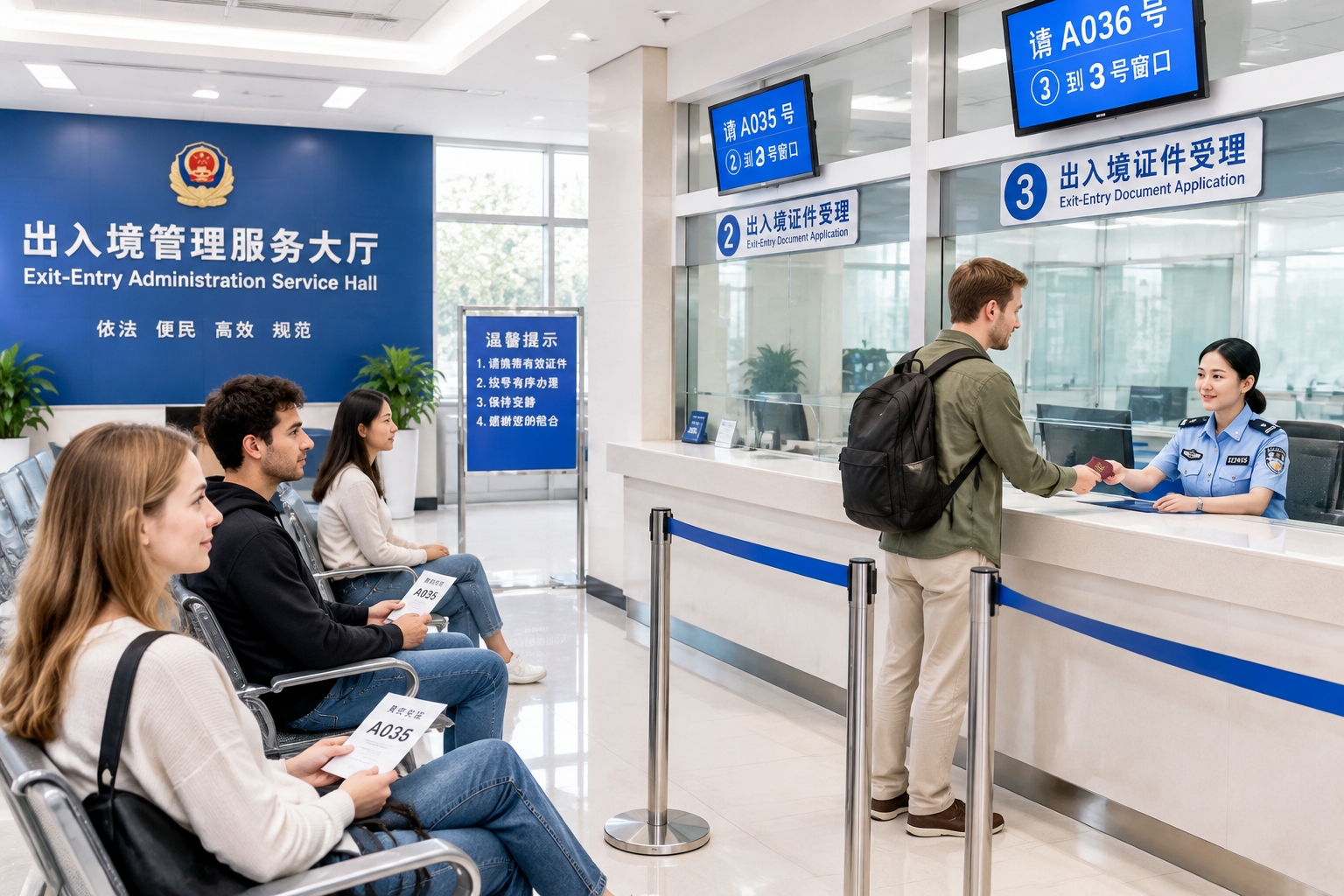
Why the order matters
Your plan cannot simply be inverted. Let’s return to Marco. He landed on November 2. On November 3 he went to the police station with his landlord in Puxi. On November 4, he went to the medical center, but the X-ray machine was booked for group physicals, delaying his blood test to the next day. His report printed on November 8 — three working days later. He had to coordinate with HR to submit the work permit application on November 9. The work permit card was ready by November 17. He rushed to the emigration office on November 20, exactly 18 days after his Z visa entry. It was enough time, but only because he did not wait for the result of one step before starting the next.
Your week-by-week 30-day plan
Week 1 (Days 1–3): Get your legal status into gear.
- Day 0: On arrival, check the entry stamp duration.
- Day 1: Register at the police station or hotel.
- Day 2 or 3: Morning medical exam at an approved hospital.
- Day 4: Ask HR to prepare all other work permit documents so only the medical report is missing.
Week 2 (Days 4–10): Tie up loose ends
- Day 5: Call the medical center if you haven’t received an electronic report.
- Day 6: Forward the medical report to HR as soon as it arrives.
- Day 8: Collect the original medical report and photocopies.
- Day 9: Chase HR for the work permit status.
Week 3 (Days 11–20): Race toward the residence permit
- Day 12: Collect the work permit card or confirm HR received it.
- Day 15: Prepare all residence permit documents and make copies.
- Day 17–19: Go to the Exit-Entry Bureau to submit the application. Even if it’s a little early, do it now — don’t wait until the very last day.
- Day 20: Keep your application receipt; it protects your legal status while you wait.
Week 4 (Days 21–30): The waiting game
- Day 22–27: Track your permit status via text message or website.
- Day 28–29: Pick up your new residence permit and check all dates.
- Day 30: Celebrate by opening a bank account or getting a phone card — both become much easier now that you have a long-term permit.
What to do if 30 days are not enough
Common delays include: medical results pushed to the next week, degree authentication arriving late, or HR not noticing a missing stamp. If you find yourself in Week 3 without a work permit, do not simply wait until the 30th day. The safest path is to have your company contact the local Exit-Entry Administration and explain. In some cases, they will give you a short-term stay permit for processing reasons. If you have already filed the residence permit application, the receipt covers you.
Don’t try to leave the country and re-enter quickly unless your Z visa is multi-entry. A better backup plan is to leave before the 30-day deadline, solve the paperwork gap, and then have your employer issue a new visa invitation. That way, your immigration record stays clean.
Three practical notes for newcomers
- No, “work permit” is not “visa.” The Z visa is the entry ticket; the work permit proves your job; the residence permit is your legal status to stay and travel on multiple entries. You need all three at various stages.
- Plenty of paperwork can be done digitally. QR codes, building management apps, or local service hotlines can confirm queues. Use the 12367 immigration services hotline, which has English-speaking support in many provinces.
- Your deadline is per entry, not per visa. Each time you re-enter China with a residence permit, look at the new entry stamp to confirm the permitted stay is still aligned with your permit.
The bottom line
Navigating China’s entry and residence requirement is like installing a new software: there is a small learning curve and several steps that feel repetitive. By breaking the process into four actions and putting deadlines on your calendar for the first 30 days, you can convert this administrative hurdle into an opportunity to learn how the system actually works. Marco now laughs about his first week, and says the lesson is simple: “Don’t plan meetings for the first month — plan paperwork instead.”
Start the discussion at forum.chinacomes.com