

A result that looks like a corrupted file
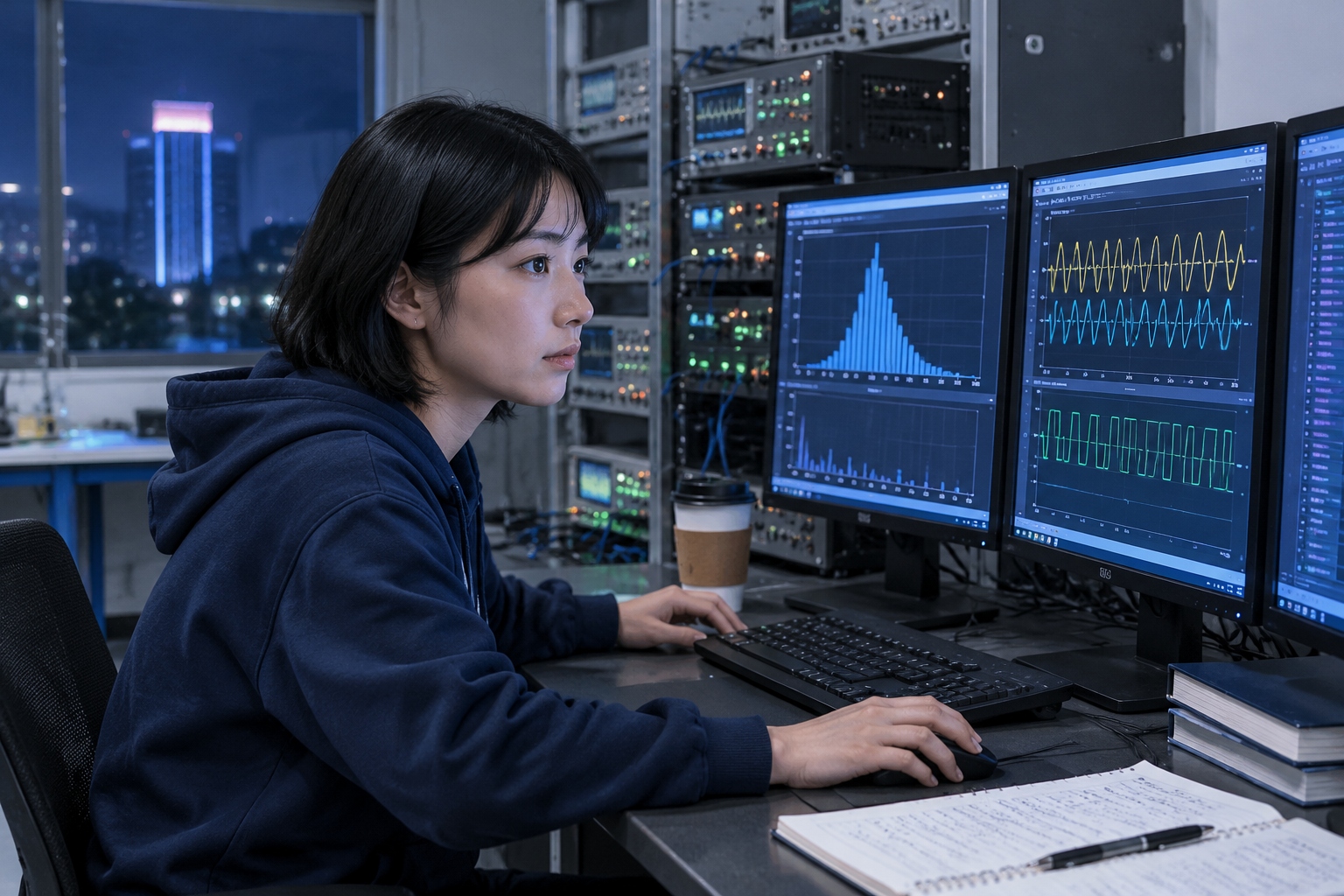
On a monitor in a basement laboratory in Hefei, in eastern China, the output of the country’s newest quantum processor scrolls past as a column of zeros and ones: 0001011100, 1100100011, 1011100010. To a casual eye it looks like a corrupted file. It is actually the measurement record of 105 superconducting circuits, each cooled to roughly 10 millikelvin — colder than empty space — and driven with microwave pulses for several hundred seconds.
The strings are not evenly distributed. Statistical tests show that some bit patterns turn up slightly more often than pure chance allows, and that the shape of that bias matches what quantum mechanics predicts for the circuit the team programmed. That small, hard-won structure is the entire result. It is what a team at the University of Science and Technology of China (USTC) reported in Nature in March 2025 as the latest demonstration of “quantum computational advantage,” or 量子计算优越性 in Chinese.
The experiment has a name that sounds more impressive than it is: random circuit sampling. The researchers build a random sequence of quantum gates, run it on the chip, and collect a million output samples. Because the circuit entangles all 83 qubits used in the benchmark, working out the exact probability of every possible output on a classical computer becomes exponentially expensive. The quantum device simply produces them. The test is whether the samples are distributed the way quantum mechanics says they should be, and not like noise.
Think of a carmaker renting a salt flat to show a top speed with no passengers, no luggage and no corners. It proves something real about the engine. It does not prove the car is useful for the school run. Random circuit sampling is that salt flat: deliberately chosen because classical computers find it hard, and useless for almost anything else.
What “quantum computational advantage” means, and what it doesn’t
The term describes a narrow, carefully defined milestone: a programmable quantum device completing a specific task faster than the best available classical computer, and faster than any known classical algorithm could manage in a reasonable time. It is a claim about one benchmark, on one day, against one class of classical methods.
It is not a claim that quantum computers are now better than classical computers at things people pay for. A 105-qubit chip cannot run the algorithms that make quantum computing interesting to banks, chemists or cryptographers. It cannot factor a large number, search a database, simulate a drug molecule or optimise a supply chain. It is not a product, and nobody can buy one.
The distinction matters because the phrase travels badly. Headlines in several languages described the result as a leap toward computers that beat everything. The paper says something more modest and more interesting: the hardware is now good enough, and large enough, to run a benchmark that classical machines cannot follow.
The numbers behind Zuchongzhi 3
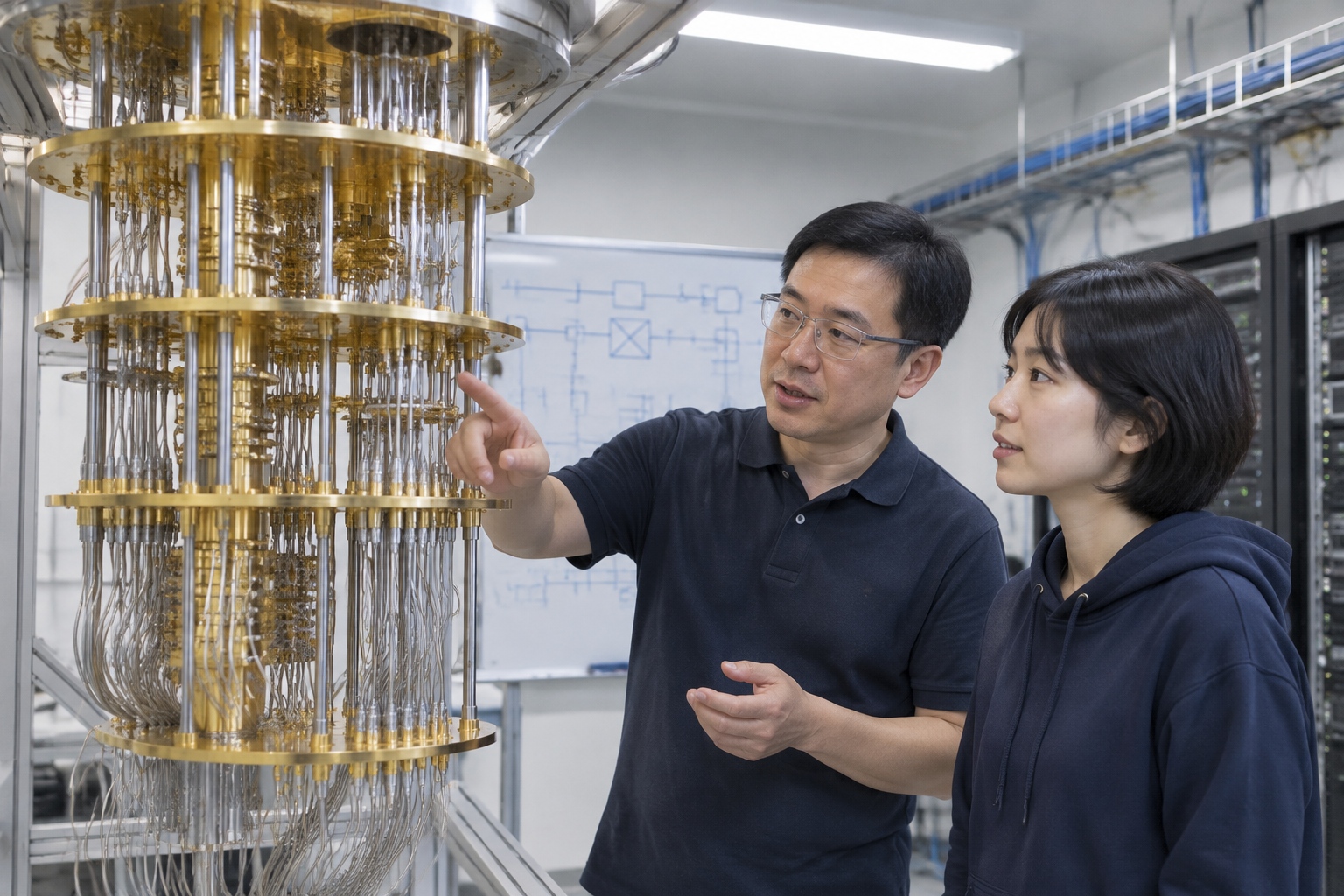
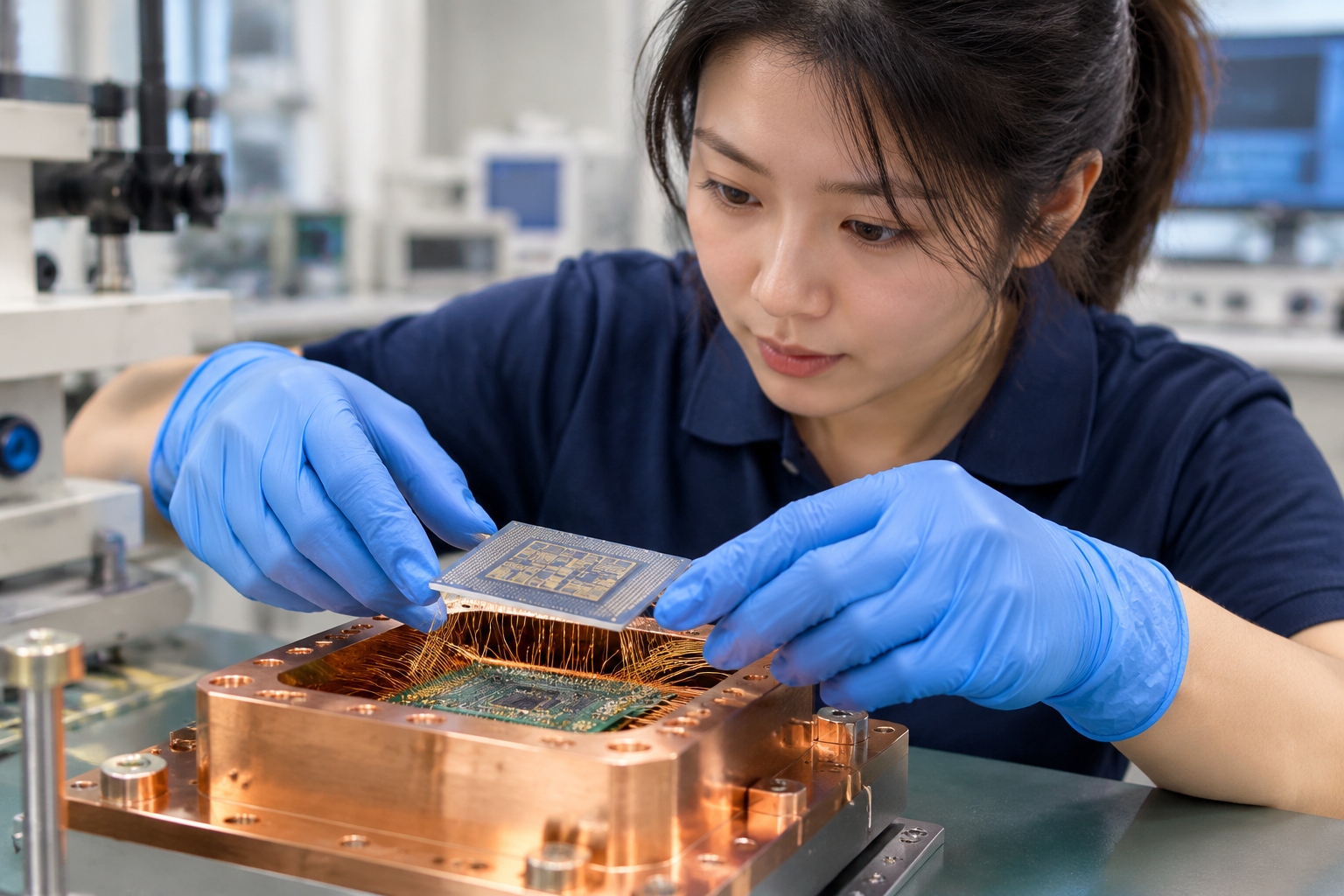
Zuchongzhi 3 is named after a fifth-century Chinese mathematician who calculated pi to seven decimal places. It is a 105-qubit superconducting processor with 182 couplers linking neighbouring qubits. Each qubit is a tiny aluminium circuit patterned on silicon, cooled until it becomes superconducting and starts behaving quantum-mechanically. The whole stack sits inside a dilution refrigerator: a hanging, gold-plated assembly of plates and cables that is one of the most recognisable objects in modern physics.
Three numbers in the paper matter more than the qubit count. Single-qubit gate fidelity is 99.90 percent. Two-qubit gate fidelity is 99.62 percent. Readout fidelity is 99.13 percent. These are among the best figures published for a chip this size, and they are the real achievement; qubit counts are easy to inflate, error rates are not.
For the benchmark itself the team used 83 of the 105 qubits in a 32-cycle random circuit and collected one million samples in a few hundred seconds. Their estimate of the classical cost: about 600 million years on Frontier, the fastest supercomputer in the world. Compared with Google’s 2019 Sycamore experiment on an equivalent task, the team puts its machine about a million times faster.
The part usually left out: these comparisons have a shelf life
Six hundred million years is not a constant of nature. It is an estimate made against the best classical algorithm available at the time of writing, and classical algorithms have a habit of improving.
In 2022, a group led by Pan Zhang at the Chinese Academy of Sciences’ Institute of Theoretical Physics showed that tensor-network methods running on GPUs could reproduce Google’s 2019 Sycamore sampling task in hours rather than millennia. In 2023 the same approach was applied to Zuchongzhi 2.1, cutting the estimated classical cost from an astronomical figure to something measured in hours and petabytes of memory. Similar back-and-forth followed IBM’s 2023 utility experiments, where a 127-qubit circuit was matched by classical simulation within months.
None of this means the quantum experiments are fake. It means the boundary keeps moving, and that a headline number has a best-before date. It is also why several groups, Google included, have shifted toward benchmarks with a verifiable answer, where the quantum machine’s output can be checked rather than merely estimated.
Zuchongzhi 3 against Sycamore and Willow
Google’s Sycamore, in 2019, was 53 qubits running a sampling task in 200 seconds that the team estimated would take 10,000 years on a classical supercomputer. IBM disputed the classical estimate within days; the argument has continued ever since.
Google’s Willow, unveiled in December 2024, also has 105 qubits. Its sampling run took under five minutes for a task Google estimated would take Frontier around 1025 years — a far larger number than Zuchongzhi 3’s, which reflects a different circuit and a different classical baseline more than a difference in engineering quality.
The comparison that actually matters is elsewhere. Willow’s headline result was not speed but error correction: as Google grew its surface-code lattice from distance 3 to 5 to 7, the logical error rate halved each time. That is the first convincing evidence that adding more qubits makes a quantum memory better rather than worse, which is the precondition for everything useful. Chinese groups have published their own error-correction experiments, and this is the race that will decide who gets to a useful machine first.
A fair reading of the two 105-qubit processors is that they are broadly comparable instruments with different strengths, built by teams that read the same literature and hit similar walls. On fidelity and the scale of sampling, Zuchongzhi 3 is competitive with anything outside Google. On error correction, Google is ahead.
Why 99.6 percent is nowhere near good enough
Two-qubit fidelity of 99.62 percent sounds close to perfect. Run the arithmetic. A hundred gates leave you with about 68 percent of the original state intact. A thousand gates leave you with two percent. Useful quantum algorithms, whether in factoring, chemistry or materials, need millions of gates.
The fix is error correction: bundling many physical qubits into one logical qubit protected by redundancy, the way repeated checks protect a message sent over a noisy line. The overhead is brutal. Early estimates suggest a thousand physical qubits or more per logical qubit, which is why serious projections for a machine that could break RSA-2048 land in the millions of physical qubits running for hours.
The obstacles are not only about qubit quality. Each qubit needs control lines, and every cable carries heat into a refrigerator with a fixed cooling budget; a thousand-qubit machine needs a different wiring architecture, not just a bigger chip. Coherence times are measured in tens of microseconds while gates take tens of nanoseconds, so a few thousand operations is roughly where a computation dies. Real-time decoding of error-correction syndromes needs classical electronics fast enough to keep up. And the software layer — compilers, error-aware circuit design, algorithms that will actually run on noisy hardware — is still immature everywhere, not only in China.
Who builds these machines in China
The Zuchongzhi line comes out of USTC in Hefei, working with the CAS Center for Excellence in Quantum Information and Quantum Physics, the Hefei National Laboratory and the Shanghai Quantum Science Research Center. The same broad group runs two hardware tracks: superconducting circuits, under the Zuchongzhi name, and photonic systems, under the name Jiuzhang. Funding comes from national key research programmes, the Chinese Academy of Sciences, and provincial and municipal governments in Anhui and Shanghai.
Hefei itself is worth knowing about. A stretch of road in the city’s high-tech zone has acquired the nickname Quantum Avenue because of the density of quantum companies along it: QuantumCTek, which sells quantum key distribution equipment and is listed on Shanghai’s STAR Market; Origin Quantum, which sells superconducting machines and has developed domestically built dilution refrigerators; and dozens of smaller suppliers of lasers, detectors, microwave electronics and cryogenic parts.

That supply chain matters because quantum hardware sits on the same fault lines as other advanced technology. Reports that Washington has considered restricting exports of dilution refrigerators to China have made domestic substitutes a strategic priority, and much of the plumbing around Chinese quantum chips is now sourced at home — a change from a decade ago, when almost everything came from abroad.
The commercial picture is less glamorous than the science. Alibaba shut its quantum computing laboratory in late 2023 and donated the equipment to Zhejiang University, a reminder that private capital in this field is patient only up to a point. Baidu, SpinQ and a cluster of startups continue, but most revenue today comes from research instruments and government-funded projects rather than from anyone solving a commercial problem on a quantum computer.
What to watch next
Qubit counts will keep rising, and they will keep being the least informative number in the press release. The milestones that matter over the next few years look different: logical qubits that beat their own physical components; error rates that fall as devices grow; benchmarks whose answers can be verified independently; and the first credible claims of quantum utility, meaning a computation that is both hard for classical machines and useful to somebody outside physics.

So what did Zuchongzhi 3 actually prove?
It proved that a Chinese laboratory can build, calibrate and operate a 105-qubit superconducting processor with world-class control fidelity, and run a benchmark at the edge of what any computer can do. That is a genuine technical achievement, and it places China among perhaps three or four places on earth that can do it.
It did not prove that quantum computers are about to do anything for your business, your medicine or your bank. The most interesting thing about the result is not the 600 million years. It is that within months, people with better classical algorithms will publish a smaller number — and that argument, rather than the headline, is what a real field looks like.