

The 6:40 a.m. Bench Test
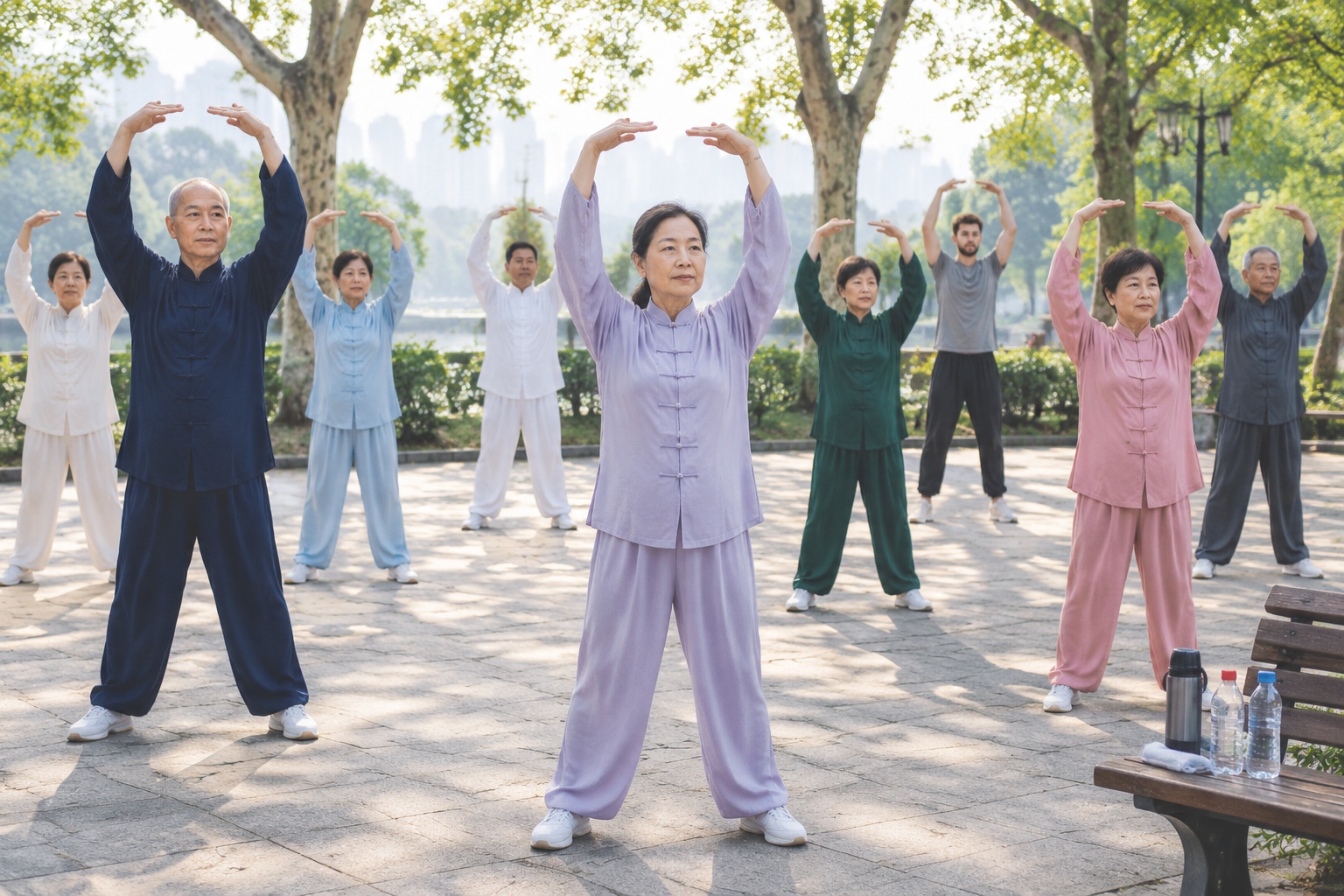
Jonas is 34, from Hamburg, and he is doing something wrong with his elbows. It’s 6:40 on a Tuesday in a park in Chengdu, and about twenty people — most of them over sixty — are moving through a slow sequence together: hands rising overhead, palms pushing up, then sinking back down. Jonas stands three rows back, copying the woman in front of him. His arms keep drifting out of line.
He has been coming for five weeks. “The first week I felt stupid,” he says. “The second week my shoulders stopped aching at my desk. Maybe that’s the movement. Maybe it’s that I’m standing outside at 6:40 instead of lying in bed looking at my phone.”
The routine has a name: baduanjin, “eight pieces of brocade.” Eight slow movements, about twelve minutes, no equipment, enough floor space to stand in.
Two hours later, in my kitchen, I do something equally unremarkable: I fill a thermos with hot water, let it cool until it is drinkable, and drink it. That’s the whole habit.
There is a hashtag going around in English — “becoming Chinese” — where young foreigners film themselves making warm water, buying thermoses, doing baduanjin in bedrooms. Some of it is a joke. Some of it is sincere. What interests me is neither. It’s that these are the parts of Chinese daily life that are genuinely easy to copy, and copying them tells you something about how ordinary life here is organised.
So I tried a version of it for 30 days. I’ll get to the parts that failed.
Why Warm Water Is Everywhere in China
Order a meal in a Chinese restaurant and hot water or tea usually arrives without being asked. Ask for cold water and you’ll often get a puzzled pause, then a bottle from the fridge, sometimes with ice, sometimes not.
That’s the surface. Underneath is a tangle of reasons, and only one of them is about health.
Boiling water has been a household habit for a long time, partly for practical reasons: boiled water is safer water. Tea culture made hot water the default. And there’s a family script most Chinese children grow up hearing: don’t drink cold things when you’re sick, don’t drink cold things in winter, don’t drink cold things on an empty stomach. My mother-in-law can deliver it as one sentence without pausing for breath.
The thermos is the physical version of the same idea. Offices, classrooms, high-speed trains, hospital waiting rooms — people carry hot water with them. There’s a word for it, 保温杯 (bǎowēn bēi), and for a while it was a slightly mocking shorthand for “you’re getting old.” Then young people started using them too, and the joke stopped working.
What is it actually good for? Honestly: it’s pleasant, it’s cheap, and it slows down the first ten minutes of the day. There’s no strong clinical consensus that warm water does anything special that room-temperature water doesn’t. Chinese friends who drink it mostly say it “feels better,” especially in winter or after a cold. That’s a personal report, not a medical claim, and it’s worth keeping it that way.

How Baduanjin Got Into a Berlin Living Room
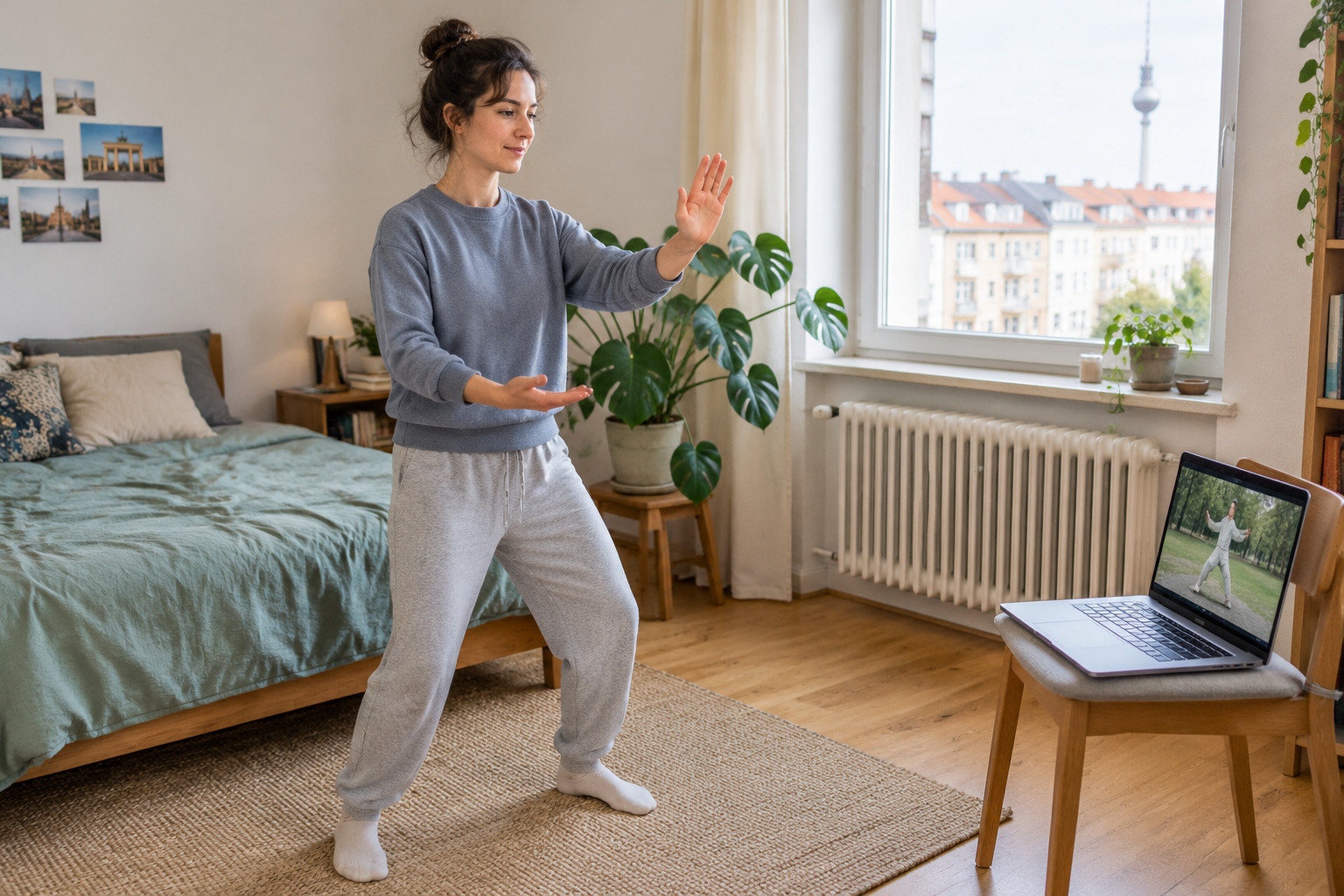
Rachel is 29, from Ohio, living in Berlin, and her lower back complains. Her physiotherapist told her to move gently every day and stop sitting for six hours straight. She tried yoga videos and found them too long, too hard, or too cheerful.
Then an algorithm handed her a twelve-minute baduanjin video, filmed in a park, with subtitles.
“Twelve minutes I could do,” she says. “No mat, no app subscription, no downward dog. I do it in socks next to my bed.” After a month, she says her back feels looser in the mornings. She also says she doesn’t know whether that’s the baduanjin or the fact that she now stands up at 7 a.m. every day.
That’s the honest version. What people report from habits like these is hard to separate from the rest of the routine attached to them.
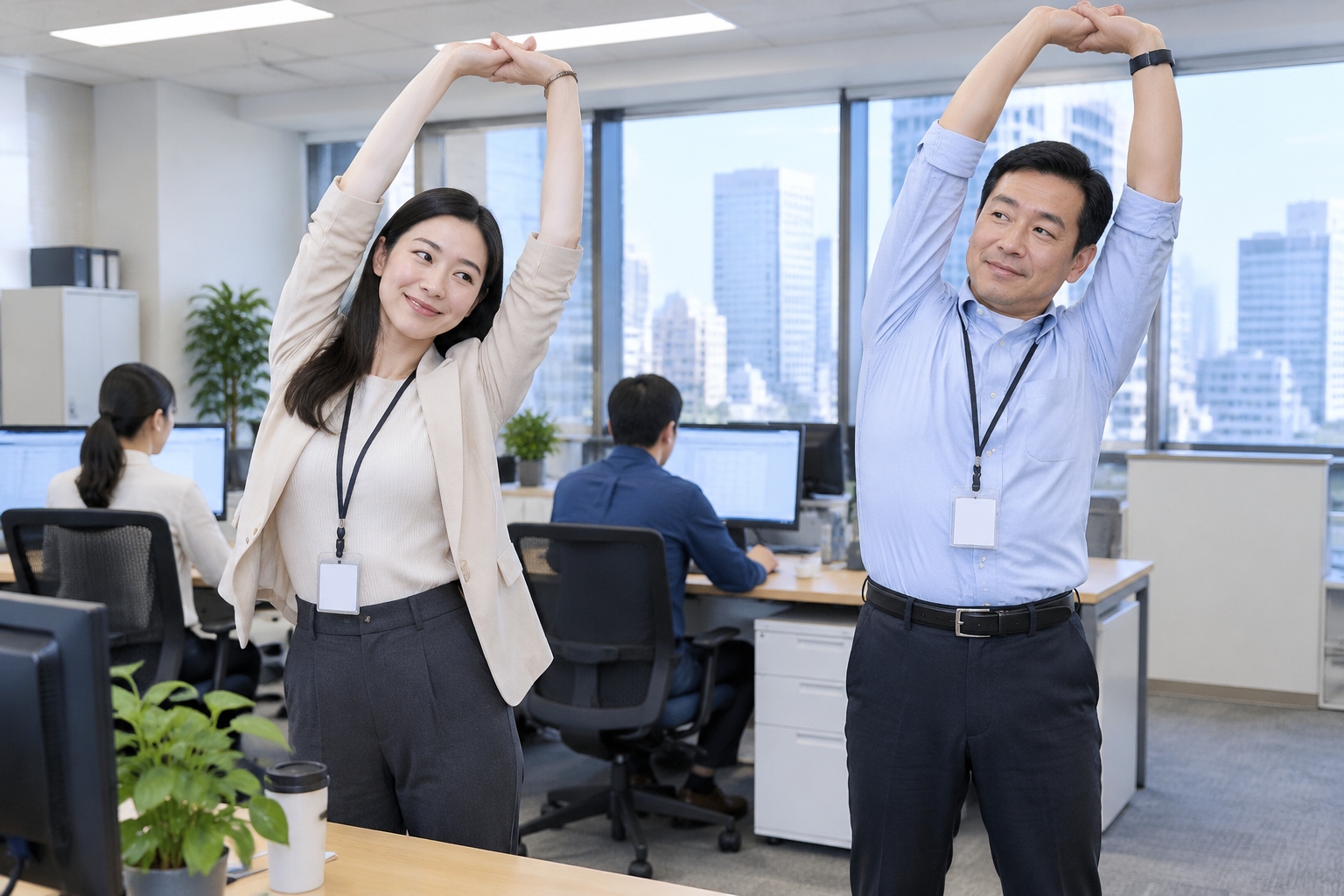
In China, baduanjin isn’t exotic at all. It’s the thing happening in parks at dawn, sometimes next to people doing tai chi, sometimes next to a speaker playing square-dance music at a volume that suggests a personal disagreement with the neighbours. Hospitals teach it in rehabilitation classes. Some offices run it as a five-minute break. At 3 p.m. in a lot of Chinese workplaces, people stand up and stretch, and nobody finds it strange — the strangest thing, to a foreign eye, is how unembarrassed everyone is about it.
My 30 Days: What Stuck, What Didn’t
I’m the test subject here, and my results were mixed.
Warm water in the morning: easy. Genuinely pleasant. I kept it. What failed was everything around it — I still want coffee, and I still want iced drinks in July. In week three I drank a large iced Americano at 2 p.m. and felt no guilt whatsoever. The habit didn’t replace anything. It just added a glass of water.
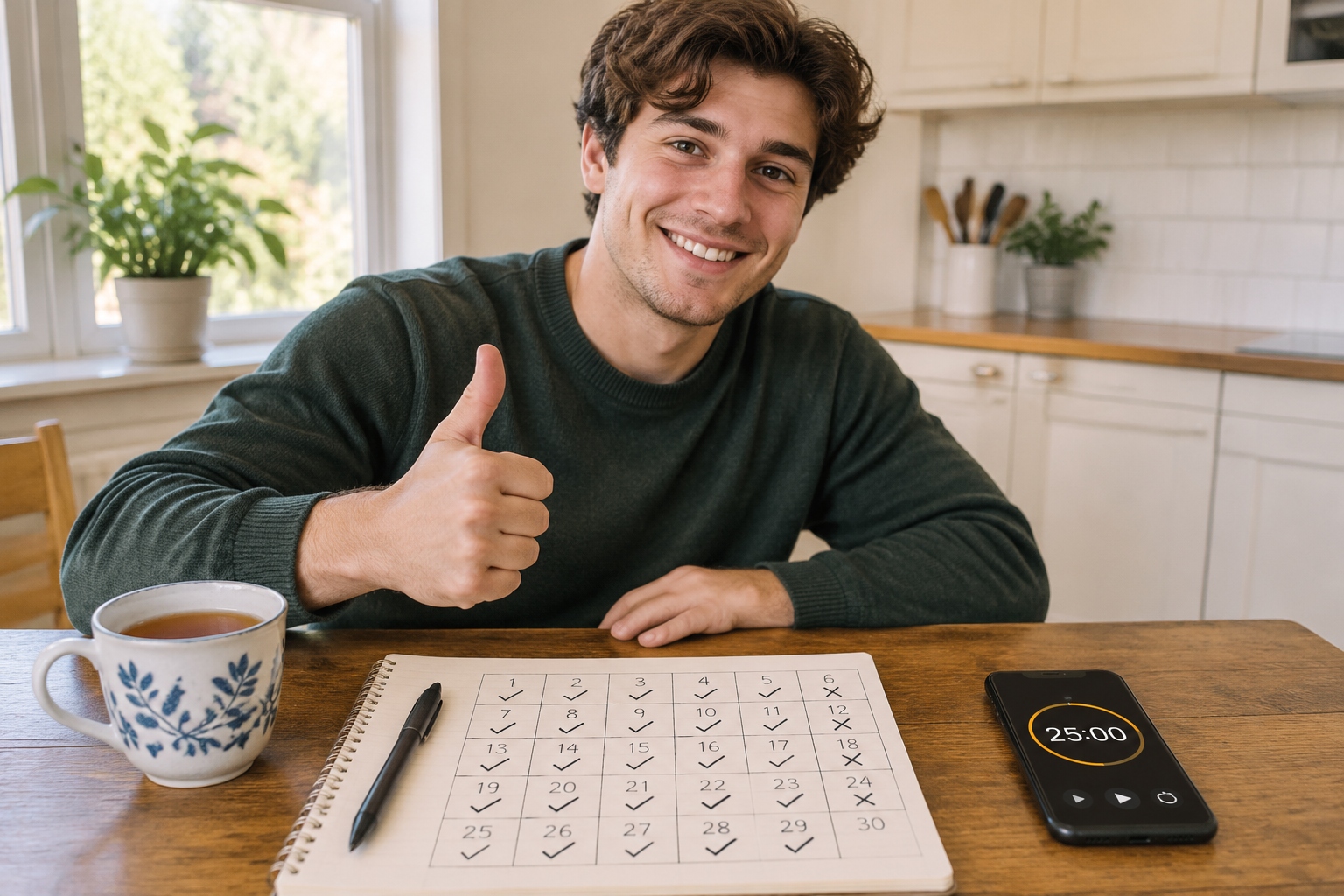
Baduanjin: harder. Days one to four I felt like a man pretending to be a tree. Day five I skipped. Day nine I skipped. Around day fifteen, one movement — the one where you push one palm up and the other down, eyes on the upper hand — suddenly made sense in my shoulders, and I stopped needing to check the screen. I finished 21 of 30 days. That’s a 70 percent completion rate, which I’m told is normal for anything, and which felt at the time like a small triumph.
The 24 solar terms were the part I expected to find silly and found interesting instead. A blogger I follow loosely restructured her year around them — sleeping earlier after the summer solstice, eating differently as the weather turned. When I asked what actually changed, she didn’t talk about energy or meridians. She said: “I noticed the seasons. Before, I noticed the weather. Those aren’t the same thing.”
Which is a fair description of what the 24 solar terms are: a very old calendar for paying attention. You can use it as a calendar and skip the metaphysics.
What These Habits Actually Reveal
Strip away the trend and three practical things remain.
They’re nearly free. Baduanjin costs nothing. Warm water costs nothing. A thermos costs maybe 100 yuan and lasts five years. Compare that with a gym membership, a wellness app, or a nine-dollar green juice. In a country where public health advice has to work at scale, cheap and copyable beats premium and exclusive.
They happen in public space. This is what foreigners notice first: Chinese parks at 6:30 a.m. are full. Not just joggers — people doing slow movements, walking backwards, swinging on the free outdoor fitness equipment found in almost every residential compound. Nobody books anything. Nobody pays. You show up, stand at the back, and within three days someone will correct your posture. I watched a woman in her seventies tap Jonas on the shoulder and adjust his hand by about ten degrees. He says it was the most useful coaching he’s had.
They’re shared across generations. Baduanjin in a Chinese park is not a youth trend. It’s mostly people in their sixties and seventies, which is exactly why it works as a bridge: a foreigner joining in isn’t joining youth culture, they’re joining a general, unremarkable public ritual.
What Foreigners Keep, Change, and Get Wrong
The adjustments are where it gets interesting.
Rachel kept the twelve minutes and the timing, but does it in socks beside her bed rather than in a park — Berlin in February is not Chengdu in February. The warm water she adapted: hot water with lemon, which isn’t really the Chinese habit, but is close enough that her Chinese colleagues approve.
What gets misread is the framing. A lot of English-language content about these habits slides into “ancient wisdom” and “detox,” which is not how Chinese people talk about them. Nobody in a Chinese park at dawn is discussing qi. They’re discussing their knees and whether it’s going to rain.
There’s a mirror-image error too: foreigners sometimes assume this is what all Chinese people do. Plenty of young Chinese workers skip breakfast, drink iced coffee year-round, and haven’t done a single baduanjin movement since a school sports day in 2009. The habits are common, not universal.
A Short Starter List
Five things, with honest cost and time.
Warm water in the morning
One minute, zero yuan. Boil, pour, let it cool, drink it while doing something else.
Baduanjin, the eight-movement set
Twelve minutes, free on video. Learn four movements first; nobody does all eight correctly on day one.
The 3 p.m. stand-up
Three minutes, zero yuan. Stand, roll your shoulders, look out a window. The point is the interruption, not the exercise.
A thermos
One purchase, around 100 yuan. The point isn’t the cup. It’s that carrying water changes how often you drink it.
Following the seasons, loosely
No cost, some attention. Sleep a bit earlier in summer, eat what’s actually in the market. Skip the parts that feel like homework.
Tuesday, 6:40 a.m., Again
Back to the park. Jonas finishes the set, picks up his thermos from the bench, and drinks from it while standing there. He doesn’t look enlightened. He looks like a man who got up early and did something mildly useful with his morning.
That’s about as far as I’d take the conclusion. These habits travel well not because they’re exotic, but because they’re small, cheap, and ask almost nothing of you — no membership, no equipment, no belief system. You can copy the glass of warm water in about a minute. Whether it changes anything is something you find out by drinking it for a month, and reporting honestly on the days you didn’t.