

At the Nagqu Horse Racing Festival, Everyone’s a Broadcaster
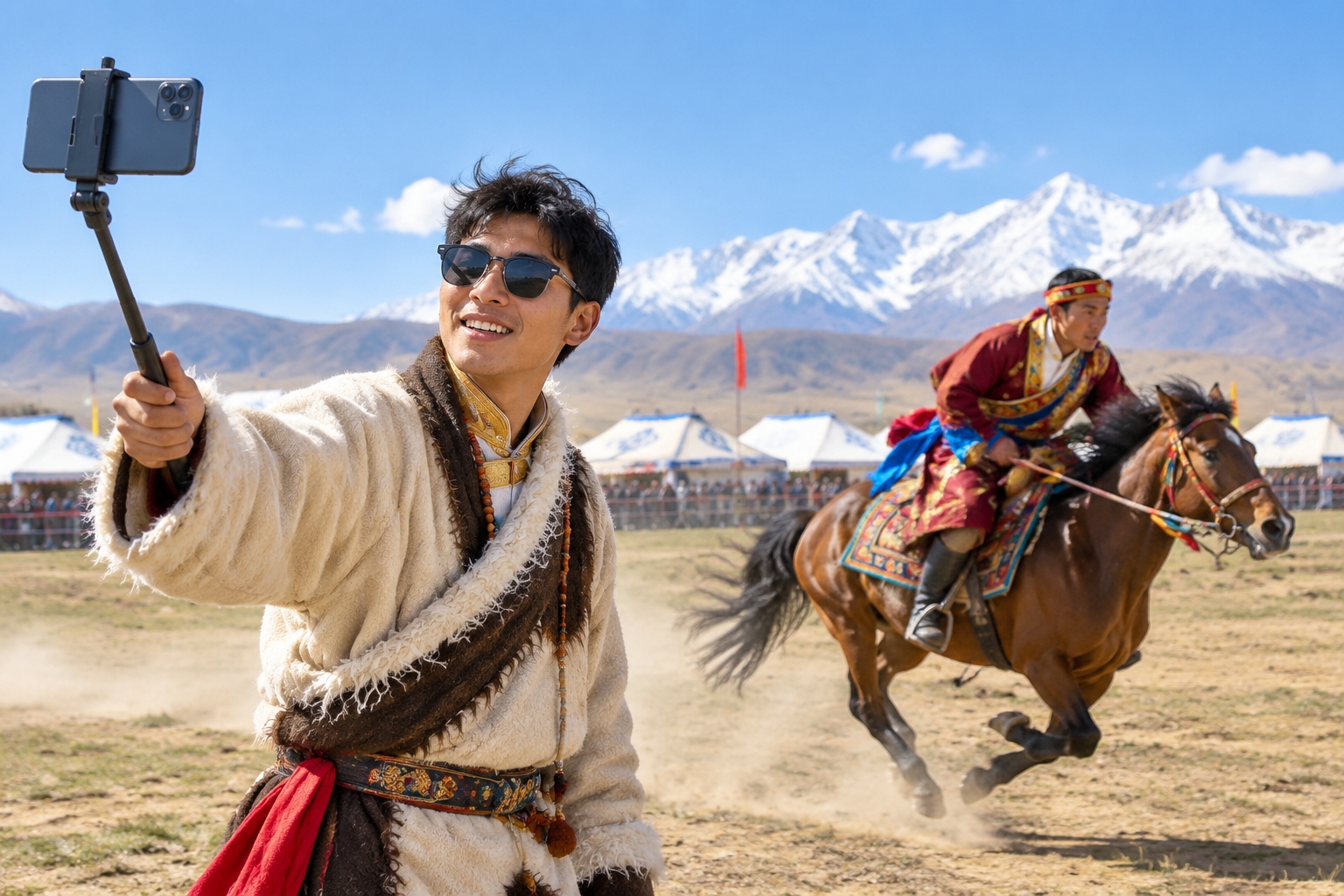
The first thing you notice at the Nagqu horse racing festival isn’t the horses. It’s the forest of arms holding smartphones. On a breezy summer afternoon on the Qinghai-Tibet Plateau, a rider in a bright silk robe and broad-brimmed hat charges across the grassland. Around the track, herders in thick sheepskin coats are not just cheering—they’re holding selfie sticks, tapping screens, and talking to their phones as if the horses were performing just for a tiny lens.
This is the annual Qiangtang horse racing festival in Nagqu, one of Tibet’s most important summer gatherings. For centuries, it was where families from far-flung nomad communities came to race horses, trade goods, and catch up with relatives they hadn’t seen since winter. This year, the photos of the event looked almost identical to the past: tents stretching across the green grass, riders gripping the reins, the smell of yak butter tea and dust in the air.
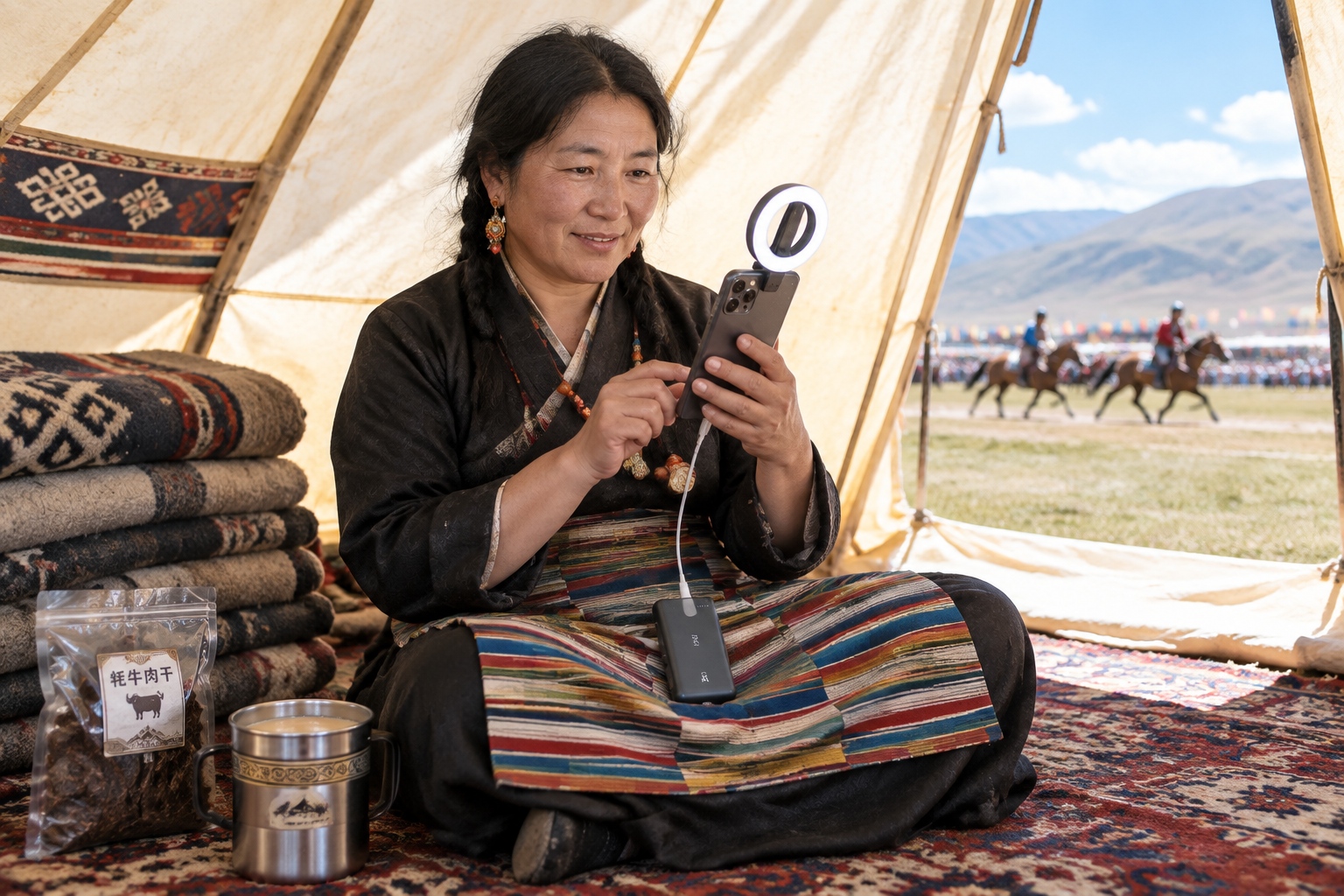
But look a little closer and you’ll see something that would have been unimaginable just a decade ago. Grandmothers in traditional striped aprons are swiping their phones to switch camera modes. Children are holding portable chargers like they’re sacred relics. And young herders are calmly narrating the race into tiny ring lights balanced on thermos bottles.
Why Herders Are Going Live
If you’ve ever lived through a cold winter in a remote mountain village, you understand why a horse race is more than entertainment. It’s a social lifeline. In Nagqu, people often live many kilometers from their nearest neighbor. The horse festival is the one time of year when the grassland feels crowded.
Now, thanks to high-speed mobile networks that have reached even some of the most remote corners of the Tibetan plateau, that lifeline has gone digital. During the festival, hundreds of herders open accounts on Douyin, the Chinese version of TikTok, and broadcast the races live to friends, family, and anyone who finds their stream.
“My sister lives in Lhasa and can’t come this year,” one young man told me, holding his phone in one hand and a piece of dried yak meat in the other. “She said watching my livestream is almost as good as being here. Almost—I still owe her a cup of butter tea.”
The streams aren’t just about sharing a good view. Viewers send virtual gifts—small animated hearts, gold coins, even rocket ships—that can be exchanged for real money. For some herders, a few hours of live-streaming during the festival adds a nice little income. Others use the attention to sell local specialties: dried meat, handmade wool blankets, even caterpillar fungus, the famously expensive medicinal herb found on these mountains.
“I used to bring my goods to the festival and hope people would stop by my tent,” said a woman selling pouches of dried cheese. “Now I point my phone at the goods, and customers from Shanghai and Beijing are asking me to ship overnight. The horse race is the best commercial I’ve ever had.”
Signal at 4,500 Meters
Nagqu is often called the highest city in the world, sitting at an average altitude of around 4,500 meters. The air is thin, the sun is fierce, and the Wi-Fi password, believe it or not, is often “12345678.”
The mobile signal at the festival grounds is surprisingly robust. Telecom companies set up temporary mobile base stations during the event, knowing that thousands of people will spend as much time uploading as cheering. In the tent city that rises around the racetrack, you’ll see young herders charging three phones from a single power bank while their mother cooks dinner over a small stove.
The only thing racing faster than the horses, locals joke, is the comment section.
From Spectator to Broadcaster
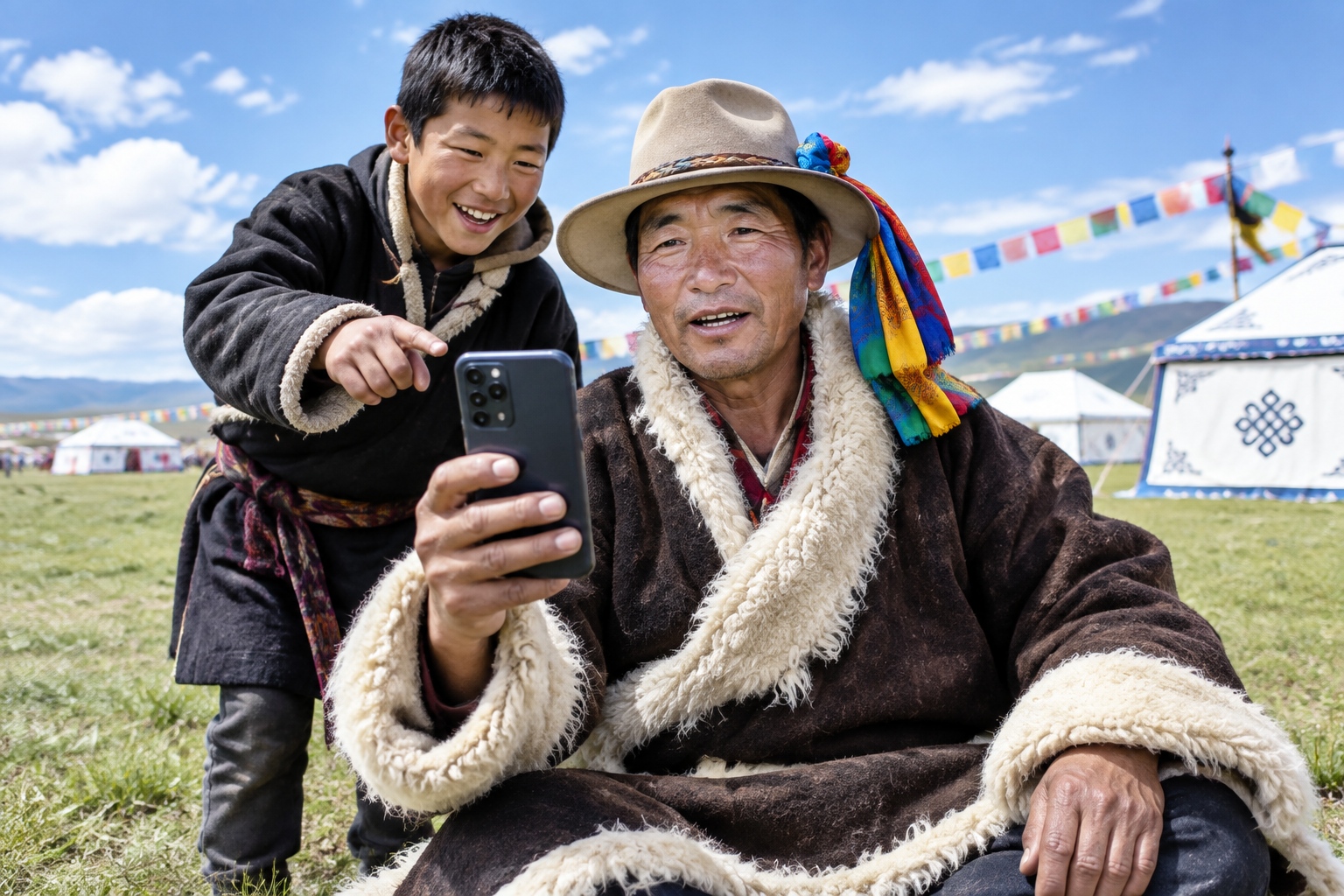
Not everyone is a natural performer, though. I watched a middle-aged herder struggle to find the right button on his phone, then turn to a teenager for help. The teenager laughed, tapped the screen a few times, and suddenly a livestream titled “Horse race from my uncle’s tent” went online. Within minutes, retired herders who had moved to cities were leaving comments in Tibetan and Chinese: “My family’s tent was near that hill!” “Is that Lhamo’s hat?”
Some of the best live-streamers are older women. They don’t use fancy transitions or background music. They simply point the phone at the track and comment in a relaxed, unhurried way, the way you might talk to a neighbor across a fence. “That horse is fast,” one grandmother said, “but his rider looks more nervous than my goat before a storm.” The viewers loved it.
The Offline Scene Is Still the Show
All this live-streaming doesn’t mean the in-person festival is losing its magic. On the contrary, the energy of the crowd feeds the streams. You can still hear hooves thundering before you see the lead horses. You can still feel the ground vibrate when a dozen riders pass. The smell of dust, grass, horse sweat, and roasted barley flour still hits you as you walk between tents.
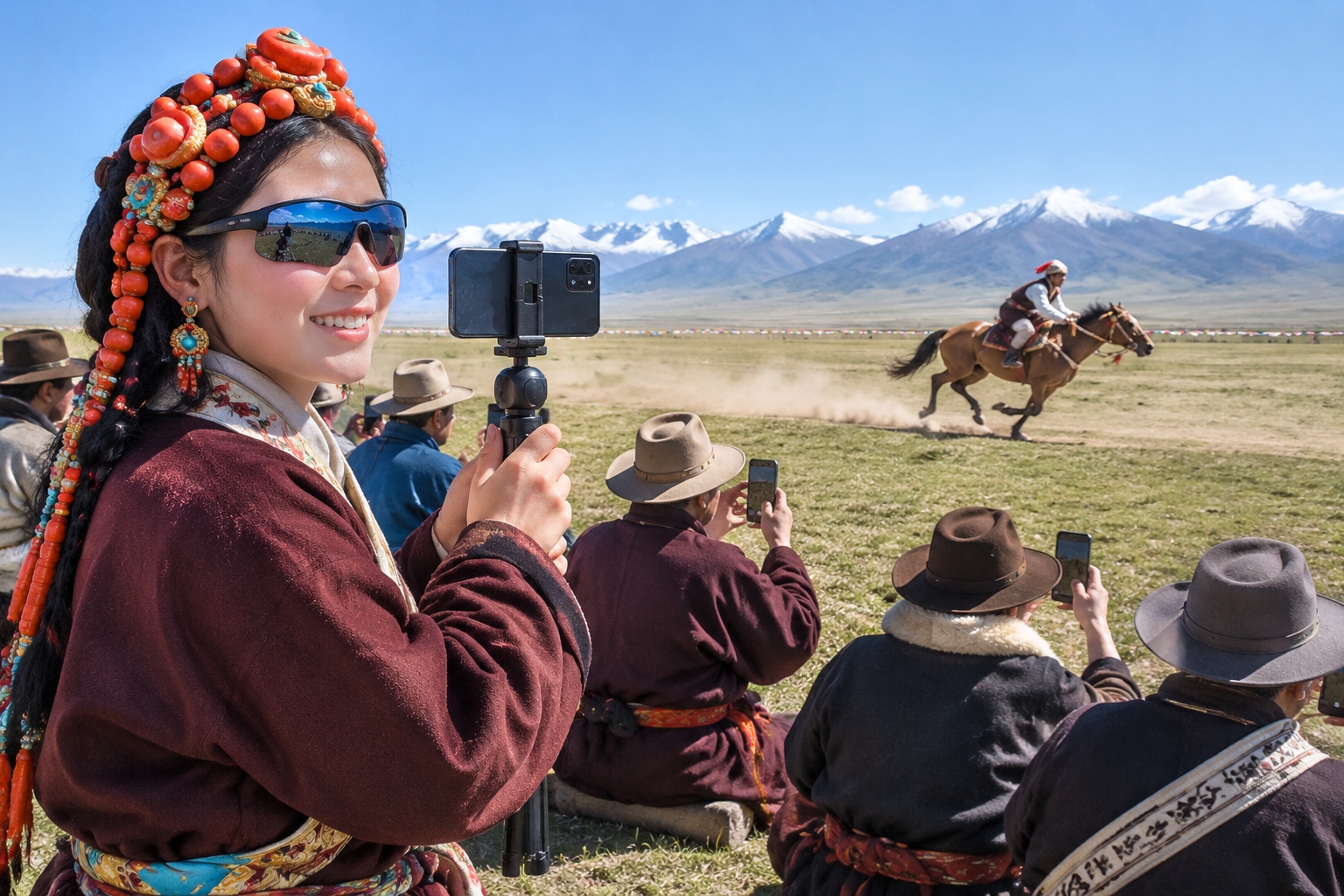
Livestreaming is an addition, not a replacement. It opens a window for people who can’t travel to the plateau, whether they’re living in Beijing, Chengdu, or abroad. A Tibetan student in New York can watch her hometown festival from her apartment, and for a moment the distance feels smaller than a click.
“People sometimes think we are disconnected from the modern world,” said a herder who had just finished a race, wiping sweat from his face. “But the horse was our internet. It carried messages, brought families together, connected us. Now we just have a horse in one hand and a phone in the other. It’s the same spirit, different saddle.”
A Festival That Refuses to Be Pigeonholed
For visitors expecting either an “ancient untouched Tibet” or a “fully modernized country,” Nagqu offers a gentle surprise. The young women wear designer sunglasses above traditional coral headdresses. The sound of Buddhist prayer songs mixes with the electronic chime of livestream notifications. A rider’s race number is pinned onto a handwoven robe that his grandmother wore to the same festival many years ago.
This isn’t tradition versus technology. It’s tradition finding a new way to breathe. The horses are still the stars, the riders still train for months, and families still travel long distances to meet face-to-face. But now, when the wind carries the sound of hooves, it also carries digital signals across the mountains to millions of small screens.
And if you ask a herder why they bother to livestream a race that everyone around them can already see, you might get a simple answer: “Because the earth is round, my friend. Not everyone can stand on this hill.”
Start the discussion at forum.chinacomes.com