
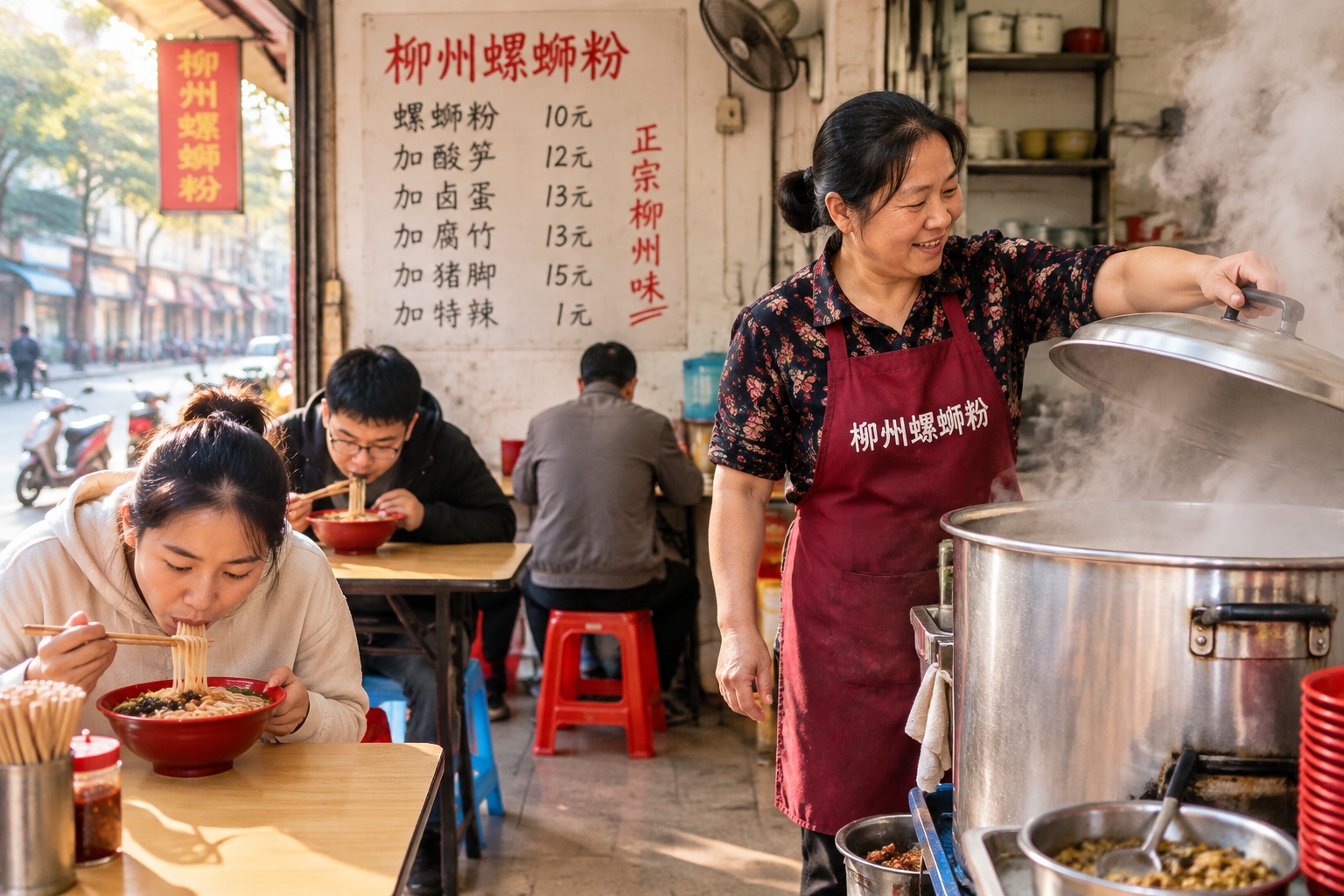

6:45 AM — The First Pot of Luosifen Broth
The alley off Liubei Road smells before it is visible. Sour bamboo shoots, fermented and pungent, hit you half a block away. By the time you reach the shop — a narrow storefront with plastic stools stacked against the wall — a woman in an apron is already lifting the lid off a giant steel pot. Steam curls up into the damp morning air.
This is Liuzhou, Guangxi’s industrial heartland, a city of about 4 million people that most foreign travelers skip on their way to Guilin’s karst peaks. But Liuzhou has its own gravity, and it pulls hardest at breakfast.
Luosifen — literally “river snail rice noodles” — is the dish that made this city famous across China. The broth is simmered for hours with river snails, pickled bamboo shoots, dried chili, and a dozen other aromatics. The noodles arrive in a bowl crowded with fried peanuts, tofu skin, green beans, and a splash of chili oil that turns the surface a deep, glossy red.
The first customers arrive before 7 a.m. A construction worker in a hard hat. Two college students sharing a table, filming the bowl with their phones before the first bite. An older man who has been coming here for eleven years and doesn’t look at the menu — the owner already knows his order.
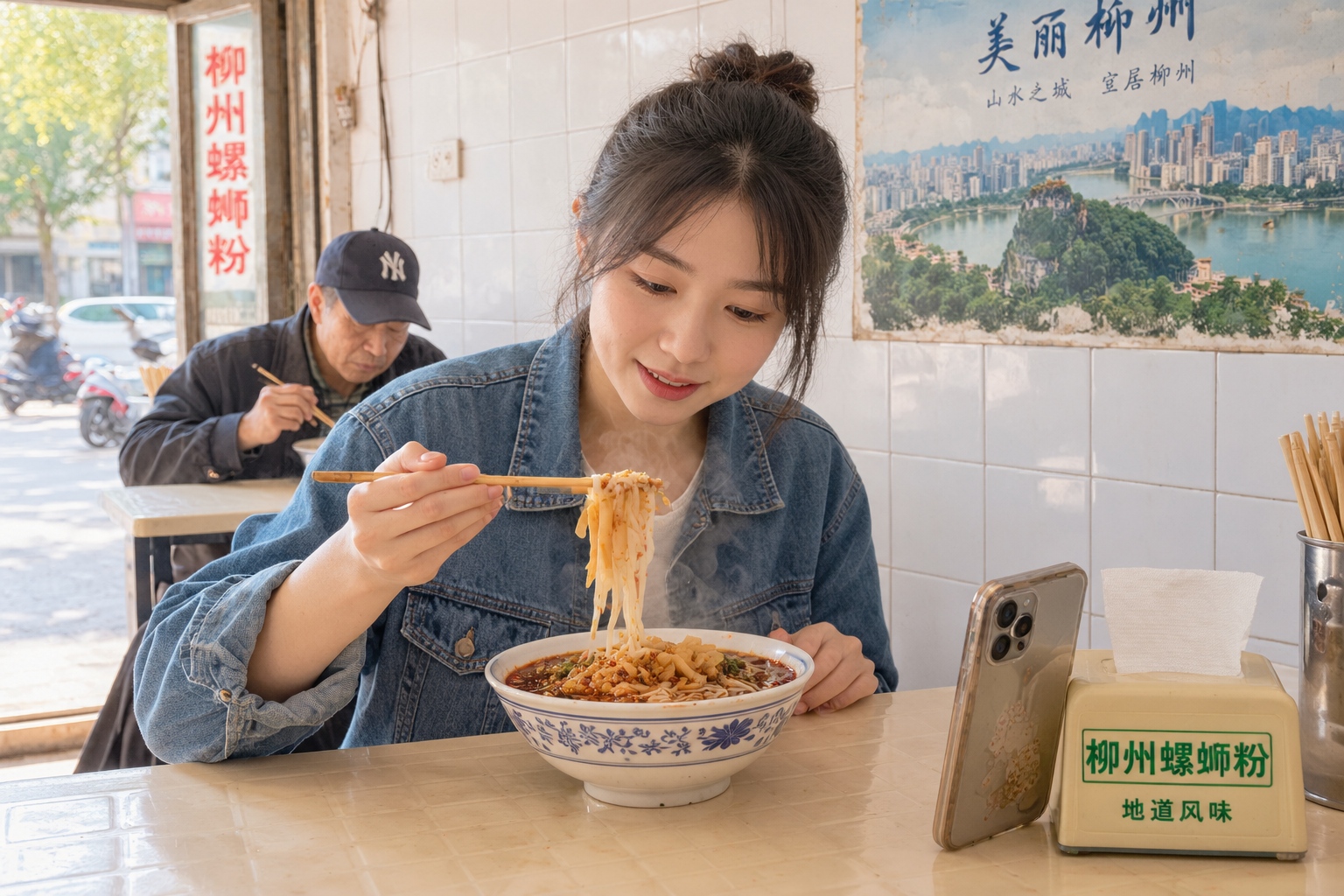
“Smell it first,” the woman at the next table says, noticing a hesitant newcomer. “If you can get past the smell, you’ll never stop eating it.” She laughs. This is a line every luosifen vendor in the city has used a thousand times, and it never gets old.
8:15 AM — The E-Bike Tide
Step outside the noodle shop and you walk straight into a river of e-bikes. Hundreds of them, maybe thousands, flowing through the intersection in a continuous, low hum. Helmets, ponchos, delivery boxes strapped to the back. A mother with a child standing on the footboard. A teenager weaving between cars with one hand on the handlebar, the other holding a phone.
Liuzhou, like most cities in Guangxi, runs on two wheels. The reasons are practical: the terrain is flat enough in the city center, the weather is warm for most of the year, parking a car is expensive and scarce, and e-bikes cost a fraction of what a car does. A decent electric scooter here runs between 1,500 and 3,000 yuan (roughly $200–$420), and charging it at home costs almost nothing.
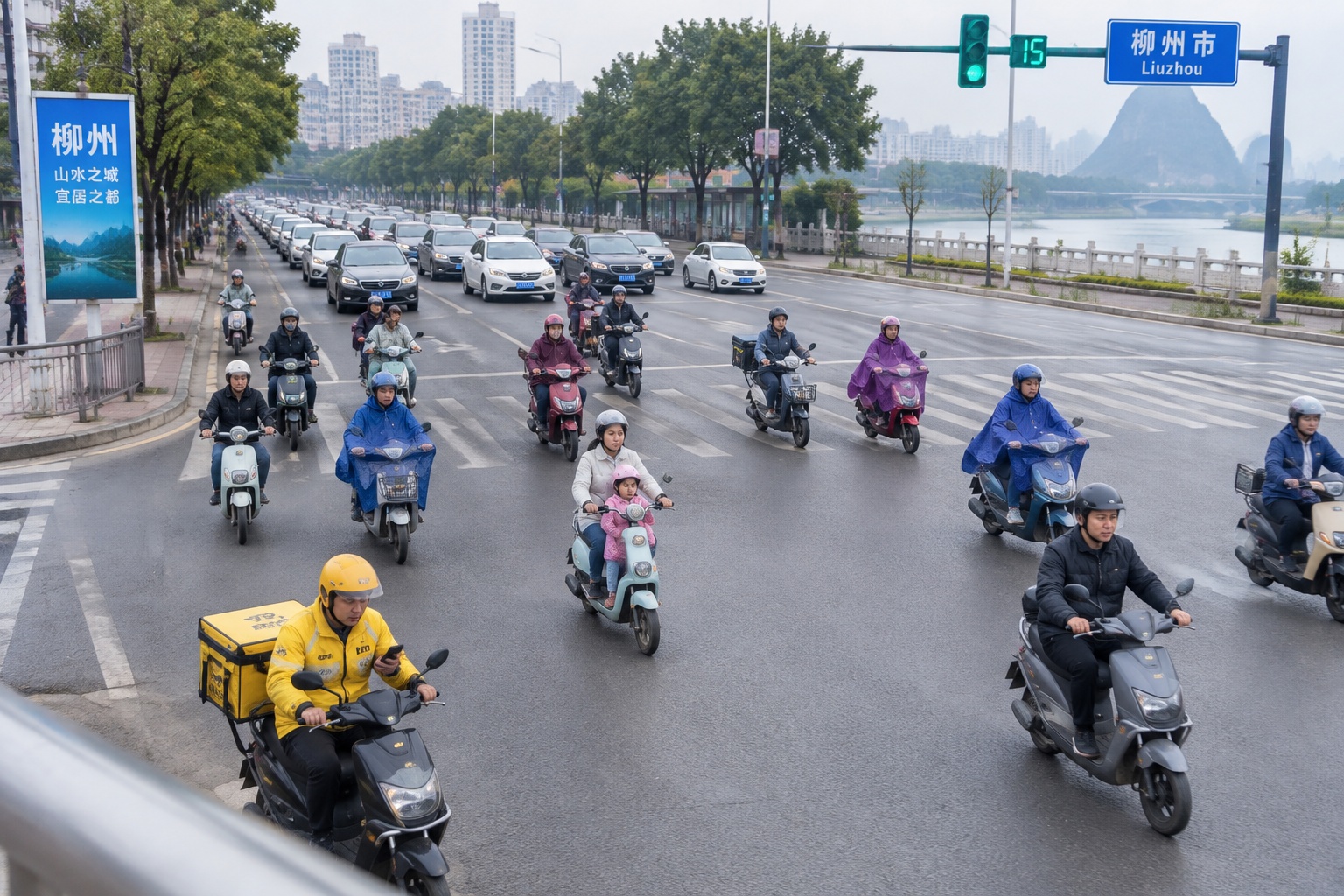
But the numbers only tell part of the story. What you notice as a visitor is the choreography. At a busy intersection, e-bikes don’t just mix with cars — they form their own lane, their own rhythm, their own unspoken rules. When the light turns green, they surge forward like a school of fish, then disperse into side streets, alleys, and market entrances that cars can’t reach.
Delivery riders are the most visible. Guangxi has one of the highest rates of online food delivery in southern China, and the yellow and blue boxes of Meituan and Ele.me are everywhere. A rider named Xiao Wei, 26, tells me he covers about 80 kilometers a day in Liuzhou. “Rain or shine,” he says. “The e-bike is my office.”
10:00 AM — From Street Stall to Factory Floor
Luosifen is no longer just a street food. It has become an industry.
In the Liuzhou Luosifen Industrial Park, about 30 minutes from the city center, factories churn out millions of pre-packaged luosifen kits every month. The process is a strange blend of industrial precision and folk recipe: bamboo shoots fermented in temperature-controlled rooms, broth reduced and sealed into vacuum pouches, chili oil measured by machine.
The numbers are staggering. In 2023, Liuzhou’s pre-packaged luosifen industry reported over 60 billion yuan in combined revenue, according to local government figures. That’s up from less than 10 billion yuan just five years earlier. The noodles now ship to more than 20 countries, including the United States, Australia, and Canada, where they are sold in Asian grocery stores and on Amazon.
For a dish that was once dismissed as a smelly regional specialty, this is a remarkable turnaround. The COVID-19 pandemic accelerated it: when restaurants closed, people ordered pre-packaged luosifen online. Influencers on Douyin and YouTube filmed themselves trying it for the first time. The smell became a selling point.
Back in the city center, the old-school shops haven’t disappeared. If anything, they’ve become more crowded. A bowl at a street stall costs 8 to 12 yuan. A pre-packaged kit costs about the same. But locals will tell you it’s not the same thing. “The packaged one is for people who can’t come here,” a vendor says. “The real one is for people who can.”
7:30 PM — Night Market and Riverbank
By evening, the city shifts gears again. The night market along the Liujiang River comes alive with neon signs, sizzling woks, and the smell of grilled seafood and sugarcane juice. E-bikes are parked three deep along the curb, helmets hanging from handlebars, some still humming with the faint whine of a battery charger.
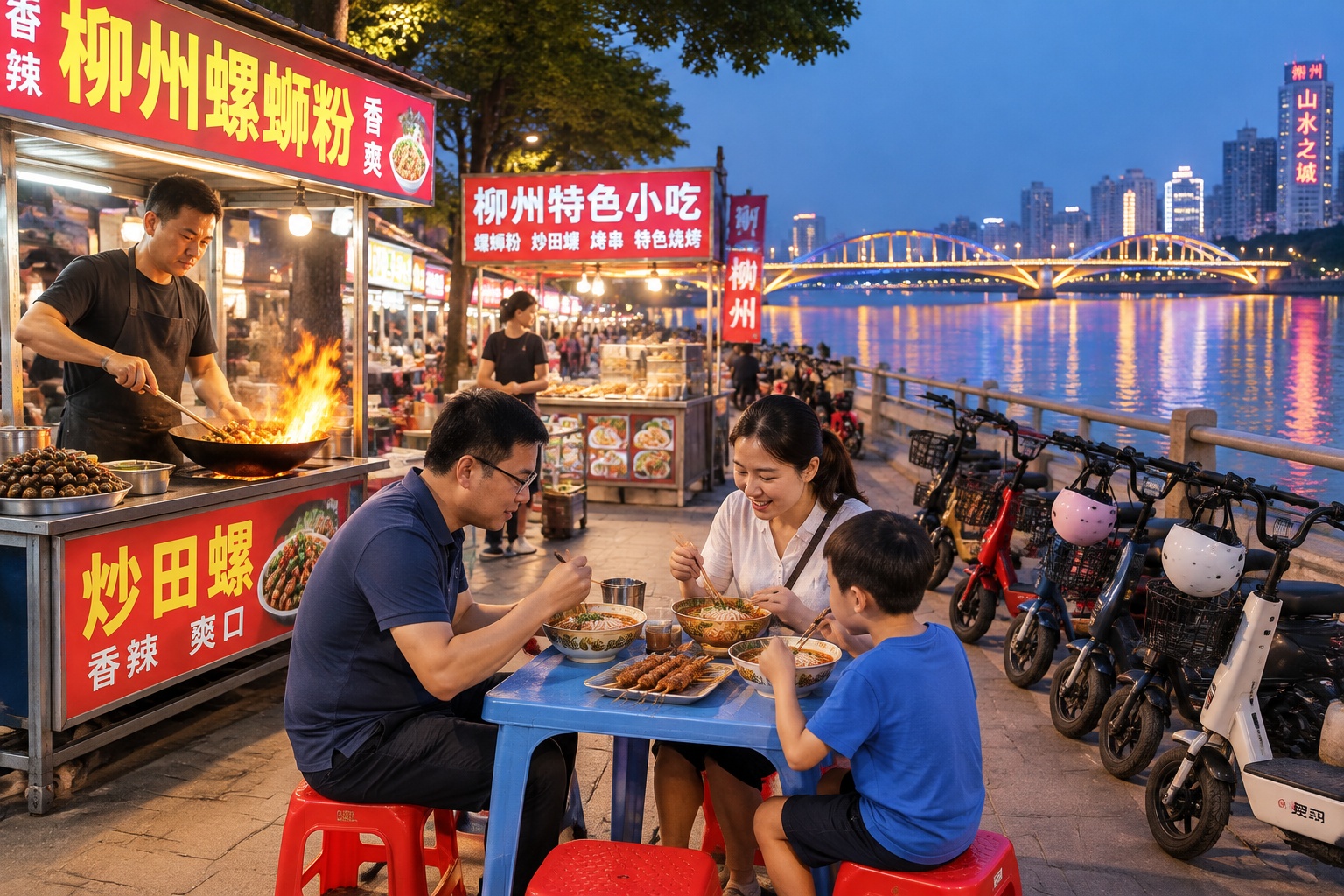
Families walk along the river promenade. Teenagers sit on the steps, sharing a bowl of luosifen and scrolling through their phones. A group of older women practice dance moves near a speaker. The river itself is dark and wide, reflecting the lights of the bridges that cross it.
This is the part of Guangxi that doesn’t make it into travel brochures. It’s not the karst mountains of Guilin or the rice terraces of Longsheng. It’s just a city, at night, doing what cities do — feeding people, moving them around, letting them sit by the water and talk.
Why This Matters Beyond Guangxi
For readers outside China, Liuzhou’s story might feel specific — but the patterns are not.
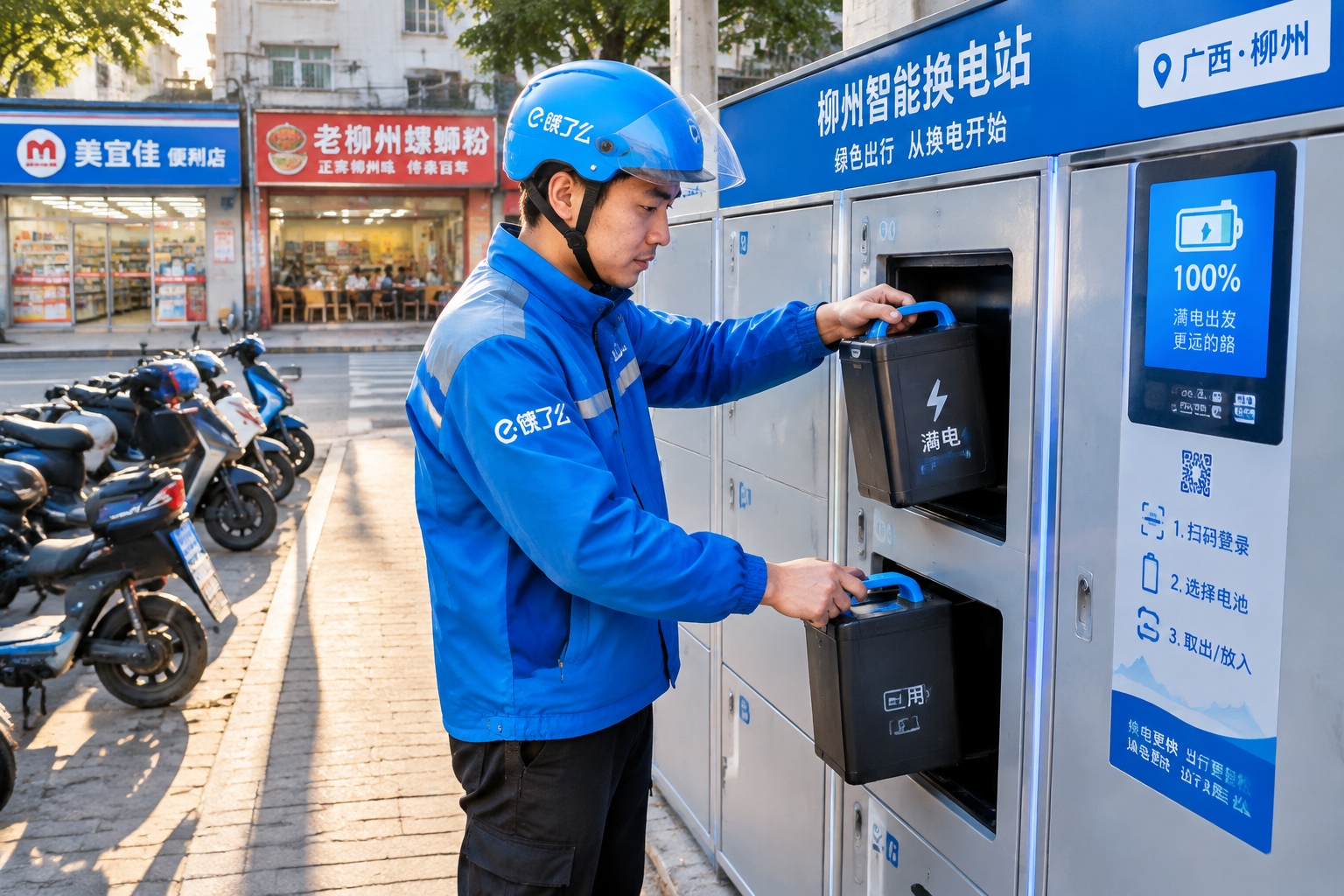
The e-bike culture here echoes what you see in Hanoi, Bangkok, and Taipei, where two-wheeled transport is not a niche choice but a default. The difference is scale and infrastructure. China has invested heavily in bike lanes, charging stations, and battery-swap kiosks. In Liuzhou, you can swap a depleted battery for a full one in under a minute at a roadside kiosk.
The food story is similar. Sour, spicy, fermented flavors are having a global moment — think kimchi, kombucha, and Thai som tam. Luosifen fits right in, but its rise was driven less by foodie culture than by supply chains and social media. It’s a case study in how a local dish becomes a national product, and then an export.
And the e-bike commute? That’s a direct challenge to the car-centric assumptions of many Western cities. In Liuzhou, a 30-minute commute by e-bike is normal. In Los Angeles or London, it would be unusual. But as cities everywhere grapple with congestion and emissions, the Liuzhou model — cheap, fast, flexible, and quiet — looks less like a curiosity and more like a preview.
Practical Notes for Visitors
Getting there: Liuzhou has a high-speed rail station with direct trains from Guilin (about 1 hour), Nanning (1.5 hours), and Guangzhou (4 hours). The airport handles domestic flights.
Best time to visit: October to December, when the humidity drops and the nights are cool enough for river walks. Summer is hot and wet.
Where to eat luosifen: Anywhere with a line of locals. The shops around Liubei Road and the old city are reliable. Expect to pay 8–15 yuan per bowl.
Renting an e-bike: Possible in some hotels, but you’ll need a Chinese driver’s license or an international permit. Most visitors stick to walking and taxis — the city center is compact.
A word of caution: The smell of luosifen is strong. If you’re sensitive to fermented odors, start with a mild version and ask for less sour bamboo.
Liuzhou isn’t trying to be a tourist destination. It’s a working city, and that’s exactly what makes it worth a stop. Come for the noodles. Stay for the e-bike rush hour. Leave understanding a little more about how a Chinese city actually moves.
Start the discussion at forum.chinacomes.com