
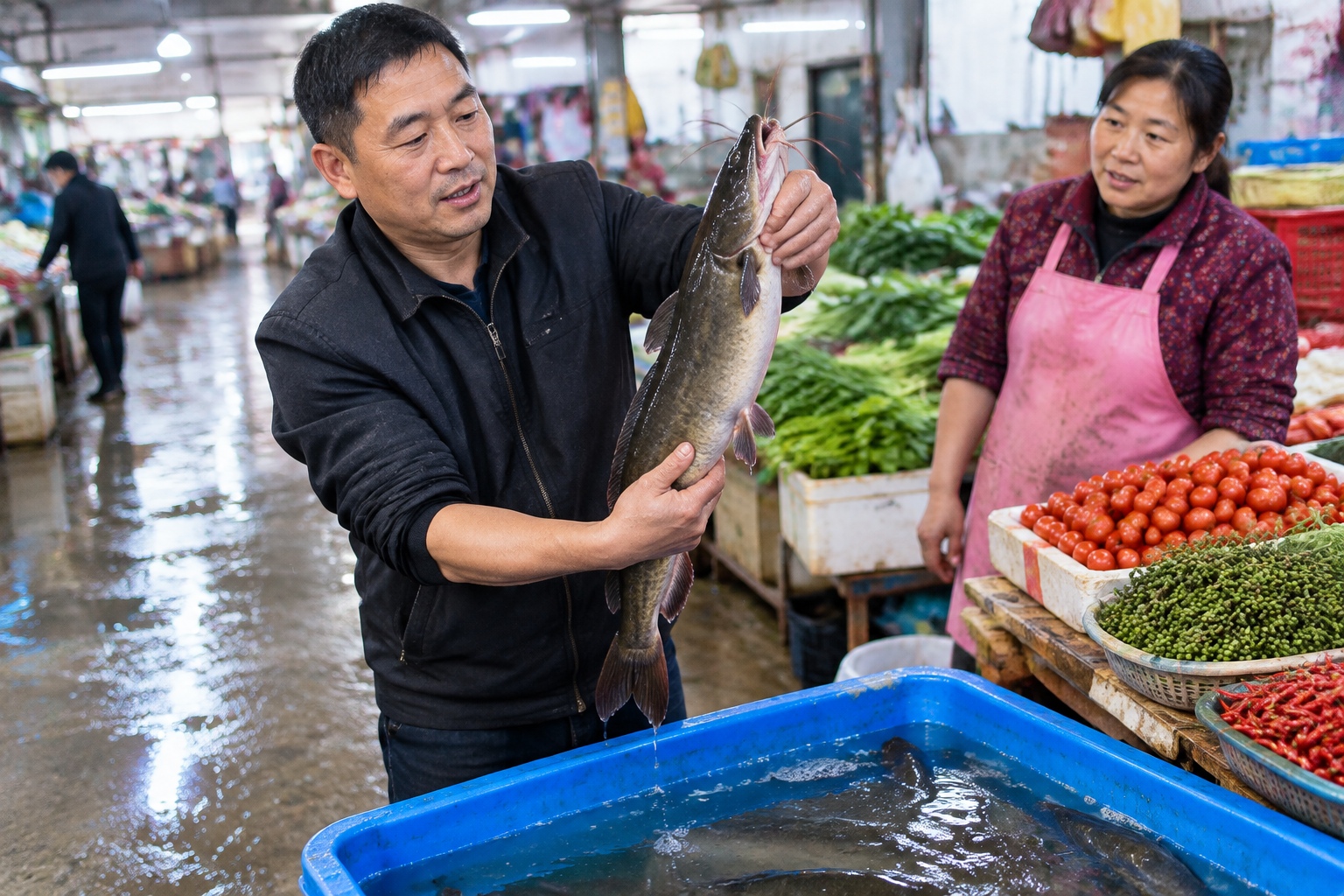

A Fish Weighed at 6:20 a.m.
Chen Minggui lifts a live longsnout catfish out of a blue plastic tub by its tail and presses a thumb into its belly. The fish, about two kilos, thrashes hard enough to splash the concrete. “Twenty-six a jin,” says the vendor, a woman in a pink apron who has sold him fish for nine years. Chen puts it back, walks two stalls down, and points at a smaller tub. They settle at 23 yuan a jin — about US$3.20 a pound — for three fish. He pays with his phone and moves on. The whole transaction takes four minutes.
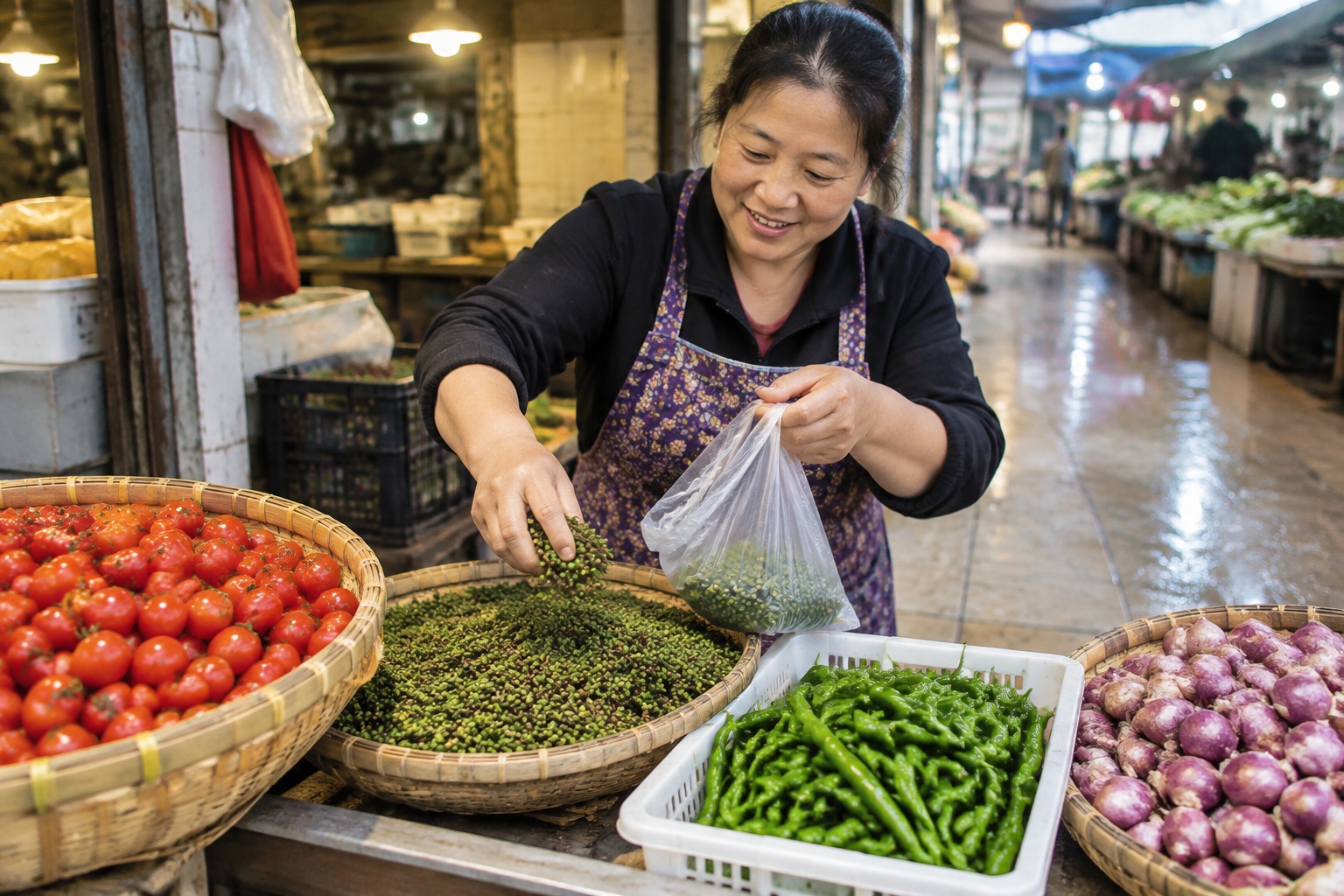
By 8:40, Chen will have bought 6 kilograms of fish, 4 kilograms of small sour tomatoes, a fist-sized bag of litsea buds, fermented chili and houttuynia. “The litsea is the thing,” he says, zipping his jacket against the damp. “In August you can smell it from the street. By November you take whatever’s left.”
Chen’s name has been changed at his request. The prices, wages and margins below come from his own accounting app.
What Sour Soup Fish Actually Is
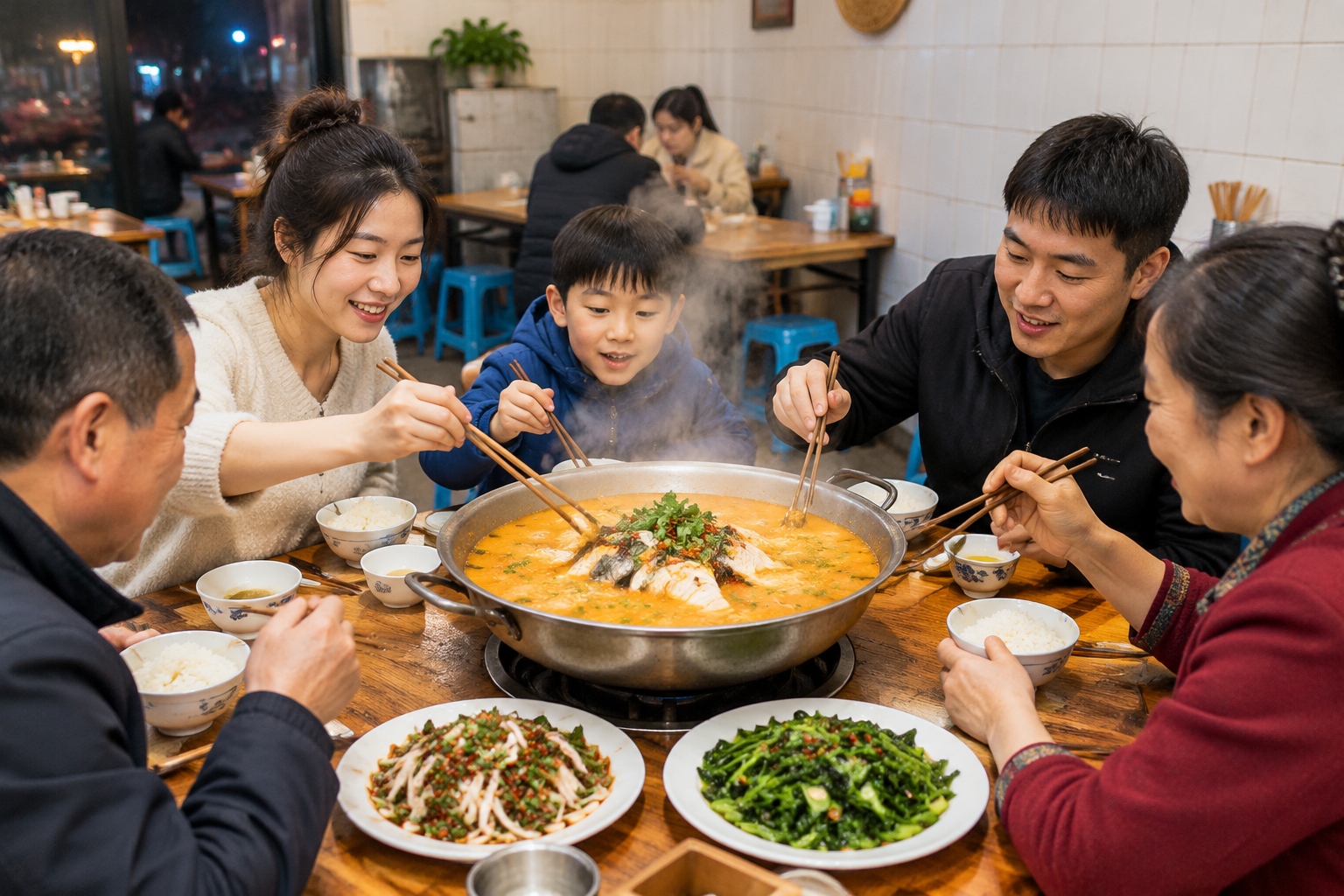
Sour soup fish (suantang yu) is a whole fish poached in a fermented broth and served in a wide pot in the middle of the table. Red sour soup, made from small sour tomatoes and chili fermented together for weeks, is orange, tangy and faintly sweet. White sour soup, made from fermented rice water, is pale and mild. Both get a handful of litsea — Litsea cubeba, a green bud that tastes like citrus peel crossed with eucalyptus and is often translated as mountain pepper. It is not spicy, and there is no substitute for it.
The dish comes from the Miao and Dong communities of Qiandongnan in eastern Guizhou, where sour fermentation long predates refrigeration. In Guiyang, about two hours west by car, it has settled into ordinary life: what a family orders when a cousin comes back from Shenzhen, what a nine-table restaurant serves on a Wednesday. It is a neighborhood dish, not a banquet dish and not a show for tourists. A neighborhood shop charges 60 to 90 yuan (US$8–13) a head. A mid-range restaurant with air conditioning and a live-fish tank charges 120 to 180. A pot for four at Chen’s place is 168 yuan.
One Chef, Fifteen Hours
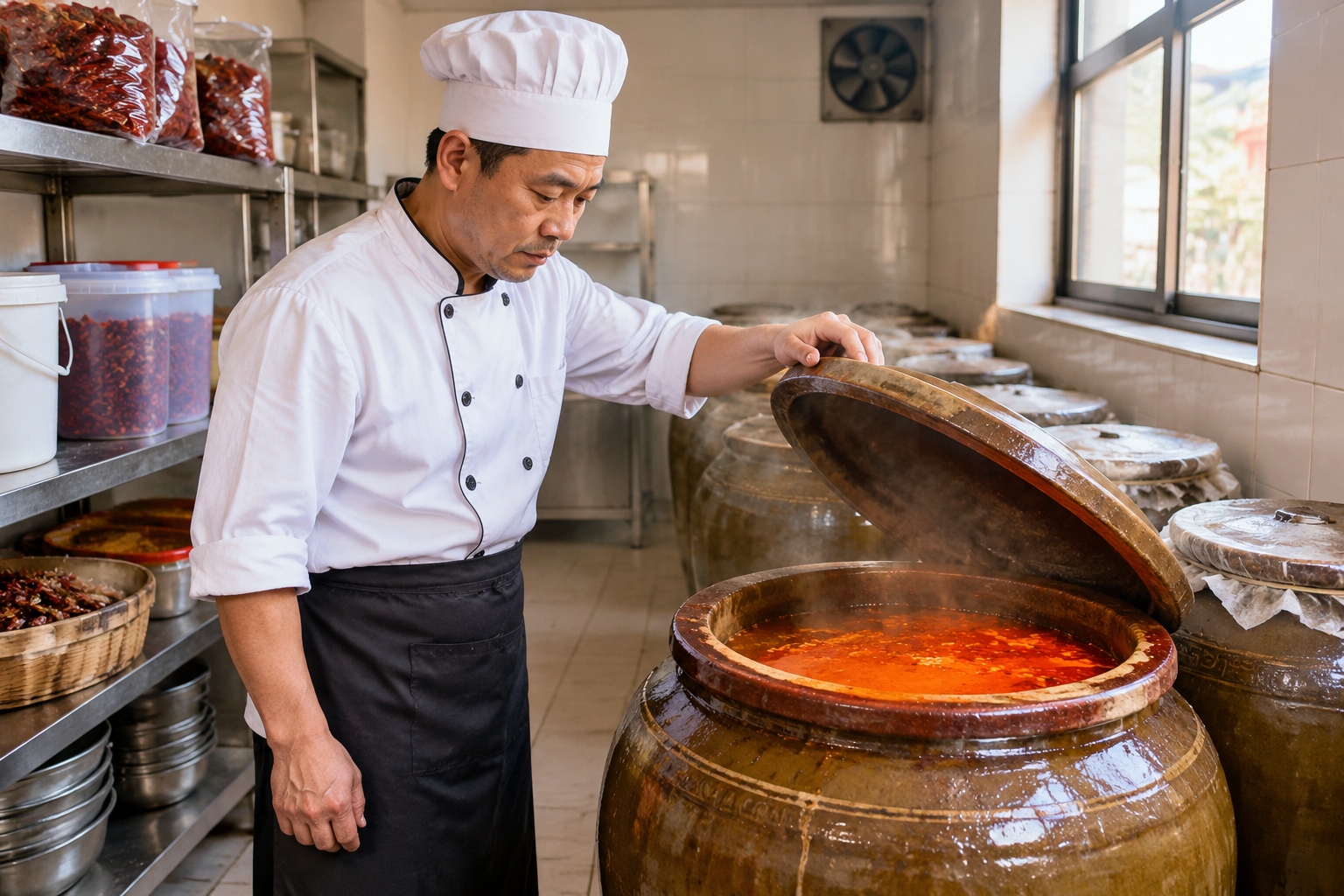
Chen is 43. He spent 12 years cooking in other people’s kitchens before opening his own place in 2016, on a street behind a bus terminus in Yunyan District. He employs nine people: three cooks including himself, three servers, two dishwashers, and one who handles takeout and prep. His day runs from 6 a.m. to about 11:30 p.m., when he sits in the back with cold rice and reconciles the day’s receipts on his phone.
The six ceramic jars in his back room are the part he refuses to outsource. Each holds a red sour soup base fermenting for 15 to 30 days. For volume he uses a factory base; for depth he uses his own jars, the way a baker might combine commercial yeast with a ten-year-old starter. “If I used only the jars, I’d be sold out by Friday,” he says. “If I used only the bags, I’d be selling soup, not sour soup.”
From a Karst Spring to the Table
The fish in Chen’s tank did not swim here. Guizhou is about 90 percent mountains and hills, and its rivers have been under fishing bans and restocking programs for years. Nearly all restaurant fish now comes from farms, many built around the province’s cold karst springs, which hold steady between 14 and 20 degrees Celsius year-round. That has made Guizhou one of China’s larger producers of farmed sturgeon and cold-water catfish.
Chen buys from two farms, in Anshun and Zunyi, on annual contracts repriced twice a year. A refrigerated van arrives at his back door at 7:30 six days a week. He stopped buying fish at the wholesale market because wholesale can no longer beat his contract price.
The tomatoes are a different story. The small sour tomatoes he needs come from Qiandongnan, and over the past decade they have become the raw material of a real industry. Kaili, the city that gave sour soup its best-known brand name, now has fermentation plants that salt, cook and package sour soup base in 5-kilogram bags sold nationwide. That standardization is why a sour soup fish restaurant can open in Beijing and taste roughly like one in Guiyang. Litsea remains the least industrial link: it grows wild on hillsides above 1,000 meters, is picked by hand in late summer, and costs 22 yuan a bag in a good year and 60 in a bad one, depending on what the pickers carry down that week.
The Small Loop Around One Pot
A restaurant like Chen’s isn’t a single business. It’s a junction. Nine employees earn 3,500 to 5,500 yuan a month plus two meals a day; two of them come from counties four hours away and send money home. Rent goes to a landlord whose family has owned the building since the 1990s. Fish money goes to two farms. Vegetable money goes to a market with about 60 stalls. A delivery rider collects 20 to 40 orders a day from the block. The rice noodle shop next door absorbs the overflow when Chen’s queue reaches the door, and Chen’s staff eat breakfast there.
None of that shows up in a tourism statistic. It shows up as nine paychecks, two farm contracts, one refrigerated van route, and a woman in a pink apron who has sold fish to the same man for nine years.
The Arithmetic of a 168-Yuan Pot
Here is how Chen breaks down one pot of red sour soup fish for three or four people, priced at 168 yuan (about US$23):
- Fish, 1.5 kg: 48 yuan
- Sour soup base, tomatoes, litsea, vegetables: 20 yuan
- Rice, side dishes, tea, condiments: 14 yuan
- Labor, allocated per table: 32 yuan
- Rent: 22 yuan
- Gas, electricity, water, cleaning: 9 yuan
- Packaging, waste fees, tax: 8 yuan
- What’s left: about 15 yuan, or roughly 9 percent
Two things dissolve that margin. The first is delivery. Send the same pot through a food delivery app and the platform takes 15 to 20 percent, plus about 3 yuan for packaging — which cuts the profit roughly in half and requires the soup to survive a scooter ride. Chen caps delivery at a quarter of his orders and refuses to send whole fish during rain.
The second is seasonality. Guiyang’s tourist season runs from May to October, when cool summers, street concerts and the amateur “Village Super League” football tournaments in nearby counties pull in visitors. On those weekends, tables turn three times. In January and February, a weekday lunch might serve 11 covers. Chen keeps a cash cushion sized for two slow months, not one.
There is also a split in the customer base that never appears on the menu. Visitors order red sour soup, because that is the version they saw on television. Locals, especially older ones, ask for white sour soup or a half-and-half pot. The kitchen knows the difference even when the menu doesn’t.

What Is Changing
Five years ago, Chen’s competition was other neighborhood restaurants. Now it includes franchised sour soup hotpot chains with branches in Beijing, Shanghai and Chengdu, and packaged sour soup base on supermarket shelves. Standardization has made the category bigger and made it easier for someone with no connection to Guizhou to open a shop called “Kaili Sour Soup.”
Costs have moved too. Chen says kitchen wages in Guiyang have risen by roughly a third since 2019, fish prices swing 15 to 20 percent within a year, and his rent went up at the last renewal. Younger customers want smaller pots, more side dishes, less sourness, and food that photographs well.
His answer has been subtraction. He cut the menu from about 60 dishes to 32. He swapped wholesale purchasing for direct farm contracts. He now sells his own jarred sour soup base to regulars at 25 yuan a jar — a side business worth around 4,000 yuan a month in winter, when restaurant traffic thins. And he kept the jars in the back, even though factory bags are cheaper, because that is the part guests can taste and rivals cannot copy quickly.
The Pot at 9 p.m.
On a Thursday night, a table of twelve is celebrating something. Two plates of houttuynia and a dish of fried chili are already empty. The fish goes in raw, the broth clouds from orange to pale, and someone drops in the litsea at the last second so the steam carries it across the room.
Chen stands by the door with his arms crossed, watching the table rather than the pot. “People say I sell fish,” he says. “I sell a reason for twelve people to sit down together for two hours.”
That is what a community economy looks like from the inside: not a growth rate, but a jar of fermenting tomatoes in a back room, a van arriving at 7:30, nine people with paychecks, a rider with a thermal bag, a farmer in Anshun who knows he has a buyer until at least next June — and a chef who got to the market early enough to buy litsea while it was still in season.
Start the discussion at forum.chinacomes.com