

A donation van on a Saturday morning
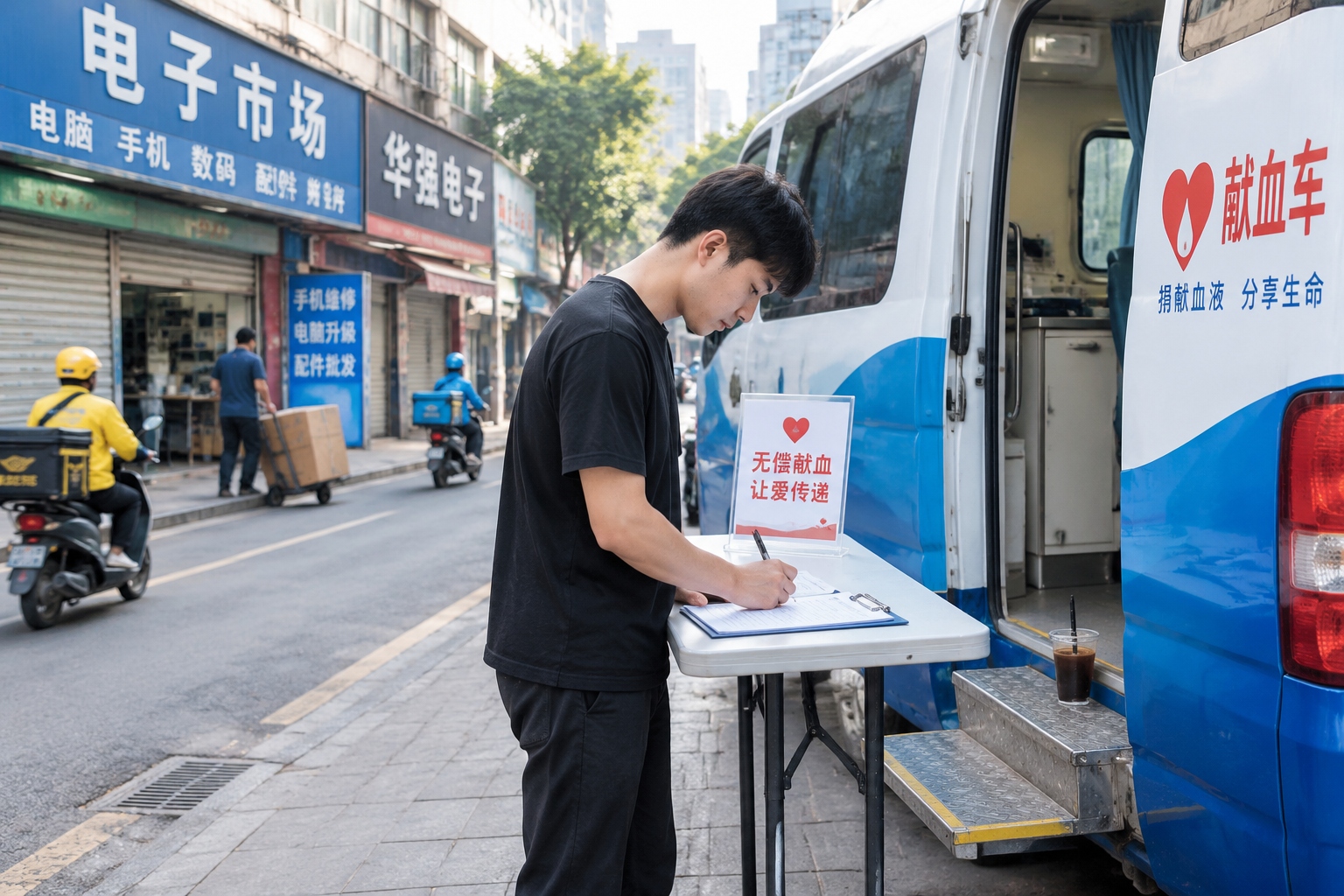
By 8:20 on a Saturday morning in Huaqiangbei, the heat is already coming off the pavement. This is Shenzhen’s electronics district, and the street is just waking up: roller shutters rattling open, boxes of cable rolling along the sidewalk, delivery riders threading through traffic. A white and blue blood donation van sits in its usual spot. On Saturdays it arrives before most of the shops.
A young man in a black T-shirt walks to the back of the van, sets an iced coffee on the step and starts filling in a form. He has donated twice before. A nurse leans out of the window. “Two hundred again?” He nods.
From the form to the last swallow of coffee, the whole thing takes about thirty-five minutes. Nobody photographs him. Nobody claps. “I live around here,” he says later. “Roughly every six months. It’s not a big deal.”
The not-a-big-deal is the point.
The system that made blood donation ordinary
Before 1998, most of the blood used in Chinese hospitals came from paid donors, and the system was not a proud one. Cash for plasma pulled in the poorest people — migrant workers, students — who often sold more often than their bodies could afford. HIV clusters in parts of Henan province in the 1990s remain the best-known scar from that era.
The Blood Donation Law took effect on October 1, 1998, and banned payment for blood. It took about a decade for practice to catch up with the statute, but by around 2010 more than 99 percent of the blood used clinically in China came from unpaid volunteers — the direction the World Health Organization has recommended for decades.
Today the rules are fairly straightforward.
- Age: 18 to 55, extendable to 60 for people with a donation history who pass the health check.
- Weight: at least 50 kg for men, 45 kg for women, with minimum hemoglobin levels.
- Whole blood: six months between donations. A standard donation is 200, 300 or 400 milliliters.
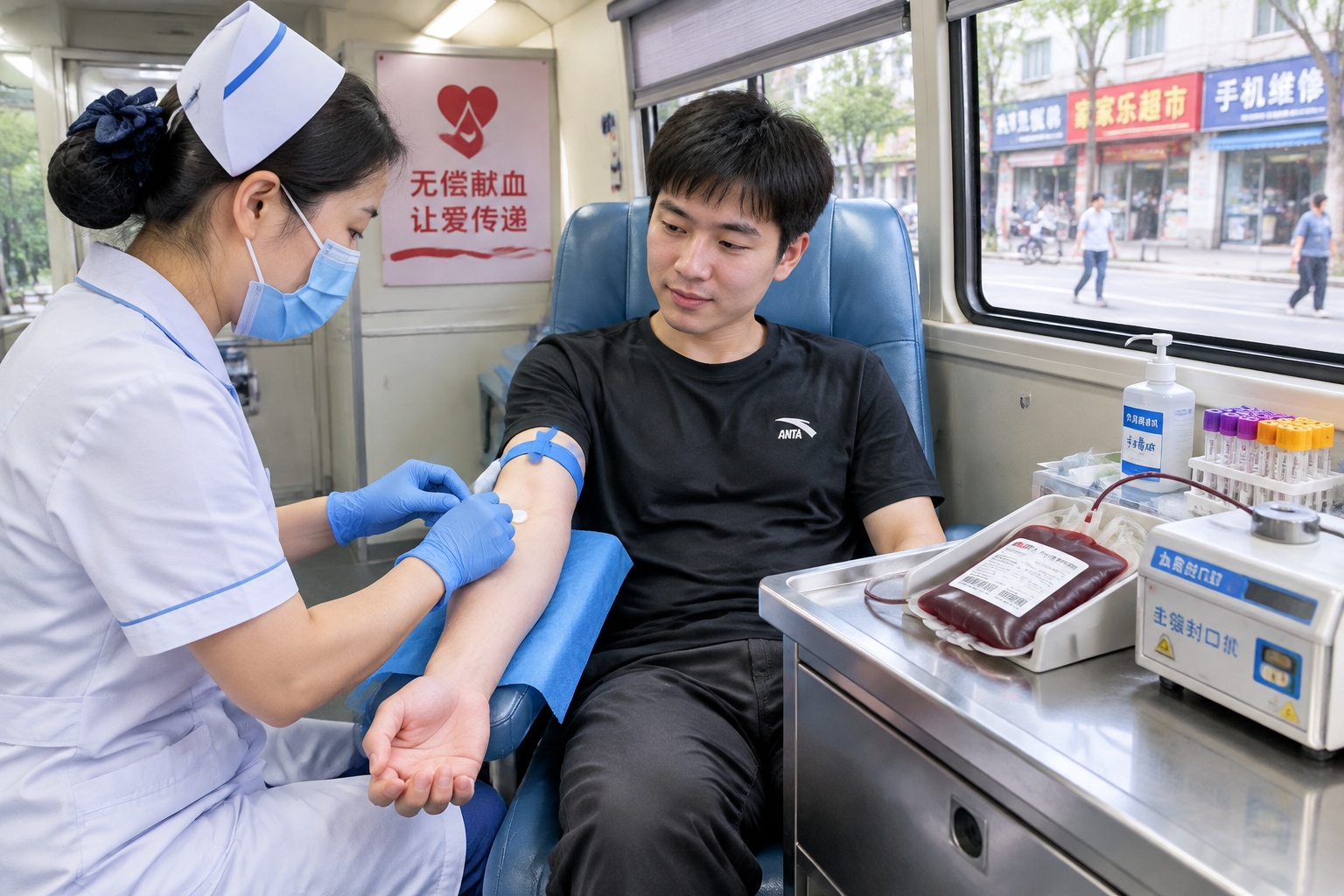
- Platelets (apheresis): every two weeks at most, capped at 24 times a year. It takes longer — about an hour — because blood is drawn, spun to separate the platelets and returned to the donor.
Most cities run three kinds of collection points: fixed donation houses, usually near a metro station or a mall; mobile vans on a set schedule; and group donations organized by universities, hospitals, state-owned companies and private firms, which often send a bus.
Blood itself is free. Patients pay for testing, processing, storage and transport, and donors can claim reimbursement for those costs, for themselves and for close family. The rules vary by province but typically cover a donor’s spouse, parents and children.
A woman on her eleventh donation
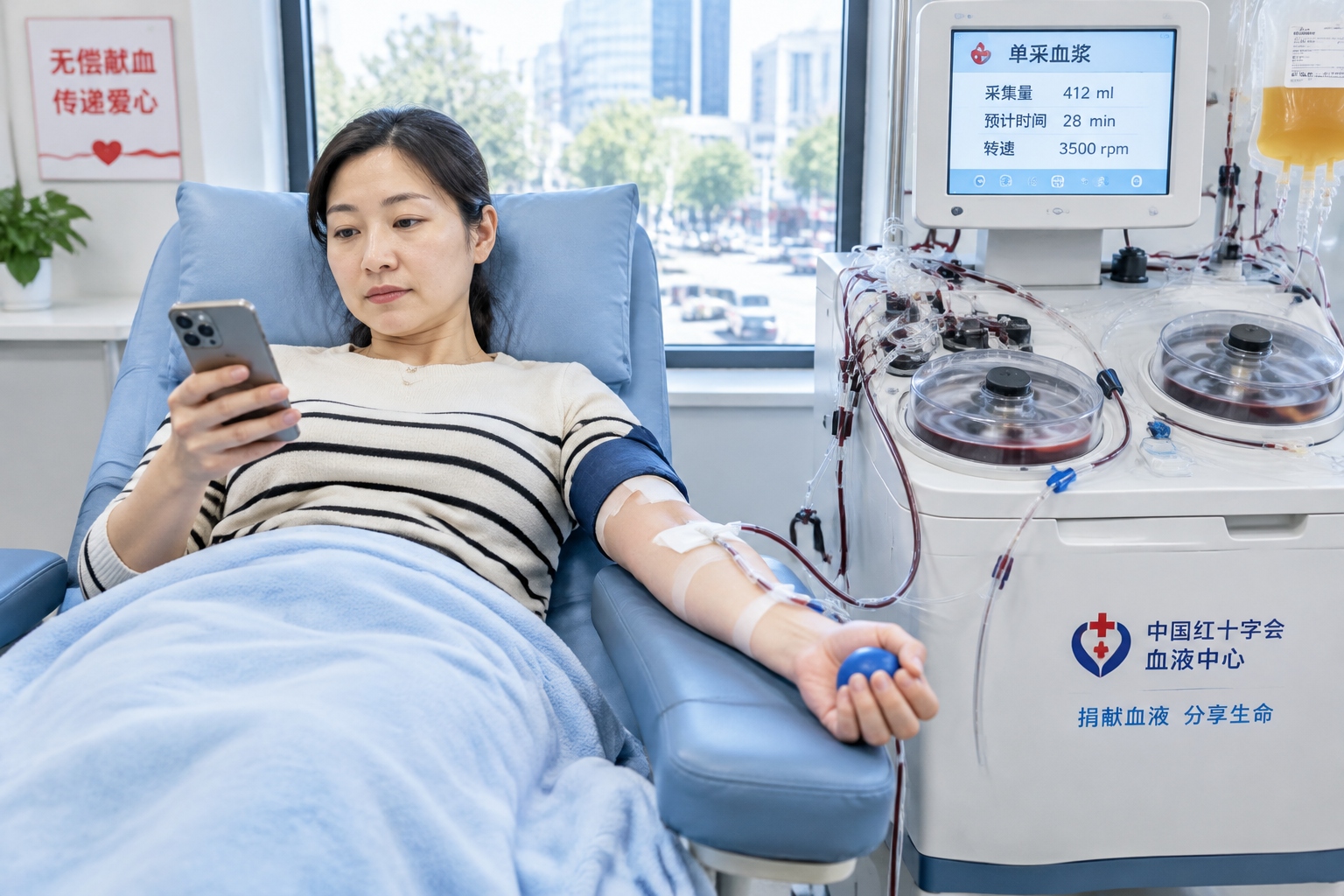
In a donation house in Futian, a woman in her early forties lies on a recliner with a blanket over her knees, one arm connected by clear tubing to an apheresis machine. Two centrifuge bowls spin beside her. She works in accounting at a logistics company, and this is her eleventh donation, most of them platelets.
Her father had surgery in 2016 and needed a transfusion. Hospital staff mentioned that if a family member had donated, part of the cost could be reimbursed. “That was what got me in the door,” she says. “Later it stopped mattering whether it was reimbursed or not. It just became something I do.”
She takes her phone out of her bag and scrolls with her free hand. The machine cycles through another round. Almost an hour.
Why people show up
Ask donors in different cities why they started, and the answers cluster in a few places.
Reimbursement. A donation record can offset part of the cost if you or a relative needs blood later. A surprising number of first-time donors walk in because someone in the family has surgery scheduled.
The workplace. Group donations by employers and universities make up a large share of the national total. A bus pulls up, a floor of an office empties out in shifts, and there is often a day off or a small subsidy attached — which many donors quietly admit is a factor, though rarely the main one.
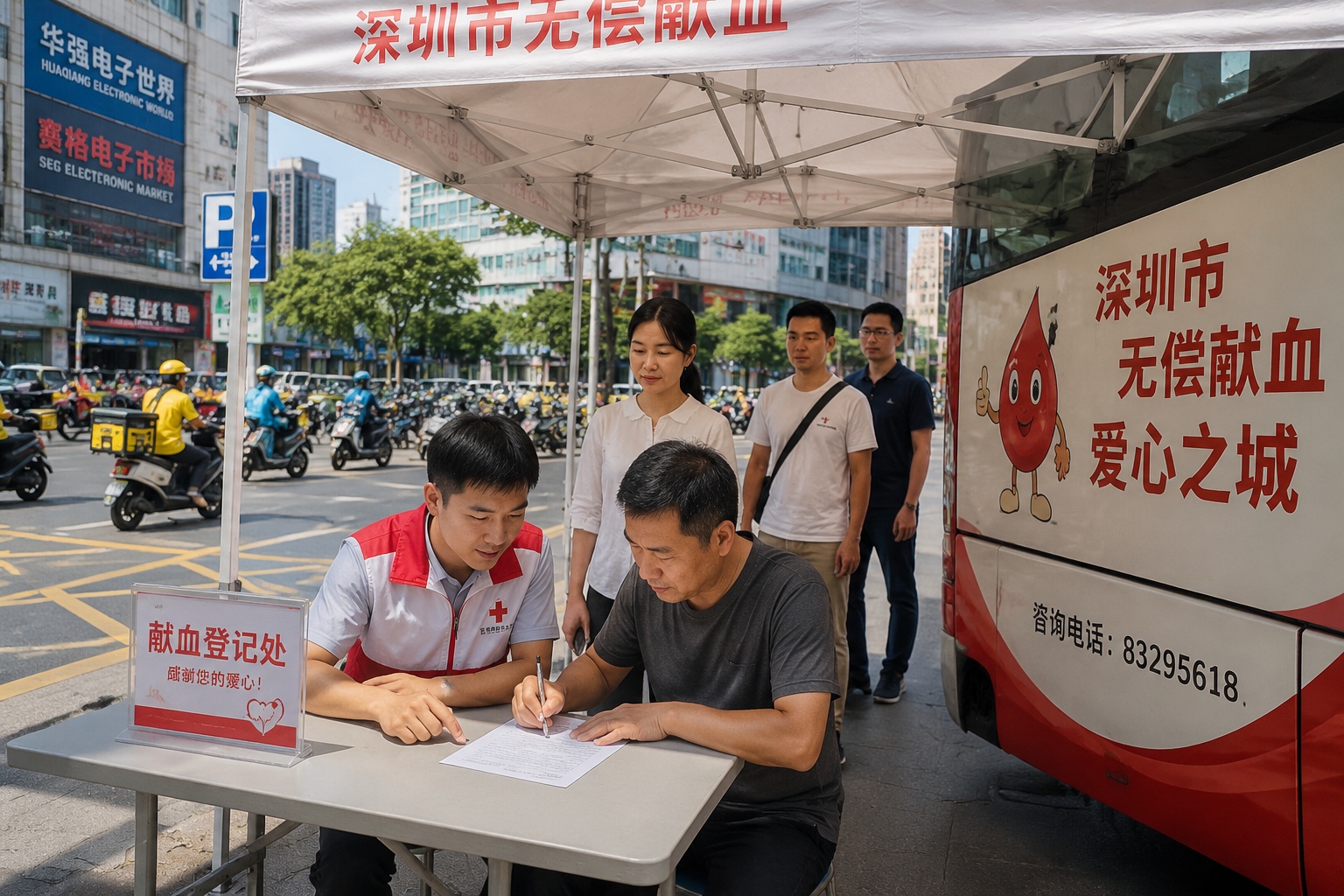
Volunteer teams. In cities like Shenzhen and Shanghai, experienced donors recruit and accompany newcomers, standing at tables outside the van.
Marking a date. Birthdays, turning 18, graduating, getting married. Blood centers lean into this — themed events around Valentine’s Day or Lunar New Year, a card with the date printed on it.
And then there is the simplest answer, which is hard to put in a policy document: at some point a person decides that this is something they are.
Chinese framing of altruism tends to be understated. It is not “I am a hero.” It is zuo hao shi — doing a good thing — a phrase that assumes a good thing should not need an audience.
When the blood banks run low
The system works, but it does not work evenly. Supply tends to dip in winter, especially around Lunar New Year in January or February, when university students go home, migrant workers leave the cities and colds and flu temporarily rule people out. Summer, in July and August, brings a second dip.
Demand, meanwhile, keeps climbing. Hospitals in big cities perform more surgeries each year, and cancer treatment consumes a large share of the platelet supply. In tight months, some hospitals ration blood and postpone non-urgent procedures.
Early 2023 was the loudest recent example. With infections sweeping the country, donations fell sharply and blood centers in many provinces issued public appeals. The response was real — lines formed outside donation houses — but the episode put the fragility of the inventory on the record.
Blood centers have answered with a mix of tactics: moving vans into residential compounds and industrial parks, organizing emergency group donations, expanding reimbursement rules, and using mobile apps to book appointments so donors do not spend an hour waiting.
What would widen the circle
Roughly 15 million donations are made in China each year. That sounds like a lot, but it is a small fraction of the population, and regular donors in particular remain a narrow group. Most people who donate once never come back.
The question blood centers keep returning to is how to turn a first-time donor into a habitual one. Internationally, the evidence points to boring things: convenient locations, short waits, a reminder message at the right moment, and a clear explanation of where the blood went. Big campaigns tend to do less than a convenient Saturday morning.
There is also a demographic squeeze. The patient population is aging faster than the pool of eligible donors is growing. Japan and South Korea have been working through the same arithmetic for years.
Back on the street
The young man in the black T-shirt stands up, folds his sleeve down and takes the small card the nurse hands him. She gives him a drink and a biscuit. He asks when he can come back. “Six months,” she says. “December, then,” he says, and taps it into his phone.
He picks up the iced coffee, now mostly water, and walks back out into the Shenzhen morning. Nobody on the street notices what he has just done. That was never the point.
Start the discussion at forum.chinacomes.com