
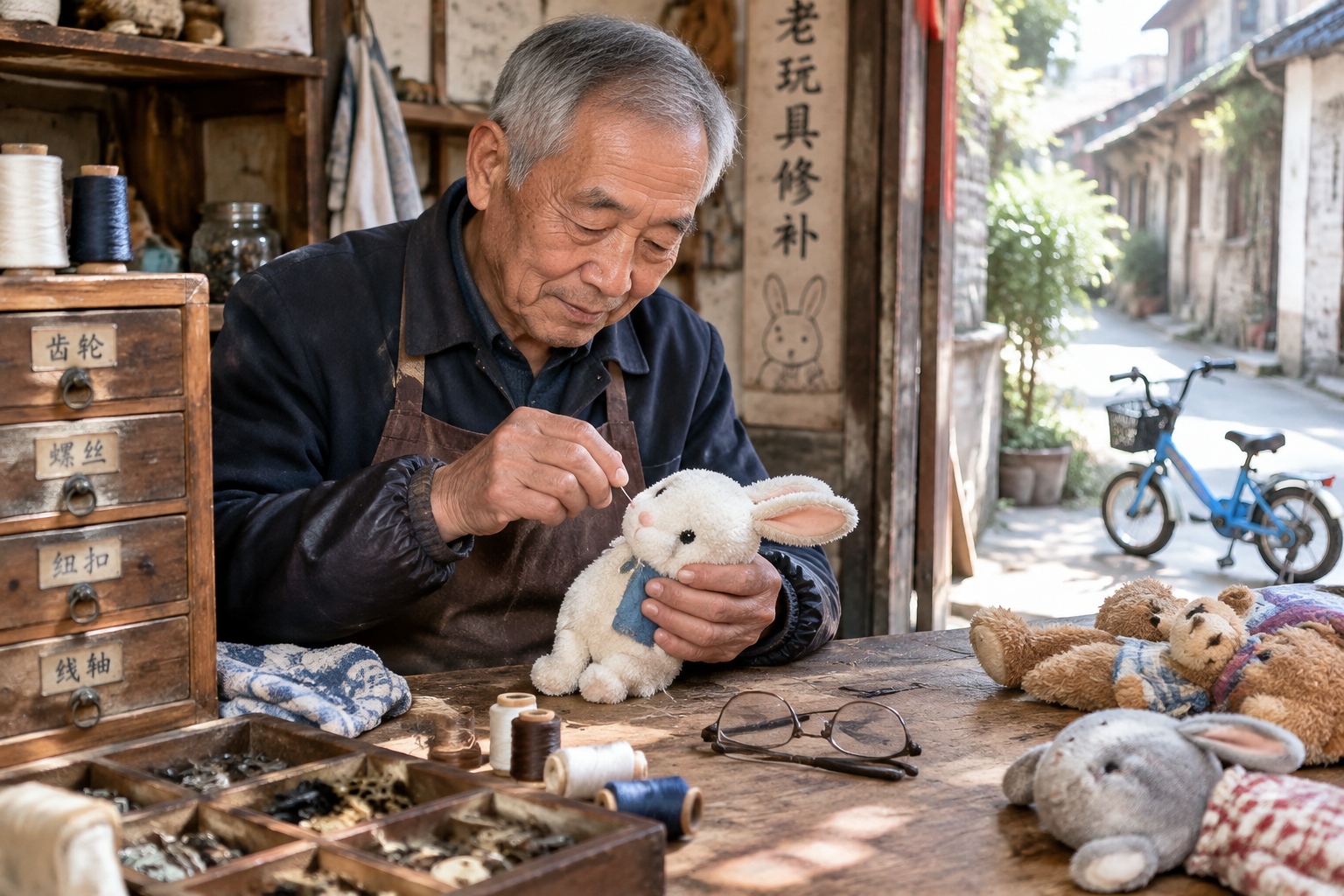

A tiny waiting room in a Chengdu alley
It’s 4:30 in the afternoon in an old neighborhood in Chengdu, the capital of Sichuan province in southwest China, a city of about 21 million people. Inside a shop barely ten square meters, Grandpa Chen flips a plush rabbit over and studies the split seam through the top of his reading glasses.
“This one has used up three of its lives,” he says. It sounds like a joke, but only partly.
A girl of about seven watches his hands. Her mother stands in the doorway holding a bag of vegetables. The rabbit’s name is Doudou. It has been with the girl for four years. It lost its left ear last year. Now the right arm is coming off.
Chen measures the tear and picks a thread that matches the faded fur — not the original pink, but the washed-out pink it has become. Then he starts to sew. Slowly. The stitches are so small you can barely see them.
Twenty minutes later, Doudou’s arm is back. Chen holds the rabbit up to the light, the way a jeweler holds a stone.
“Don’t hug it for three days,” he says.
The girl nods with the seriousness of someone signing a contract.
How a watchmaker became a toy doctor
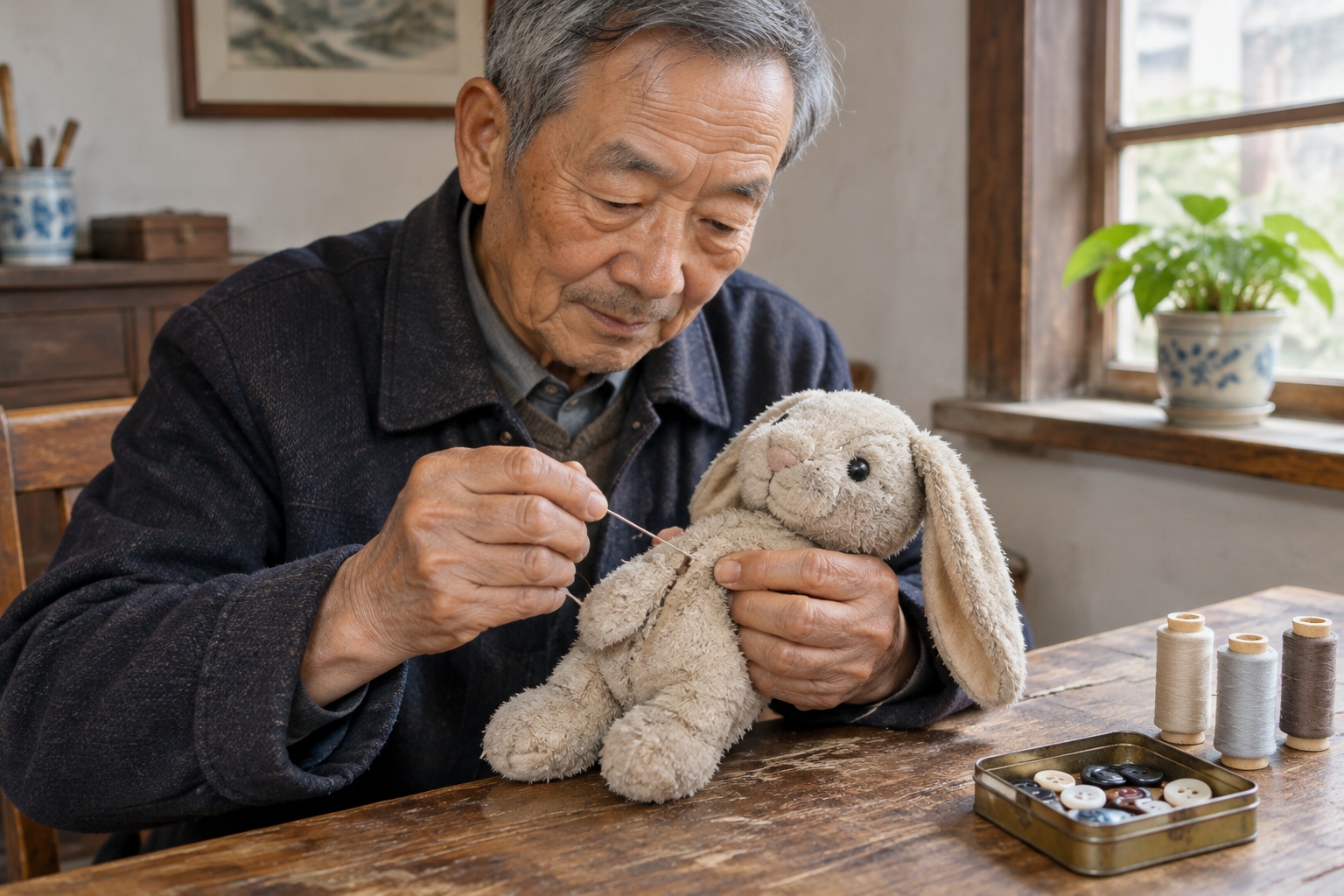
Grandpa Chen is 73. In China, people call him lao daye — a warm term for an older man — and he has run this shop for about a decade. The handwritten sign above his counter says eight characters: Toy Hospital — Mending Childhood. There is no phone number, no QR code, no delivery service.
His first trade was watches. From the late 1970s through the 1990s, he repaired mechanical timepieces on a small table near Chunxi Road, Chengdu’s old commercial district. Replacing a hairspring, re-setting a gear — it was respectable work. Back then, repairing things was the default. Shoes, umbrellas, radios, enamel cups. You fixed what you had.
Then quartz movements and cheap digital watches changed the economics. Fixing a watch for 50 yuan stopped making sense. “The thing became cheaper than the labor,” he says. He says it without bitterness, the way someone reports the weather.
The toys arrived not long after. Around 2008, a neighbor showed up with a smoking toy train and asked him to take a look. He looked. He fixed it. Word traveled between customers. People started bringing plush animals, remote-control cars, plastic dogs that barked. In 2015, he cleared away the watch parts and built a toy bench. He never went back.
These days he takes on roughly 15 to 20 jobs a week. There is no price list. He charges somewhere between 30 and 200 yuan (about $4 to $28), depending on the work. He often charges nothing at all — a loose screw, a battery that needs re-seating.
What the job actually requires
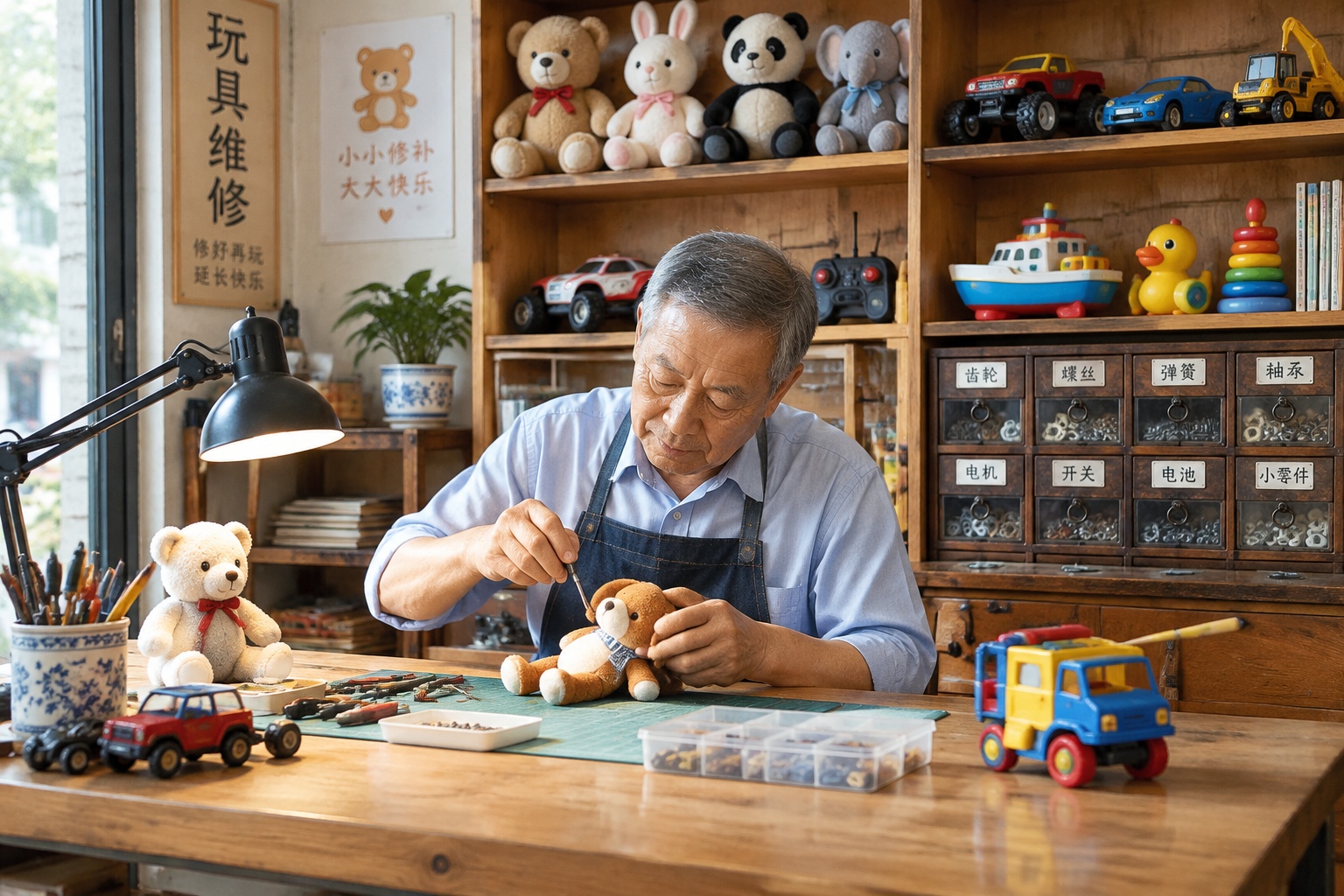
Toy repair is a mix of skills. For a torn plush animal, the first step is diagnosis. Chen opens the seam slowly. He calls it surgery, and he means it. He removes the stuffing, brushes the fabric with a soft brush, avoids the embroidered eyes. Then he adds new cotton — but he keeps some of the old filling, because, he says, worn materials carry their own weight. “You can’t replace all of it. Otherwise it won’t recognize itself.”
Mechanical toys are another world: plastic gears, tiny motors, thin metal axles. He keeps a small box of salvaged parts, gears pulled from toys beyond saving, going back to 2013. “I never run out of parts. Broken things keep arriving.” It is an environmental statement he has never framed as one.
Then there is color. Faded ink, chipped paint. He mixes acrylics by eye, building up the tone in small layers until it blends with the surrounding surface. A bear’s face can take three days.
The hardest part is telling damage from age. A woman once brought in a rabbit that had turned gray and asked him to wash it back to white. Chen refused. It was never white. Gray was the point.
“New isn’t better. The way it was, that’s better,” he says.
The people who come with boxes
Grandma’s rabbit
Last autumn, a 22-year-old woman brought in a rabbit with one eye missing. She had just been accepted to a graduate program overseas and wanted to take it with her. Her grandmother had given it to her when she was six. Her grandmother died the winter before.
Chen patched the fabric and found a brown button in his collection that was the right size and hue for the missing eye. The woman asked what she owed. He told her to keep her money. She showed him a photo of her grandmother on her phone. He looked at it for a long time.
A fire truck and a twelve-year-old
A father in his forties came in with a red plastic fire truck held together by three layers of tape. His son had learned to walk while pushing it. The son was now 12 and hadn’t touched it in over a year. The mother wanted to clear things out — the apartment was small.
The siren had stopped working. The front wheels barely turned. Chen took apart the sound board, re-soldered two wires, and fitted a salvaged axle sleeve. It took him two hours. When he pressed the button, the siren came back loud and shrill, exactly as it had sounded a decade earlier.
The man stood at the counter for a few seconds before he spoke.
“That’s the same sound,” he said.
“Yes,” Chen said. “The same sound.”
The high schooler who wouldn’t explain
On a Saturday last year, a boy came in with a palm-sized brown bear. Nothing was really wrong with it — a plastic thread around the neck had come loose. Chen fixed it in two minutes and waved off payment. The boy said thank you, walked three steps toward the door, and turned around.
“It’s from her,” he said. “Please don’t tell anyone.”
Chen nodded. He has seen enough over the years to know what not to ask.
Why keeping old toys is becoming a quieter choice
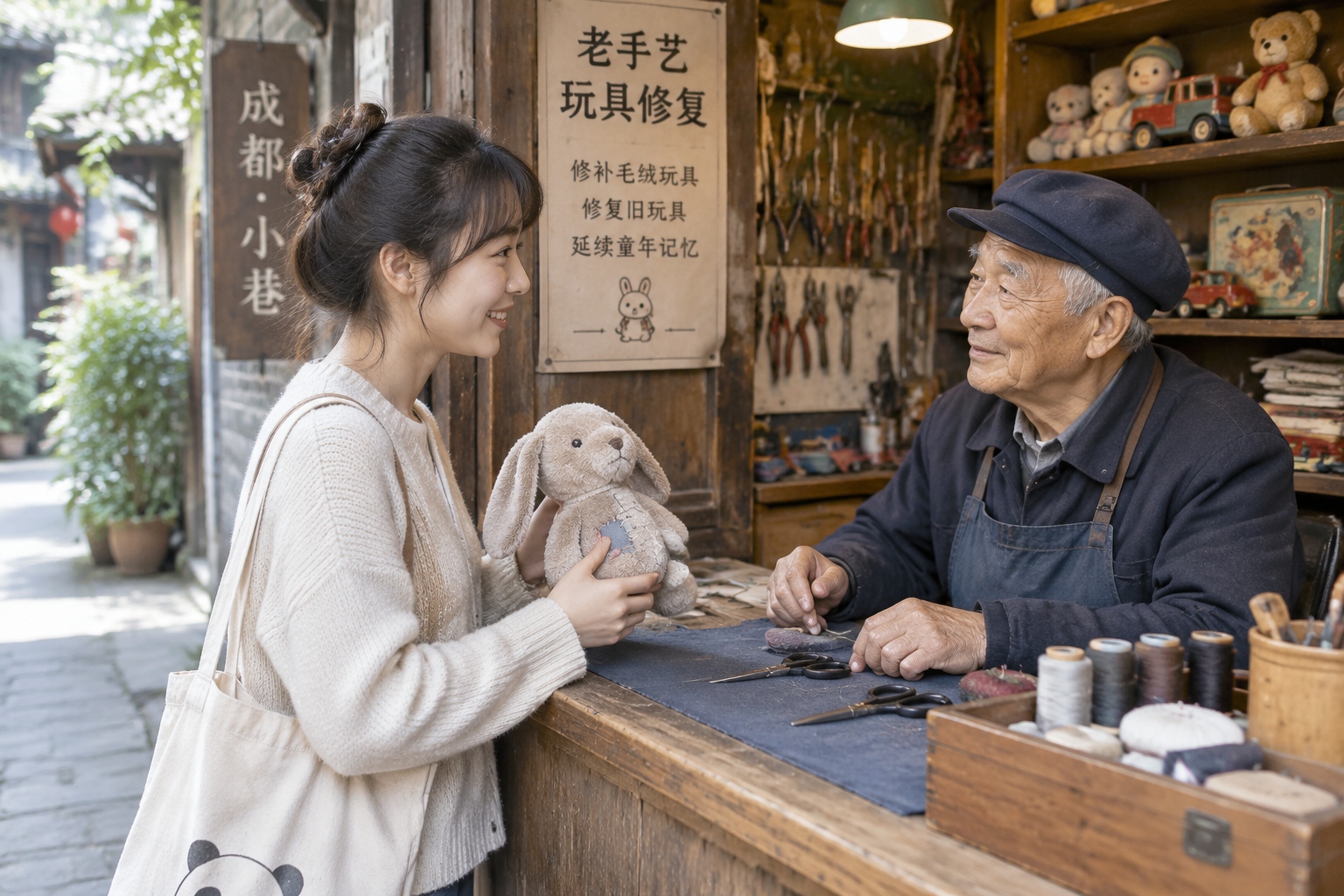
China makes most of the world’s toys. It also makes them cheaply. Ordering a replacement online is often faster and less expensive than repairing what you already own. That math is real for almost every family.
But there is a counter-current. Second-hand toy listings on platforms like Xianyu keep growing. Small repair stalls — shoes, bags, electronics, toys — are finding new customers in cities where a generation of young adults now rents rather than owns. Many of them moved across provinces for work: Sichuan to Guangdong, Hunan to Shanghai. When you carry less, the things you keep matter more.
A rabbit, a fire truck, a Rubik’s cube. They aren’t worth much. But they’ve been carried across time, and they still hold the imprint of someone’s hands, the light of a particular afternoon, the smell of a demolished building.
Grandpa Chen sits in the middle of that traffic. He doesn’t talk about heritage or revival. He just bends his head and sews.
Six-thirty, closing up
When the light goes, Chen switches on the desk lamp and puts things back one by one. Needles sorted by size. Thread spools returned to their places. An operating room turning off its lights. A classroom emptying out.
He says he isn’t doing anything special. Fixing watches, fixing toys — it’s the same work. “Broken doesn’t mean it should be thrown away. Things are like that. People too.”
Tomorrow at 4:30, school lets out. Kids will run down the alley again. The little bell tied to the doorframe with wire will ring when they push the door — old, and still ringing, like everything else in the room.
Start the discussion at forum.chinacomes.com