

Eleven Forty at the Red Gate
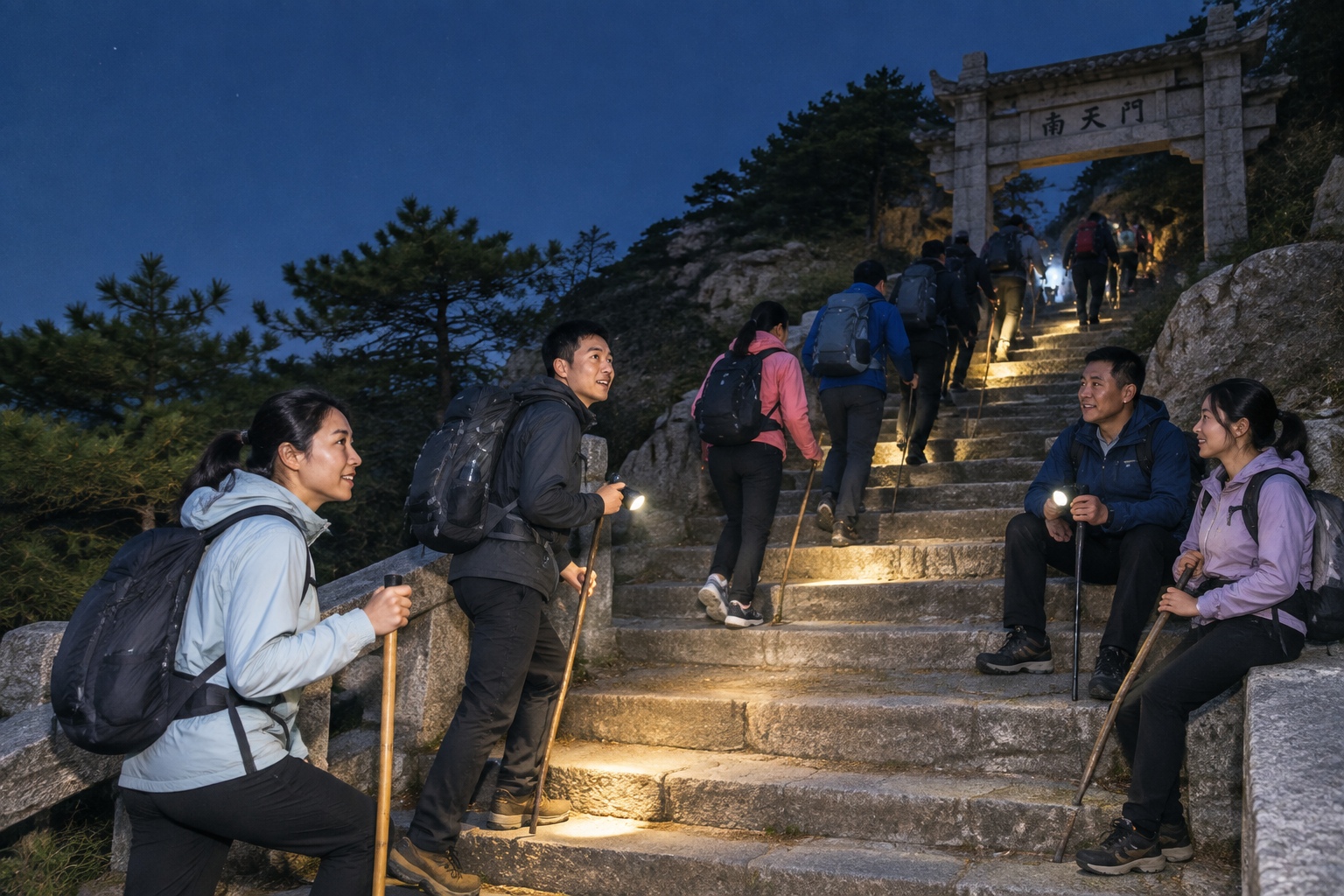
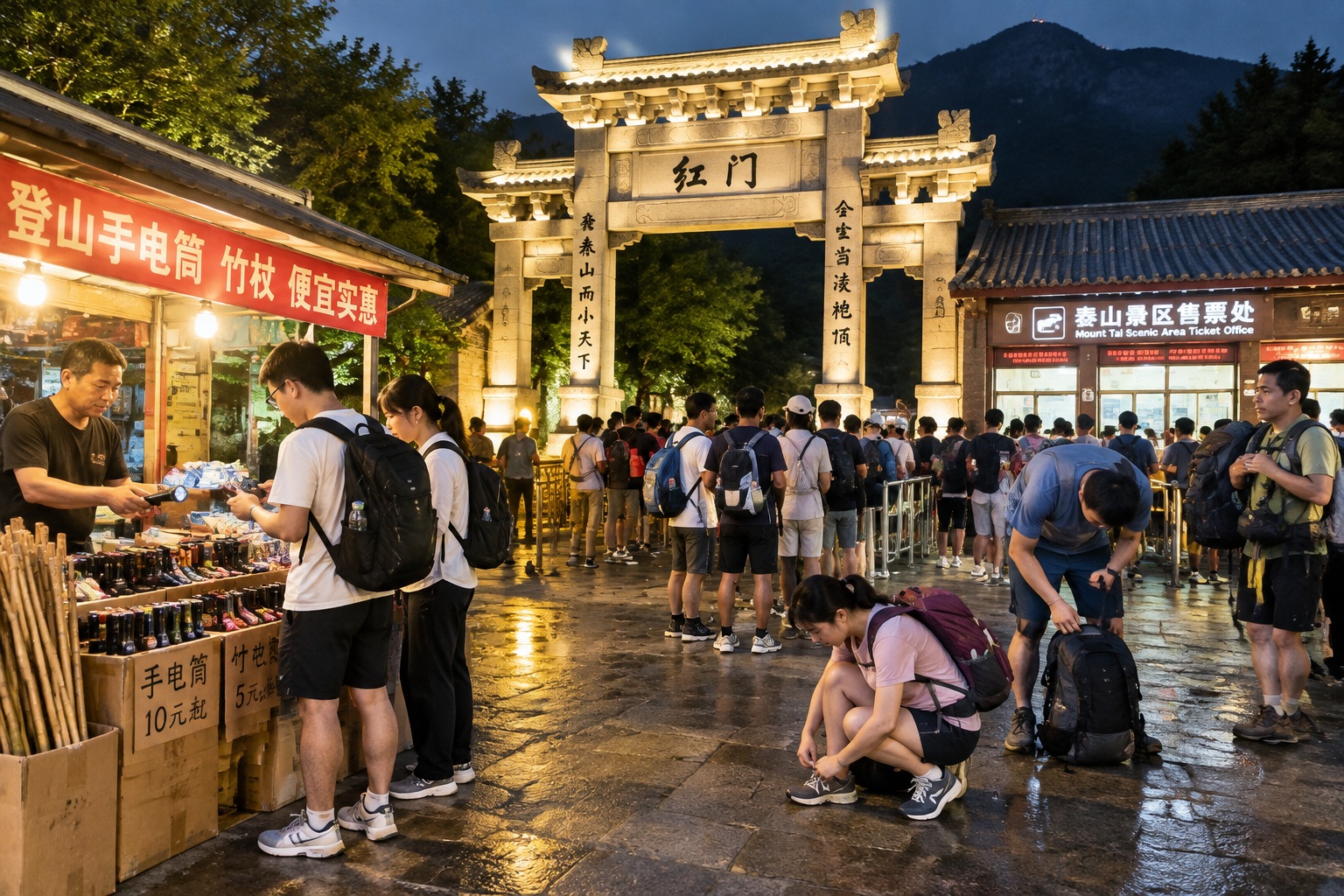
The first thing you notice is the sound of plastic. Thousands of cheap flashlights — the kind sold out of cardboard boxes for ten yuan — clicking on, one after another, down the length of the street. Then the smell: fried dough, thermos coffee, pine resin, and the sharp mineral cold of a mountain at night. Then the sight of it. A line of people, maybe a thousand strong, filing up a stone staircase into a darkness that looks solid.
It is 11:40 p.m. at Hongmen, the Red Gate, the traditional starting point for climbing Mount Tai in Shandong Province. Nobody here is going to bed. Everyone is going up.
Mount Tai — Taishan — rises 1,545 meters above the North China Plain, the highest point in the province and one of the most climbed mountains on earth. Chinese emperors came here for two thousand years to perform sacrifices to heaven and earth; Qin Shi Huang, the first emperor, hauled himself up in 219 BC. Confucius is credited with the line that from the top of Mount Tai, the world looks small. Today a high-speed train from Jinan takes twenty minutes, and an entry ticket costs around 115 yuan.
Almost none of the people around me are thinking about emperors. They are thinking about the 5:02 a.m. sunrise, and whether they will make it.
Who Climbs a Mountain at Midnight
A group of twelve university students from Jinan passes me, all wearing the same red headband, counting each other off like a shepherd. Behind them, a man in his fifties carries a sleeping five-year-old on his shoulders; the child’s sneakers knock gently against his chest. Two women in office clothes are still on the phone with their manager. An old man in cloth shoes overtakes everyone at a steady pace and disappears — I later learn he does this every month.
Night climbing is not a niche hobby here. It is a budget strategy, a rite of passage, a team-building exercise and a date, all at once. There is no hotel to pay for, no cable car to queue for, and the whole thing costs less than dinner for two in a mid-range city restaurant. On a summer weekend, 20,000 to 30,000 people go up Mount Tai in a single night. On national holidays it can be twice that.
It is also cooler. Climbing in daytime summer means 35°C and direct sun the whole way. At night it is roughly 22°C at the bottom and about 8°C at the summit, plus wind. People know this. That is why half the crowd is carrying a jacket they will be very grateful for at four in the morning.
The Economics of a Staircase
Prices rise with altitude, and everyone knows it. Bottled water costs two yuan at the Red Gate, five at the halfway point, ten near the top. A bamboo walking stick — the unofficial badge of the Mount Tai climber — is three yuan at the bottom and eight yuan higher up. Cucumbers, sold in threes out of plastic buckets, are the local energy gel: cold, salty, cheap, and inexplicably perfect at 1,200 meters.
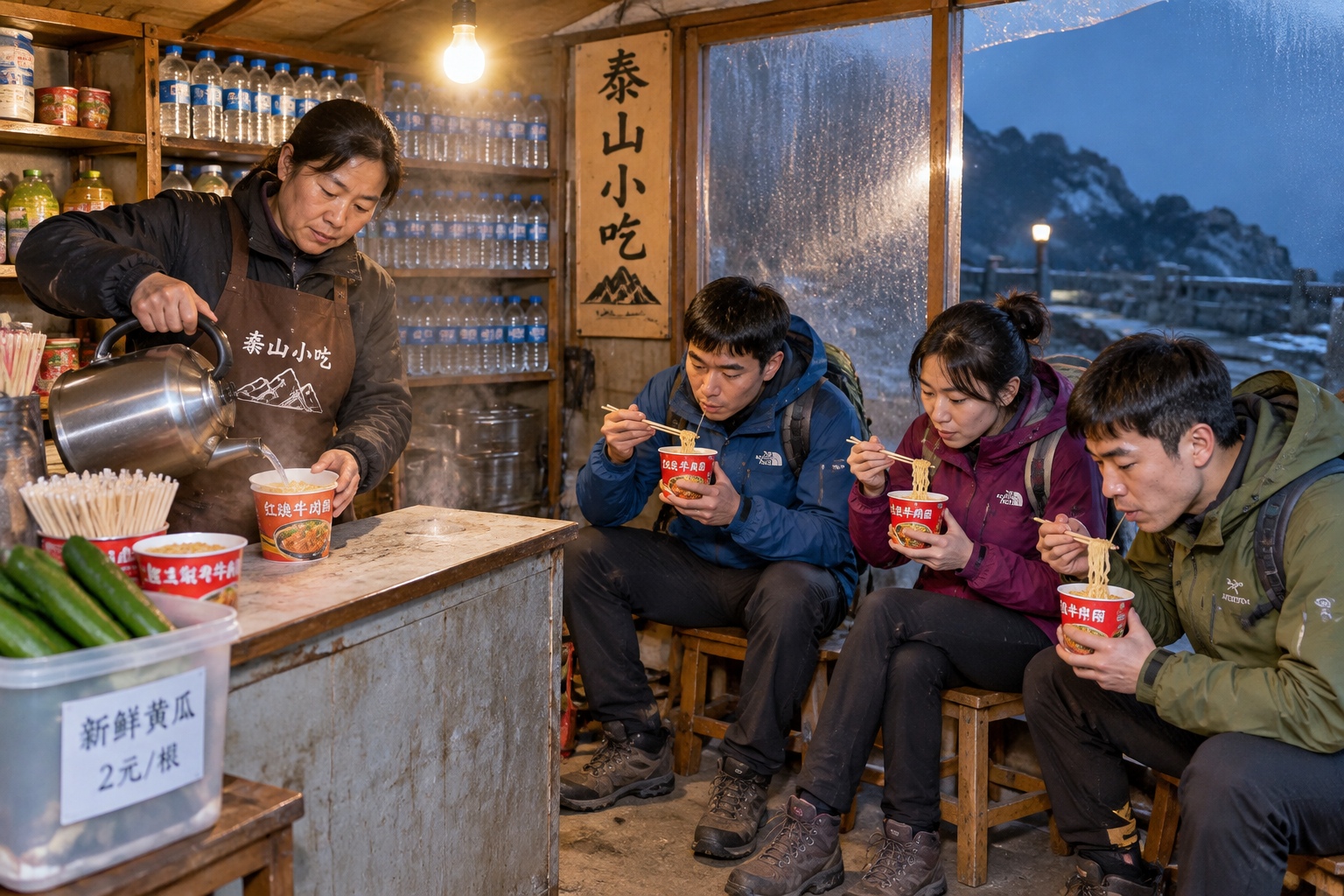
Instant noodles are the summit food. At the small shops below the peak, a paper cup of noodles costs fifteen yuan, and the hot water comes free with purchase. Picture a few hundred people sitting on cold stone at 3:30 a.m., holding identical cups of steaming noodles, saying very little.
Some of what you eat is still carried up by people. Cable cars do most of the heavy lifting now, but the last stretch of the mountain is still supplied by porters — 挑山工, the mountain carriers — with loads strapped to a shoulder pole. The writer Feng Jicai made them famous in an essay from the 1980s that Chinese students still read in school. Seeing one at 2 a.m., bent forward under a load of bottled water, is a different experience from reading about it.
Zhongtianmen, the Honest Halfway Point
Two hours in, the staircase widens into a plateau called Zhongtianmen — the Midway Gate to Heaven. Here the mountain divides into two kinds of people: those who queue for the cable car, and those who do not.
Most do not. The cable car does not reach the summit anyway; it drops you above the steepest section and you still walk the rest. There is a row of snack stalls, a public toilet with a twenty-minute line at midnight, and a large, brightly lit sign that everyone photographs: 十八盘 — the Eighteen Bends — 1,600 steps, starting now.
The Eighteen Bends
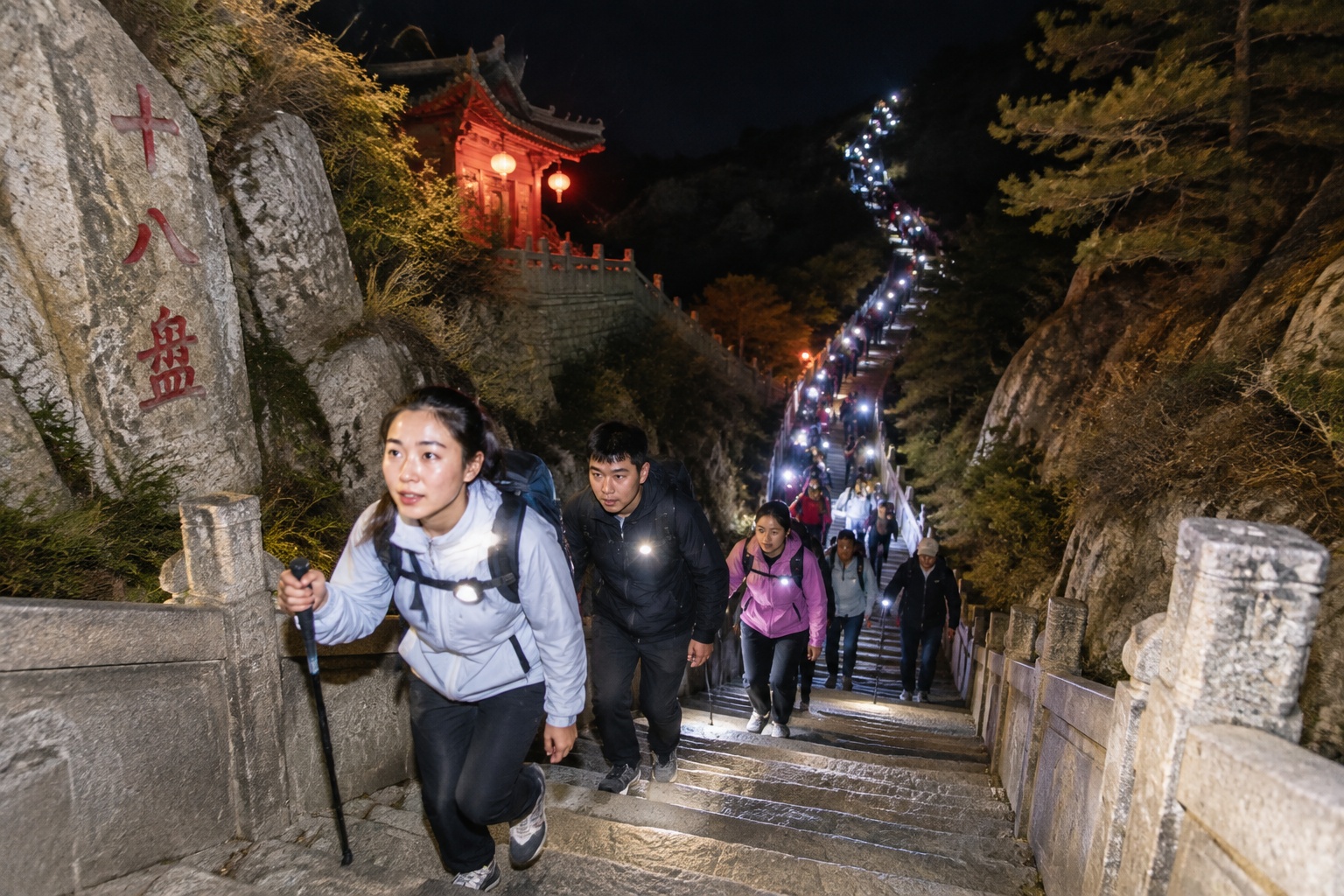
This is the part people remember. Roughly 1,600 stone steps built into a ravine, the steepest sections pitched at close to 70 degrees. At 2:30 a.m. it becomes a human traffic jam. Nobody climbs fast here, because nobody can. You move up in a slow collective shuffle, stopping when the person above you stops, listening to the same heavy breathing as everyone else.
What happens inside that jam is the real reason to come. Strangers hand out plasters for blistered heels. Someone passes around a bag of sunflower seeds. A woman in her sixties starts singing a folk song from Shandong and about forty people join in badly. A man with a Bluetooth speaker plays a pop song from 2015 and an entire staircase of strangers sings the chorus. When the crowd bunches up and stalls, someone shouts 加油 — keep going — and the shout travels uphill like a wave, thinning out as it climbs, until you cannot hear it anymore.
Somewhere around 4 a.m. you stop being cold. You stop checking your phone. You just climb, one step at a time, inside a line of flashlights that stretches above and below you as far as you can see.
The Summit, and the Rental Coats
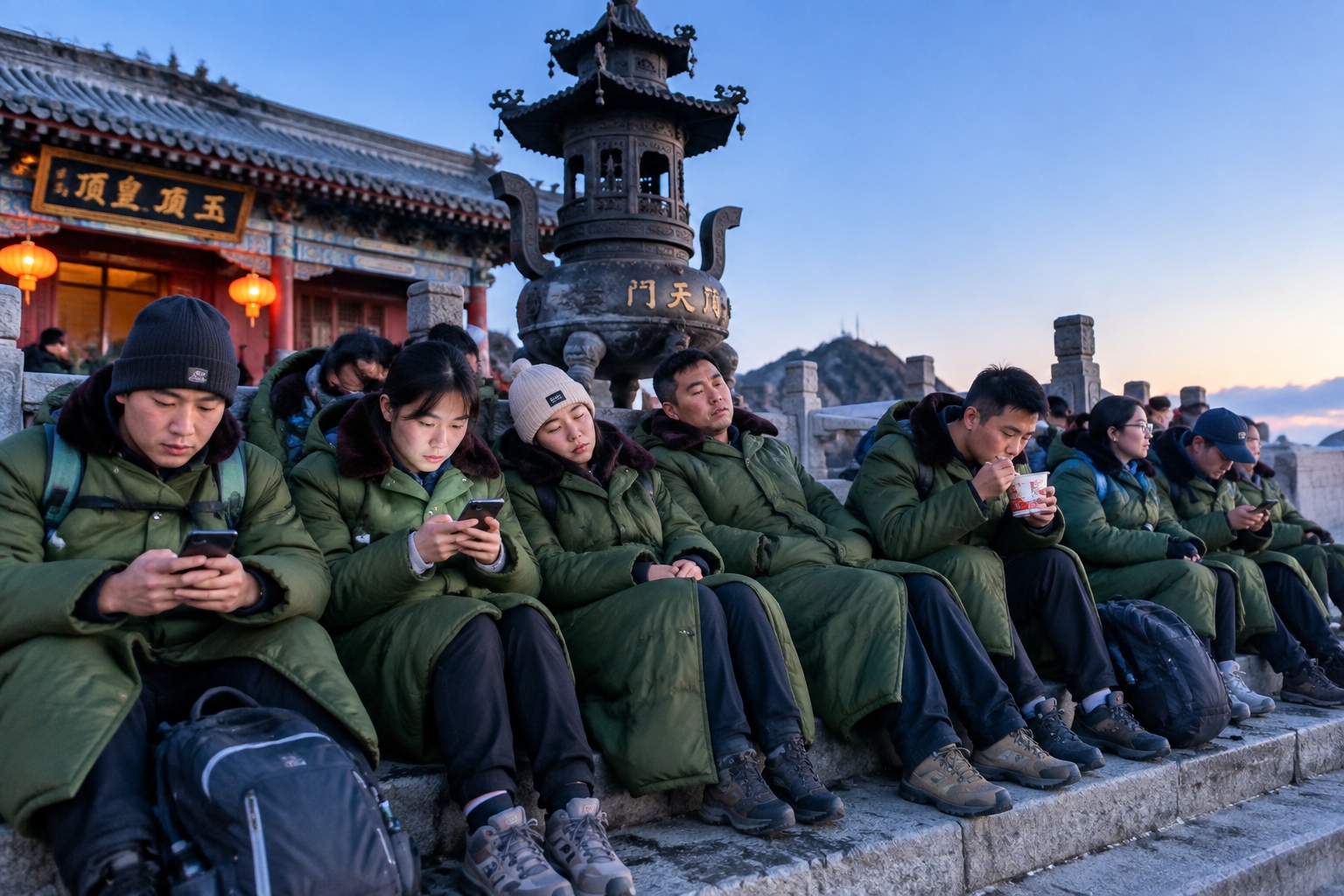
You reach Nantianmen, the South Gate to Heaven, and the wind hits you. Above, the street is lined with shops renting out military-style padded coats — thick, dark green, cotton, ugly, wonderful. Thirty to fifty yuan for the night, plus a deposit. Almost everybody takes one. Within ten minutes, half the people at the top look like they belong to the same army.
Past the gate, the crowd settles into every sheltered corner: temple courtyards, stairwells, the space behind low walls. People sit shoulder to shoulder on cold stone, some asleep sitting up, wrapped in coats, phone screens glowing. A vendor sells hot millet porridge in paper cups. A father points out the constellation Orion to his daughter. Somebody’s alarm goes off and six people check the time.
Four Minutes of Light
At 4:40 a.m., an unspoken signal moves through the crowd. Thousands of people stand up at once, like a field of grass turning in the wind. The good spots — Jade Emperor Peak, Sun-Watching Peak, the east-facing railings — fill first, but honestly, anywhere with a clear line of sight east works.
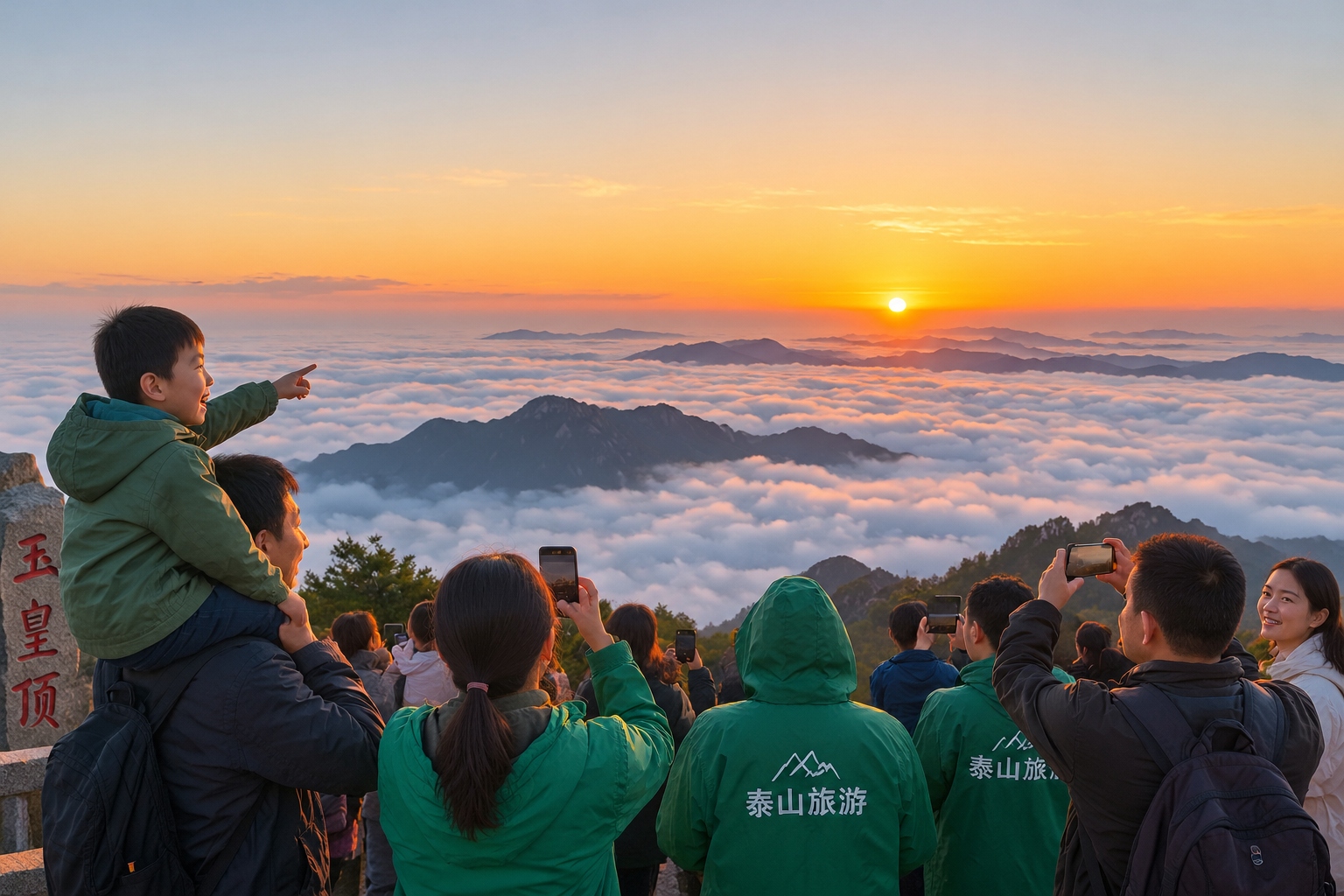
The sky is grey-blue. Then grey-pink. Then a thin, hard line of orange appears along the horizon, and the whole mountain goes quiet — a particular kind of quiet, the sound of twenty thousand people holding their breath at the same time. The line widens. The light comes up fast, much faster than you expect, and the ridges below emerge one at a time out of a sea of cloud: dark blue, then green, then gold at the edges.
It lasts about four minutes. When the sun clears the horizon, the crowd makes a low, collective noise — not quite a cheer, more like a sigh with an 哦 in it — and then ten thousand phone cameras go up at once. A child on his father’s shoulders asks whether it is finished. A woman near me cries without seeming embarrassed about it. A group of students take a photo of their feet, because they made it.
What You Only See on the Way Down
Going down in daylight is a different mountain. You see everything you climbed past in the dark: more than a thousand inscriptions carved into the rock, some of them over a thousand years old; small temples with iron incense burners still smoking; the actual gradient of the steps you stumbled up, which is steeper than you would like to know.
You also see the ordinary stuff: litter, and men in orange vests picking it up; vendors counting damp banknotes into a plastic bag; a woman asleep behind a stall with a coat over her head. Mount Tai is a UNESCO World Heritage site and also, quite simply, a municipal park with toilets, signage and a bus at the bottom. Both things are true at once, and that is what makes it feel alive rather than embalmed.
If You Want to Do It Yourself
Getting there: Tai’an has two stations. Tai’an Station (high-speed) is about a 20-minute taxi ride from the Red Gate. From Jinan it is 20 minutes by train; from Beijing about two hours; from Shanghai about four.
Tickets: Around 115 yuan in high season (roughly February to November) and 100 yuan in winter. Book ahead through the official Mount Tai WeChat mini-program and register with your passport at the gate. Night entry is allowed — the mountain does not close — but weekend and holiday slots sell out days in advance.
Timing: Sunrise is around 4:50–5:10 a.m. in summer, later in winter. Most people start walking between 10 p.m. and midnight. Start later than 1 a.m. and you will be climbing hard to make it.
Cost: Budget 300–500 yuan per person including the ticket, water, noodles, a walking stick, a rental coat, and the cable car down (about 100 yuan) if you cannot face the stairs again.
What to bring: Layers — the summit is 10–15°C colder — a headlamp or your phone torch, cash in small notes, plasters, and something to sit on. Leave your suitcase in Tai’an.
Avoid: The first three days of May and the first week of October, when holiday crowds can push daily visitors past 80,000 and you may literally queue on the stairs. Weekdays in late spring and early autumn are the sweet spot.
Be honest with yourself: This is between 6,000 and 7,000 steps and roughly 1,350 meters of vertical gain. It is not technical. It is very long. Teenagers do it in three hours; a slow, steady pace takes five or six.
Why the Four Minutes Are Not the Point
The sunrise lasts four minutes. You spend six hours getting there and three hours coming down. On paper, that is a terrible deal.
What you are actually buying with those nine hours is time inside a crowd that has nothing to do but keep going. You overhear strangers’ conversations. You lend someone your lighter. You learn that the man beside you has been saving for an apartment in Jinan for six years, that the girl in front of you just failed an exam, that the old man with the stick has been up this mountain forty times and still stops at the same rock to rest. A mountain does not make people interesting. Six hours without an exit does.
At the bottom, in the morning, the shops are selling congee and the buses are running and everyone looks wrecked and slightly pleased with themselves. There is a Chinese phrase you hear constantly on the way up — 来都来了, “you’ve come this far already.” It is an excuse, a joke and a philosophy of life, all at once. On the Eighteen Bends at three in the morning, surrounded by flashlights, it is also just good advice.
Start the discussion at forum.chinacomes.com