
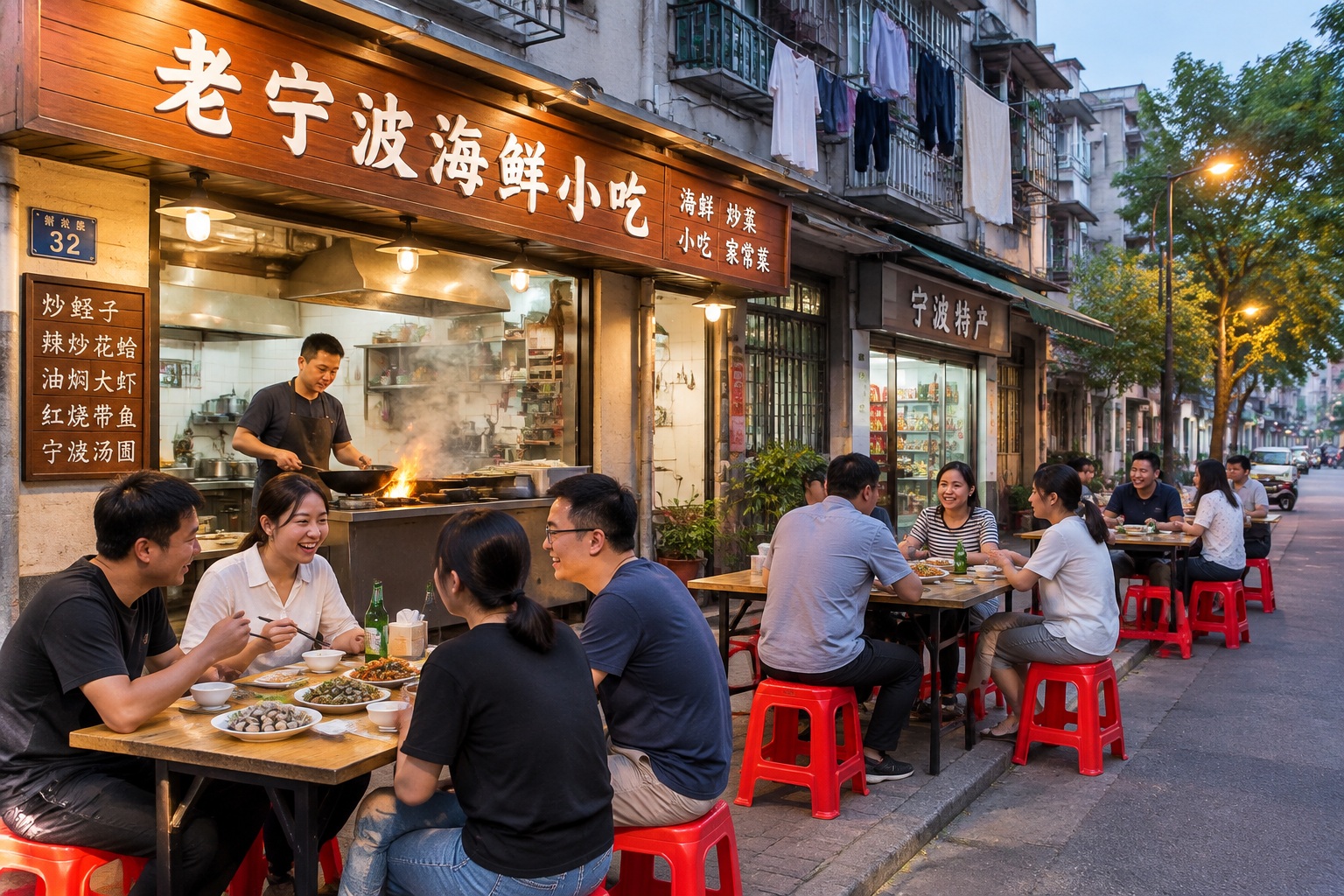

Dusk on a Ningbo side street
At 6:40 on a Tuesday evening in Ningbo, Zhejiang, a woman in a floral apron drops a laminated menu onto a folding table, pours two cups of barley tea, and walks off before anyone can ask a question. Eight tables stand on the sidewalk in front of a shopfront the size of a garage. Every red plastic stool is taken. Two meters away, a wok throws a sheet of scallion oil up into the dark.
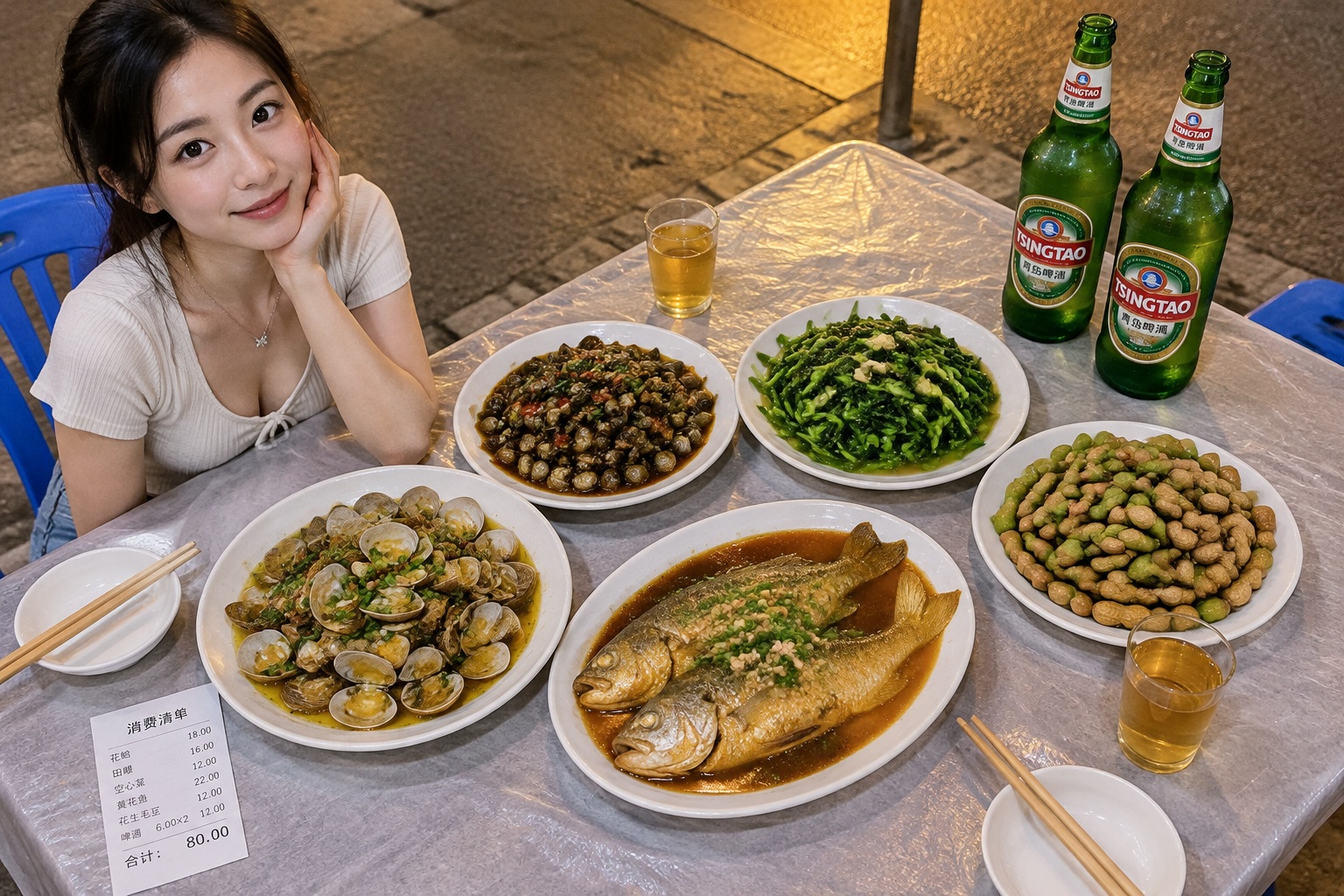
Five dishes arrive within eleven minutes: clams in scallion oil (18 yuan), stir-fried river snails (12), garlic morning glory (10), braised little yellow croaker (24), and a plate of boiled peanuts and edamame (8). One bottle of local beer, 8 yuan. The total is 80 yuan — about US$11 — for two people.
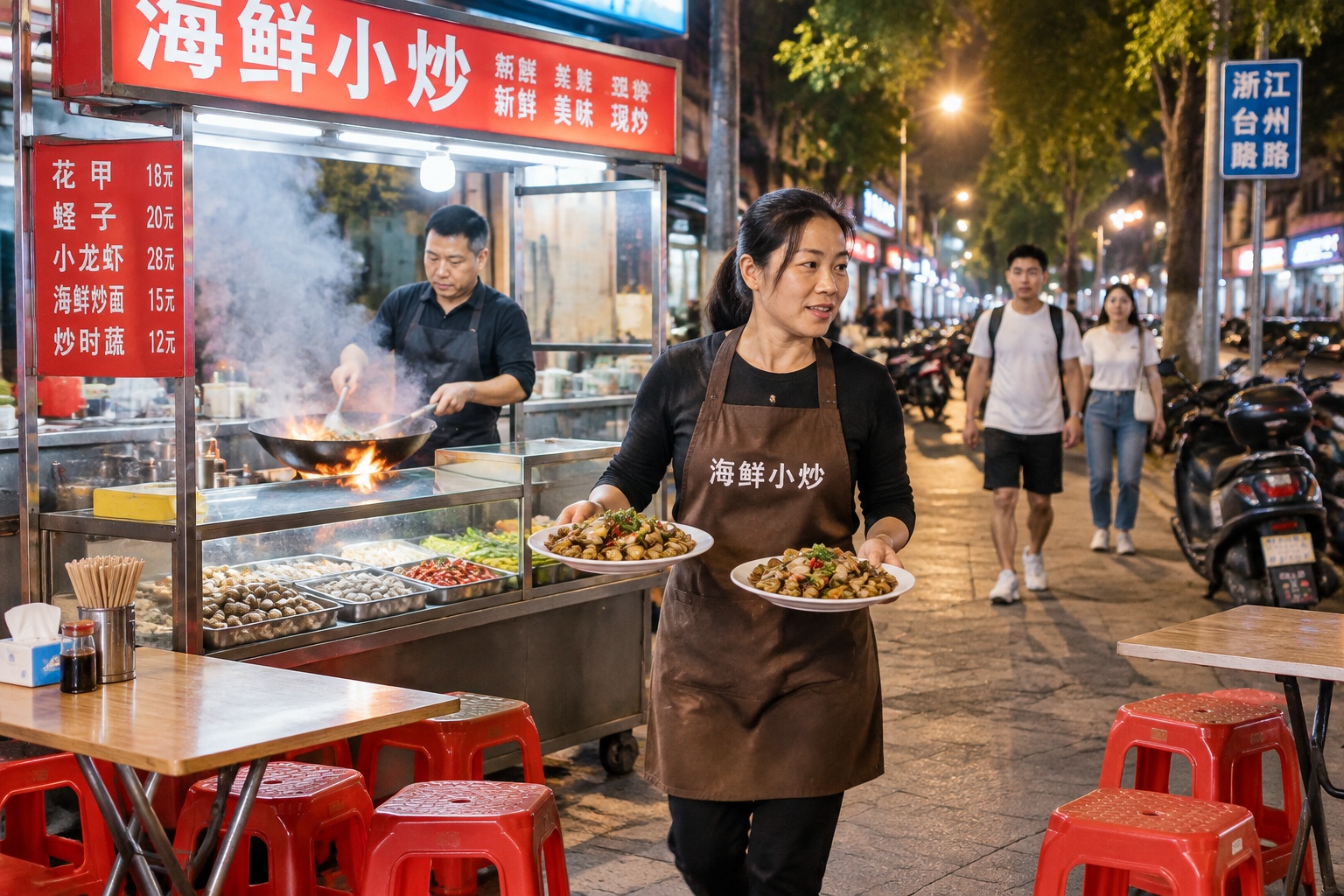
Nothing about this is a special occasion. Nobody photographs the food. The man at the next table is on speakerphone with his mother. This is what dinner looks like on an ordinary Tuesday for a great many people along China’s coast, and it is the part of Chinese daily life that visitors tend to either romanticize or misread.
What 80 yuan buys — and what it does not
Be precise about the price point, because “cheap food in China” slides easily into poverty tourism. It isn’t that. In Hangzhou or Ningbo, a mid-range restaurant inside a shopping mall charges 58–98 yuan for a single main dish. A chain coffee is 25–35 yuan. A bowl of noodles at a centuries-old shop runs 22–35 yuan. So 80 yuan for five dishes is not the national average for eating out; it is the bottom third of the market, chosen deliberately by people who could easily spend three times as much.
The dishes explain themselves. River snails, clams, morning glory, small croaker: cheap because they are abundant and landed nearby, not because anything is stretched or substituted. The kitchen’s real advantage is that it cooks them the moment they arrive, in a wok hot enough to do in ninety seconds what a home stove takes eight minutes to do badly.
Yanhuoqi: the plastic stool is the point
Chinese has a phrase for what people come here for: yanhuoqi (烟火气), literally “the air of smoke and fire.” It describes the visible, audible, slightly chaotic evidence that food is being made by a human being a few steps away — the hiss, the steam, the clatter of plates, the argument between the owner and a supplier over two kilos of clams.
The word has leaked far beyond restaurants. Real-estate agents in Zhejiang and Shanghai advertise flats near night markets as having yanhuoqi, meaning a lively street downstairs. Residents on the second floor of those same buildings use the identical word to complain about noise and cooking smells. Both usages are accurate, which is the honest way to describe it.
The economics behind an 18-yuan plate of clams
Three cost lines keep the total under 100 yuan.
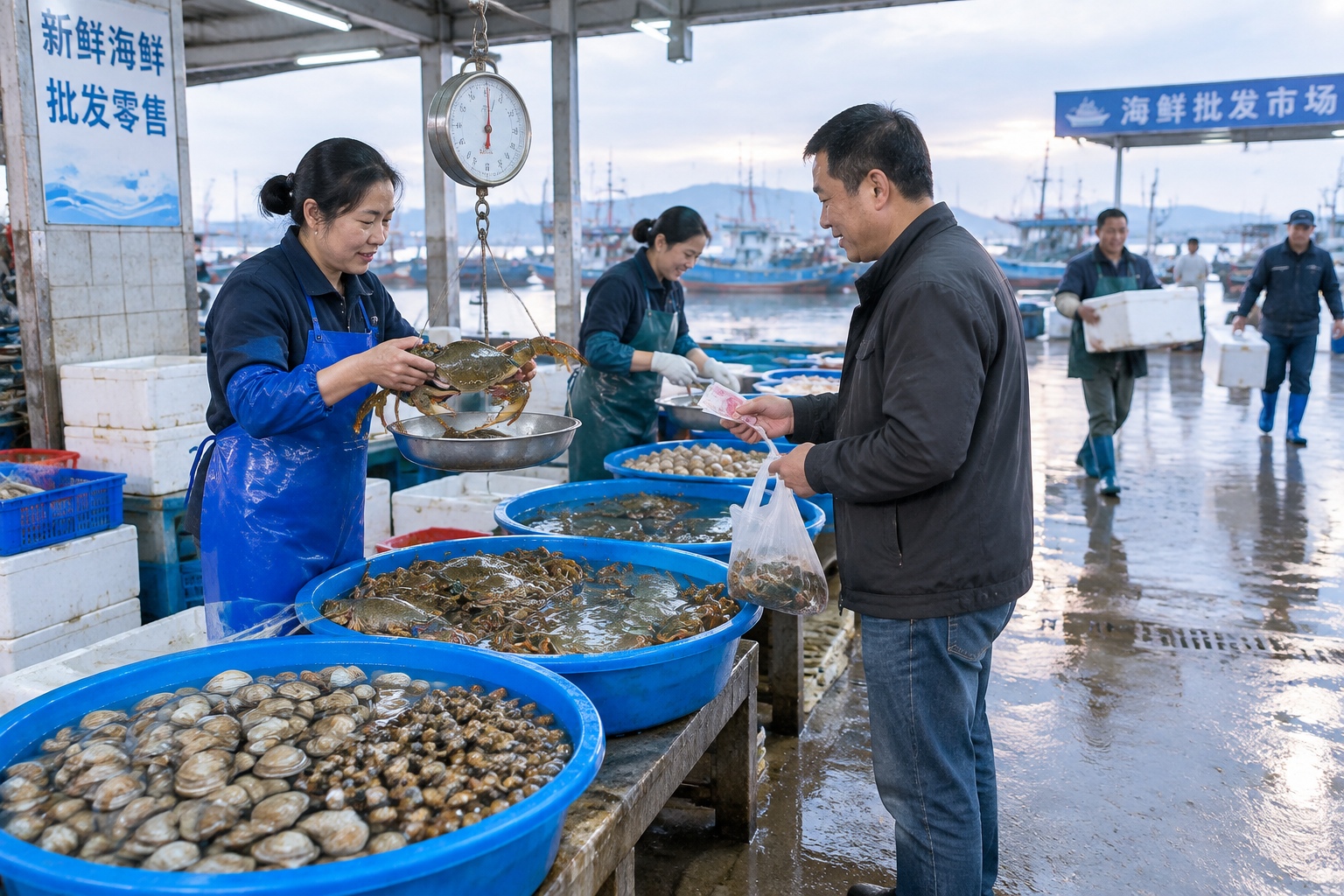
Ingredients. Zhejiang has roughly 6,500 kilometers of coastline and some of the busiest fishing ports in the country — Zhoushan, Xiangshan, Shitang, Shipu. Clams bought in bulk at 4 a.m. at a wholesale market cost maybe 8–12 yuan per jin (500 grams). A plate uses about 400 grams. Food cost lands at 40–50% of the menu price, normal for Chinese casual dining.
Rent. A stall like this usually takes part of a ground-floor residential shopfront on a side street, or a place on an officially designated night-market strip, at 3,000–10,000 yuan a month. The same footprint inside a shopping mall or on a tourist street can run five to ten times that.
Labor. The owners work in it. In the case above, the woman with the menu is the owner, her husband is on the wok, and one hired helper earns maybe 4,500–5,500 yuan a month. Zhejiang’s top-tier monthly minimum wage is around 2,500 yuan, so that sits just above it. A ten-table stall turning five or six times a night might clear 15,000–30,000 yuan in profit in a good month, and much less in winter.
What really holds prices down is density. Along one 300-meter stretch of a residential street in Ningbo you can find fifteen to twenty places to eat, all reading each other’s menus. Delivery and review platforms add a second squeeze: a “99 yuan for four people” group-buy voucher is now the effective price at many mid-tier restaurants, and owners say the discount has stopped being a promotion and become the baseline.
The market-to-table trick
Along the coast, from Shipu in Ningbo to Shenjiamen in Zhoushan, there is an institution that explains Zhejiang’s food culture better than any menu: buy your own seafood. Customers walk through a wet market at five in the afternoon, buy a kilo of swimming crab or a couple of pomfret, then carry the plastic bag across the street and pay 20–35 yuan per dish to have it steamed, fried with ginger and scallion, or turned into soup.
The stall carries no inventory, takes no risk on spoiled fish, and sells what it actually owns: a stove, a cook and a table. The customer gets restaurant-grade freshness without restaurant markup. That model only works when wholesale markets and cheap eating places sit physically next to each other, which in Zhejiang they often do.
Who is sitting at these tables now
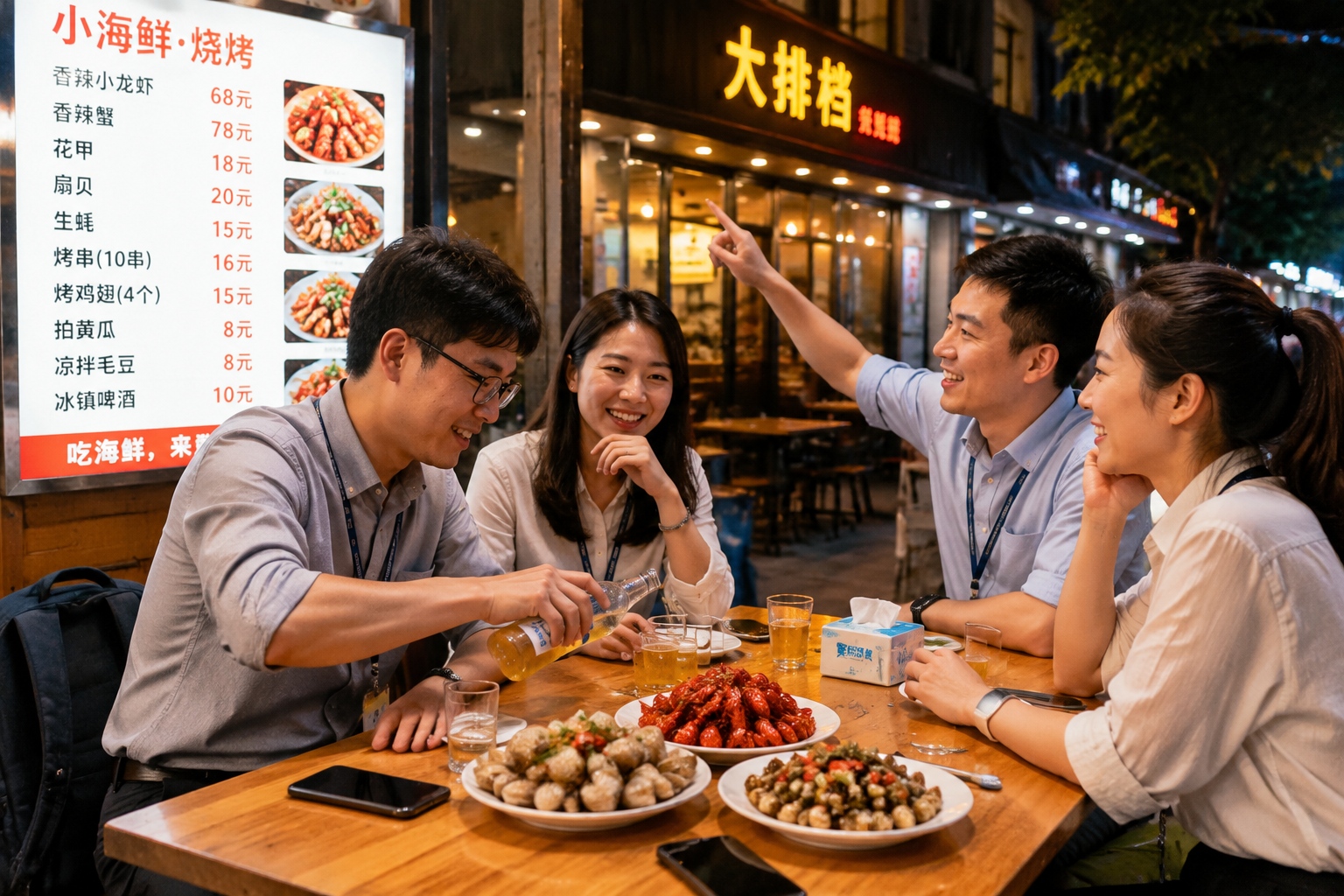
Ten years ago the answer was families, and on weekends it still is — three generations, a grandmother holding a child on her lap, a father ordering one more dish than the table can finish. Weekday evenings look different. The tables fill with people in their twenties and thirties straight from the office, ordering two dishes and two beers each, splitting the bill in a WeChat group, then heading home.
Two things complicate the cheap-food story. First, solo diners: more single-person households in cities have pushed operators to offer smaller portions and one-person sets, because a table for one occupies the same space as a table for four. Second, alcohol. Once a group orders xiaolongxia (crayfish, often 60–100 yuan per jin) and a few rounds of beer, an 80-yuan meal becomes a 120-yuan-per-person night. Street stalls are cheap; street drinking is not.
The old brands are learning to fight back
Zhejiang’s time-honored restaurants — laozihao (老字号) — include Kuiyuan Guan, founded in 1867 and known for pian’erchuan noodles with pickled greens and pork; Zhiweiguan; and Louwailou, which has served West Lake vinegar fish on the lakeshore since 1848. Nationally, the Ministry of Commerce has recognized well over a thousand such brands.
Their problem is structural: prime locations with high rents, a large permanent staff, and menus that local diners read as “for tourists.” The response in recent years has been pragmatic rather than nostalgic. Smaller portions and half-plates let a two-person table order four dishes without waste. Group-buy vouchers, once considered beneath a heritage brand, now appear in almost every shop window. Several brands have pushed prepared and semi-prepared food — vacuum-packed braised pork, seasonal qingtuan and mooncake gift boxes — where the margin is higher and the competitor is a supermarket shelf rather than the stall across the street. Others have opened cheaper sub-brands or moved into neighborhood locations with shorter menus. A few have quietly closed downtown branches and said nothing about it.
What they cannot copy is the stall’s cost structure. What the stall cannot copy is a recipe that has been selling for 150 years.
What an 80-yuan bill actually tells you
For a visitor, the practical translation is short. Point at what you want from the display case instead of ordering from a list. Pay by WeChat or Alipay; no tipping. Don’t be surprised when an extremely good dinner lands under 100 yuan.
The price is not a sign of a depressed economy, and it is not a magic trick. It is the visible tip of a dense system: short supply chains, brutal competition, family labor, and a culture in which eating out is an ordinary Tuesday activity rather than a luxury. The people running these stalls work twelve-hour days in summer heat for margins that would shut most Western restaurants. Both facts sit on the same plastic table — and that may be the most accurate single thing you can learn about everyday life in China right now. Not that it is cheap, but that so much of it is organized to be within reach of almost everyone, most nights of the week.
Start the discussion at forum.chinacomes.com