
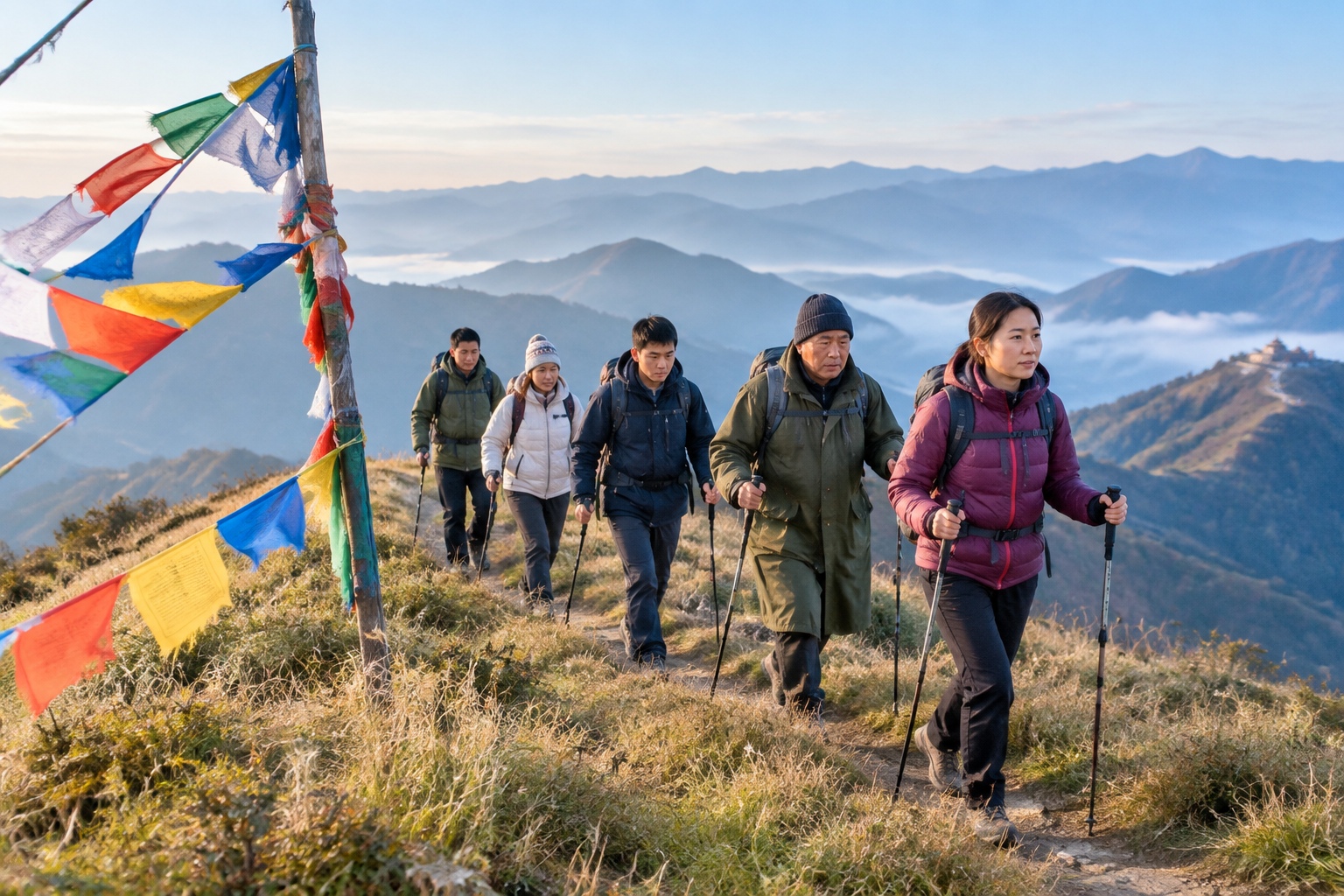

At 5:30 a.m., the street outside the temple gate is already full
It’s still dark in Taihuai, the small town sitting in the valley at the center of Mount Wutai. The noodle shops are open, steam curling out of the doorways, and a line of buses idles with headlights on. People stand around in down jackets and rented army coats, tightening backpack straps, taping their heels, checking hiking poles for the third time. A woman in her fifties ties a red string around her wrist and looks up at the ridge she can’t quite see yet.
Hardly any of them are monks.
That’s the part of Mount Wutai that never makes it onto the postcards. Yes, it’s one of China’s four sacred Buddhist mountains and a UNESCO World Heritage site, with temples that go back well over a thousand years. But on a summer morning, the people heading up the trails are mostly office workers, retirees, students, small shop owners, parents who came to say something about a child’s exams. They come for many reasons. Religion is only one of them.
What Mount Wutai actually is
Mount Wutai — Wutai Shan, literally “the mountain of five terraces” — sits in Shanxi Province, roughly three hours by road from Taiyuan. Five flat-topped peaks ring a central basin: East, South, West, North and Central. The North Peak, Yedou Feng, reaches about 3,061 meters, which makes it the highest point in northern China.
The mountain belongs to Manjushri — Wenshu Pusa in Chinese — the bodhisattva of wisdom. That single association explains a lot about who shows up here. People don’t only come to worship. They come to ask for clarity: about a job, a marriage, a medical diagnosis, an exam, a business that isn’t working.
There are two ways to do the pilgrimage, and they are not the same experience at all.
The short version, xiao chaotai, means climbing the 1,080 stone steps to Dailuoding, a temple on a ridge above Taihuai. Tradition holds that making that climb counts as visiting all five peaks. It takes an hour or two, and on a holiday weekend you climb shoulder to shoulder with grandmothers, toddlers and tour groups.
The long version, da chaotai — the Great Pilgrimage Circuit — means walking to all five peaks on foot. Depending on where you start and how you link the peaks, that’s somewhere between 50 and 60 kilometers, usually spread over two or three days, with nights in temple dormitories or simple family guesthouses along the way.
Most visitors to Mount Wutai never walk it. Shuttle buses run up to the peaks, and on a busy day the parking areas at the top fill with tour groups taking photos. The walkers are a minority. But they are the reason the mountain still feels like a mountain.
Who actually walks the circuit
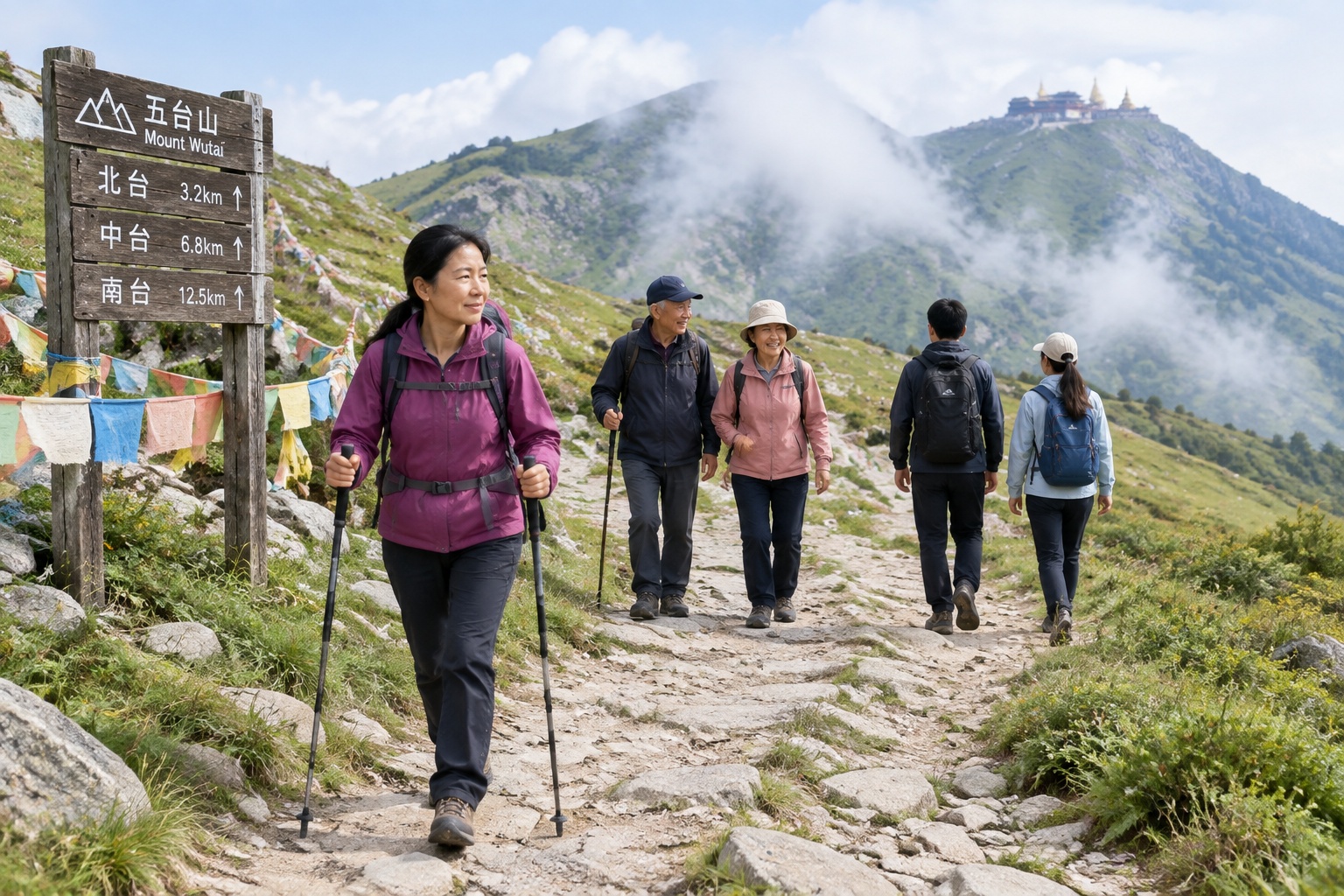
The people on the trail are a pretty good cross-section of ordinary China. On the day I walked the section between the Central and West peaks, our loose group included a product manager from Beijing who had taken three days off without telling his team why, a retired couple from Shijiazhuang doing the circuit for the fourth year running, two college friends who had bought their boots the week before, and a woman in her forties who said almost nothing for six hours and then explained, quietly, that she was walking for her father’s surgery.
“I’m not really a Buddhist,” is one of the most common sentences you hear up here. People say it almost apologetically, as if they need to justify being on a sacred mountain. They don’t. Chinese pilgrimage has always been a mixed practice — part faith, part exercise, part a wish, part simply wanting to stand somewhere high and quiet for a few days.
It also has a very practical side. At Wuye Temple, the busiest shrine in Taihuai, people queue from around 4 a.m. in summer. The wishes they bring are not abstract: good health, a promotion, a university place, a baby, a house that finally sells. Watch the line for twenty minutes and you’ll see more of everyday Chinese life than any documentary will show you.
A day on the trail
A typical walking day starts before dawn and ends before dark. You climb out of the valley on stone paths and dirt roads, past prayer flags strung between poles, past wooden signboards that tell you which peak you’re heading toward and how far. The air thins. The sound changes: fewer voices, more wind, the crunch of boots on gravel.
Between some peaks it’s a two-hour walk; between others it’s four. The terrain is not technical — no ropes, no scrambling — but the altitude and the weather do the work instead. Cloud can roll in within twenty minutes and cut visibility to fifty meters. The sun at 2,000 meters is strong enough to burn your neck through a shirt.
Along the way you’ll pass small temples with someone sweeping the steps, a tea stand run out of a plastic tent, and — increasingly — foxes. They have learned that walkers carry food, and they will sit calmly a few meters off the path, waiting. There’s a mild ongoing argument among regulars about whether feeding them is kindness or a problem.
Sleeping up there: temple dorms and thirty-yuan beds
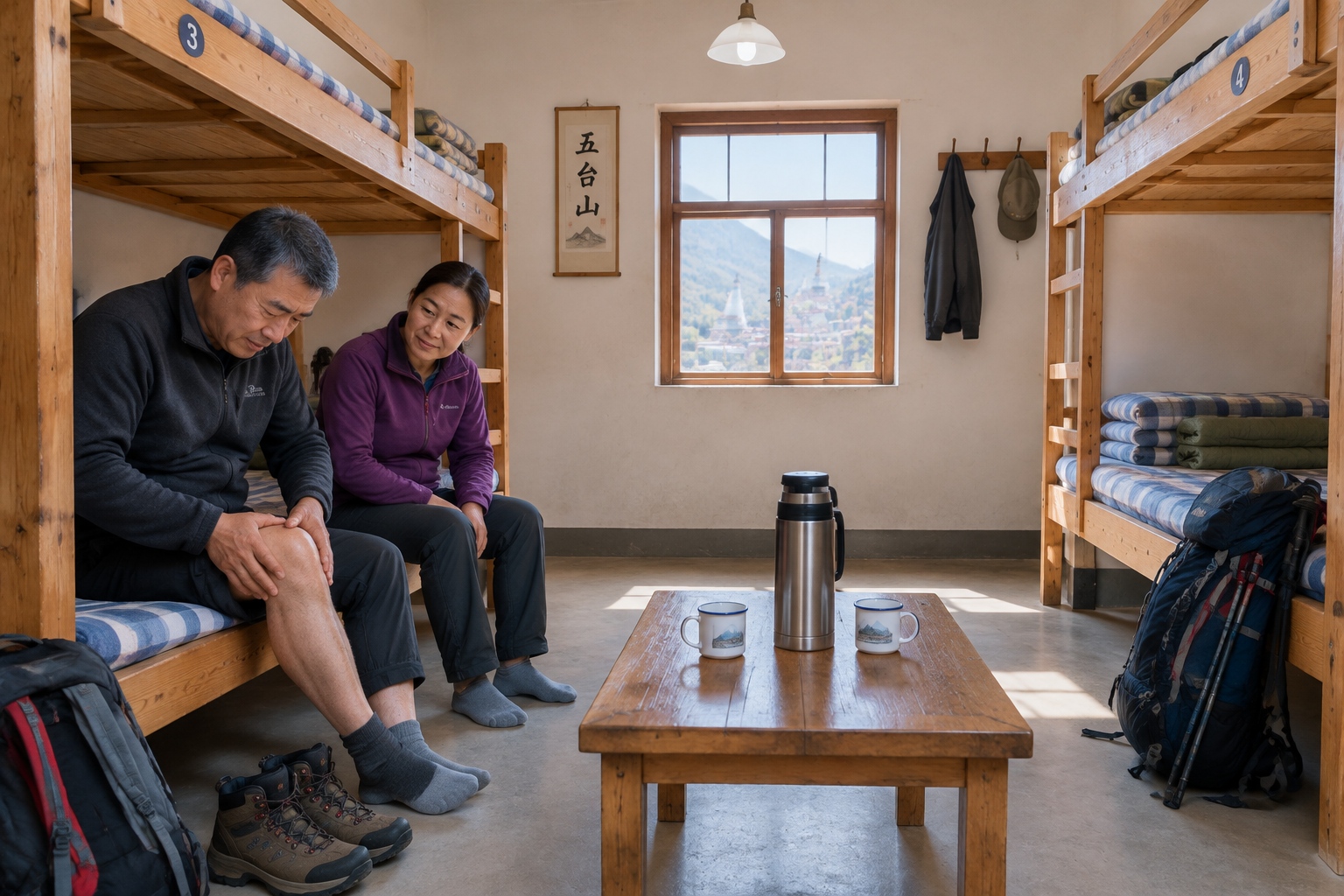
Where you sleep is the part that surprises first-timers most. On the peaks, several temples accept overnight guests — a practice called guadan, literally “hanging your name.” You register at a small office, hand over your ID card, and get a bed in a shared room, usually four to eight bunks, with thin blankets, a communal washroom, and often no shower.
The cost is modest: typically a donation of 30 to 50 yuan for a night, sometimes a little more for a smaller room. Meals may be included or cost ten or twenty yuan. Lights-out is early, often around nine, because the morning bell rings at four.
Down in Taihuai, the options widen. Family-run guesthouses go for roughly 150 to 400 yuan a night depending on the season, and prices double around major holidays and the lunar April festival that marks Buddha’s birthday.
Then there’s the cold. Even in August, temperatures on the North Peak can drop close to freezing after dark. Every shop in town rents out thick military-style coats for 20 or 30 yuan a day, and the fact that so many people take them tells you something. Bring a hat. Bring a layer you didn’t think you’d need. You will need it.
Vegetarian food, and the etiquette nobody explains
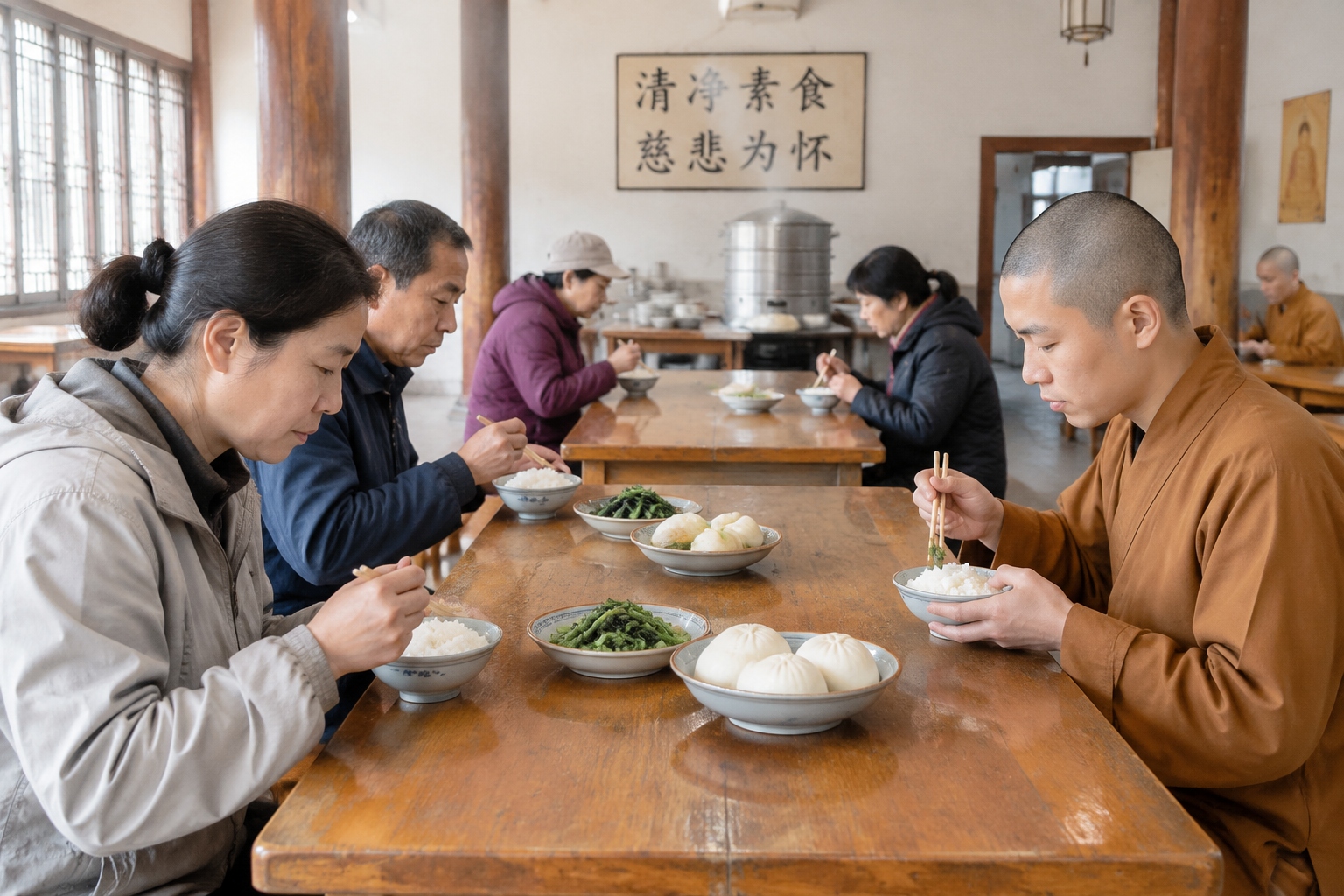
Temple meals — zhai fan — follow a rhythm that has nothing to do with restaurant hours. Breakfast around six, lunch around eleven, dinner around five. You eat what is served, which usually means rice or porridge, steamed buns, and a few vegetable dishes, cooked without garlic, onion, scallion, leek or chives — the five pungent vegetables that Buddhist kitchens avoid.
The rules are simple but strictly kept. You don’t talk much in the dining hall. You take only what you can finish, and you finish it. Some halls ask you to rinse your bowl with a little water and drink it, so nothing is wasted. In most places the meal is free or by donation; you drop money into a box on the way out.
Outside the temple walls, the local speciality is taimo — mushrooms picked on the slopes — served in noodle soup or stir-fried with greens. A bowl of mushroom noodles at a small shop costs 25 to 40 yuan. It is one of the few foods I’ve eaten in China that tastes specifically of where it came from: damp pine forest, high altitude, cold mornings.
The people who keep the mountain running
What stays with you isn’t only the temples. It’s the woman outside the trailhead renting coats out of a van, who can size you up from ten meters away. It’s the family running a noodle shop in Taihuai who start boiling water at 4:30 a.m. and don’t sit down until nine at night. It’s the bus drivers who take the same switchback road six times a day, and the volunteers at some rest points who hand out hot ginger water for free.
Pilgrimage mountains in China are not museum pieces. They’re working places, and the work is done by ordinary people who live there year-round — through the summer crowds and the long, empty, freezing winters when the guesthouses close and the town goes quiet.
If you want to go
June to September is the practical window; July and August are busiest. Getting there usually means a high-speed train to Xinzhou or Wutai Shan station, then a bus, or a direct bus from Taiyuan. There’s an entry ticket of around 135 yuan in peak season, plus shuttle buses inside the scenic area.
Bring cash for small places, sun protection, and more layers than you think you need. The Great Pilgrimage Circuit doesn’t require technical skill, but it does require basic fitness and honest self-assessment. If you’re unsure, you can walk one or two sections and take the bus for the rest — plenty of people do exactly that, and nobody on the mountain will judge you for it.
Why people come back
Ask the retired couple from Shijiazhuang why they return every year and they’ll shrug and say something about the air. Ask the product manager and he’ll say he liked not having signal for two days. Ask the woman walking for her father and she’ll probably just nod.
Mount Wutai is a religious site, and for many people who go there it is genuinely that. But it also does something simpler. It takes people who spend their lives moving fast and puts them on a ridge at 2,500 meters, where the only thing to do for the next six hours is walk. That’s a rare commodity anywhere. It’s why the buses are full, why the dorm beds are taken, and why the noodle shops open before dawn.
Start the discussion at forum.chinacomes.com