
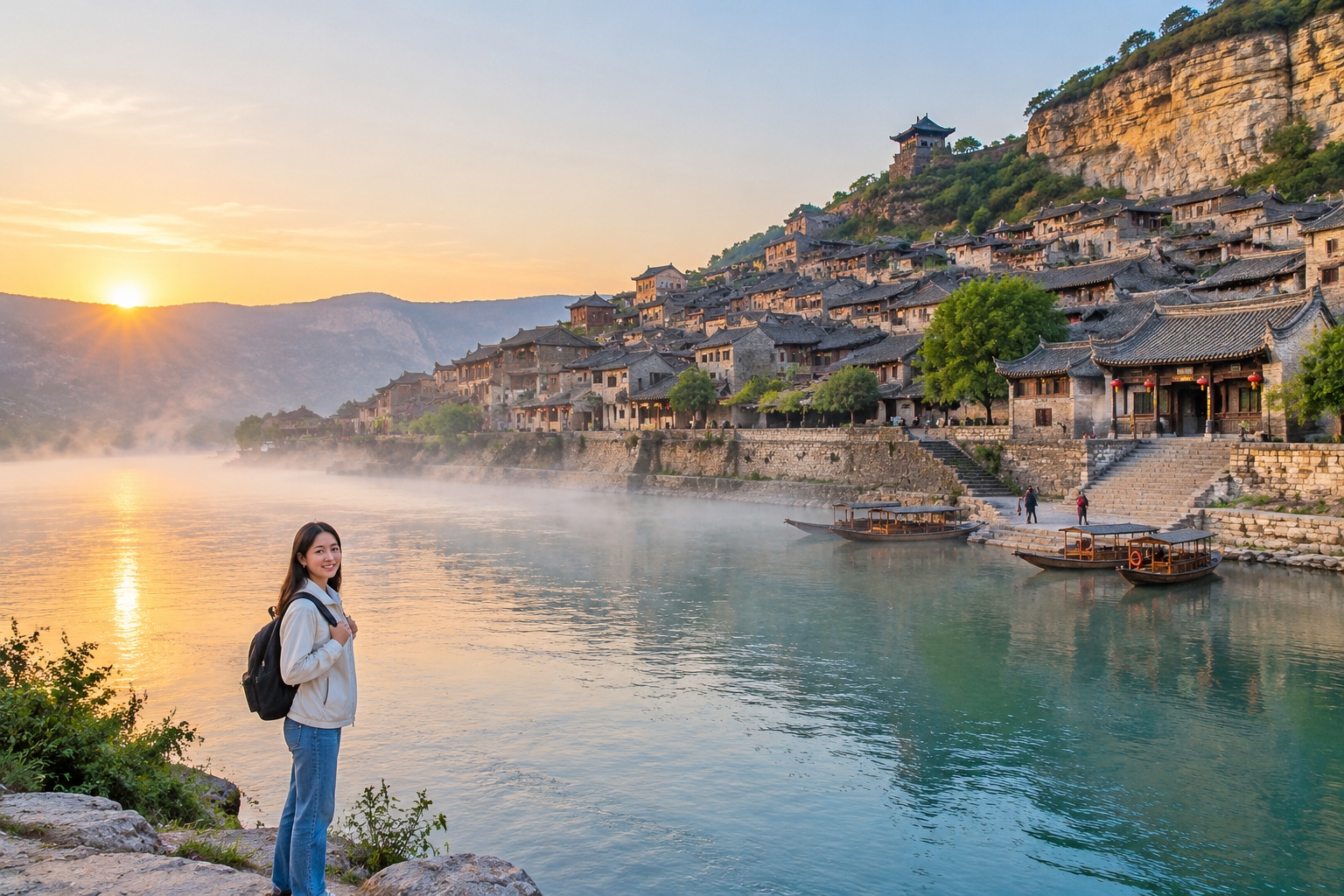

A Morning at the River Crossing
By 7 a.m., the water is already awake. The Yellow River runs past the edge of Qikou Ancient Town with a low, heavy sound, carrying silt the color of tea. I had come to this town in Shanxi Province, north-central China, to understand what draws people to a place that once thrived on river trade and then spent decades almost forgotten.
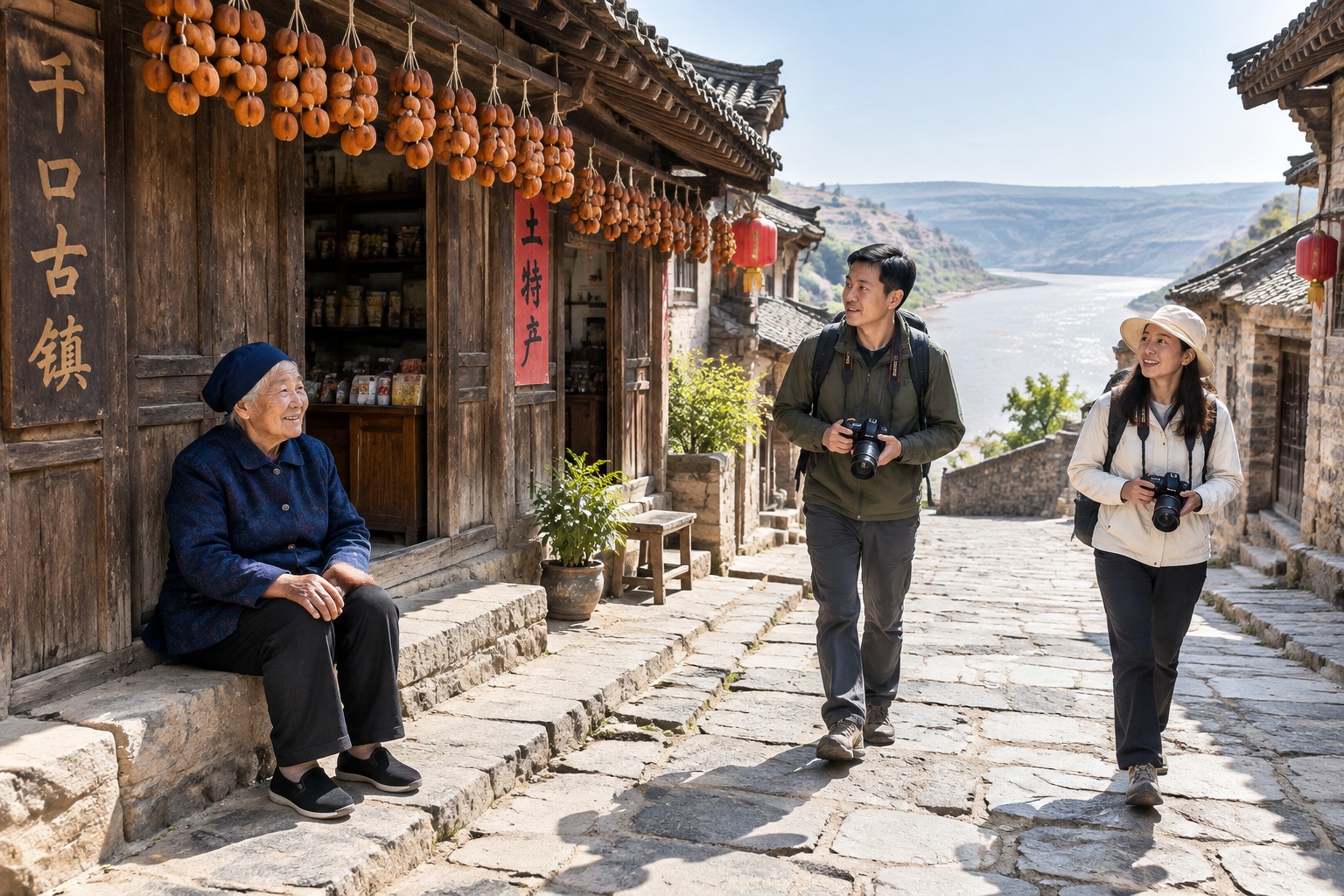
Stepping out of a cave-house hotel, I joined a few visitors walking the stone lanes. A woman in a red down jacket was having her photo taken beside a row of dried persimmons. An old man with a fleece hat sat on a doorstep, holding a glass of tea, watching the flow of people. About 30 minutes upstream, the river bends sharply and pours over a series of hidden rocks. That is the qi in Qikou, a name that translates roughly as the mouth of the stone beach.
The Merchants Who Never Sailed Through
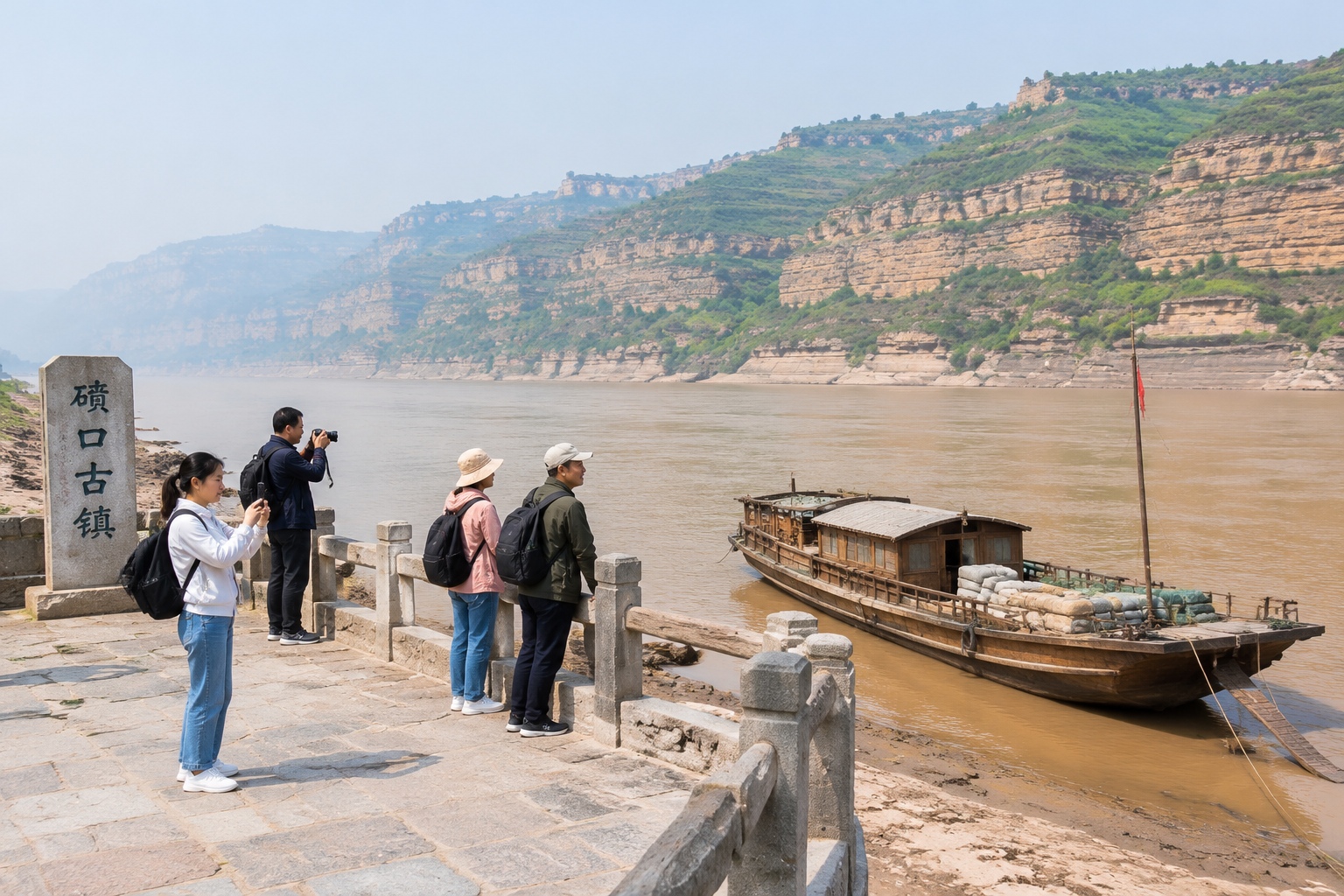
Qikou sits at the confluence of the Yellow River and the shallow Qushui River. For centuries, the Yellow River was a major transport route for grain, wool, furs, salt, and tea between China’s northwest and the central plain. But the rapids near Qikou made the waterway impassable for large boats. Goods had to be unloaded on the western bank, carried overland around the shoals, and then loaded onto smaller boats or pack animals. This made Qikou a natural break-in-bulk point.
At its height in the late Qing and early Republic periods, the town had hundreds of warehouses, hotels, and trading firms. Historians who study the region say that on any given day during the trading season, more than a hundred boats and over a thousand mules might stop in Qikou. Merchants from Shanxi, Shaanxi, and Beijing built shops with tall stone walls, thick timber doors, and carved signs. The streets were so busy that local people sometimes compared the town to a northern version of the great trade ports on the coast.
Then the train arrived. In the 1930s, a railway pushed westward through Shanxi; later, highways followed. River shipping along this stretch of the Yellow River all but stopped. Qikou’s economy collapsed almost overnight. For decades, the town remained frozen in time—poor, quiet, and largely untouched by modern construction. That accidental preservation became its second life.
When the Stone Streets Woke Up Again
In the 1990s, artists and architecture professors from Beijing and Taiyuan began visiting the town. They photographed the ancient shop fronts, the roof terraces, and the narrow alleys that climb the hillside. The images circulated in magazines and academic books, and Qikou slowly became known as one of China’s best-preserved river-port towns. In 2005, the central government listed it as a Chinese historical and cultural town, unlocking funding for restoration and tourism infrastructure.
The first wave of visitors were backpackers and history enthusiasts. Then came driving holidays. Today, on summer weekends and national holidays, tour buses line the new parking lot outside the old town, and visitors pour into the stone streets. Local families have opened guesthouses, noodle shops, and souvenir stalls. Vendors sell dried persimmons, walnuts, jujube dates, and so-called Yellow River stones—round pebbles polished by the current, lined up on cloth like exhibits. A boat ride along the river is now one of the most popular activities, and on a clear day you can see the layers of yellow-brown cliffs that have been cut by water for thousands of years.
A New Generation Digs for Gold
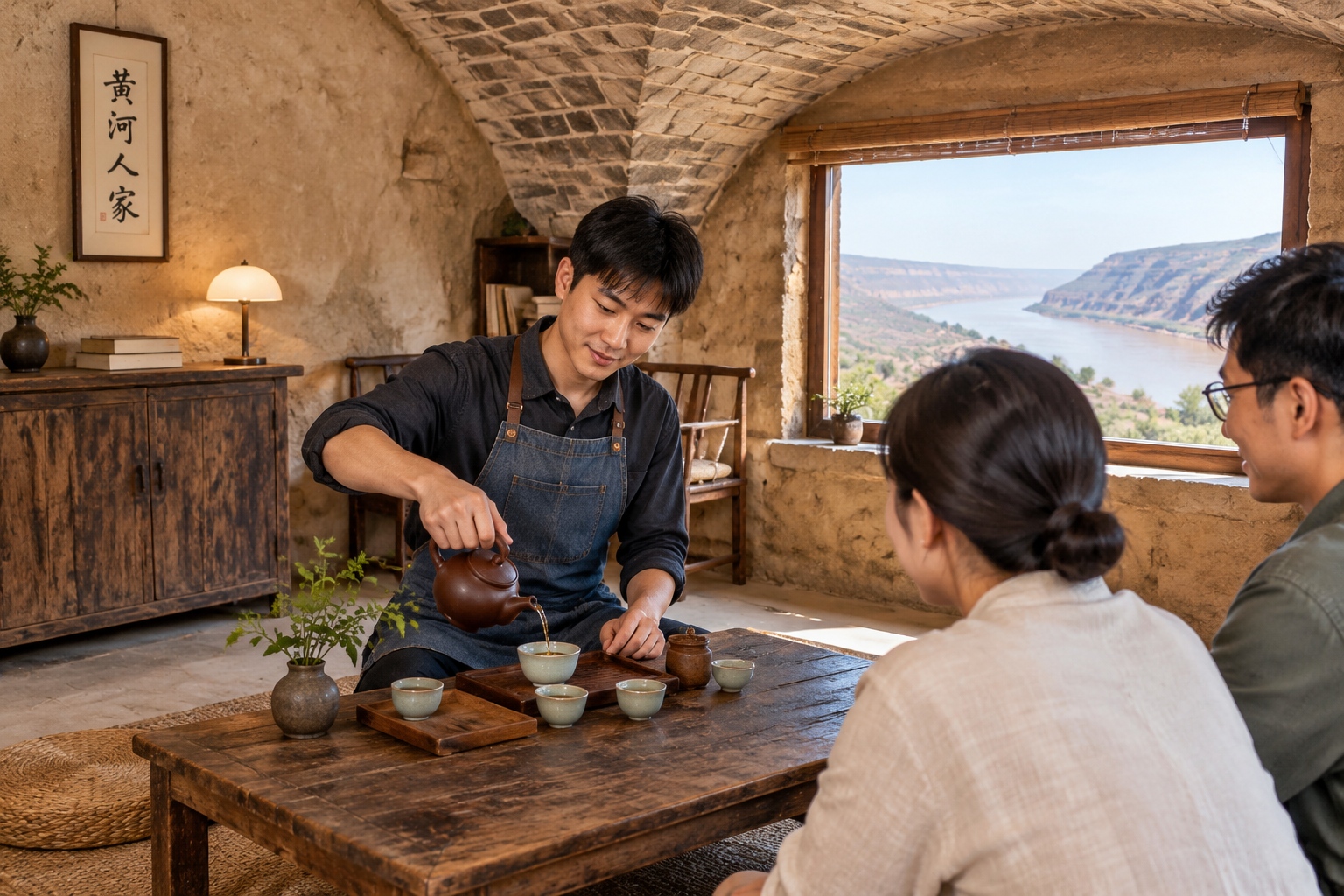
The most striking change is happening among younger locals. Xiao Chen, 31, worked in Taiyuan for six years before returning to Qikou. He converted his grandfather’s cave dwelling into a small guesthouse with six rooms. Every morning he posts short videos of the river at sunrise on social media platforms such as Xiaohongshu and Douyin. During summer his rooms are full; in winter, he sells dried peppers and herbs from the village through livestreams. Before, we left because there were no opportunities here, he said, pouring tea in his courtyard. Now the opportunities have come to us. But you have to move fast.
Not everyone is moving fast. The tourism boom is seasonal, and most local families still rely on farming, remittances from children working in cities, or odd jobs. An older woman selling boiled eggs near the dock told me she does not mind tourists, but she dislikes being photographed without warning. They treat the village like a film set, she said, with a laugh that suggested she had accepted the trade-off. Her son works in Linfen and comes home only for holidays. Still, she admitted, her own house has been repaired with money she earned from the stall, and that has made winter easier.
The Uneven Shape of the Gold Rush
The town government faces a familiar dilemma: how to keep the ancient streets authentic while improving sanitation, parking, and sewage. So far, Qikou has avoided the tacky attractions that blight some other Chinese historic towns—no slot-machine arcades or plastic lantern factories. But there are signs of homogenization: the same-brand milk tea chain has opened near the main square, and many souvenirs come from a wholesale market hundreds of miles away. Local officials say they want to cap the number of chain stores and prioritize family-run businesses, but enforcement is not always easy.
The result is a landscape of improvisation. On a single street you might find a 200-year-old grain shop with its original beams, a new cafe with exposed concrete, and an old woman frying potatoes in a wok over a coal stove. The atmosphere is less like a museum than a construction site for a new economy, with dirt and mistakes still visible. One guesthouse owner told me he had to learn to wire electricity and fix pipes because the old houses were never designed for modern comfort—but that improvisation is part of what gives the town its character.
Beyond the Old Streets
The river itself remains the town’s most powerful attraction. A short boat trip from the dock takes visitors along the western bank, where water has carved shallow caverns and striped patterns into the cliffs. These river murals change with the light and are a favorite spot for photographers. Across the river is Shaanxi Province; the hillsides are dotted with cave dwellings and terraced fields. Nearby villages—Lijiashan and Xiwan—are often combined with Qikou on a single itinerary, and their stone-paved lanes and ancient courtyard houses offer a quieter, more rural version of the same story.
For visitors, this cluster makes a satisfying two- or three-day stay. They can watch the sunset from a roof terrace, taste fish pulled from the river, and sleep in a converted cave with heated brick bed. But what makes Qikou exceptional is not just the scenery; it is the visible layering of time. Old trade signs are still painted on the walls of abandoned buildings: Longhua Hemp, Yisheng Oil Shop, Auspicious Flour Mill. They are relics of a commercial memory that once defined this place.
A Living Ledger
Qikou was never a static monument. It was always a place of exchange—first for goods, now for experiences and capital. The stone streets are still a ledger, but the entries have changed. Tourists are the new mules; their money backs the new merchants. The town feels like a community in the middle of adding a new chapter to its old book.
Whether that chapter will be as prosperous as the first one depends on how well the people of Qikou can balance the very things that made them special: honest trade, a hard-won topography, and the patience of waiting for boats to come back. So far, they seem willing to try. As an old motto carved on a gate in the town says: Trade begins with diligence; character is strengthened by generosity. That message may have been written for merchants a century ago, but it still hums beneath the surface of this modern gold rush, waiting to be read by anyone who stops to look.
Start the discussion at forum.chinacomes.com