
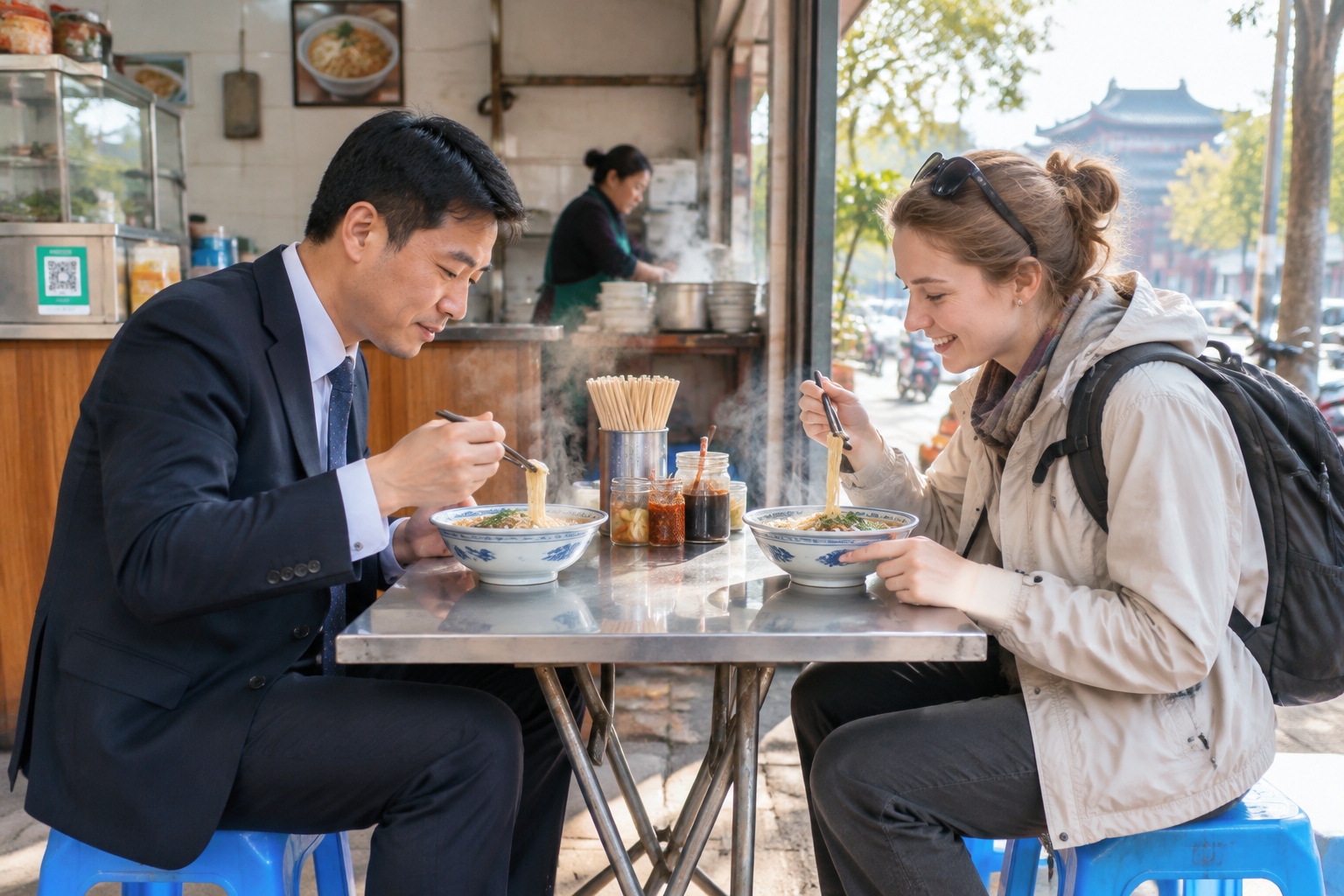

7:30 a.m., a bowl of noodles, and a stranger’s table
At 7:30 on a Tuesday morning in Kunming, the plastic curtain of a rice-noodle shop is still wet from rain. Inside: six small tables, a pot of broth, jars of pickled vegetables, chili oil and herbs. A jet-lagged visitor pays at the counter and looks around. The only empty stool is across from a man in a blue shirt, halfway through his noodles, scrolling on his phone. The visitor sits. The man moves his phone an inch. Nobody speaks. That is how sharing a table often begins in Yunnan: not with an invitation, but with an empty stool in a small room.
Tourists come to Yunnan for old towns, mountains, coffee farms and tropical borders. Food is part of the draw. But the most revealing eating is ordinary: close tables, fast service, strangers sharing without ceremony.
In Yunnan, ‘eating like a local’ is a timetable, not a checklist
The Chinese word chike literally means a ‘food guest’—someone who eats with curiosity. In Yunnan, it is less a badge than a daily schedule. Breakfast happens early, often at a shop near home or work. Lunch is quick. Dinner stretches: a bowl of noodles at six, or a barbecue table at nine, with beer and conversation.
Visitors often chase a list: the most famous crossing-bridge noodles, the most photogenic market, the oldest tea house. Those places can be good. But shared-table moments usually happen somewhere less planned—when you are hungry, walk into a neighborhood shop, and the only seat is next to a local eating what you are about to order.
Breakfast: broth, condiments, and the QR code
At a regular rice-noodle shop in Kunming, a small bowl often costs 10 to 15 yuan, about $1.40 to $2.10. In a smaller county town, it may cost 8 to 12 yuan. A tourist-style crossing-bridge set in a big restaurant can cost 30 to 60 yuan, but that is a different meal: small plates and a large bowl of hot broth. The everyday version is simpler. You choose rice noodles or erkuai, a chewy rice cake; you choose a topping such as braised pork, minced meat or beef; and you say whether you want it spicy.
The queue moves fast. A woman behind the counter calls to a regular, ‘Same as usual?’ He nods. A visitor points at the jars. The vendor lifts a spoon: pickled vegetables, chili oil, coriander, crushed peanuts. The visitor takes a little of everything, then more chili than intended. The man across the table smiles and pushes a small dish of pickled cabbage toward the visitor. No introduction. Just a small correction to the bowl.
Payment is usually a QR code on the wall or counter. WeChat Pay and Alipay dominate daily life; a customer scans, types the amount, and shows the screen. Cash is still accepted, but in a busy morning shop it can slow things down. The QR code is a small emblem of how ordinary technology has become in Chinese food life. It is not a futuristic scene. It is a sticker next to the chili oil.
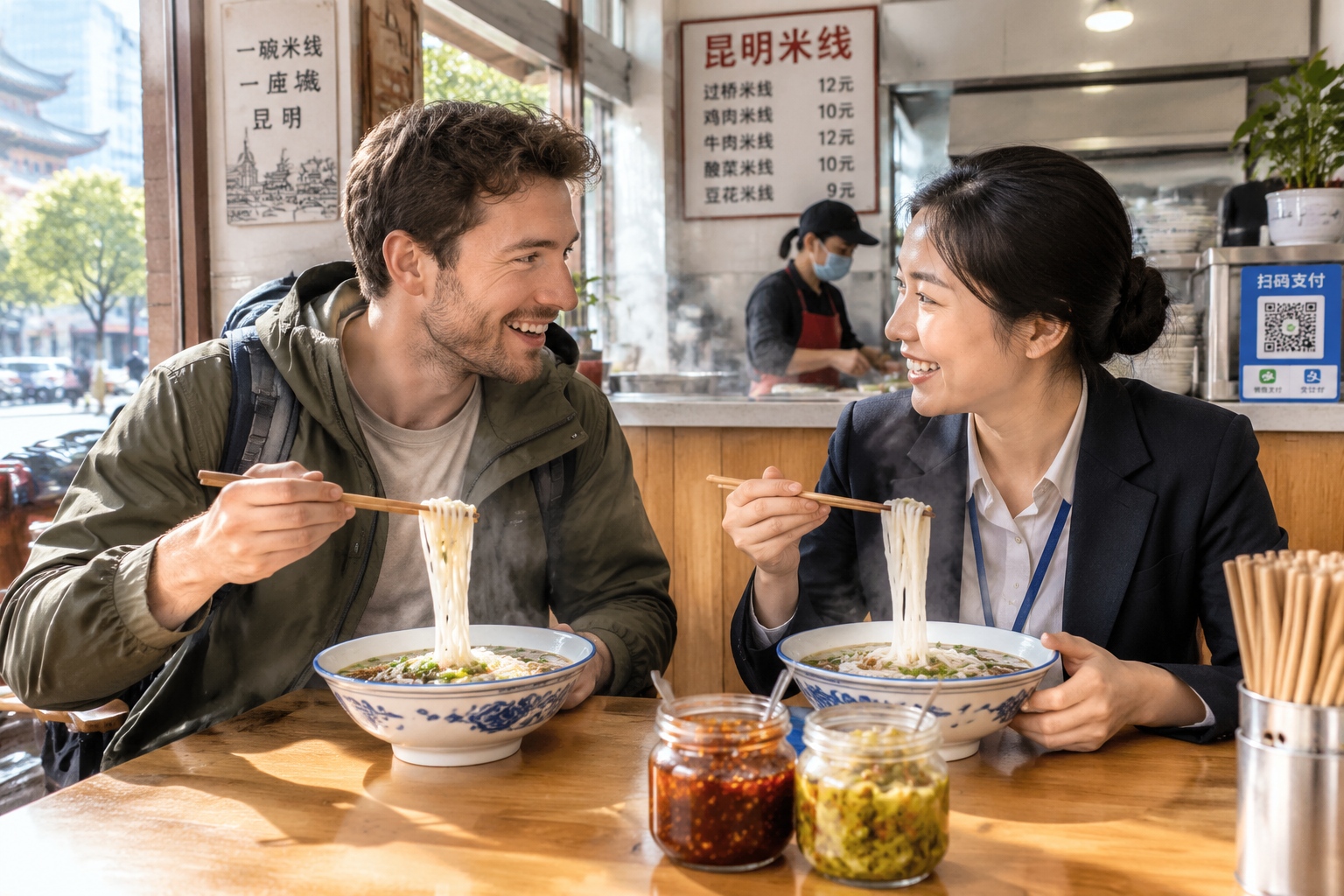
Lunch and the unwritten rules of a shared table
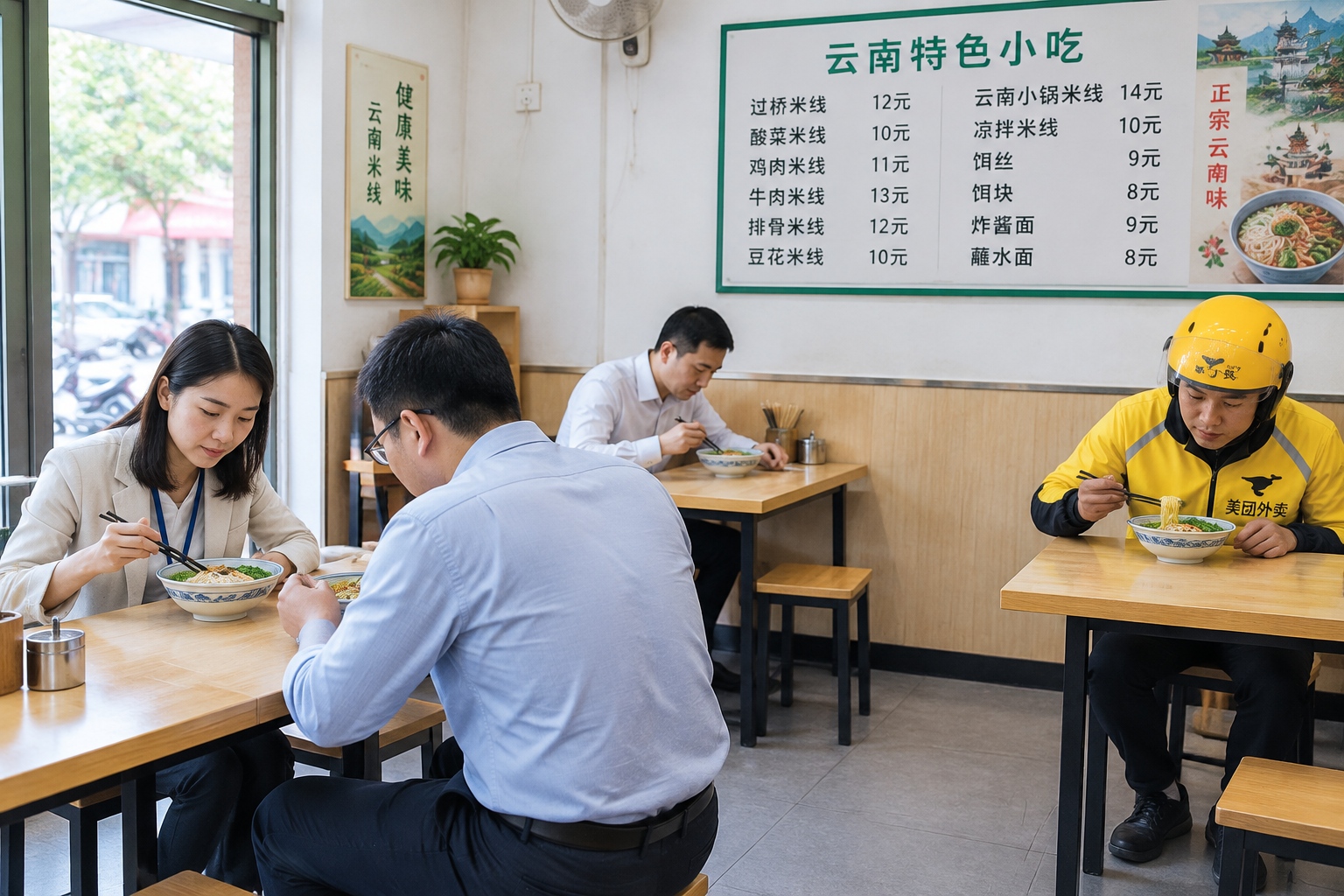
By 12:30, small restaurants near office buildings are full. A room with six tables may hold twenty people. Office workers in lanyards sit with delivery riders in yellow jackets; a mother feeds a child from a small bowl; two tourists study a menu on the wall. The first rule is simple: take the empty seat. Do not hover, do not move chairs from another table unless you ask, and do not expect a long conversation. In a noodle shop, everyone has their own bowl. In a stir-fry shop, dishes go in the middle, and sharing is normal, though serving spoons are increasingly common.
The second rule is about money. At most small places, you order and pay at the counter or scan a code at the table. Friends may fight over the bill, but strangers do not. You pay for what you ordered. The third rule is about attention. Locals are used to tourists, especially in Yunnan. They are usually helpful if you ask a question. But a phone camera pointed at someone’s face is not a friendly question. Ask first, or photograph the food and the table, not the person.
Why do locals accept this? Space is one reason. High turnover is another. A small shop with 30 seats may serve 200 people between 11:30 and 1:30. If every party of two waited for a private table, the queue would block the street. In a Paris café, an empty chair may feel like your territory for an hour. In a Kunming noodle shop, the chair is a temporary resource. The sharing is practical, not intimate. You are not being adopted by a family. You are being given a seat.
Afternoon: markets, fruit by the jin, and two speeds of Yunnan
After lunch, the city slows in a different way. In a neighborhood market, fruit is sold by the jin, which is 500 grams. In season, strawberries might be 15 to 25 yuan a jin; bananas 5 to 8 yuan; a pineapple is peeled and cut while you wait. Cooked-food stalls sell cold dishes by weight: wood ear mushrooms, tofu skin, peanuts, cucumber, chili. Older men sit outside a tea shop with covered cups. Children stop for a yogurt drink after school.
In a tourist town such as Dali’s old town, the same scene has a second layer: English menus, coffee shops, souvenir stores, visitors on rented electric scooters. The local market still exists, but it is mixed with the visitor economy. In a non-tourist neighborhood of Kunming, the market is less polished and more practical. Prices are lower, signs are in Chinese only, and the main customers live within walking distance. Young people shop in both worlds: a 12-yuan coffee in one hour, a 3-yuan fruit cup in the next. That is how urban consumption in China often looks—global brands and neighborhood stalls sharing the same street.
Dinner: smoke, skewers, and the limits of togetherness
At 8 p.m., barbecue stalls set out low plastic stools and small square tables. Skewers are ordered by the handful: tofu, pork, potato slices, mushrooms, chicken feet, small sausages. Prices are often 2 to 5 yuan per skewer. A table might spend 40 to 80 yuan per person before drinks. The dip matters: chili, garlic, coriander, fermented tofu, or a sour, herby sauce. The grill sends smoke into the street. Conversation gets louder.
Shared tables are even more common here because the tables are small and the stools are low. A group of three may be asked to squeeze in with two strangers; usually someone shifts a bag and makes room. A local might slide a plate toward you and say, ‘Try this.’ You can accept or decline. Both are fine. What is less fine is filming the whole table without asking. Yunnan’s barbecue culture is social, but it is not a stage.
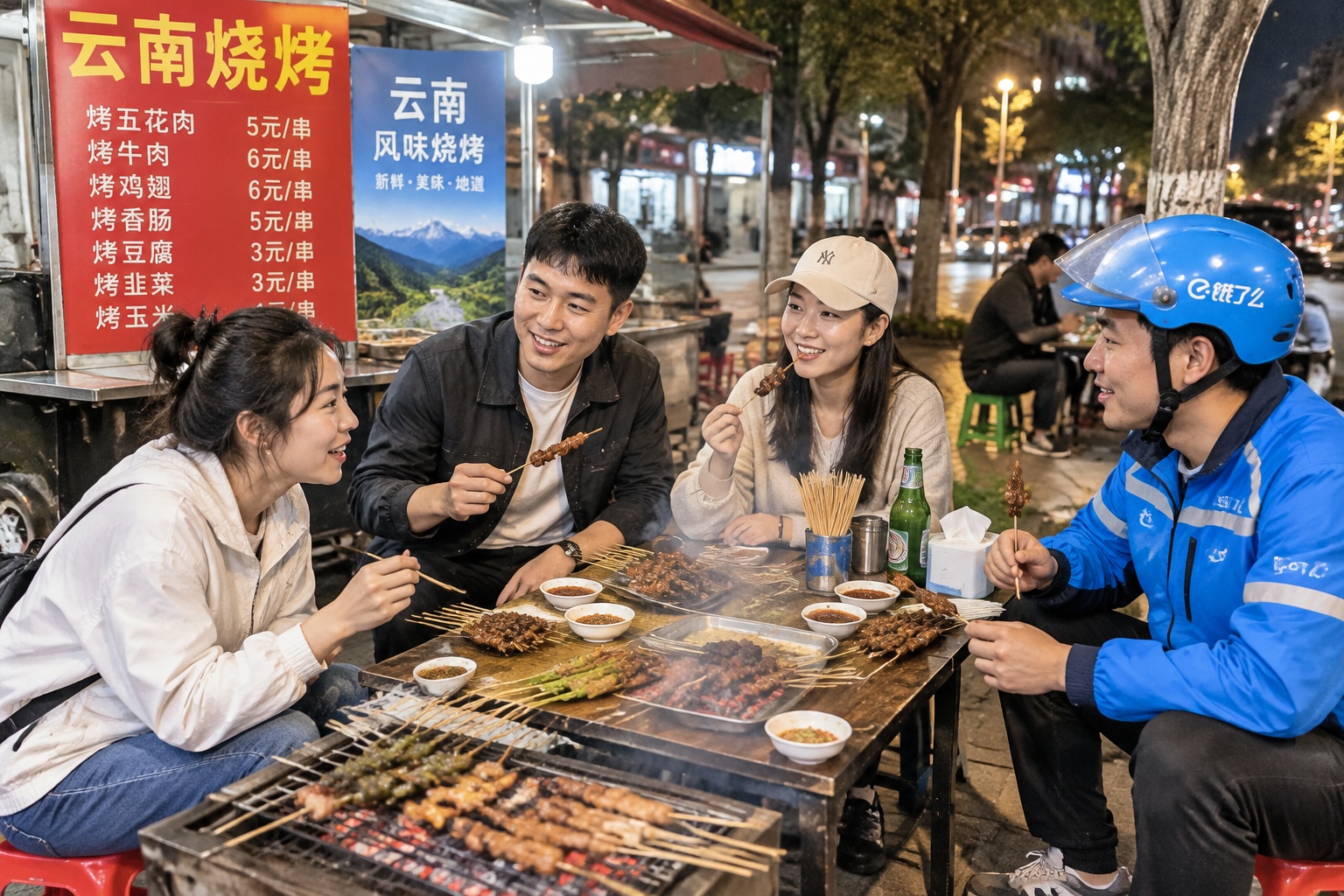
Five people around one table
The owner of a noodle shop in her fifties stands by the door, calling regulars by nicknames and tourists by ‘hello.’ She knows which construction worker takes extra chili and which schoolgirl wants no coriander. An office worker in a gray shirt eats lunch alone but shares a table with two strangers; he finishes in twelve minutes and leaves. A mother cuts noodles for her daughter, who is more interested in a phone game. A tourist from Australia asks the man across from her how to use the condiments; he demonstrates, then returns to his bowl. A young man back from three years in Shenzhen says he came home because the rent was too high and the pace too fast. He now helps at his family’s barbecue stall. ‘Here, I eat dinner with my parents,’ he says. ‘In Shenzhen, I ate dinner on the metro.’
What a day costs, and what is changing
A day of eating this way—breakfast, lunch, fruit, barbecue—can cost 70 to 120 yuan, about $10 to $17, without alcohol. In a tourist center, add 30 to 50 percent. Mobile payment is nearly universal in urban Yunnan. Delivery platforms have changed the lunch economy: more offices order in, and small shops take online orders alongside walk-in customers. But barbecue stalls and noodle shops still depend on the street. Their business is not only the food; it is the stool, the smoke, the noise, and the person sitting next to you.
Tourism does change things. In Dali and Lijiang, rents rise in peak season, and some old shops give way to guesthouses and souvenir stores. Some locals move to newer neighborhoods. This is not a simple story of loss. Tourism brings income, and young people find work as guides, drivers, cooks and coffee workers. But the shared table survives best where daily life still has a local base: a market, an office, a school, a neighborhood. That is why a bowl of noodles on a residential street can feel more revealing than a famous restaurant in an old town.
Three misunderstandings about Yunnan food and shared tables
Not everything is spicy
Yunnan food is varied. It uses herbs, sour flavors, fermented ingredients, mushrooms and gentle broths. Chili is often a condiment, not the whole dish. If you cannot eat spicy food, say so: ‘Bu yao la’ means ‘no chili.’ In many shops, the vendor will adjust.
Table sharing is not a performance
It is not staged for tourists, and it is not a sign of a ‘backward’ or overly familiar society. It is an efficient use of small space and high turnover. Locals do it because it is normal, not because they are trying to teach visitors a lesson in communal living.
Tourists are not the show
Most locals are busy. They will help if asked, and they may be curious, but they are not watching you. The easiest way to fit in is to keep your voice at table level, pay for your food, and treat the shared table as a small public space: you have a right to be there, and so does everyone else.
Back to the table
By 10 p.m., the barbecue stall is still busy. The same table has held a delivery rider’s quick meal, a family’s argument about homework, two tourists comparing train tickets, and a group of friends who stayed for two hours. The plates are stacked, the stools are wiped, and the next customers sit down. In Yunnan, a shared table is not a grand cultural encounter. It is a small, ordinary fact of urban life: space is tight, food is good, and for twenty minutes, different accents have to share the same patch of light.
Start the discussion at forum.chinacomes.com