


A whiteboard, two words, and one awkward question
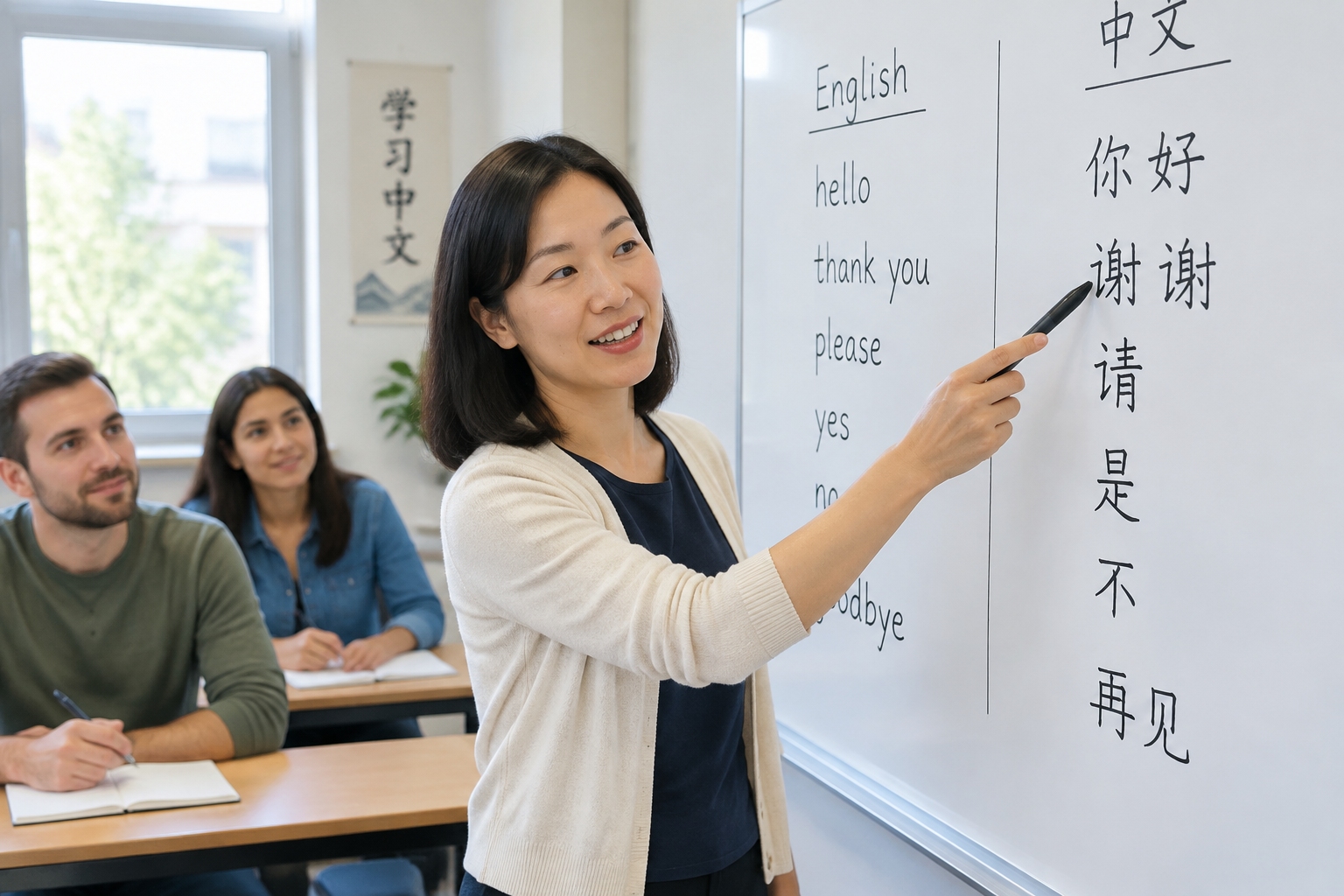
On a bright whiteboard, a British YouTuber writes two words: butterfly and 蝴蝶. Then he asks his viewers a question that sounds almost too simple. If you did not already know English, what would you guess butterfly means from butter and fly?
The answer, of course, is nothing. The word does not describe a fly made of butter. It simply has to be memorized. The YouTuber, who teaches Mandarin to foreigners, used that small moment to make a larger argument: Chinese is often more logical than English. Or, to put it more precisely, Chinese often shows the logic inside a word, while English often hides it.
His video circulated among language learners and set off a familiar internet argument. Some English speakers pushed back. Others said the video explained something they had felt but never articulated. The most interesting part is not the scorekeeping. It is what the debate reveals about how languages package meaning, and who gets to guess their way into knowledge.
Butter, pineapple, and a language assembled from pieces
The British teacher begins with English. Butterfly contains butter and fly. Pineapple contains pine and apple. Hamburger contains ham. None of those pieces help you understand the whole. A learner can stare at the word and still be locked out.
English is not irrational, he says. It has clear compounds too: bedroom, football, toothbrush, sunlight. But those are not the majority. English is a language assembled from several layers. Its base is Germanic. After the Norman conquest of 1066, French and Latin entered the court, law, and education. During the Renaissance, scholars brought in Greek vocabulary for medicine and science. The result is less a single system than a house with additions from different centuries.
That history explains some strange pairs. The animal in the field is often English: pig, cow, deer. The meat on the table is often French: pork, beef, venison. The words reflect a social order, not a logical classification. A modern learner who does not know Latin or Greek can still use English perfectly well, but the internal logic of many words is not available without extra training.
Where Chinese shows its work
Chinese works differently. It is written in characters, and each character is a unit of meaning as well as sound. Many modern Chinese words are compounds built from those units. Once you know the common characters, you can often make an educated guess.
猫头鹰, the word for owl, is built from cat, head, and eagle. 长颈鹿, giraffe, is long, neck, and deer. 河马, hippo, is river and horse. These are not scientific definitions. A giraffe is not a deer, and an owl is not an eagle. But the names give a learner a handle. They describe what the thing looks like instead of asking the learner to memorize an arbitrary label.
Chinese also has families of words that share a character. 电 means electricity. Add computer and you get 电脑, literally electric brain. Add speech and you get 电话, telephone. Add vision and you get 电视, television. Add shadow or image and you get 电影, movie. The connections are visible even to a beginner. English has electricity, computer, telephone, television, and movie, each with its own history and root. The roots are useful to a specialist, but they do not sit on the surface for an ordinary speaker.
The teacher is careful not to make Chinese sound perfectly transparent. Chinese has plenty of words that resist guessing, especially loanwords. Sofa is 沙发, coffee is 咖啡, chocolate is 巧克力, tank is 坦克. These are phonetic borrowings. They have to be learned as sounds, not decoded as compounds. Chinese also has characters with complex histories, and a learner still has to memorize thousands of them. The claim is not that Chinese is easy. It is that Chinese has a different kind of difficulty.
The comment section pushes back, then shifts
When the video first appeared, some native English speakers argued with the teacher. English has transparent words, they said. Chinese characters are hard. The video was oversimplifying. All of that is true. But as the comments piled up, a different response became common. Many viewers said the video had put words to a feeling they had in school or at work.
One example keeps coming back: medicine. In Chinese, the ear, nose, and throat department is 耳鼻喉科. It literally says ear, nose, and throat. In English, the same department is often called otolaryngology, or the even longer otorhinolaryngology. The word comes from Greek roots. A patient standing in a hospital corridor may have no idea what it means. The Chinese sign is not poetic, but it is legible to a layperson.
Other examples are similar. 贫血, anemia, is literally lack of blood. 肺炎, pneumonia, is inflammation of the lungs. English speakers can learn these words, of course. But they learn them as vocabulary, not as a description. In law and medicine, where precise terms matter, the gap becomes especially visible. Professionals need specialized language. The question is how much of that language also functions as a wall.

Chinese words carry culture, too
The British teacher’s argument becomes more interesting when it moves beyond animals and household objects. Chinese words also carry cultural history. 东 means east, but it is also linked to the idea of the host. A landlord is 房东, literally a house host. An employer or owner can be 东家. The host of an event is 东道主. To play host is 坐东. The direction is not just a compass point. It is a social position.
The character 汉 has an even deeper story. It comes from the Han River. In ancient Chinese cosmology, the stars in the sky and the rivers on earth were thought to correspond. The Han River was seen as the earthly Milky Way. The Milky Way itself could be called 天河, 天汉, or 星汉. The Han ethnic group, 汉族, therefore carries a name that once connected a river, a galaxy, and a people. Most Chinese speakers do not think about this every day. But the layer is there, and it shows that Chinese words are not only logical compounds. They are also small archives.
This cuts both ways. The same cultural depth that makes some words meaningful to insiders can make them less obvious to outsiders. Chinese is not a perfectly transparent code. It is a living language with history, metaphor, and convention.
Why a YouTube argument about language matters
The most practical consequence is education. In China, a middle-school graduate can usually read most government notices, news reports, and popular science articles. That is not because every student is a genius. It is because the writing system and the vocabulary make certain kinds of knowledge more accessible. Characters take years to learn, but once learned, they keep paying back. A reader who knows 肺 and 炎 can guess that 肺炎 has something to do with the lungs. A reader who knows 电 can start to unlock 电脑, 电话, 电视, and 电影.
English has its own power. It is a global language with enormous resources, and its Greek and Latin roots give scientists and lawyers a shared international vocabulary. But some English majors in China have made a sharper criticism. They argue that English can become a tool of class stratification. If legal and medical language is opaque to ordinary people, then professionals gain authority not only from expertise but from access to a code. That argument can be overstated. Every profession builds a language wall, including Chinese professions. But the wall is easier to see when the words themselves do not explain what they mean.

A different logic, not a winner
The British YouTuber’s video does not prove that Chinese is better than English. It explains why Chinese can feel hard at the beginning and then accelerate. It also breaks a common assumption among foreigners that Chinese is a pile of arbitrary characters. Many characters and compounds are built from meaning. But Chinese still has tones, character variants, regional accents, loanwords, and professional registers. It can be just as opaque as English when it wants to be.
The real question is not which language wins. It is how a language organizes access to knowledge. On that whiteboard, butterfly and 蝴蝶 are not just two words. They are two different ways of showing, or hiding, the logic inside a name. The British teacher’s video is useful because it makes that difference visible. It does not settle the argument. It gives English-speaking viewers a way to see their own language from the outside, and to understand why Chinese learners sometimes feel that the language suddenly clicks.
Start the discussion at forum.chinacomes.com