
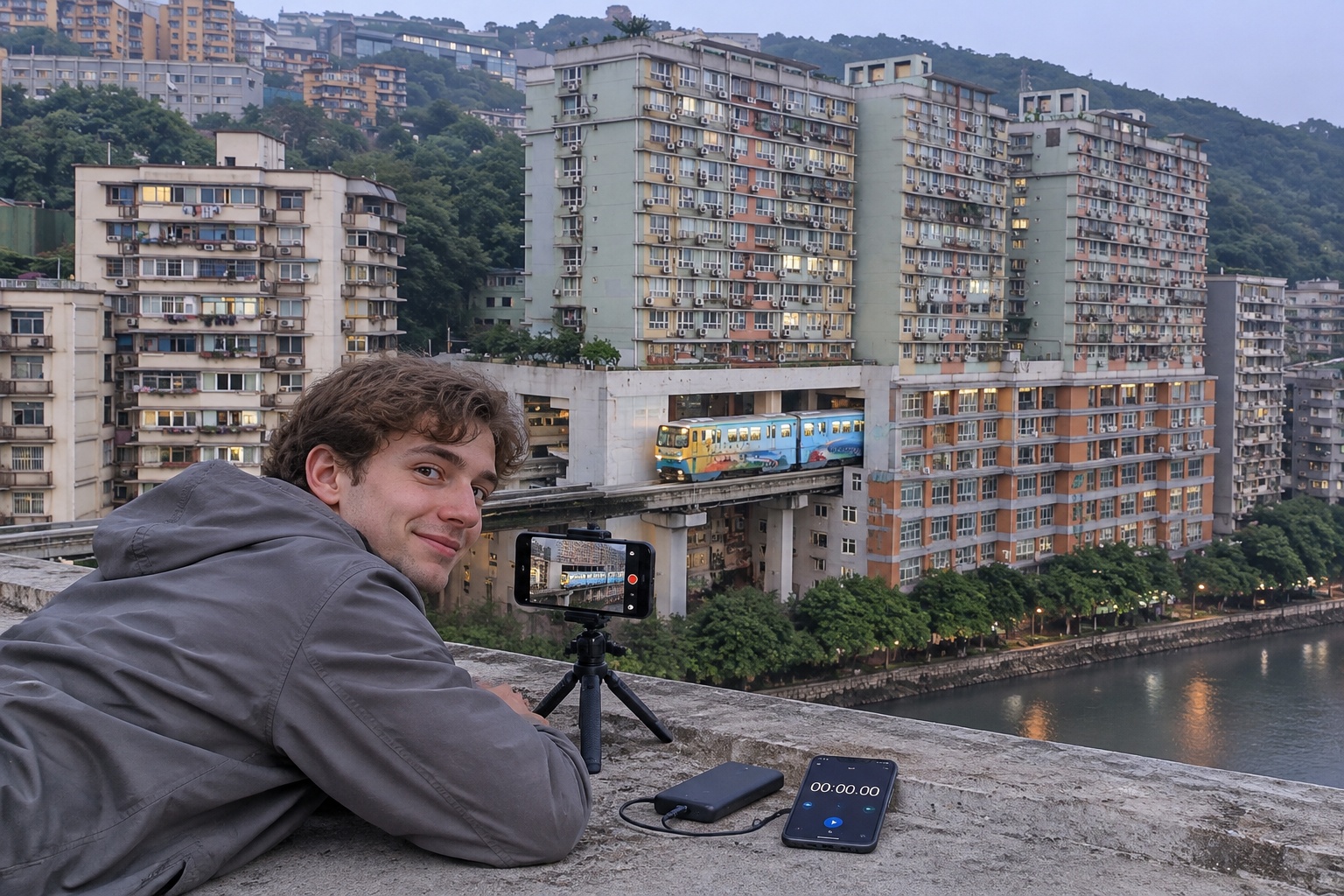

At 8:40 p.m., a rooftop in Chongqing waits for a train
Jonas Weber is lying on his stomach on a concrete rooftop, chin propped on his wrist, a phone clamped into a small tripod in front of him. Below the parapet, the Jialing River runs dark and slow. Across the water, a 19-storey apartment block has a hole punched through its middle floors, and a light-rail line runs straight through the hole.
At 8:47, a train slides out of the gap. It is gone in four seconds.
Weber does not say wow. He looks at his stopwatch and says: “Eight forty-seven. Again.”
He is 31, an industrial designer from Berlin, and this is his third night on the same roof. He has already filmed the monorail from street level, from a noodle shop opposite, and once from inside the train itself. The clip he is trying to get is not about spectacle. It is about the timetable. “In Germany, people would say this is impossible,” he says. “So I film the clock.”
Weber is one of millions of foreign visitors who have arrived in China since the country made itself drastically easier to enter. Their phones are doing something that no tourism campaign was ever able to do: describing the country in the first person, at street level, at the pace of an ordinary day.
The paperwork that put them on the plane
For most of the 2010s, a weekend in China was impractical for a European or an American. The visa application was a paperwork project, and the trip had to be planned weeks ahead.
That changed fast. In December 2024, China extended its visa-free transit window to 240 hours — ten days — available at 60 ports across 24 provinces to travellers from 54 countries. In parallel, unilateral visa-free entry of up to 30 days has been extended to a list of countries that keeps growing, with additions across Europe, Latin America and the Gulf. Ordinary tourism, not just business travel, became the point.
The numbers moved accordingly. China recorded 26.94 million foreign entries in 2024, according to the National Immigration Administration, roughly double the year before.
The second half of the fix was smaller and, for visitors, more decisive: money. Linking a foreign Visa or Mastercard to Alipay or WeChat Pay now takes a couple of minutes, and a street vendor’s QR code accepts the payment. The daily friction that used to keep foreigners inside hotel restaurants — no cash, no card, no menu — mostly dissolved. Metro machines in big cities speak English. Signage in tourist districts has been rewritten.
Remove the friction and something else shows up: curiosity with a camera attached.
What they actually point the camera at
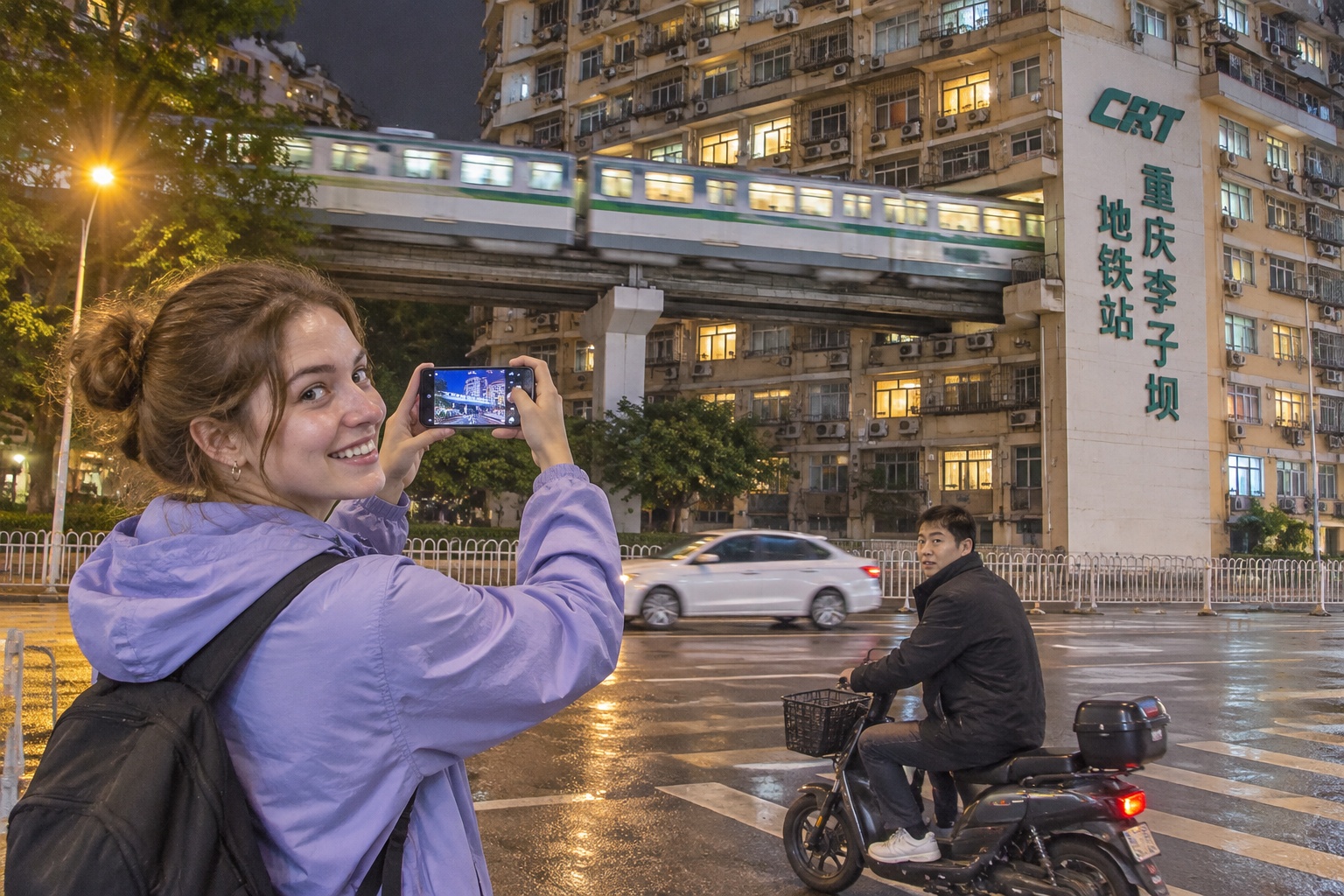
Almost nobody films the postcard. Search the “China Travel” tag on YouTube or TikTok — it has accumulated billions of views — and the most-watched clips are rarely about monuments. They are about plumbing.
A vending machine that talks. A hotel robot that rides the lift and calls your room. A high-speed train covering the 1,318 kilometres between Beijing and Shanghai in about four and a half hours, with more than 45,000 kilometres of such line now laid across the country. A 24-hour convenience store at three in the morning with a woman working alone behind the counter, filmed precisely to prove that the street outside was quiet and lit.
In Guangzhou, Amara Okonkwo gets up at 5:40 to reach the wet market before the good fish are gone. She is 28, from Lagos, teaching English at a training centre on the east side of the city, and she films with a phone in one hand and a lavalier mic clipped to her collar. Her most-watched video is not of food. It is of a woman weighing carp on a scale, then turning a laminated QR code toward the camera. “This is the part nobody at home believes,” Okonkwo says. “A fish stall. No cash. No card. She doesn’t even look up.”
Then there is the medical clip, which has become its own genre. Ellen Parks, 62, a retired nurse from Vancouver, arrived on a ten-day transit stamp and, after three days of a bad knee, walked into a public hospital in Chengdu with her passport. She filmed the queue screen, the registration counter, the price list. She was seen in 47 minutes and paid 68 yuan. Her video has 1.2 million views, and the comment pinned at the top is from a woman in Ohio asking whether the doctor spoke English. He did, badly, and Parks left that in.

Three cameras, three different countries
Jonas Weber: the timetable
Weber films systems. Level crossings, station clocks, the announcements that play twice in two languages, the way passengers queue on the markings. He is not uncritical — he has a whole video on how confusing the ticket app was before the English version improved — but his subject is competence, measured in seconds. His audience is largely European rail enthusiasts and Chinese viewers who enjoy watching a foreigner be impressed by something they take for granted.
Amara Okonkwo: the money
Okonkwo films transactions. Breakfast stalls, yum cha trolleys, a hotpot bill split four ways by phone. Her footage is close, handheld, often out of focus at the edges, and the sound is the point: the hiss of a wok, the beep of a payment confirmation. “Food is the entry ticket,” she says. “But I’m really filming how people pay, how they queue, how they argue about the bill.”
Renata Alves and Paulo Mendes: the hour nobody films
The couple from São Paulo, both 34, shoot at night. Their format is deliberately dull: they walk for forty minutes through ordinary residential streets and narrate what they see — a man carrying a fold-out chair home, a group of retirees dancing badly to a speaker, an e-bike rider delivering noodles at 1 a.m. They started the channel to prove a point to a sceptical brother-in-law. It now has 300,000 subscribers.

The comment section is the second film
Under every one of these videos, the same three comments appear in the same order.
First: Who is paying you? It arrives within minutes, sometimes hundreds of times. Second, days later: Okay, I looked it up, and the train thing is real. Third, and most interesting: messages from the Chinese diaspora, writing about a city they left a decade ago, correcting the vlogger’s pronunciation of a street name, asking him to go and film the noodle shop near their old primary school.
That third category explains something the numbers miss. These videos are not only read by foreigners. They are read by Chinese viewers checking whether an outsider got it right — and the correction, the argument, the “you went to the wrong branch”, is itself part of the circulation.
It is not all applause. Politics enters the comments on certain topics and the threads get locked or worse. Some creators respond by narrowing their beat: trains, breakfast, alleys, nothing else. A few have been accused, fairly or not, of producing content so relentlessly positive that it reads like advertising. The accusation stings because it is sometimes true — an algorithm that rewards delight quietly shapes what gets filmed.
What the camera misses
Walk with these vloggers for a day and the gaps are obvious.
They are almost always outside. Public space is safe, visible and open to a phone; the inside of an ordinary family’s flat is not, and hardly anyone gets that access. They film eight cities — Chongqing, Shanghai, Xi’an, Chengdu, Guangzhou, Shenzhen, Zhangjiajie, Changsha — because those are the cities the algorithm and the flight map offer, and a country of 1.4 billion is compressed into a loop of the same skyline.
Language is another wall. Most of them speak a few phrases and lean on translation apps for the rest, which means the conversations they record are shallow by default: prices, directions, compliments. The depth comes later, in the edit, where a ten-day trip is squeezed into twelve minutes with a beginning and an end.

What goes home in the suitcase
The videos are only half of what leaves the country. In Huaqiangbei, the electronics market in Shenzhen, foreigners buy earbuds by the dozen, tiny drones, a folding keyboard. In Chengdu they buy hanfu and wear it badly on the plane. Somebody’s suitcase contains a pressed tea cake, a rice cooker, a bag of chilli powder that will be confiscated at customs.
Objects outlast videos. A nephew sees a robot vacuum in an apartment in Hangzhou and asks where it came from. A colleague borrows a power bank with a strange logo. The diffusion is slow, physical and almost impossible to measure, which is exactly why it works better than a slogan.
At 9:20, the rooftop empties
The train has passed through the building eleven times. Weber packs the tripod, checks the footage, and finds the clip is fine — not perfect, the focus drifted on the ninth pass. He walks down six flights, past a mahjong table still going in a ground-floor courtyard, and buys a yoghurt from a vending machine that greets him in Mandarin. A security guard nods at him. He nods back.
Tomorrow he will film something else: the ferry, the cable car, the escalator that goes up a hill. He will post it. Someone in Manchester, or Ohio, or São Paulo, will watch it on a phone at lunch and think, for the first time and for about ninety seconds, that this place might be a place. That ninety seconds is not a policy outcome and cannot be scheduled. It is just what happens when the camera is handed over.
Start the discussion at forum.chinacomes.com