

7:10 a.m.: The Park Is Already Busy
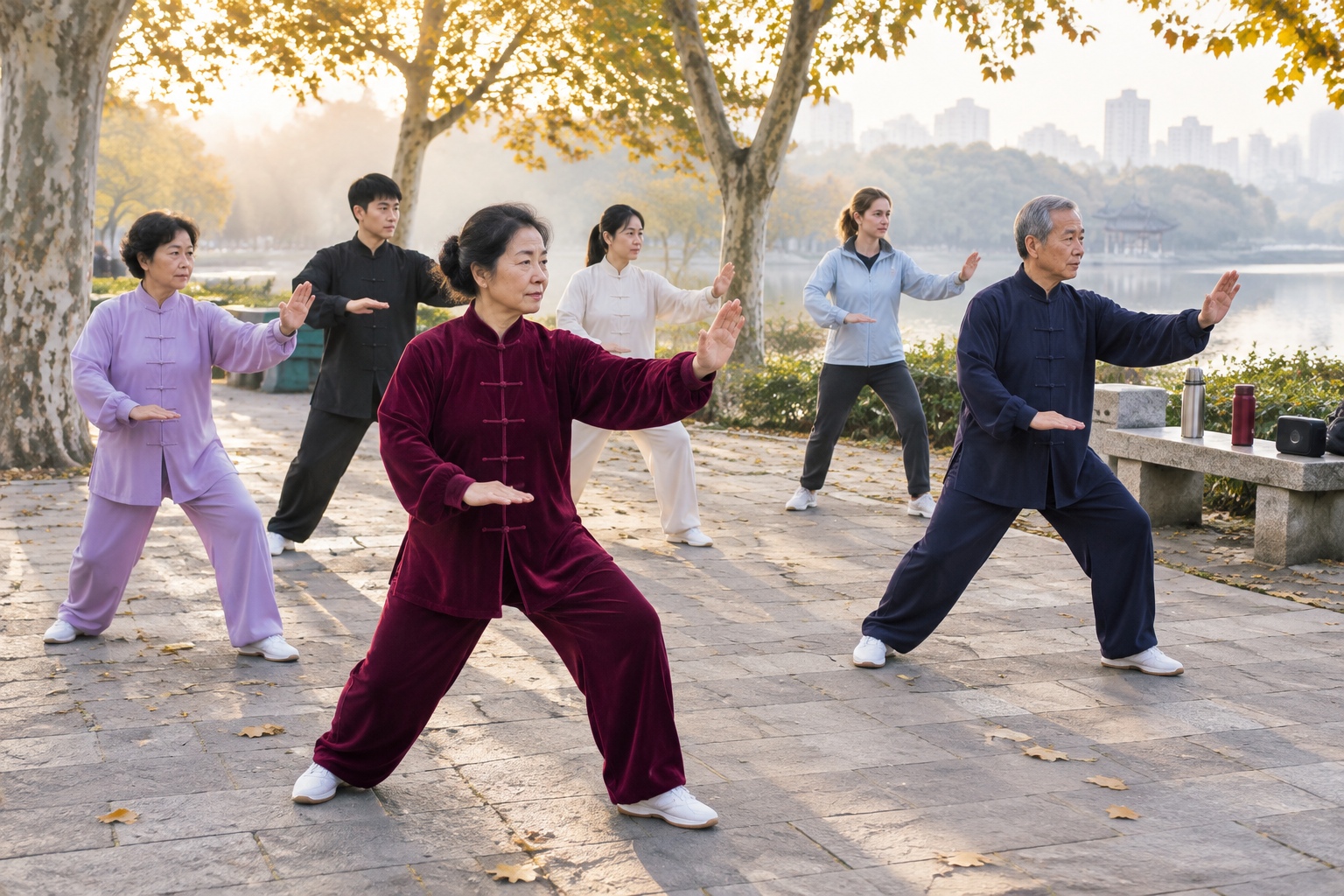
At 7:10 on a cool Tuesday in Chengdu, the park gate near the Jinjiang River is already a turnstile of thermoses, coughs and low conversation. A woman in a pink visor sets a small speaker on a stone bench. Before I can ask whether this is a class, six retired men and two office workers in running shoes line up behind her. The music starts—not the pop I expected, but a slow, scratchy erhu recording. They lift their arms as if pushing something soft away from their chests.
I am here because I have a blunt tourist question: is Chinese medicine a system of health care, a set of habits, or a tourist performance? I have a day, no Chinese beyond “ni hao,” and a translation app. I start with the least expensive doorway: the public park.
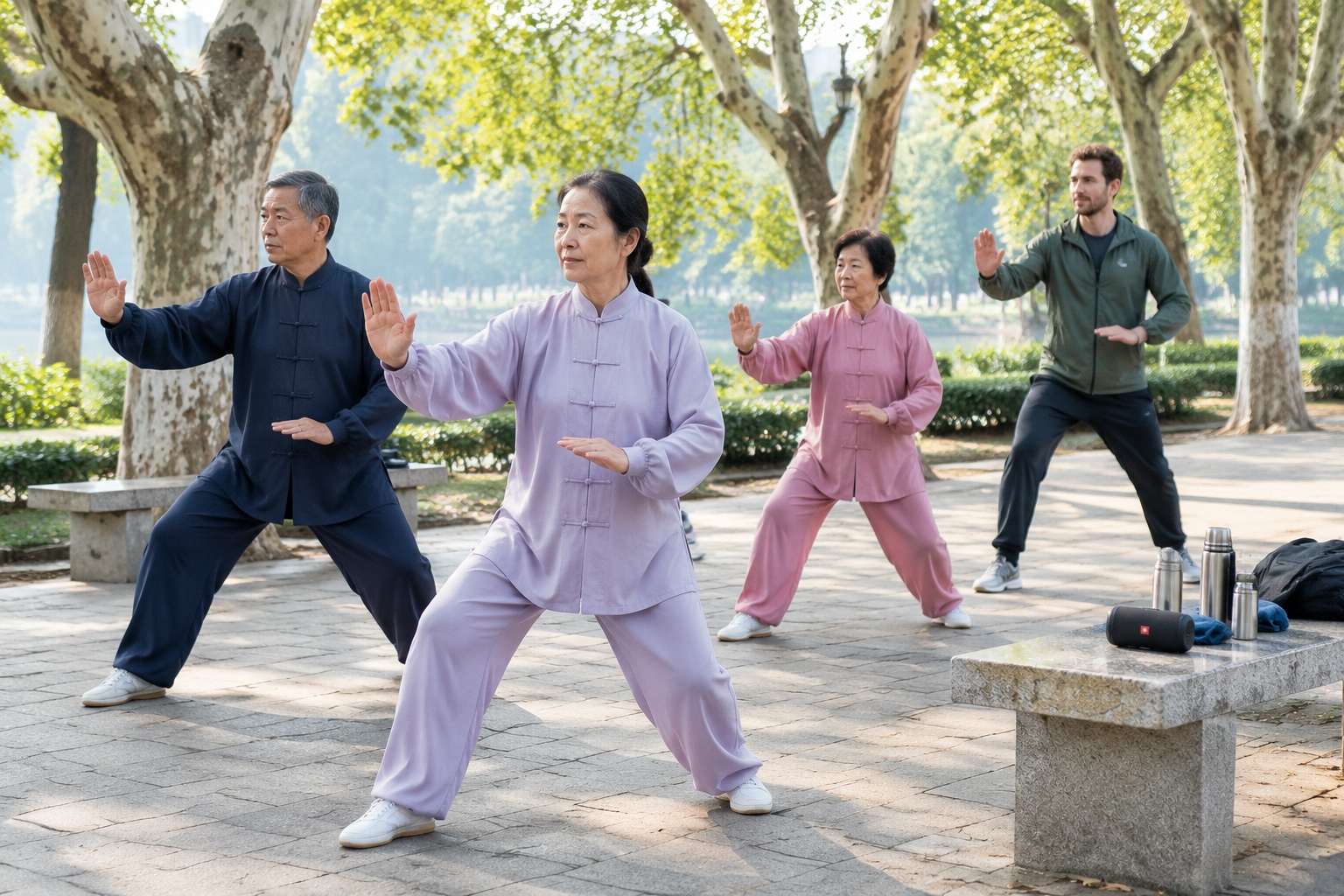
Nobody charges admission or checks a membership card. Chengdu’s parks are free at this hour and full of people doing tai chi, baduanjin—eight-section brocade, a set of slow qigong movements—square dancing and brisk walking. A man in a navy cardigan drinks from a steel thermos between movements. A woman in her seventies corrects my elbow without asking my name. “Song,” she says, patting my arm. “Not tight.” She means loose. I am tight.
For twenty minutes I copy the group badly. My knees complain; my hands move like paddles. Nobody minds. A younger man in a hoodie tells me he comes three mornings a week before his shift at a software company. He says the park is cheaper than the gym and closer than the hospital. That is not a medical claim, just a scheduling fact.
What surprises me is the social texture. Retirees arrive early. Office workers drift in around 7:30. A grandmother parks a stroller beside the bench and joins the back row. Between sets, people trade information about a vegetable stall and a new subway exit. The exercise is free; the company is part of the routine. If you want to observe how Chinese medicine sits inside ordinary life, this is a better starting point than a museum.
9:30 a.m.: Breakfast, Herbal Tea and a Market Basket
After the park, I walk to a breakfast shop with plastic stools and a menu taped to the wall. I order millet porridge, a steamed pumpkin bun and a tea egg. The porridge is plain, warm and cheap: 6 yuan. Next door, a convenience store sells bottled “health tea” with goji berries and chrysanthemum flowers. A young woman in a beige coat buys one on her way to work. The label promises calm; the ingredient list looks like a soup recipe.
This is where “药食同源” (yao shi tong yuan), often translated as “food and medicine share the same source,” stops being a slogan. In many Chinese households, ingredients such as red dates, goji berries, Chinese yam, lotus seeds and dried tangerine peel are not exotic. They go into soups, congee and tea. My breakfast is not a prescription. It is just food with a long cultural memory.
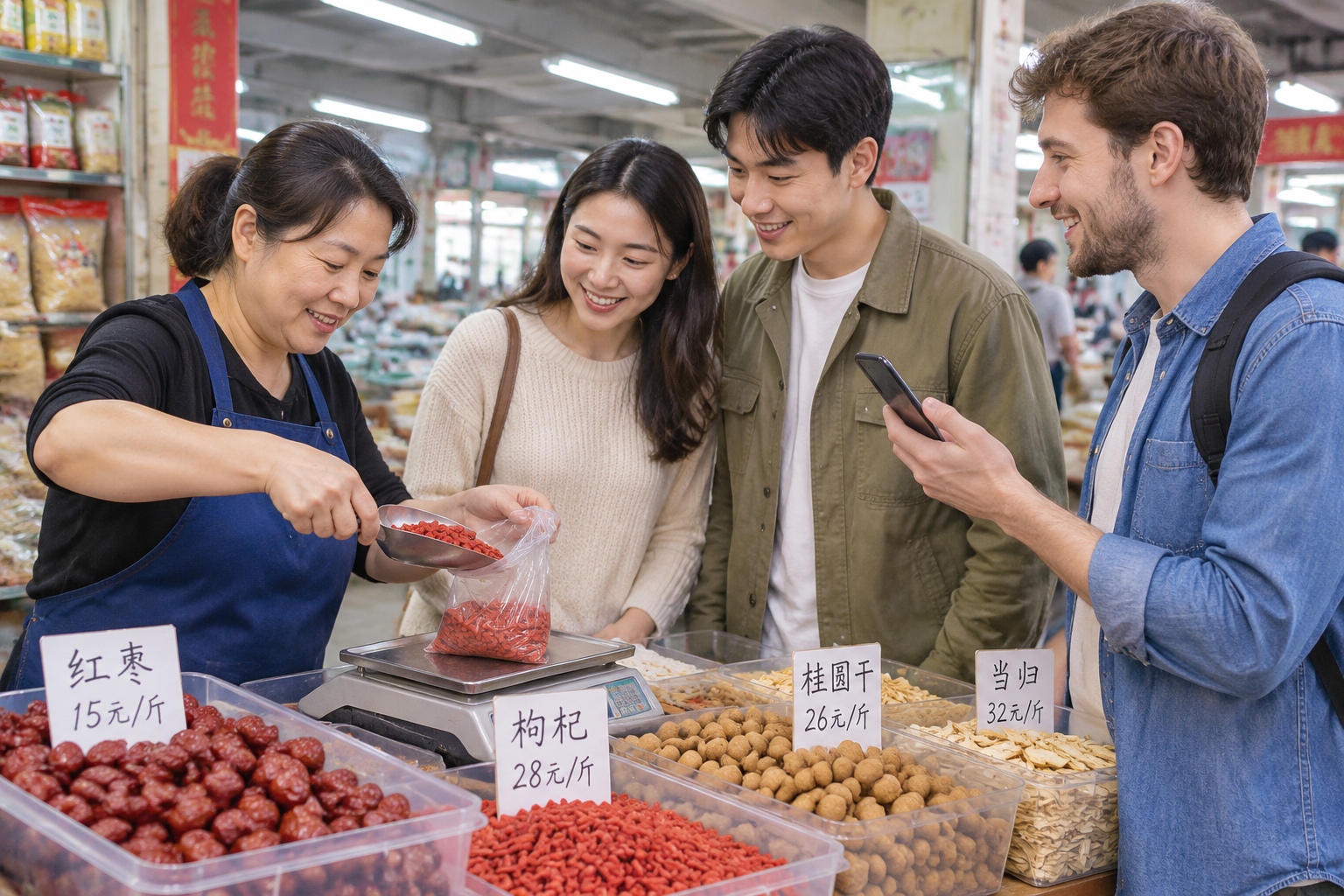
At a wet market near the community health center, I find a stall with clear plastic bins of red dates, goji, dried longan and something labeled “fu ling” (poria), a fungus used in soups. The vendor, a woman in a blue apron, weighs goji into a small bag. Forty-eight yuan for 500 grams. Red dates are 18 yuan. Fresh yam is 9 yuan per jin, or 500 grams. A twenty-something couple asks for a “small package for soup”; they say they cook once a week and are trying to eat less takeout. The vendor laughs. “Don’t treat it like medicine,” she says. “It’s food. Put a few in the pot.”
That distinction matters. English-language search results about “Chinese herbal medicine” often lead to clinics, dried roots and strong decoctions. The everyday version is milder: a handful of goji in a thermos, red dates in chicken soup, yam steamed with rice. It is also commercial. Supermarkets sell “health” drinks, malls have herbal tea chains, and younger consumers buy “guo cha” or “yang sheng” wellness beverages in sleek cups. Prices range from 12 yuan for a basic cup to 30 yuan for something with more elaborate packaging. Not all of it is traditional; much of it is marketing.
For lunch I stop at a small “medicinal diet” restaurant near an office tower. The set meal is chicken soup with yam, goji and red dates, plus a plate of greens and rice. It costs 48 yuan. The soup is light, slightly sweet, and not bitter. The woman at the counter tells me most customers are nearby office workers. “They want something warm,” she says. “Not a cure.”
1:30 p.m.: A Neighborhood Massage, Not a Mystery Ritual
The community health center is on the second floor of a beige building behind a bus stop. The sign says “Community Health Service Center” in Chinese and English. Inside, the air smells of disinfectant and a faint herbal plaster. A queue of six people waits near a registration desk. A father holds a toddler; an older woman in a floral shirt rests a hand on her lower back; a man in a delivery jacket checks his phone.
I have booked a tuina session through a WeChat mini-program, but I did not need to. The receptionist tells me walk-ins are accepted if there is an opening. I show my passport. The clerk types my name into the system, asks me to scan a QR code, and charges 128 yuan for a 45-minute session. For local residents with public insurance, part of the cost may be covered; as a foreign visitor, I pay the full self-pay price. The receipt is printed on flimsy paper and includes the therapist’s name.
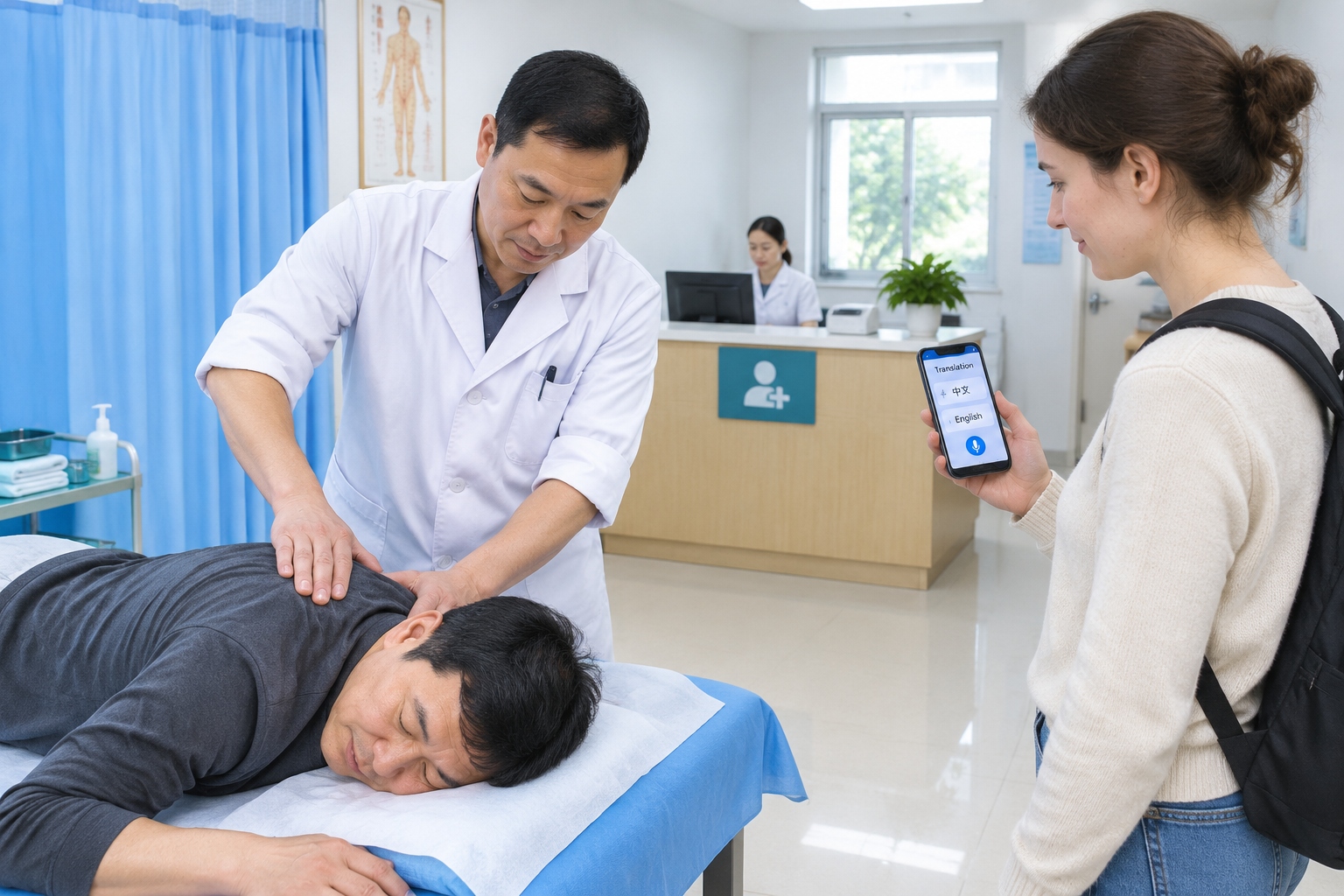
The therapist, Mr. Li, is in his forties and wears a white coat over a polo shirt. He asks what I do for work and where I feel tight. I point to my shoulders and say, in bad Chinese, “computer.” He laughs and presses two fingers into the muscle above my shoulder blade. It is sore in a specific, almost electrical way. He asks, “Suan?” Sour? “Zhang?” Distended? “Tong?” Pain? I understand pain. The other two words I learn by gesture.
This is not a silent mystical ritual. It is a small, practical clinic. A curtain separates the beds. A timer beeps. Mr. Li explains that he is not diagnosing me from my pulse; he is working on muscle tension and asking me to tell him if anything feels wrong. He uses elbows, thumbs and forearms. At one point he asks whether I have dizziness or recent injury. When I say no, he continues. The session is firm, sometimes uncomfortable, and oddly similar to sports massage I have had in Amsterdam.
That similarity is the point. Tuina is one branch of Chinese medicine, but in this setting it functions as accessible bodywork: something a delivery driver can book after a shift, something an office worker does on a lunch break. There are licensed practitioners and regulations, and there are also commercial chains with inconsistent quality. A single session tells me what the room feels like, not whether the whole system works. It would be dishonest to claim otherwise.
6:00 p.m.: What Stayed With Me—and What Still Doesn’t Add Up
By evening, my shoulder feels looser, though that may be the massage, the walking or the placebo of a novel day. I sit on a bench outside the market and drink a 12-yuan cup of chrysanthemum tea. The street is loud with scooters. A vendor closes a metal shutter. Two women compare bags of red dates.
At home in the Netherlands, my usual health routine is a gym membership, a bicycle, and a physiotherapy appointment that can take two weeks to get. Here, that same instinct—maintain the body before it breaks—appears in cheaper, more social forms: a free park group, a market soup, a neighborhood clinic with a printed receipt. None of it is magic. Some of it is marketing. Some of it is genuinely useful. The mix is the story.
I still do not know what “qi” means in a way I can verify. I cannot judge from one massage whether a practitioner is skilled or just strong. I do not know how often ordinary families actually cook with goji and yam, or whether the young wellness-drink buyers will keep the habit. Language remains a barrier: I could describe “sore” but not “dull ache that moves.” I relied on translation apps and gestures, and I probably missed the humor.
But I came with a lazy question—is this real or superstition?—and left with better ones. Who trains the therapist? How do locals choose between a community clinic and a private chain? What does a good herbal meal taste like when no one is selling it to you? Those questions are more useful than a verdict.
If You Want to Try a TCM Day Yourself
Start small and stay curious. You do not need to book a formal course to join a morning park group; stand at the back, watch for ten minutes, and follow the slowest person. Wear loose clothes. Ask before filming. If a session is free, a small “thank you” in Chinese is enough.
For food, treat “food and medicine share the same source” as a culinary idea, not a prescription. Try red date and goji tea, yam in soup, or a simple herbal chicken broth at a casual restaurant. Ask prices by weight at markets; 500 grams is a “jin” in many places. If you have allergies, medical conditions or take medication, talk to a qualified professional before experimenting.
For tuina, use a community health center, a licensed clinic or a hotel spa with clear pricing. Bring your passport. Expect a short intake and a chance to say “stop” or “lighter.” Ask for the price before you lie down. And keep the receipt. The most revealing part of a Chinese medicine day is not the mystery. It is how ordinary it can feel.